Case file
The Warm Houses
Part One: The First Warm House
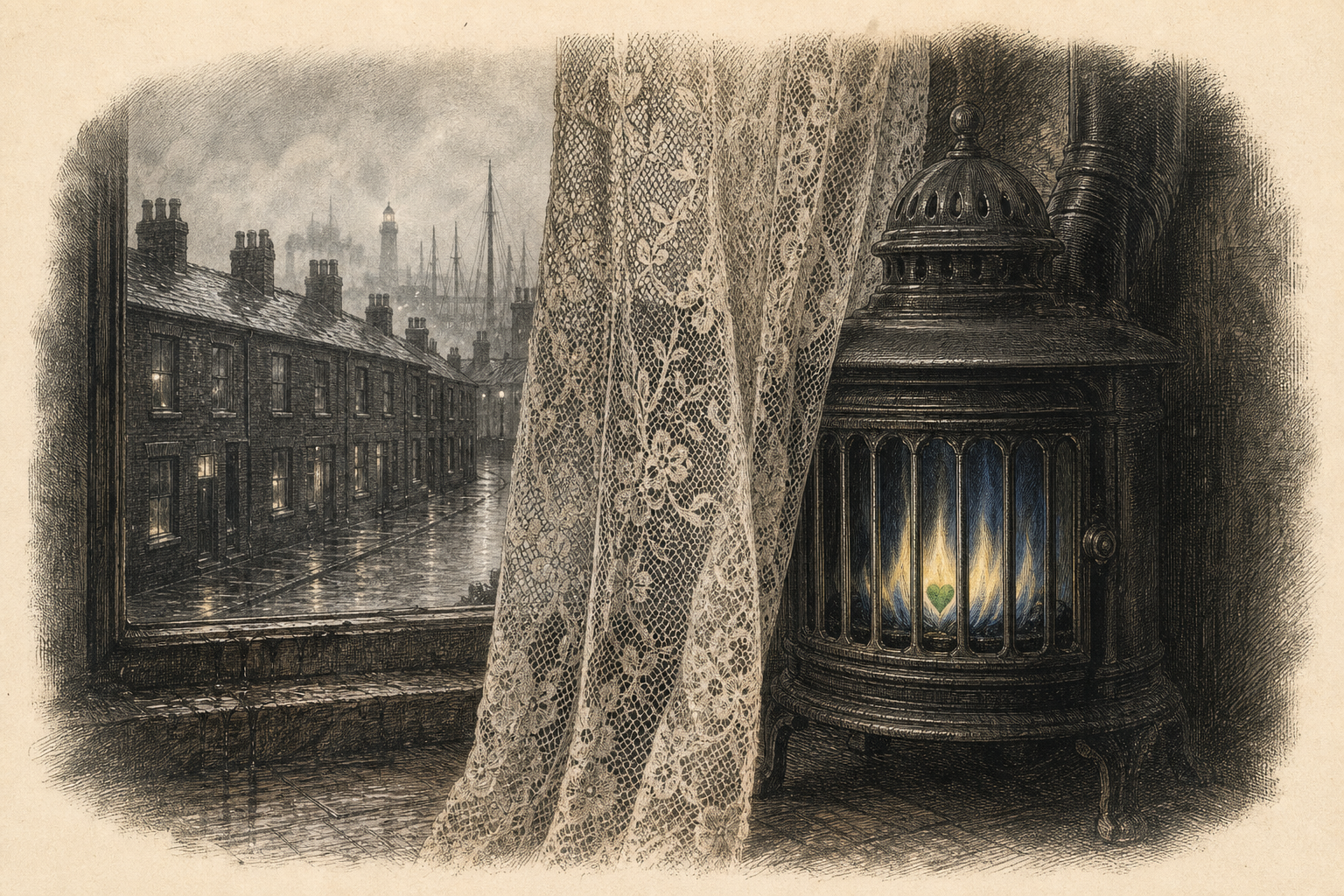
The first warm house Machen saw in Crowmere had frost on the pavement outside and a gas fire burning behind a half-drawn curtain. The flame was blue at the base and yellow above. At its centre another colour held for a second, too faint to name with confidence.
Constable Wace saw him looking.
"The new heaters," he said. "Company supplies them with the connection."
"They all burn like that?"
Wace glanced at the window. "Don't they always?"
Machen walked on.
He had arrived with a dead constable, an escaped prisoner and two handwritten lines added to the county request by Sergeant Gale:
The prisoner was attempting to stop the gas supply. He believes it is doing something to the town. I don't know what to make of that. I thought you should know before you arrived.
Crowmere had been declining for twenty years before the new works opened. The mines had closed, the fishing fleet had contracted and younger people had gone inland. Since April, Crowmere Gas and Coke Company had employed one hundred and forty-seven men and connected much of the town to gas before Christmas.
The change was visible in the windows.
Wace took the long way round by Bridge Street rather than the harbour front. Gutters ran full. A bakery showed one early lamp behind steamed glass. In house after house, orange light pulsed behind curtains in rooms that would once have been cold at this hour.
Above the roofs, the gasworks stack stood against a flat morning sky. Its plume moved northwest with the wind. For a few seconds, while the smoke was dense enough to hold the light, the same uncertain tint appeared in it.
The police station stood on Wharf Street, dark stone, a lamp over the entrance and rainwater spilling from a cracked corner gutter. Inside, the front desk had been pushed back to make room. A sheet covered a body on the floor in the passage to the cells. The room smelled of blood, cold air, and the residue of men who had been standing about helplessly since before dawn.
Sergeant Gale came forward. A broad man in his fifties with iron-grey hair and an expression that had gone past shock into duty sometime in the night.
"Inspector."
"Sergeant. You have a dead officer and an escaped prisoner."
"Constable Arthur Nore. Found at half past two by Wace, when he came on early. Stabbed. Prisoner gone."
"Who was the prisoner?"
"Silas Greeve. Clerk and sampling man at the Crowmere Gas and Coke Company. Arrested last night at the works."
"For?"
"Sabotage, so far as we can tell. He got into the valve house with tools and lamp oil. He was shouting that we were pumping something into people's homes."
"Show me."
Gale drew back the sheet.
Arthur Nore lay on his back, head turned slightly toward the cell passage. A solid man in his thirties, broad through the chest, one hand half-curled against his tunic. His shirtfront was dark with blood below the ribs. His eyes had been closed by a careful hand.
Machen crouched. The blood had dried dark around the entry point. "Blade entered low, angled upward."
"That is what Dr Pritchard thought."
He looked at Nore's right side. The leather keeper that should have held his key ring against his belt had been stretched almost white at the edge and partly torn loose. The key ring lay on the passage floor beside the cell door.
"Were the keys found there?"
"Yes."
"Not in his hand?"
"No."
Gale led him to the cells. The farther cell stood open. Inside, a blanket bunched at one end of the stone bench. A cup of untouched water on the floor. No blood visible at first glance.
Machen stood in the cell doorway and looked back at Nore, whose right shoulder had come to rest against the bars. The front room was eight feet down the passage from the cell door. A man inside could reach through the bars only a little.
"You believe Greeve attacked Nore after Nore opened the door."
"That seems obvious enough."
"Why would Nore open it?"
Gale hesitated. "We don't know. Perhaps Greeve asked for water."
Machen turned to the cell door. Around the keyhole on the inside face, barely visible, was a faint smear of dried blood. Near the lowest cross-piece of the bars lay a narrow scrap of torn leather.
"Sergeant."
Gale crouched. "That from Nore's key strap?"
"Likely."
Machen rose. "Do not conclude too early that Greeve stabbed him."
Gale frowned. "He was the only prisoner in the building."
"Yes. The cell is open. Nore is dead beside it. Those are facts. Their order is not yet known."
Part Two: Greeve's Notebook
By eight, Dr Pritchard had confirmed what Machen had suspected. Nore had been killed by a single knife thrust delivered from the front at close range, blade entering below the ribs and passing upward into the heart.
"Could the wound have been made by a man stepping from that cell?" Machen asked.
Dr Pritchard adjusted his spectacles with the irritability of a doctor who dislikes becoming a detective's instrument. "If Nore stood directly before him. If the knife was concealed. If he had no warning."
"Would Nore then have fallen backward against the cell bars?"
"Possibly."
"And the keys would have come within reach."
"Inspector, I cannot tell you what keys do after a man is stabbed."
"No."
He returned to the front desk, where Gale had laid out Greeve's confiscated belongings on an oilcloth. A wallet with two shillings. A handkerchief. Two pencils worn short. A small notebook with a blackened cover. A stub of blue chalk. A packet of matches. No knife.
Machen opened the notebook.
L6 / retort 3 / 14 Nov / flame abnormal in test room. Complaints from Harker St. after 14 Nov supply? Ask M. Mrs Slade: "house too still." Rooke boy walked out at night, said cold was "behind him." No. Not gas sickness. Not ordinary.
Further in, columns of dates, addresses, batch numbers. Then a list of streets.
Harker St., 14 Nov, 3 incidents. Anchor Yard, 17 Nov, 2. Osprey St., 17 Nov, 1. Chapel Row, 22 Nov, 4. Salt Lane, 22 Nov, 2.
Below this, in a different pen, pressed harder into the paper:
They think I wish the town cold. I wish it awake.
Near the back were individual addresses. Nore house, Anchor Yard, was underlined twice, with a date beside it: 17 Nov. Three weeks ago. Three pages further, between batch numbers, a line in different ink had been crossed through once but left legible: counts? not houses. exposures? Greeve had written it, then seemed to have stopped himself.
The pages had the texture of something read and reread. The spine was broken in two places. A man who had been carrying this for weeks, building something from it against his own uncertainty. Machen closed the notebook and put it in his coat pocket.
"Who arrested him?"
"Constable Nore and Leonard Hask from the gas company. Hask raised the alarm."
"Hask."
"Nore's wife's brother. Works the yard: wagons, deliveries, bit of everything."
Gale reached for Nore's duty notes. He read:
Prisoner Silas Greeve continued agitated. States company must cease lower-seam gas immediately. Repeated that "it enters houses in the heat." Claims harm already done. Requests county inspection. States no one will listen because "they like the warmth too much."
"Insane enough to sabotage half the town's supply," Gale said.
"Or desperate enough."
"I need to speak with the company," Machen said. "I would like to understand how much of the case they've handed me is genuine before I speak to anyone with something to gain from my conclusions."
Part Three: The Gasworks
The walk from the police station took Machen through the centre of town. Crowmere was small enough that its recent change of fortune was visible on every street. Old marks of contraction: a vacant shop front, terraces in disrepair, a public house whose sign had been repainted over a different name. Beside them were signs of something turning: a timber yard newly busy, a chandler’s shop restocked.
Outside one terrace a company gas fitter was completing an installation. His tools lay in neat order, and a length of copper pipe curled over the sill and disappeared through the wall. A woman in the doorway watched him as if a promised improvement were arriving.
"Almost done, Mrs Petch," the fitter said without turning.
"You'll test it properly before you go."
"Always do."
The gasworks gate bore a board:
CROWMERE GAS & COKE COMPANY LOCAL COAL. LOCAL HEAT. A WARMER FUTURE.
New buildings set against old ones: fresh brick offices, ordered runs of black pipework, iron tanks behind a wall, and at the centre the base of the stack from the train. The brickwork was excellent. Someone had spent money here carefully, which meant someone believed it would last.
The clerk brought him to a room where a gas heater stood beneath the window, black enamel with polished brass fittings. Its front plate bore an emblem pressed into the metal: three slender lines rising from a shallow bowl, like a stylised flame, or like something else if you came to it with the right expectation.
The room was warm with a completeness coal heat rarely achieved. It reached the corners, the ceiling, the back of the neck.
A man in his late fifties entered. Silver hair, well-cut brown suit, the practiced attention of someone accustomed to receiving deputations.
"Inspector Machen. Selwyn Serle. Director of works, though the title sounds grander than the office warrants. Terrible business at the station."
"You knew Constable Nore?"
"Everyone knew Arthur. He was my nephew's commanding officer for three years. A genuine loss." Serle's hands rested on the desk, relaxed. "And Silas Greeve, yes. Sampling and records. A careful man, originally."
"Originally?"
"Until recent months. He became fixed on the idea that our gas supply was harming the town."
"Was it?"
"No." Serle folded his hands. "We supply town gas made from locally mined coal, as gasworks have done for generations. Mr Greeve took ordinary complaints of domestic life and arranged them into a private theology. He noticed that unhappy people remained unhappy after their gas was connected. This offended his sense of pattern."
Machen glanced at the heater. The flame burned low and steady, blue at the base, yellow above, or mostly yellow. At moments, when he looked away and back, there seemed to be a greenish wash near the heart of it, brief and sourceless.
"Lower Six," Machen said. "He objected to that seam."
"A deep maritime bed, reopened in September. Excellent yield. It made the project viable." Serle said it without particular emphasis, as though reciting a fact that had been recited before. "Without Lower Six, there is no gasworks. There are no wages for a hundred and forty-seven men."
"Was the seam previously worked?"
"Briefly. Abandoned on economic grounds."
"Only economic?"
Serle smiled briefly. "If you ask old miners why any gallery was closed, you get twelve answers. Bad air. Bad luck. A voice in the rock. Old workings collect stories."
Machen asked whether Greeve had seen older records. Serle looked once toward the heater before answering. "He had access to the general archive. Whether he looked at earlier company documents, I cannot say with certainty." Machen wrote the answer down.
Serle called Torben Lace in from the records desk, younger by twenty years, thin and pale, ink on one fingernail, stooped from long hours over ledger columns. His face showed strain without grief.
Machen asked whether Lace had shared Greeve's concerns.
"I checked his figures. No chemical irregularity in any batch I tested."
"Were there delivery clusters?"
Lace looked at Serle.
Serle answered for him: "With enough addresses and enough unhappy homes, any clerk can make a cluster."
Machen noted the exchange and let it rest. He asked for access to Greeve's desk, the complaint logs, and the Lower Six feed records. Serle agreed without hesitation.
At the heater, on his way out, Machen paused. "The emblem. Three lines."
"Warmth rising from the ground," Serle said.
"They resemble vapour."
"Heat is vapour, in one sense."
"Not in the sense most people mean."
Part Four: The Records Room
The records room was long and narrow with shelved ledgers along both walls. A small gas heater stood in the corner. Machen crossed the room and turned the valve off.
Lace stood in the doorway. "It gets cold without it."
"I find I think more clearly in the cold."
He worked through the records for two hours. Lace remained available throughout, offering each piece of information as though he had weighed it before speaking.
Greeve's desk was orderly to the point of strain: every edge squared, nothing left where it might be found by accident. At the back of the lower drawer, behind blank forms, Machen found two things.
The first was a carbon of a letter to the county engineering inspector's office, dated 24 November:
The undersigned respectfully requests that the county office conduct an independent inspection of the Lower Six coal feed, with particular attention to the period 14–22 November of this year. The undersigned believes that gas produced from this feed has effects on domestic occupants that cannot be explained by standard toxicological analysis, and that these effects may be cumulative and directional in nature.
Below the formal text, in pencil:
I have delayed writing this longer than I should have done. I wished not to appear ridiculous and I wished not to be wrong. I no longer have the luxury of either concern. I am writing it down because if something happens to me, I want it on record that someone tried.
The second was smaller: a folded scrap tucked under the blotter.
Tell her the windows should be open when I'm not there. Tell her I wasn't wrong about the cold being safer. Tell her I'm sorry about the other thing.
Machen put both in his coat pocket.
When he came to the feed ledgers, the Lower Six entries were, on the surface, clear. But on the seventeenth of November, the batch designation had been altered. Not crudely: the original figures erased and rewritten in ink slightly different from the surrounding entries, close enough to pass a casual reading.
"This entry."
Lace came to look.
"The seventeenth batch. Your notation indicates Upper West coal. But the ink is different from the lines above and below it. And the coal-wagon delivery log for that date carries the original batch mark." Machen set the two documents side by side. "It is Lower Six."
Silence.
"Who altered this entry?"
"I made a correction to a figure I believed was erroneously recorded."
"At whose suggestion?"
Lace looked at the wall.
"I shall need these pages."
"Those are company property."
"They are evidence." He said it without particular force. Lace did not argue again.
Before leaving, Machen checked the internal correspondence in the records annex. A note from Serle to Lace, dated 18 November, asked that the seventeenth batch entry reflect Upper West specification before the county review of the November ledgers. Machen folded it into his coat pocket.
Part Five: The Keys
He returned to the police station before noon and spent an hour alone in the cell passage.
He began with the body's original position as Wace could reconstruct it. Nore had been found partly turned toward the cells, right shoulder close to the bars. Machen marked the key ring's position with chalk.
He stood where Nore must have stood. He imagined Greeve behind the bars: thin, unarmed, frightened, watching a man die on the passage floor with a key ring swinging within reach. A witness, then, rather than the killer.
Could Greeve have stabbed through the bars? No. The spacing was too narrow for the angle. Could Nore have opened the cell and been attacked at the door? The blood on the passage wall lay to the right of the cell door, not in front of it. It suggested Nore had been stabbed in the front room and staggered the eight feet down the passage to the bars.
The blood smear on the inner lock plate was dragged downward, as if fingers had pressed against the metal under strain and slipped. A hand through the bars could reach the plate. If Nore staggered into the bars, his keys might swing within reach. Greeve could have drawn the ring through, worked the lock from the cell side, then dropped the keys back onto the passage floor as he left. A steady pull would stretch the leather keeper before it tore.
He examined the keeper under the desk lamp. The leather had stretched before it tore. The frayed edge pulled outward, away from Nore’s belt.
Gale appeared with two mugs of tea. "Have you decided our prisoner is innocent?"
"I have decided the question is worth asking."
He laid it out: Nore had been stabbed by someone in the front room. He staggered into the passage dying, struck the cell bars, and went down with his shoulder against them. The keys at his belt swung within Greeve’s reach. Greeve drew them through the bars, opened the lock from the cell side, then left the ring on the passage floor as he ran. The explanation waiting for him in the morning required nothing else.
"Then someone else killed Nore."
"Yes. That is the useful question."
Part Six: The Nore House
Arthur Nore had lived with his wife in a narrow terrace off Anchor Yard. The house smelled of damp mortar and cooked onions and something newer: the faint mineral sweetness of gas. A company heater stood where a coal grate had been bricked over. It was lit.
Harriet Nore sat near it with both hands folded over a handkerchief. She had been crying since the small hours and had run through the acute stage and arrived somewhere beyond it.
"You are here because Arthur is dead," she said. "Get on with it."
She told him Leonard had come after supper. He had been wanting to say things to Arthur for a long time and had decided last night was when he would say them. That Arthur was hard. That he had been hard for years and Leonard was done tolerating it.
"Leonard was not wrong about that," she said.
Arthur had left for the late watch. Leonard stayed ten minutes more. She poured tea he did not drink. When he left, she said, he seemed clear.
"Clear," Machen said.
"He had come in with all this anger that had been building up, and when he left it was as if he had shed something. Resolved it."
"Resolved it how?"
"I thought he meant he was done with Arthur. Done hoping he would change." She looked at the heater. "But you are asking because of something else."
The knife drawer was open in the morning, a large knife missing. She had not seen Leonard take anything.
"When was the heater installed?" Machen asked.
"Three weeks ago."
"Do you like it?"
The question surprised her. "Everyone likes them."
"That is not what I asked."
She was quiet for a moment, looking at the flame. "I do. The house was always cold. Arthur believed in making do. Two fires a day, properly banked. But the corners were never warm. The stairwell smelled wet through winter. This reaches everywhere."
He rose. At the door he turned back. "Mrs Nore. Has anyone else, a neighbour, mentioned feeling differently after spending an evening near the heater?"
She looked at him steadily. "Mrs Tench next door said her husband stopped drinking. Three weeks, no drink. She asked if I thought the gas had done something to him." She looked at the heater. "I told her that was a ridiculous idea."
"And now?"
She was a long time answering.
"No," she said. "But ask me when the frost comes."
Outside, the rain had stopped. Through the front window, behind a lace curtain not fully drawn, he could see the small steady flame. He watched it for a moment before turning away.
In the glass, his own reflection was slightly wrong. He looked down at his hands. They were where they should be. He looked back. The reflection had settled.
He walked on without looking back.
Part Seven: Leonard Hask
Leonard Hask arrived at the station at noon. He had his sister's eyes, though where hers were watchful, his were raw. A powerful man in his late twenties, broad-handed, with the slightly lowered head of someone long accustomed to entering rooms expecting to be found unwelcome.
He confirmed finding Greeve at the works the previous night, with Lace. He confirmed the quarrel at his sister's house.
"Why last night?" Machen asked.
Hask pressed both hands flat on the table. "I saw it clearly. After we'd been sitting there in the warm. I saw that if I didn't go then, if I didn't make him hear it from my mouth before it was too late, I would go on being what he thought I was until one of us was dead." He stopped. "And now one of us is."
He said he didn't remember taking the knife. He said he hadn't intended to use it. He said Arthur wasn't frightened of it anyway, just looked at him and said: Leonard, this is the most foolish thing you've done yet. And then turned his back.
"I didn't plan to," Hask said. "I want you to know that."
"No," Machen said. "I believe you. But you did it."
The silence that followed was long enough that Sergeant Gale, watching through the door glass, took half a step forward before Machen put up one hand.
"Yes," Hask said at last.
"Tell me about the heater at your sister's house."
Hask frowned. "What about it?"
"You sat near it most of the evening."
"So did Arthur."
"Did you feel different? Clearer?"
Hask looked down at his hands before answering.
"I was not drunk," he said.
"I did not ask whether you were. Your sister used that word. Clear. She said you seemed clear when you left."
Hask stared at the table. "I said what needed saying."
"So did Arthur Nore, perhaps. So did Silas Greeve." Machen stood. "You decided one thought mattered more than the rest and acted on it. The fact that part of it was true does not lessen what you did."
Hask lowered his head.
Part Eight: The Hotel Fire
The Merrit Hotel stood above the market square. Mrs Merrit showed Machen to his room on the second floor.
"You'll be glad of the new heater. The old place used to freeze guests solid in winter."
The heater stood beneath the bricked-over mantel. The same company emblem: three lines rising from a bowl. The same completeness of warmth already present in the room.
"Please leave it off," Machen said.
When she left, he opened the window an inch and sat at the small desk. Greeve's notebook, Nore's duty notes, and the altered ledger page lay before him. On a fresh sheet he wrote four names: Greeve, Hask, Lace, Serle. He looked at them for a while, then added Lower Six. He worked on a summary for the county office for the next hour.
At some point, without his noticing precisely when, the room warmed.
Machen looked up. The heater was lit. The brass control had been turned a quarter of the way round. He had turned it fully closed. He was certain of this.
He remained seated.
The warmth moved through the room quickly, present everywhere at once instead of gathering low or rising unevenly like coal heat. It reached him where he sat and the muscles across his shoulders eased.
He became aware, as the warmth increased, that a thought was forming with an unusual completeness. It had not grown from the evidence he had been arranging. The conclusion arrived complete, with none of the usual work visible behind it.
The thought was: Greeve was wrong.
The conclusion arrived complete: Greeve was simply wrong, a disturbed man who had arranged coincidences into a system. The pattern in the ledgers became a clerk's error. The incidents in the houses became the ordinary turbulence of a town in transition. Hask had killed Nore out of old rage. Lace had made an error in a record and been too proud to admit it. The entire case could close without a seam beneath the sea, vapour in the coal, or fog selecting what it lit.
Machen sat very still.
The thought was tidy. It was more than tidy. It was sealed, accounting for everything with the effortless economy of an explanation that has been prepared for you rather than arrived at by your own hand. The evidence had not led him here. The warmth had.
And then a second thought, quieter, beneath the first: there was a case from five years ago, a house fire ruled accidental in the midlands. Machen had doubted the ruling at the time and said nothing, had been right to doubt it, but the family had already left the county and he had calculated it was not worth the cost of reopening. He had carried this calculation for five years without examining it. Now, in the warmth, it seemed simply accurate. The failure had dropped out of the memory. What remained looked like a reasonable decision made under constraint.
He looked at his hands.
The calculation had not been new. The warmth had not invented it. But the warmth had moved it to the front of the room and taken the discomfort out of it, and that was different, and he recognised the difference because Greeve had told him what it felt like from the inside.
He rose, crossed the room, and turned the brass control hard to the right.
The flame shivered, thinned, went out.
He threw the window fully open.
Cold air entered in a rush, carrying rain and soot and the raw salt smell of the harbour below. He stood in it, eyes watering, and breathed it steadily until his mind felt like his own again. Including the case from five years ago, which was back where it belonged: not resolved, not comfortable, simply there.
Then he looked at the desk.
On the blank sheet he had not yet written on, a row of pencil marks ran along the top edge. Thin verticals, evenly spaced, pressed with the specific pressure of someone making a careful count.
He had not made them.
He looked at his pencil. The tip was worn in a way it had not been worn when he sat down.
He thought of the line in Greeve's notebook: counts? not houses. exposures? He had not known what that meant when he read it. He was less certain than before that it meant nothing.
He rang for Mrs Merrit and asked that the heater not be lit again for any reason.
"You'll take a chill," she said.
"I shall prefer it."
"It is perfectly safe."
"Perhaps," Machen said. "But I do not care for the way it thinks."
She stared at him. He did not explain. When she left, he counted the marks. Eleven. He wrote below them the only question he could honestly attach to them: what is it counting. He put the sheet in his coat pocket, closed the window to a crack, and went back to the evidence.
Part Nine: What Greeve Knew
He found Silas Greeve near nine that night, behind the abandoned net sheds off Salt Wharf. The clue was in the notebook: M. under rope loft if no other place. Machen had first taken the initial for a person, but the rope loft had been owned by the Greeve family before the harbour trade declined.
Machen went alone. He had not told Gale. He had not yet settled whether he was looking for a murderer or a witness.
The sheds faced the dark water, doors warped, roofs patched with tin. Behind the third, in a recessed passage between brick and timber, someone moved.
"Silas Greeve. I am Inspector Machen. I know how you came out of the cell."
Greeve was smaller than Machen had expected. In his thirties, narrow-faced, dark stubble, a coat too thin for the weather. His eyes were bright from sleeplessness and the specific brightness that comes from a long time spent being frightened.
"You know I did not kill Nore?"
"I know there are reasons to doubt it."
"That is not the same thing."
"No."
He confirmed what Machen had already reconstructed: the sabotage attempt with the regulator wheel, the oil for the thread, the intention only to shut the Lower Six line long enough that someone with authority would have to ask why a clerk would risk prison to stop it.
"Tell me what you found," Machen said.
"They reopened Lower Six in September. It had been closed under a false report. 'Poor viability.' The men who worked it then said the walls sweated in dry weather. There was green vapour in the galleries after sea fog. Two men walked out and didn't go home for three days. One came back without his boots. The other was found on the shore, sitting on a rock. He said he'd been counting something but couldn't remember what."
Machen thought of the hotel room. The arrived thought. The warmth, and the case from five years ago brought to the surface without discomfort. He thought of the crossed-through line in the notebook.
"In the retort house," Greeve continued, "the flame burns green at the base on wet days. Men come off shift too calm. Like someone has removed the part that warns them."
"And in the houses?"
"It is not sickness. People remain themselves. More themselves, they say. That is what makes it hard." He looked at his hands. "The gas doesn't invent anything. It finds what is already in a person and lights one part too brightly until that part is all there is."
He gave three examples: the man on Harker Street who struck his foreman after ten years of swallowing insult; the woman on Salt Lane who left her husband in the night without saying goodbye to the children; and his wife.
"I had forbidden the heater. We were cold. She said I had turned fear into a profession." He looked away. "We'd been sitting in the kitchen, arguing, and I heard myself ask whether she thought anyone would miss her if she left. I had never thought it, not truthfully. But in that warmth it seemed simply accurate. Not cruel. The cruelty was somewhere else and I couldn't locate it. I went outside and stood in the rain until I could feel ashamed of myself. And then I went to the works."
Machen studied him. A thin man who had seen something and been systematically disbelieved until he was left with only the most visible intervention available. A man whose own exposure to what he was reporting had nearly destroyed his marriage. Whose apology to his wife was folded in Machen's coat pocket, addressed to no one, in case he did not come back.
Greeve gave his account of the night: the man who came in, the raised voices, Nore staggering into the passage already holding himself, the bars, the keys, the blood on his hands, the flight.
"You must come back with me," Machen said.
"To a station where I am already the answer."
"To a station where I can say otherwise."
"Can you prove it?"
"Not yet."
Greeve looked past him. His face changed.
At the end of the lane, under the wharf lamp, a figure had appeared. Coat collar raised. Motionless, watching.
Greeve ran.
He went past the end of the shed and into the alley between the warehouses. Machen followed. The alley narrowed quickly, cobbles slick, brick walls rising on both sides.
Then the alley changed.
Fog had gathered at its far end, held between the buildings rather than drifting in from the harbour. It was pale green in the low light and thick enough to erase the mouth of the lane. The air above showed stars. The surrounding streets were clear. The fog occupied the alley's end with the precision of something placed.
Greeve ran straight into it.
"Greeve!"
No answer.
Machen reached the edge and stopped. He did not decide to stop. His body stopped before any decision was made. His lungs refused the next breath. One hand found the wet brick wall.
He called again. The fog shifted once, inward, as if taking the sound and turning it over. Then it shifted again. Pressure moved against his face, hands and chest, slow and even. It was gentle enough to be worse. Machen had the unpleasant sense of being tested.
Machen held still. He breathed. He held the boundary and let the pressure work against him.
It held for ten seconds. Then it eased, as a hand eases when a surface has been judged.
The fog thinned. The far end of the alley was empty.
He looked at the wall where his hand had rested. At shoulder height, in the mortar between bricks, three thin lines had been pressed, vertical and evenly spaced. He had not made them. He had not touched that part of the wall.
He looked at them for a long moment, then turned back toward the wharf.
Part Ten: The Loading Stage
They found Greeve at first light behind the gasworks loading stage.
A yardman saw the body below the timber platform. Greeve lay on his side in black grit and rainwater, head turned sharply, one arm pinned beneath him. The fall from the platform could have broken his neck.
Machen arrived with Gale twenty minutes later.
"Poor fool," Gale said. "Ran blind in the night."
The packed mud beneath the platform showed no disturbance consistent with a body striking it. Greeve's boots were clean on the soles. At the back of his head, a swelling darker than the surrounding tissue, not consistent with the neck impact. A blow first. Then the fall arranged to account for it.
His right hand was clenched. Machen opened the fingers carefully. A fragment of dark wool came free.
"From his coat?"
"His coat is brown."
And there was no notebook. Machen said: "He had none when I found him last night. But whoever found him afterward may have been less certain of that."
Gale was quiet. "You found him."
"Yes. Last night. I attempted to bring him in. He ran."
Across the yard, workers had gathered. Among them Torben Lace stood hatless in the rain, face pale, his dark coat wet across the shoulders. Beside him Serle spoke quietly to a foreman.
Machen held the wool fragment between his fingers and looked at it.
Part Eleven: Lace's Confession
The formal interview was in Serle’s office. Gale sat in the corner, Lace across from Machen, and Serle at his own desk to one side, uncertain of his advantage.
The office heater was lit. Machen crossed the room and turned it off before he sat down.
He laid the facts down one at a time. The wool fragment. The fresh tear in Lace's cuff. The blow to the back of Greeve's head that preceded the fall. Greeve's testimony about the ledger alteration.
Lace sat through it with his hands on his knees. They did not move.
"Greeve told me you had initially agreed with his findings," Machen said. "That you checked his figures and found the delivery cluster was real. That at some point you changed your position and altered a ledger entry to break the pattern."
"That is not accurate. I checked his figures. I found they were consistent. That is not the same as agreeing with his interpretation."
"But the pattern was there."
"Patterns can be found in anything."
"The coal-wagon log disagrees with the ledger. Someone altered the ledger."
"I made a correction."
"At whose suggestion?"
Lace glanced at Serle.
Machen took the folded sheet from his coat and set it on the table between them. It was dated 18 November, on company letterhead, in Serle’s hand: “T.L., please ensure the seventeenth batch entry reflects Upper West specification. The county review will look at November ledgers first. S.S.” Lace looked at it.
"That is not an instruction to falsify," Serle said.
"No," Machen said. "It is an instruction to a subordinate to produce a particular result without specifying the method. The method was left to Mr Lace's judgment. You tell a man what you need the ledger to say. He decides how to make it say that. When it becomes a problem, the man who made the correction is the one who made the correction." He looked at Lace. "You understood this when you altered it. You understood it better when Greeve told you he was going to name you formally."
Lace's shoulders dropped. He pressed both palms flat on the table and kept them there.
"He would not listen. To proportion. To consequence." He rubbed one thumb across the opposite palm before continuing. "You have walked this town, Inspector. Men with wages again. Old women with warm rooms. Children sleeping through winter. Greeve would have ended all of it over a pattern he believed was proof."
"Did you believe the pattern was real? Before you altered the entry?"
Lace looked down at his hands.
"I thought it was possible," he said at last.
"And you altered the ledger anyway."
"Because the alternative was destroying something this town needed."
"And last night?"
"He told me he was going to you. I asked him to meet me at the yard. I told him I had the old ledger and would give it to him." He stopped. "He came. He wanted to know why. I tried to explain proportion. He said proportion was how men like me helped men like Serle avoid responsibility for things they had decided to permit." Lace rubbed his thumb once across the edge of the table. "He was not entirely wrong about that either."
"And?"
"I had the hand lever from the gate. I struck him once. He fell against the rail." His hands were still on his knees. "I thought if he fell from the platform, in the fog, it would look like a man who had run blind."
"It nearly did."
"I did not hate him," Lace said. "I want that understood."
Machen turned the torn cuff once between finger and thumb. "Did you believe that before you struck him, or only while the moment remained available to believe it?"
Lace had no answer.
Machen turned to Serle. "You knew the pattern existed."
"I knew Greeve believed it."
"You had the county office forward his complaint back to you. You told Lace that the town's welfare depended on the supply continuing. You wrote an instruction that made the result necessary without naming the method. You created a room in which the alteration could be decided without being ordered."
Serle met his eyes. "Take care."
"No." Without heat. "Mr Greeve is dead and the caution is no longer warranted."
Serle was silent for the first time since they had met.
"The old ledger. I will need it."
"There is no such ledger," Serle said.
"There will be when Mr Lace tells me where it is."
He looked at Lace.
Lace looked at the wall for a long moment. Then he told him.
Part Twelve: The Old Ledger
The ledger was behind a false panel in the records furnace cupboard. Heat had warped its edges over years, but the pages held. The handwriting changed across decades as different hands took up the record. The subject did not change.
Machen read it at the desk with a candle lamp and his coat on against the cold. Gale sat in the corner. Neither of them spoke for a long time.
The earliest relevant entries were from decades ago:
Green vapour observed in gallery six after tide. Seven men reported dreamlike calm. Recommend reduced shifts until condition understood.
H. Dallow left post on the morning of the 12th. Found the next day at the tide marker, sitting, apparently well. Could not account for the period.
Two men this month reported acting against their habitual nature. Both described having seen clearly.
Recommend closing maritime bed. Full account in separate report to company, marked for destruction on receipt.
And then, in Dallow’s own hand, pressed hard into the page:
It knows who is watching. Left post this morning and stood at the tide marker for two hours before I remembered why I had come.
Do not go below without cause. It counts the visits. I have been down seven times this month and I did not intend half of them. The entries in this ledger may not all be mine.
Machen took the sheet with the eleven marks from his coat pocket. He set it beside the ledger page and looked at both of them. He thought of the crossed-through line in Greeve's notebook. He thought of the man on the shore who had been counting something he could not remember. He did not connect these things into a conclusion. He let them lie beside each other and looked at them.
"Is this proof of anything?" Gale asked.
"It establishes a prior pattern. Whether a court will know what to do with it is another question."
"Will they shut the works?"
"The county office will order a suspension pending inquiry."
"And then?"
Machen looked at the ledger. "That depends on how cold next January is."
He closed it, gathered the pages he needed, and went outside. The gasworks stack produced its steady plume, greenish at the base in the failing light. Along the yard wall, a line of workers passed the gate. One man stopped to cough into his sleeve and then laughed, which was the wrong response to a cough.
"Sergeant. Where does Greeve's wife live?"
"Fore Street. Above the chandler."
"Send someone to her. Tonight. Tell her what has happened and tell her to open the windows." He paused. "All of them."
Part Thirteen: The Households
The following morning he went with Gale through the addresses from Greeve's notebook. He needed the visits for the record.
At 12 Chapel Row, a woman named Nora Fells opened the door with a baby on her hip. The heater burned below the window. Her husband had given notice at the factory three weeks ago. Said he was done being owned. He'd complained for years and never walked out. He was looking for other work now; she didn't know if he'd find it.
"Do you like the heater?" Machen asked.
"Before it, the nursery wall was wet every winter. The children were coughing from October. Now they sleep clean." She looked at the flame. "Whatever Mr Greeve thought, the children sleep clean."
At 4 Osprey Street, an old widower said his daughter had burned a bundle of her dead mother's letters.
"Why?"
"She said she saw no virtue in keeping grief organised by date." His eyes were wet.
At the Weller house on Salt Lane, the father refused entry until Gale invoked authority. Inside, the heater had been struck hard enough to dent the grate.
"Had anything happened here before Greeve came?" Machen asked.
"No," said Mrs Weller.
Her daughter, fourteen, said from the doorway: "Father locked the dog in the coal shed. Said he was tired of it whining."
The room went still. Mr Weller flushed. He did not speak.
"When?" Machen asked the girl.
"The morning before Mr Greeve came."
He did not say what he thought.
At Harriet Nore's house on Anchor Yard, the heater was off. The room was cold. Harriet sat in a shawl.
"You turned it off," Machen said.
"Yes. Because when it burned I could understand Leonard."
Gale shifted beside him.
"I don't mean I excused him. I mean I could see it from his side and mine at the same time, and feel, underneath it all, that it was fair. Arthur's death included." She stopped. "And then the fire went out because I forgot to turn the tap properly, and I sat here in the cold and I could not understand how I had thought those things."
"Do you want it lit again?"
She was a long time answering.
"No," she said. "Come back and ask me in January, when I've stopped being able to feel my hands."
Part Fourteen: Serle
He went back to the gasworks in the afternoon. Lace was already in county custody. Machen asked to see Serle.
Serle received him in the same office. The heater was off. Machen had not requested this. He noted it.
Serle sat further back from the desk than he had two days ago, both hands in his lap instead of on the ledgers. The change made him look older.
He did not offer tea.
"Lower Six will be suspended," Machen said. "The town will be cold again."
Serle looked at the dark heater. "Yes."
"Did you know what the seam was?"
"I knew men had left it for reasons that were not economic."
"And you reopened it."
"The town needed work." He said it without inflection. "Not as an abstraction. I have lived here for nineteen years. I have watched it go. I know which families were eating and which were not. I know which houses are warm for the first time in a generation." He looked at Machen. "I know what the suspension will mean."
"Yes. I believe you do. And I know what Greeve was. I do not think he was wrong about everything. I think he was right about some of it and could not weigh it against the rest."
"And you could."
Serle was quiet.
"That is the question. Not whether you knew, or whether you acted in good faith, or whether the town needed what you gave it. The question is whether you are the right person to decide what a town pays for its warmth."
Serle had no answer. He was, Machen thought, an honest enough man to understand that. He was also, Machen thought, a man who had spent enough time near the heater in that room to have long since shed the discomfort of the question.
Machen stood. At the door he paused.
On Serle's desk, beside the company ledgers, a small framed photograph: a woman and three children outside a terrace on the north end of town. The heater in the window behind them was just visible. The company mark just readable.
"Your family?" Machen asked.
Serle glanced at the photograph. His jaw tightened, then eased, a small motion he did not seem aware of making. "My sister's household. I had the connection put in for them in October. First of the residential installations."
"Before the general rollout."
"Yes."
Machen slid the photograph back across the table. He said nothing further and went out.
Part Fifteen: A Warmer Future
Crowmere's paper printed the arrests in a late edition.
LOCAL MAN CONFESSES TO CONSTABLE MURDER GASWORKS OFFICIAL HELD IN DEATH OF FORMER COLLEAGUE COMPANY STATEMENT: SUPPLY REMAINS SAFE
The article on Silas Greeve called him "the troubled employee whose recent violent conduct culminated in a fatal flight." It did not say that he had tried to stop the town feed. It did not say that he had warned anyone. It did not say that by the time he died, Machen had begun to believe him.
The county office ordered Lower Six temporarily suspended pending inquiry. Serle issued a dignified public statement. Workers gathered outside the gasworks gates the following morning and one threw a stone at the county officer's car, breaking the rear window. The county officer filed a report.
At the hardware shop on Bridge Street, the stock of coal scuttles was gone by noon.
On his final morning, Machen waited for the train on a platform bitter with wind.
Sergeant Gale had come to see him off, standing with both hands in his coat pockets, looking older than he had on the morning Machen arrived.
"You think it was the gas," he said.
"I think something came through the gas."
"And if the inquiry says otherwise?"
"Then the town will be warm again sooner."
Gale looked down the line. "My wife liked that heater."
"Most people did."
"She said the old grate made the front room feel like a punishment."
Machen watched a porter wheel an empty barrow across the platform.
The train appeared beyond the curve, trailing steam.
As it slowed, a cart clattered along the road beside the station yard. Six wooden crates, stamped with the company mark: three narrow lines rising from a bowl. Machen watched them.
"Where are those going?"
Gale followed his gaze. "North coast. Orders already placed before the suspension. Serle said the company cannot simply waste finished stock."
The crates jolted once as the cart hit a rut, then continued past the hedge and disappeared.
Machen boarded, found his compartment, sat with his coat buttoned.
He took out the pen and the summary for the county office. The facts were in order. He needed only to begin.
He put the pen to the paper.
His hand did not move.
He set the pen down.
He thought: I should have stopped that cart.
He thought: I thought it a moment too late.
He sat with that for some time, trying to locate when the thought had arrived. Before the cart disappeared? After? Was the delay his own, or had something held it at a distance until the moment had passed?
He could not determine the order.
What he could determine, and it arrived with a clarity that had nothing comfortable about it, was that this uncertainty did not particularly trouble him. He noted it and set it aside.
He did not reach for the pen again.
End
Case file
The Room That Remained
Part One: The Open Boot
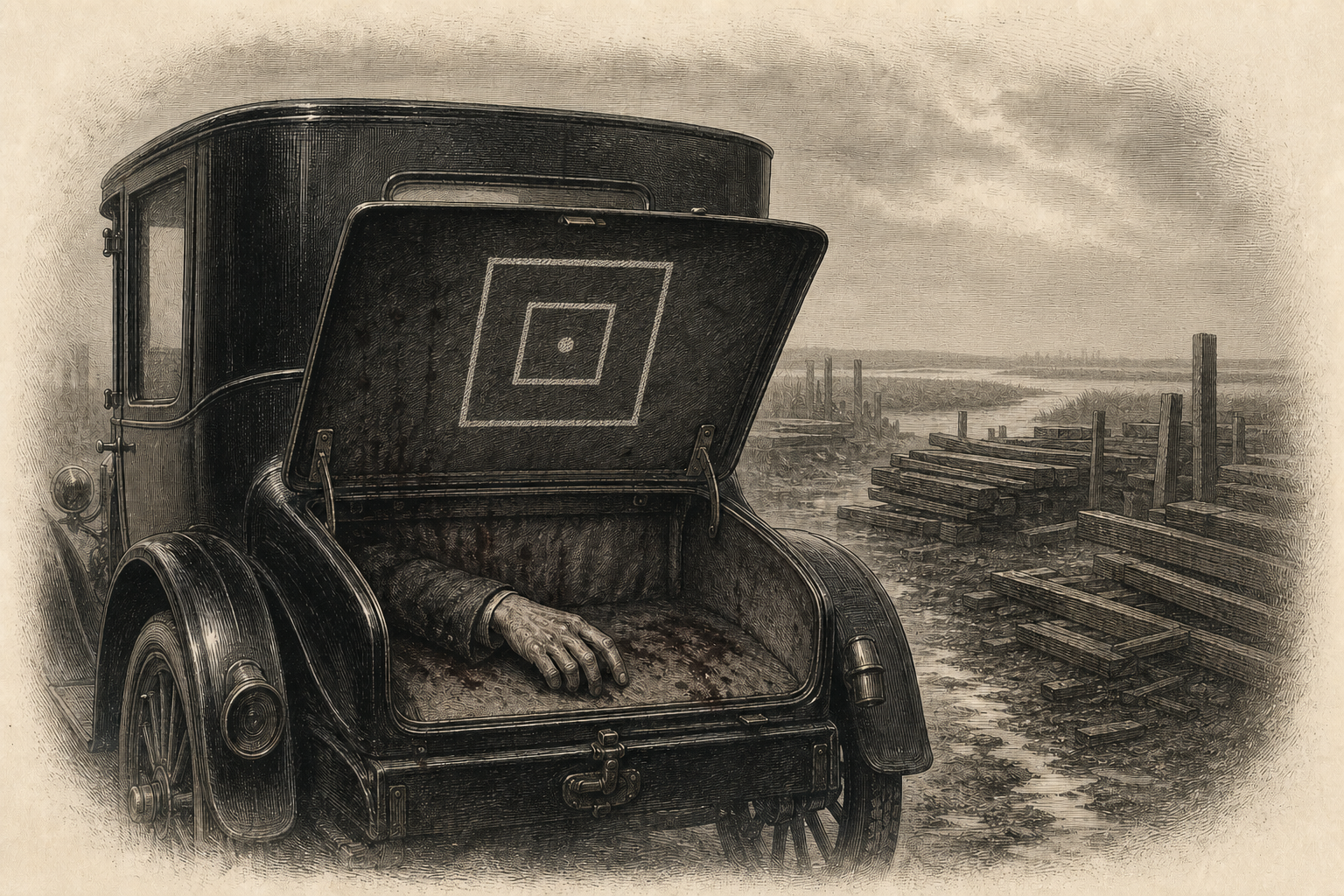
A dead man's hand protruded from the open boot of a black motorcar, palm upward, fingers bent as though asking for payment. The nails were torn. Two had split to the quick. There was blood on the lining, blood on the latch, blood in four short streaks across the inside of the lid.
The boot was open.
Machen stopped beside it.
A trapped man claws at a locked door. A frightened man claws at an open one.
The motorcar stood in the yard behind Sedgewick's Timber Merchants, where planks lay stacked under corrugated roofs and the morning had the sharp, resinous smell of cut pine. Beyond the rear fence, the lane dropped toward the salt marsh. The fog was not in the yard, but it was near enough to alter the colour of things. It lay in the lower ground beyond the fence, green and low, with the pale roofs of the sheds above it like islands after a flood.
Sergeant Bell stood beside the car with his hat in both hands.
"Name's Barnaby Keach," he said. "Known to us."
"How well?"
"Well enough to make the undertaker no loss to society."
Machen looked at him.
Bell cleared his throat. "Extortion. Theft. Violence when he had help. Cowardice when he hadn't. He was the one who drove. He was also the one who put men where he was told to put them."
"And now?"
"Now he's dead in a boot that wasn't shut."
The police surgeon was a narrow man named Vetter, with silver spectacles and a permanent look of private disappointment. He crouched beside the car, careful not to touch the paint.
"No major wound," he said. "Bruising to the shoulders, elbows, knees. Self-inflicted damage to the fingers. Dehydration. Shock, perhaps. I'll know more after the examination."
"How long?"
"Since last night. Late."
"Was the boot closed when he died?"
"That is not a medical question."
"It is now."
Vetter glanced at the open lid. "If it was closed, someone opened it before we arrived. If it was open, he did not understand that it was open."
Machen leaned into the boot.
The smell was human first: sweat, urine, blood. Under that lay oil, old carpet, damp metal. Nothing surprising, nothing theatrical. Keach had kicked through the lining on the left side and pulled a little coil of wiring loose; his heel had cracked the inner panel. A mark on the latch showed where he had struck it repeatedly with something hard, perhaps a buckle.
Machen reached toward the latch, stopped before touching it, and turned his head.
"What is that?"
Bell bent closer.
On the inside of the boot lid, beneath the streaks of blood, someone had drawn a small square in white chalk. Inside the square was a smaller square. Inside that, a dot.
"A child could have done that," Bell said.
"Yes. But children usually improve with practice."
A constable came across the yard with a notebook.
"Sir, Mr Sedgewick says the yard was locked at six. He came in at seven twenty. Found the car at the back by the timber shed."
"His car?"
"No, sir. Keach's."
"Who opened the boot?"
"Mr Sedgewick says it was open."
"Says?"
"Says."
Machen crossed to the fence, checked the lane beyond it, then stopped with the fog in view.
"Any sign of another vehicle?"
"Tyre marks by the gate, but the ground's dry. Could be old."
"Could be almost everything," Machen said.
He straightened. A gull cried beyond the sheds. The sound came strangely from the fog, flattened and thrown back as if the marsh had a ceiling.
Bell watched him.
"You're thinking of Fisher," he said.
Machen did not answer at once.
The name had arrived in the district four days earlier in a different sort of report. Aldous Fisher, proprietor of Fisher and Pelham Secure Fittings, had disappeared on Tuesday night after leaving a small dinner at the Imperial Hotel. A wealthy bachelor, polite to the point of absurdity, he manufactured strongboxes, archive cabinets, vault fittings, and the secure doors used by banks, hospitals, police stations and men with reasons to fear their clerks. He had built the company from a single workshop through seventeen years of patience and careful work. His colleagues described him as meticulous, unprepossessing, entirely without enemies. Bell's note said he had the manner of a man who had learned early that smallness was safest when it caused no inconvenience.
Thirty-one hours later, he had been found on the old military road above Graveney Marsh, his clothes wet, his face bruised and his feet bare. He could not say where he had been.
Keach had been one of three men suspected of taking him.
Suspected, not arrested. Fisher had identified no one. He had said very little. He had sat in his drawing room under a blanket and asked whether anyone had informed his factory that he would be absent until Monday.
Now Barnaby Keach was dead in the boot of his own car.
Bell said, "If Fisher did this, he found courage quickly."
"Fear can make a man act unlike himself," Machen said.
Bell looked into the boot again. "He must have hated him."
"Murderers often do."
"No, sir. I mean properly hated him. Enough to put him there and listen."
Machen turned from the car.
"Find out who saw Keach last. Find where he drank, who he drank with, who he owed, who owed him. And get me everything on Fisher's disappearance again. I want the full file, not the summary."
Bell closed his notebook.
"And Fisher?"
"I will see Mr Fisher."
"He's meant to be recovering."
"Then he will be at home."
Machen walked toward the yard gate. The fog beyond the fence shifted slightly. It did not advance. It remained low in the marsh grass, thick in the ditches, reluctant to touch the open road.
At the gate he stopped.
There was mud on the lower bar. A handprint had dried there, not large, not clear enough for identification. Beside it, in the same white chalk as the mark inside the boot, someone had drawn another square.
This one had no dot inside it.
Part Two: The Man with Open Doors
Aldous Fisher lived in a red brick house at the respectable end of Charn Street, where the pavements were swept by men who did not live there and the curtains were too heavy for the windows.
Machen was shown in by a maid who looked as if she had not slept well since Tuesday.
"Mr Fisher is in the morning room, sir."
She led him down a passage lined with framed patents. Hinges, lock housings, reinforced drawer mechanisms, collapsible filing systems. Small drawings of restraint. Small drawings of order.
Every door in the passage stood open.
The dining room door. The pantry door. The door to a narrow cupboard beneath the stairs. Even the door to the garden had been left ajar, though the day was damp and a draught ran through the house with the mild persistence of an unwanted guest.
"Does Mr Fisher usually keep the house like this?" Machen asked.
The maid looked back. "No, sir."
"Since Tuesday?"
"Yes, sir."
She seemed about to say more, but thought better of it and opened the morning room door wider than necessary.
Aldous Fisher rose when Machen entered.
He was a soft, precise man of fifty-two or so, with fair hair already thinning and a small mouth that seemed designed for apologies. Bruising yellowed the left side of his face. One eye was red in the white. He wore a dark suit, though he was at home, and a knitted waistcoat under it. His shoes were polished. His hands were not steady.
"Inspector Machen," he said. "I am grateful that you have come."
"Are you?"
Fisher blinked once. "Yes. I assumed that was the proper thing to say."
"Then it was properly said."
Fisher considered this. A faint smile touched his mouth and went away. He looked toward the tray on the side table and left it untouched.
"Please sit," he said.
Machen remained standing.
The morning room looked out over a rear garden arranged in squared beds, each bordered with clipped box. Labels stood in the soil. Rosemary. Thyme. Tarragon. Parsley. Nothing had been left unnamed. At the end of the garden, beyond the wall, the town fell away toward the lower road and the marsh beyond it. A thread of fog moved between two distant warehouses.
"You know Barnaby Keach," Machen said.
Fisher held the edge of a chair. "No."
"Think before you answer."
"I have thought. I do not know him."
"He was found dead this morning."
Fisher's fingers tightened.
"In a motorcar boot," Machen said.
The colour moved out of Fisher's face in a slow, unpleasant way.
"I see," Fisher said.
"Do you?"
"No."
"You were put in a boot on Tuesday night."
Fisher lowered himself into the chair and adjusted its position before putting his hands on his knees.
"I remember leaving the hotel," he said. "The rain on the steps. A man asking whether I was Mr Fisher."
Machen asked if the man had been Keach.
"I only saw him for a moment."
Fisher touched two fingers to the bridge of his nose. "Then something went over my face."
"A cloth?"
"Yes."
"What did it smell of?"
Fisher looked embarrassed by the question. "Vinegar. Spirits. Something sweet underneath."
"Chloroform?"
"I should not know chloroform if it introduced itself."
"After that?"
"I woke in the dark."
His voice flattened, though he did not raise it.
"In the boot?"
"I believe so."
"You believe so."
"There was no room for belief at the time, Inspector. There was only the lid."
Machen waited.
Fisher rubbed one thumb across the other.
"I tried to count," he said. "It seemed useful. There are certain procedures one follows when panic threatens efficiency. Numbers are helpful. I counted to three hundred and then back to one. I did it twice. After that the numbers became unreliable." He stopped, his thumb moving across the other hand again over the same place.
"There was a seam in the lining," he said. "I put my thumb against it because it was the only straight thing in the dark. After a while I no longer knew whether I was pressing against the seam or whether the seam was pressing back."
The car moved, though Fisher could not say for how long. He remembered three voices, perhaps four: one man laughing, another coughing, a third pressing his face into the carpet before the lid came down. There had been beer and shaving soap. "Small men fit better," one of them had said.
Machen wrote this down without comment.
"One said I would learn not to look at gentlemen when they were conducting business."
"Had you looked at gentlemen conducting business?"
"I had looked at a man striking a woman outside the Imperial Hotel," Fisher said. "I made the error of saying so."
Machen watched him.
"That was all?"
"I also said I knew the name of the man who employed them."
"And who is that?"
Fisher shook his head.
"Mr Fisher."
"No."
"The firm is Fisher and Pelham," Machen said. "Where is Mr Pelham in this?"
Fisher looked at him as if the name belonged to the furniture.
"He is not operational."
"That kind often is," Machen said. "Is he a partner in name, or in fact?"
"He holds the commercial arrangements," Fisher said. "I hold the designs."
"And who holds the decisions?"
Fisher did not answer. He looked toward the garden instead and rubbed one thumb along the seam of his waistcoat.
"If the name of Pelham's associate relates to a murder," Machen said, "withholding it is unwise."
"It relates to more than murder."
"You are frightened of more than a murder charge."
Fisher looked through the open garden door.
"They left me near Graveney Marsh," he said. "Below the road, not on it. Near the old listening station."
"The station is inside the fog line."
"Yes."
"And you walked out?"
"I was carried out."
"By whom?"
Fisher's mouth opened, then closed. He looked down at his shoes.
"I have no useful answer."
"Give me the useless one."
For the first time, Fisher looked directly at him.
"There were hands on the boot," he said. "Inside it. That is the useless answer."
The house creaked somewhere behind them. It was only wood settling in damp air. Machen did not turn.
"You escaped the boot."
"Yes."
"How?"
"The lid opened."
He did not say this with gratitude. His hands, which had shaken throughout, were still.
That troubled Machen more than if he had wept.
"Who opened it?"
"I do not know."
"You saw no one?"
"I saw fog."
"Fog does not open motorcars."
"No," Fisher said. "That is why I have not told people."
Machen let the silence sit between them.
"Where did you go after the lid opened?"
Fisher swallowed. His right hand moved toward his waistcoat and stopped.
"I do not know."
"You were missing for thirty-one hours."
"Yes."
"Where were you?"
"Inside a place that did not have distance in it."
Machen studied him. "Try plain speech."
"I walked," Fisher said. "Or believed I did. Roads were where no roads should be. I heard men behind me when no one was there. I heard my mother using a voice she never had in life. I saw the factory floor under water, and three men at a ditch with my face."
"Dreams."
"That is what the doctor called them."
Machen went to the open doors and checked the hinges and threshold again.
"And now Keach is dead."
"Yes."
"Did you kill him?"
Fisher almost smiled. "You ask it as if I should know."
"That is usually the advantage of murder."
"I did not kill Barnaby Keach."
"You did not know his name ten minutes ago."
"No," Fisher said. "I did not."
Machen crossed to the window. In the garden, one of the wooden plant labels trembled in the draught. Rosemary. The word seemed very ordinary.
"Who paid them?"
Fisher did not answer.
"Who paid Keach?"
Fisher rose, went to the side table, and poured tea into a cup. The cup rattled against the saucer. He put it down without drinking.
"Inspector," he said, "when I was in the fog, I discovered that fear has a shape."
"Is that meant to help me?"
"No."
"Then why say it?"
Fisher looked toward the hall, where the open doors made a corridor of rectangles.
"Because I think someone else is about to enter it."
Part Three: The Man Who Walked in Circles
The second death came before dusk. Gideon Crowther had three convictions, two gold teeth and a wife in Southgate who told the police she had thought him dead already, though she had meant it in the ordinary marital sense. The file noted that Crowther had driven for Keach's outfit for eleven years. He knew every road, lane and service track in the district. Men hired him precisely because he never got lost.
He was found in the concrete yard behind the old electricity works, less than half a mile from Fisher and Pelham Secure Fittings.
The yard was open on all sides. No sheds. No walls except the high brick shell of the power house at the east end. The gate had been chained for years, but the chain lay on the ground cut through with a tool clean enough to please an engineer.
Crowther lay near the centre of the concrete, surrounded by chalk lines. Dozens of thin white strokes looped around the yard in broken, uncertain paths. Some doubled back within a few feet; others ran straight toward the gate and stopped two yards short. Some circled the body so tightly that the chalk had worn to dust.
Bell stood with his hands in his coat pockets.
"Doctor says he walked himself to death."
"Doctors enjoy saying memorable things," Machen said.
"He means exhaustion. Heart gave out, maybe. Feet are in a state. Knees too."
Machen crouched.
Crowther's shoes had split at the toes, and the concrete around him was marked by scuffs and smears. His lips were cracked; his face was turned toward the gate.
The gate stood open.
Machen walked to it. From there the yard gave onto a service road, beyond which stood houses and then the town. Crowther could have shouted and been heard. He could have walked ten yards and left. Instead he had walked in circles until he died.
At the far edge of the yard, where the concrete ended at a drainage channel, the ground was soft. Two sets of prints marked it. Crowther's were heavy and dragging, the tread of a man who had long since stopped knowing where his feet were. The other set was lighter, deliberate, and led to the channel's edge and no further. Someone had stood there, watching.
In a small building beside the gate, once a guard hut, its windows broken long ago, Machen found cigarette ends, a rusted kettle, a nest of old newspapers and, on the inner wall, the same mark he had seen in the boot: a square within a square. No dot.
Bell came in behind him.
"Children?"
"Do you see children playing here?"
"Not sensible ones."
Machen crouched beside the mark and traced the outer square without touching it. The missing dot bothered him more than the earlier mark with one.
The night watchman at the coal depot opposite had seen a man in a long coat standing by the gate at half past two. He had taken him for a constable or a drunk. No cry, no quarrel, no motorcar.
Crowther had been talking, though the watchman saw no one with him. Once he shouted, "I am going straight." Across the yard, the chalk proved otherwise.
The watchman said the fog had stayed down at the cutting, where it hung most nights.
"What colour?" Machen asked.
The man looked at him. "Green."
At seven, Machen returned to Fisher's house.
The maid admitted him without surprise. The doors were still open. More of them now. Upstairs, too, by the look of it. The whole house seemed to be holding its breath through gaps.
Fisher was in the kitchen, at the plain wooden table, a ledger open before him and a pencil in his hand. He had chosen neither the morning room nor the study he kept for visitors. On the opposite chair lay an overcoat, still damp at the hem.
Machen touched it.
"You have been out."
"Yes."
"Where?"
"My factory."
"When?"
"This afternoon."
"Anyone see you?"
"My foreman. Three clerks. Miss Dacre from accounts."
"And last night?"
Fisher looked at the pencil.
"I was here."
"Anyone see you?"
"The maid until nine. After that, no."
"Gideon Crowther is dead."
Fisher closed his eyes.
"You knew him?"
"I heard his voice."
"When?"
"In the boot."
"The coughing man?"
"No. The one who called me a little king."
Fisher opened his eyes.
"It was not imaginative, but it had force at the time."
"Crowther walked himself to death in an open yard."
Fisher said nothing.
Machen sat opposite him.
"You manufacture lock mechanisms, Mr Fisher. You have contracts with the old electricity works."
"We serviced their cabinets before the closure."
"You have keys?"
"To a gate that no longer has a proper lock?"
"You tell me."
Fisher placed the pencil exactly parallel to the ledger's edge.
"Inspector, I do not object to being suspected. It is a reasonable economy. I object only to the suggestion that I am being clever."
"You may be clever without enjoying it."
"I have been careful all my life. It produced cabinets. It did not produce dead men."
Machen leaned back.
"Then help me."
"With what?"
"The name you would not give me."
Fisher stared at the ledger.
"No."
"Keach and Crowther are dead. The third man may die next."
"The third man should not have become the third man."
"That is not an answer."
Fisher looked at the window. The garden beyond it was dark. In the far corner, just above the wall, a thin pale drift moved through the herb beds, low and purposeful, touching the labels and moving on. Machen watched it.
"The fog is in your garden," he said.
Fisher did not look.
"Yes," he said. "It comes most evenings now."
"Did it come before Tuesday?"
Fisher was quiet for a moment.
"No," he said. "It did not."
"What does it do?"
"It reads the labels," Fisher said, and his voice was entirely without irony. "And then it leaves."
Machen stood.
"What frightened you more in the boot? The dark, or knowing men had put you there?"
Fisher's face tightened.
"Neither."
"Then what?"
"The boot was not large enough for what entered it." He paused. "But what entered it was not large. That was the trouble."
Outside, the fog withdrew from the herb beds one label at a time. Rosemary last.
Part Four: The Clean Hands
The third dead man was not in the open.
He was found beneath Hayburn House, an empty office building off Market Street that had once belonged to a shipping insurer and now belonged, through three holding companies, to owners whose names appeared nowhere on the building.
His name was Magnus Cordell.
He was the one Keach and Crowther had feared.
Bell had one line on him from an earlier file: Cordell had never struck a man when he could make someone poorer do it for him. He arranged things. He paid for outcomes. He kept himself on the near side of every door.
The basement room had no windows. It smelled of limewash, old water and something metallic beneath the stronger scent of disinfectant. A single electric bulb burned from a cord in the ceiling above Cordell, who sat at a table directly below it. He had been dead for perhaps an hour.
On the table lay a length of rope, a roll of adhesive tape, three keys, a stained handkerchief, a bottle of cheap spirits and a folded page torn from a hotel register. Machen unfolded it: the Imperial Hotel, Tuesday, Fisher's name in a clerk's neat hand.
Cordell's head rested on his chest. His mouth was open. His eyes had the astonished look of a man interrupted in the middle of denying something.
His hands were clean. Machen drew the nearer one under the bulb and examined the trimmed nails and pale knuckles. Everything else could be understood as arrangement: the table, the objects, the light, even the dead man placed like a pupil before a lesson. But the hands had been scrubbed with care, and a faint smell of carbolic soap lingered.
Bell stood near the door.
"Same chalk mark," he said.
On the wall behind Cordell, in white chalk, was the square within the square.
The dot had returned.
Machen looked at it. Keach had died with the dot present. Crowther without it. Now Cordell with it again. He distrusted patterns that explained themselves before anyone had earned the explanation. Still, a word came to him and stayed: occupancy.
He examined the floor. Dust lay thick in the corners, while footprints crossed and recrossed near the table. Two men at least, perhaps three. Cordell had been brought in alive; marks on the chair legs showed where he had struggled. The rope had not been used to kill him, the tape had been cut, and the spirits bottle was uncorked but nearly full.
"Cause?" Bell asked.
"Fear," Vetter said from beside the body.
Machen looked at him.
The surgeon removed his spectacles and pinched the bridge of his nose. "I dislike the word as much as you do. His heart failed. No mortal injuries. Bruising at the wrists. Small abrasions. No poison evident yet. No wound. No strangulation."
"Men do not usually die because they are frightened."
"They do. Not often. Not conveniently. But they do."
Machen lifted one of Cordell’s hands by the wrist. Whoever had washed it had done so methodically, without any sign of ritual. He put it down again.
"After death?" he said. "Or before?"
"Before, I think," Vetter said.
Bell shifted by the door. "Why wash his hands?"
Machen folded the hotel register page and put it back on the table.
"To make them innocent," he said. "After the fact."
They found the entrance route within twenty minutes. A delivery door at the back. The lock had been opened cleanly. No forced entry. The mechanism was old but good.
Fisher and Pelham.
Of course.
The evidence was arranging itself too neatly. Machen checked the lock records twice before trusting them.
By nine, Machen had the factory records. Fisher and Pelham had supplied the basement locks fourteen years earlier, when Hayburn House had still kept marine claim ledgers in fireproof rooms. The original key blanks were recorded in Fisher's own hand, before the partnership had grown enough to require clerks for such work. A separate entry listed demonstrations of the firm's test chamber for clients. Pelham had conducted them himself, explaining the locking mechanism from outside while the clients stood within.
Machen made Bell test the obvious alternative: had someone used Fisher's key or copied the old blank? The lock bore no sign of force, and the register showed that several blanks had been issued to contractors. The hotel page established that Fisher had been at the Imperial on Tuesday; it did not establish who had carried it into Cordell's room.
At ten, Machen had the witness statements.
Fisher had been seen at his factory until six. At home by seven. The maid had taken supper to his study at eight. After that, nothing firm. The foreman wanted Fisher back at work; the maid feared what the open doors meant and could not be sure she had seen him after supper. Neither statement fixed him at home all night.
At eleven, Machen returned to Charn Street with Bell and two constables.
The maid was crying before they spoke. "He's not here, sir."
"When did he leave?"
"I don't know. I thought he was upstairs."
"Doors?"
"All open, sir."
Machen went through the house himself. The morning room was empty, the study empty, the bedroom empty with its bed untouched, the kitchen empty. At the end of the upstairs corridor, a narrow door led to the attic stair. It stood open.
Machen climbed.
The attic contained trunks, rolled carpets, two broken chairs, a child's cot with no mattress, and a line of old cabinet prototypes under dust sheets. At the far end, below the sloping roof, stood a tall metal archive cabinet of Fisher's own manufacture, second generation, pre-partnership.
Its door was open.
Chalk marks covered the inner walls: hundreds of squares, some with dots, some empty, some drawn over and over until the chalk had become a grey skin on the metal. In the lower corner, almost at floor level, a single row of marks looked less like squares and more like a count: four strokes and a fifth crossing them.
On the floor of the cabinet lay a pair of shoes.
Fisher's shoes.
Bell looked at them and said nothing.
The cabinet was not large enough for a man to stand comfortably inside, or even to lie down in. It was certainly not large enough to disappear in.
Yet Aldous Fisher was gone.
For a moment Machen did not step back from the cabinet door. The cabinet had arranged the question too neatly: inside or out. He recognised the trap in the arrangement and stepped back.
The constables searched the house, then the garden and the street. No one had seen him leave. No motorcar had been taken, and no coat was missing.
At midnight, Machen stood in the garden with Bell. The fog lay beyond the wall, holding at the boundary without crossing into the beds. In its green stillness Machen had the distinct and unwelcome sensation of being observed by something that had not decided yet whether he was worth the effort.
Bell said, "He ran."
"Barefoot?"
"Then someone took him."
"Through the house?"
"Maybe before we arrived."
Machen stepped into the yard until he could see the attic window. It was black against the roof.
From somewhere beyond the wall came a sound like a latch being tested.
Bell turned.
The fog was still.
Part Five: The Locked Room That Was Open
They found Aldous Fisher the next morning in Testing Room Three, rather than in his office, on the production floor or in the yard. There Fisher and Pelham examined cabinets, strongboxes and reinforced doors under pressure, heat and forced entry.
He sat on a wooden chair facing a steel test chamber, his feet bare and his socks ruined. Chalk marked the cuffs and knees of his suit. A notebook lay in his lap.
The steel chamber door stood open.
Inside was a man, alive though only just, curled in the back corner with his hands over his ears. His hair was wet with sweat, and his eyes moved without settling. When the constable reached in to help him, he screamed.
Machen knew him from the file before Bell said the name.
Quentin Pelham.
The silent partner.
The man who had paid Keach, Crowther and Cordell.
He was neither young nor strong, but plump and guarded. His name appeared on the firm's letterhead and at the centre of its legal structure, though Machen had found it on no other document and the operational records rarely mentioned him.
The records showed that Pelham used Testing Room Three for demonstrations, placing clients inside while he explained its locking mechanism from outside. He called it proof of concept. Fisher had designed the chamber as a test; Pelham had found a way to sell the fear.
Pelham's collar had torn away from his shirt and one cufflink was missing. His hands were tied loosely with tape he could have broken if he had tried.
He would not come out of the chamber.
"It's still shut," he whispered.
Bell stood at the door. "It's open."
Pelham shook his head.
"Look at me," Machen said.
Pelham looked through him.
"It's still shut."
Fisher watched from the chair.
Machen crossed the room and took the notebook from his lap.
Fisher did not resist.
The pages were filled with squares. Some empty. Some with dots. Between them, in Fisher's small precise hand, were phrases. They were closer to fragments than sentences.
NO AIR BUT BREATHING
NO WALL BUT CANNOT PASS
THE ROOM REMEMBERS
THEY MADE A PLACE
THE ROOM STAYED OPEN
Machen closed the notebook.
"Stand up, Mr Fisher."
Fisher obeyed slowly, one hand on the table edge, weight shifted before he moved rather than during it.
"You are under arrest for the murders of Barnaby Keach, Gideon Crowther and Magnus Cordell, and for the abduction and attempted murder of Quentin Pelham."
Fisher nodded.
"That is a clean arrangement."
"Did you kill them?"
"I brought them to the proper places."
"Did you kill them?"
Fisher looked toward the open chamber.
"No."
Pelham sobbed, a dry, choking sound without tears.
"Did you want them dead?"
Fisher was quiet for a moment.
"Not at first."
"And after?"
"I stopped caring what happened to them."
Machen stopped asking for explanations and named the men instead: Keach in the boot, Crowther in the yard, Cordell at Hayburn House, Pelham here. Fisher answered yes to each name. By the fourth, he was staring at the floor between his shoes.
"Then what happened?"
Fisher's face did not soften; there was no pity in it. Something that had once been precision, and had become something else, still seemed to be looking for a word.
"I opened the door," he said.
Relief crossed Fisher’s face and was badly hidden. Machen would have preferred pride.
Machen glanced at the chamber. "Before or after?"
"Always before."
Bell said quietly, "Before what?"
Fisher looked at him.
"Before they understood."
Pelham struck his head against the inner wall of the chamber, once, then twice. The constables dragged him out by force. He fought with a strength that did not look sane, clawing at the floor and begging them not to take him "through the lid." When they got him into the light, his body stiffened, then went slack.
Vetter was sent for. Then an ambulance.
Pelham lived for eleven minutes. He died on the factory floor beneath a row of sample doors.
All of them open.
Machen walked with Fisher into the yard while Bell stayed with the body.
Morning had come grey and windless. Beyond the factory wall, the fog rested in the cutting. Green. Dense. Still.
Fisher held his wrists together though no cuffs had yet been placed on them.
"You will say I acted alone," he said.
"I will say what I can prove."
"Which is less."
"Yes."
Machen signalled to the constable, who brought the cuffs.
Before they were fastened, Fisher turned his head toward the fog.
"I was not in there for thirty-one hours, Inspector."
"You were missing for thirty-one hours."
"In your arrangement."
"And in yours?"
Fisher's throat moved.
"There was enough time for the fog to find the shape of me." He paused. "And for me to learn what I was without the rest of it."
"Without the rest of what?"
Fisher looked at his own hands for a moment. Then at the constable. Then at nothing in particular.
"Without the part that made me easy to put in a boot."
The constable closed the cuffs. Fisher did not look at the cutting again. After that, Fisher kept his eyes on the ground.
Part Six: What Machen Saw
The official report was completed four days later. It described motive, opportunity, keys, chalk, factory records and partial confession. Each death was called a retaliatory act by Aldous Fisher against the men who had abducted him. The report noted the washing of Cordell's hands, which it could not explain, and did not use the word impossible.
Machen disliked adjectives in reports.
The case was strong enough. Fisher said little after his arrest. He did not deny taking the men or explain the deaths.
He asked once whether the doors in his cell might remain open during the day. When told this was not possible, he thanked the warder for considering the matter.
On the fifth night, Machen visited him.
The cell was small, limewashed and dry. Fisher sat on the bed with his hands folded. He had lost weight; the softness had gone from his face, leaving something plainer and harder underneath.
"No solicitor?" Machen asked.
"One is coming tomorrow."
"You may wish to speak before then."
"To help myself?"
"To help the record."
Fisher looked at the door.
"The record has already helped itself."
Machen took out his notebook.
"Tell me about the square."
Fisher shut his eyes briefly.
"It is not a symbol. Not at first."
"What is it?"
"A room."
"And the dot?"
"A person inside it."
"Why draw it?"
"To see whether I was in or out."
Machen wrote this down.
"You drew it at the scenes."
"Yes."
"Why?"
"I was not always sure."
Machen stopped writing.
"Not sure of what?"
"Whether the room had ended."
The corridor outside held the ordinary sounds of confinement: a cough, a step, keys, a distant exchange answered by silence. Human sounds, just.
Machen said, "You understand that men are dead because of you."
"Yes."
"Do you regret that?"
Fisher considered the question with care. Machen had the unpleasant impression of watching a man search through a recently rearranged room, find it efficient, and still find it unfamiliar.
"I regret that I am still able to understand them."
"That is not remorse."
"No."
"What is it?"
"A remainder."
Machen closed the notebook.
"Convenient word."
"Accurate one."
"It records the measurements. It does not tell me what happened in the room."
Fisher looked at him with something that might once have been interest.
"No. But it may be all I can admit to myself."
Machen stood. At the door he paused.
"Who opened the boot?"
Fisher's expression changed with recognition. He had been waiting for the question a long time.
"I thought you had stopped asking useful questions," he said.
"Answer."
Fisher leaned forward slightly.
"I did."
"You said hands were inside."
"Yes."
"Whose?"
"Mine," he said. "Eventually."
His pencil had stopped after the question. The line beneath it was blank.
Then he left Fisher there.
The trial was set for the autumn assizes.
It did not take place.
Three weeks before it, Aldous Fisher was found dead in his cell between the two and three o'clock inspections. The door was locked, the window bars intact, the floor solid stone. No tool marks were discovered, and the body bore no marks of violence.
Vetter's report was brief. Heart failure. No unusual findings.
On the wall above the bed, drawn in white chalk, was a square within a square.
There was no dot.
Machen stood in the cell for a long time after the others had gone.
Without noticing, he had placed himself exactly midway between the bed and the door. When he realised it, he stayed there.
He thought about the thing Fisher had said in the yard: the part that had made him easy to put in a boot. He thought of Keach's hands on the lining, Crowther's shoes split at the toes, Cordell's hands washed clean, and Pelham begging not to be taken through the lid. Then he thought of the chalk mark in the attic cabinet, with its count of four strokes and a fifth.
He thought about a man who had spent his whole working life designing rooms that could not be left without a key.
He took out his notebook. He wrote the date at the top of a clean page. He looked at the square on the wall. He looked at the empty space inside it where the dot should have been.
He wrote nothing.
End
Case file
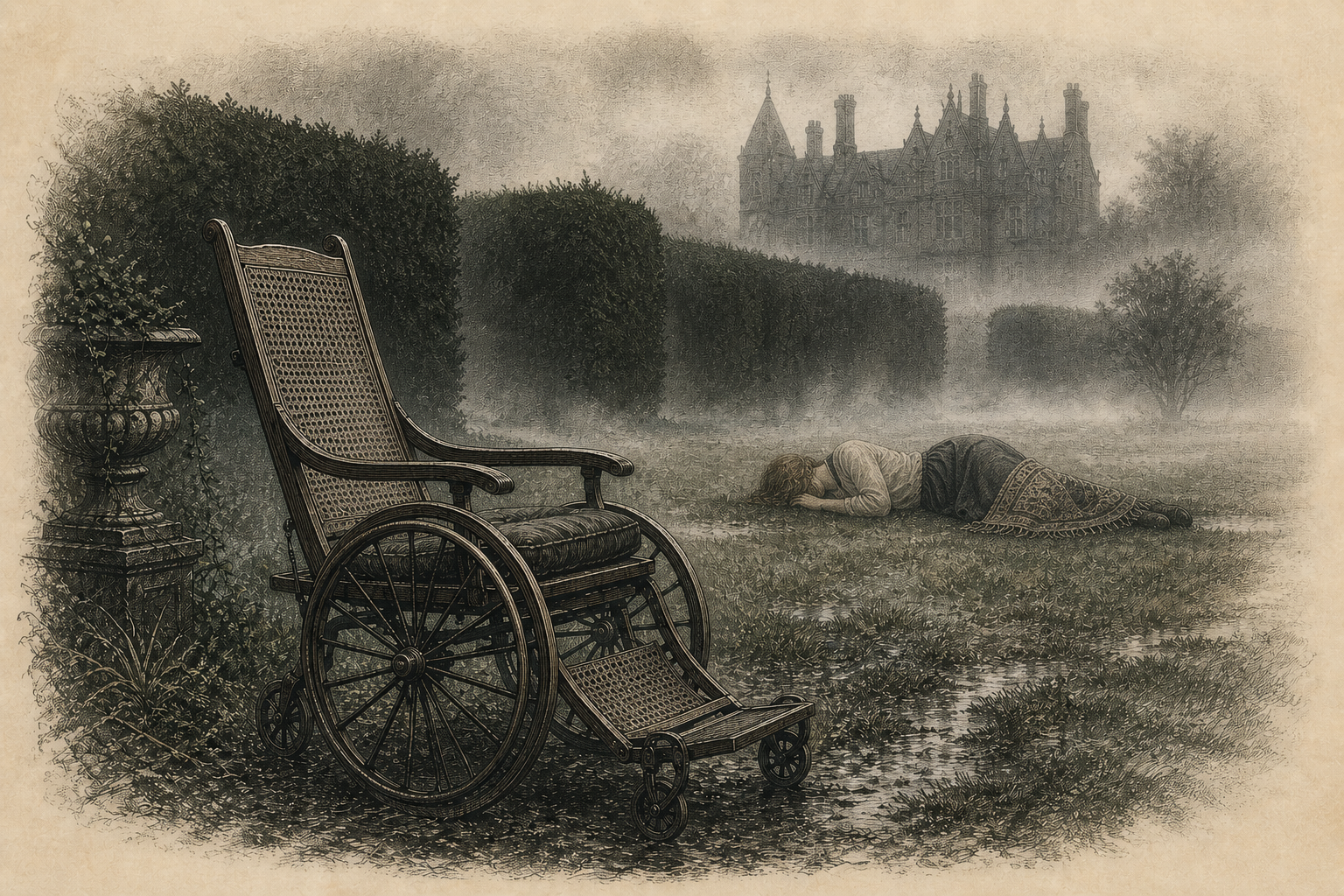
The Girl Who Lay in the Fog
Part One: The Girl on the Lawn
The dead girl had been tucked in.
What Sergeant Bell disliked first was the shawl.
It lay neatly over Miss Viola Wycliffe's knees, its corners carefully arranged. Green fog gathered low along the yew hedge. Her white face was turned toward the trees as if she had gone to sleep listening for birds, and the invalid chair stood six yards away on the wet grass with both brakes set. Bell kept looking at the shawl.
Bell stood at the edge of the lower lawn and did not step closer until the doctor finished crouching beside the body. He had learned that doctors disliked policemen near the dead until there was nothing useful left to disturb.
Harrowmere Hall rose behind them, pale and long and cold in the early morning light. Its windows looked down over the terraced lawns, the yew walk, the ornamental pond, the empty rose beds, and beyond all that the low fields where the green fog gathered whenever the ground had been wet for more than a day.
It had been wet for three.
The fog still lay in threads along the lower grass, too thin now to hide anything. By the time Bell arrived, the morning had lifted. The fog had drawn back toward the sunken ha-ha and the marsh road beyond it. Green damp remained in the hollows and marked the ground around the dead.
Viola Wycliffe lay on her side near the yew walk, one hand under her cheek, the other half hidden beneath the shawl. She was twenty-one, though Bell would have guessed younger. Illness had left her with a child's narrow wrists and an old woman's skin. Her nightdress was soaked along one side. Her hair, pale brown and loosened from its pins, was wet underneath with faint green beads of condensation, but the top was dry. Bell noticed because Inspector Machen had trained him to notice what weather had not done.
Doctor Arden stood slowly.
"Well?" Bell asked.
Doctor Arden turned toward the house before answering.
"Dead some hours."
"That is not much of a well."
"She was fragile. The lungs especially. In that fog, on wet ground, before dawn." He shook his head. "It would not take much."
"Did she fall?"
"She may have."
"From the chair?"
"Possibly."
"Did she crawl?"
The doctor looked at him.
"Why ask that?"
Bell pointed to the girl's feet. She wore thin indoor slippers. The soles were pale and almost clean.
Doctor Arden followed his gaze.
"They may have dried."
"On wet grass?"
"Then perhaps she was carried."
Doctor Arden said it before he could stop himself. Bell looked again at the shawl.
The housekeeper, Mrs Honoria Mears, stood ten paces back, both hands pressed to her apron. Harrowmere Hall no longer kept enough servants for titles to behave properly. She cooked, cleaned, laid fires, carried trays, and knew what remained of the household better than the household knew itself. Beside her stood the butler, Mr Ambrose Kettering, tall and narrow, black-coated, his white hair combed close to the skull. His face had folded itself around service until expression seemed improper. He held himself still.
"Who found her?" Bell asked.
Mrs Mears opened her mouth. Kettering answered.
"I did, Sergeant."
"What time?"
"Half past six."
"Why were you on the lower lawn at half past six?"
"I noticed the lower garden door had been unbolted. I feared Miss Viola may have gone out."
"Did she often?"
"No."
"You feared a thing she did not often do?"
Kettering inclined his head. "She was restless yesterday."
Mrs Mears looked at him quickly. Bell saw that.
"What do you mean, restless?"
"Unsettled. She asked whether there was fog in the lower fields."
Bell crouched near the chair without touching it. It was one of those wheeled garden chairs used for invalids who wanted air without exertion, old and expensive, painted green once and blackened by weather at the handles. One rubber strip on the left wheel had worn thin. Mud clung in the grooves despite an attempt to scrape it clean. The brakes had been set.
Bell stood.
"Could she set those herself?"
Kettering answered: "Yes."
Mrs Mears said nothing.
Bell turned to her.
"Could she?"
She swallowed. "If the chair were on level ground."
"It is on level ground."
"Aye."
"You hesitated."
She looked at the house. Kettering did not.
"She could set them," Mrs Mears said. "But not easily."
Doctor Arden closed his bag. "This is a tragedy, Sergeant. Miss Wycliffe was warned every week not to expose herself to damp air. With the fog low this morning, the result is terrible but not mysterious."
Bell looked from the dry slippers to the wet hair. "Her slippers are dry and her hair is soaked. I don't call that simple."
Doctor Arden frowned.
Bell looked once more toward Harrowmere Hall. A man stood in the high window above the terrace. Lord Aurelius Wycliffe. Still as stone, one hand on the curtain, looking down at the daughter who could no longer save him.
"Send for Inspector Machen," Bell said.
Part Two: Harrowmere Hall
Inspector Machen arrived at Harrowmere Hall shortly before noon and disliked the house at once. He had no objection to its age. What bothered him was the effort spent making decline look deliberate.
Harrowmere stood on a rise above the low fields, with two wings, a central portico, a stable block with cracked clock tower, and enough grey stone to suggest permanence to people who did not inspect roofs. The gravel drive had been raked recently, but not well. Two urns flanked the steps. One contained a clipped bay tree. The other contained a dead one, turned so its worst side faced the wall.
Inside, the hall was colder than outside. Portraits hung along the staircase, except where they did not. In several places, rectangular patches of cleaner wallpaper showed where paintings had been removed. A suit of armour stood near the fireplace with one gauntlet missing. A silver bowl on the side table held visiting cards, three brown leaves, and a crack along the rim that someone had turned toward the wall.
"The house is poorer than its owners admit," Machen said.
Bell, beside him, said: "Yes, sir."
"The dead girl was the only child?"
"Only living child."
"Her mother?"
"Dead. Lady Evelina Wycliffe. Long illness. Eight years ago."
"Current Lady Wycliffe?"
"Second wife. Seraphina. No children."
"Money?"
"Bad."
Kettering appeared at the far end of the hall as though summoned by impropriety.
"Inspector Machen."
"Mr Kettering."
"Lord Wycliffe will receive you in the library."
"I will receive the lawn first."
Kettering paused. "The body has been removed."
"I want the lawn before I want the library."
They went out through the side passage.
The lower garden door opened from the side passage onto a stone terrace slick with rain. Below lay the lawn and the yew walk. Beyond the yews, the land fell toward the old ha-ha and then the fields, where a greenish vapour still held close to the earth in shaded places.
Machen stood on the terrace and looked.
"Who could see the lawn from the house?"
Bell pointed. "Lord Wycliffe's room. Lady Wycliffe's morning room. Miss Viola's room overlooks the east side, not the yew walk. Servants' rooms face the back court."
They walked to the chair. Machen crouched. He studied the wheels, the grass, the position of the brakes, the handles, the footrest. Then he walked the six yards to where Viola had lain. The grass there had been flattened in the shape of a body. The fog had left a green sheen at the edges, brightest where the ground dipped.
"She lay low," Machen said.
"She was found on her side."
"No. Before that." He pointed to the marks in the grass. "Shoulder. Hip. Hair. She did not fall from the chair and remain as she landed. Someone helped her down, or she lowered herself with assistance."
He returned to the chair.
"Who cleaned this wheel?"
Bell nodded. "I thought the same."
"Badly?"
"Someone meant this to look arranged. They did it badly."
Machen touched the mud with a folded handkerchief. "The chair came out through the lower garden door, crossed the lawn, turned near the yew, then was pulled back six yards."
"Pulled back?"
"The deeper track faces the house. Someone took her out, removed her from the chair, then moved the chair away to suggest she had risen or fallen. Why set the brakes afterward?"
"To make it look as if she had stopped it herself?"
"To make the chair behave."
Bell looked toward the house. "Lord Wycliffe?"
"Too soon."
"Lady Seraphina?"
"Too neat for jealousy."
"The intended husband?"
"Ah. There is an intended husband."
"Yes. Mr Cassian Valehurst. Arrived yesterday. Still here."
Machen turned toward the yew walk. "And the unintended?"
Bell said: "Owen Ellery. Carpenter's son. Twenty. Formerly worked in the stable yard. Local talk says he and Miss Viola had an understanding."
They returned to the house.
In the library, Lord Aurelius Wycliffe stood with one hand on the mantel. He was sixty, perhaps. Grief had pared his expression down to something watchful and exact. He had a long, pale face, white moustache, and the habit of looking at men as if they had entered by the wrong door.
Lady Seraphina Wycliffe sat near the window in a blue dress and no jewellery except her wedding ring. She was younger than her husband by twenty years, with dark hair and tired eyes. She kept both hands flat on her lap while Machen entered.
Mr Cassian Valehurst stood beside a bookcase, broad, rich, and immaculately dressed. His new boots looked wrong against the worn floorboards. His grief, if present, had been carefully folded out of sight.
When Machen mentioned the chair, Valehurst did not look at the lawn. He looked at the lower door.
"I will ask questions that may seem rude," Machen said.
Lord Wycliffe said: "I expected no less from the police."
"No. They called us because the family's story no longer fits the evidence."
Valehurst shifted.
"Miss Wycliffe was engaged?" Machen asked.
Lord Wycliffe's mouth tightened. "She was expected to marry Mr Valehurst."
"Expected by whom?"
"My daughter understood her duty."
Lady Seraphina said, very quietly: "Viola understood many duties. She did not accept them all."
Machen said: "When did you last see your daughter alive?"
"Last night. After dinner."
"What was her condition?"
"Agitated. She objected to the announcement of the engagement."
Machen closed the file on his knee. "Had it been announced?"
"Not publicly," Valehurst said.
"To her?"
Lord Wycliffe answered: "We discussed it."
"Did she agree?"
"She would have."
Machen turned to Lady Seraphina. "Did Miss Viola love Owen Ellery?"
Lord Wycliffe said: "She imagined she did."
Lady Seraphina said: "Yes."
The room chilled. Machen turned to her. "Thank you."
Lord Wycliffe said: "My wife did not know Viola as I did."
Lady Seraphina's voice remained level. "No. I knew her as someone watched from the door."
Kettering entered with a tray. No one had rung. He placed it on the side table with perfect quiet.
Machen watched him pour.
"Mr Kettering," he said.
"Yes, Inspector."
"Did Miss Viola often ask about the morning fog?"
Kettering held the teapot steady. "No, Inspector."
"Not ever?"
"She had a fascination with the lower fields. She was discouraged from going there."
"By whom?"
Lord Wycliffe said: "By me."
Kettering finished pouring. He set the teapot down.
"By the house," he said.
No one corrected him.
Machen took the cup he did not want and looked at the butler's hands. Long fingers. Clean nails. Black cuffs. A small scratch crossed the right knuckle. Fresh.
Part Three: The Room
Viola Wycliffe's room was on the east side of the house, pale, narrow, and overly warm. A fire had been kept there even in mild weather. Machen crossed first to the window and opened it an inch before examining anything else. He noticed the impulse only after the latch was in his hand. Two shawls lay folded on the chair near the bed. Medicine bottles stood on the mantel. A book lay open beside the pillow, facedown, caught in the act of being left.
On the writing desk lay a blotter, a glass inkpot, a small brass lamp, and a sheet of paper turned facedown beneath a copy of the Vrentham Chronicle. Machen lifted the newspaper. The letter was unfinished.
Owen,
I cannot do what he asks. I cannot be traded into warmth for walls. Harrowmere is dying and they have decided I must marry a roof. I am tired of being preserved for a house that is already dying.
If there is fog tonight, do not come by the lower path. Kettering says it has been restless there and I think he watches more than he says.
I am not afraid of the fog when it is far away. I am afraid of how everyone speaks of it as if it has more right to enter the house than I do to leave.
He read it twice. Then a third time, over the last two sentences. Bell had come in behind him. "Not suicide," he said.
"No. Not a girl planning to lie in fog."
"Not alone, either."
Machen folded the letter into his notebook and stood to look around the room. No sign of packing, no hidden bag, no cloak missing from the wardrobe. One pair of outdoor boots stood by the screen, dry and unworn. The slippers she had died in had come from beside the bed.
He opened a drawer. Inside, beneath handkerchiefs, lay a ribbon, several pressed flowers, and a small wooden bird crudely carved. On its underside, initials scratched with a knife: O.E.
Machen placed it back.
He crossed to the bookcase. Medical texts, a few novels, a collection of pressed-flower illustrations. On the lower shelf, wedged between two volumes, a small notebook with a pale cover. He opened it.
The entries were not dated. They read like the record of a long attention.
The fog was in the ha-ha again this morning. Kettering says it is thick near the ash grove. I watched it from the window for a long time. It does not move the way ordinary fog moves. It settles in particular places and stays.
Further on:
He stood by the yew walk after dark. I saw him through the glass. He had been crying, I think, though he stood perfectly still. The fog was around his feet. He did not seem to notice. Or he had noticed before.
And near the end, in smaller writing, pressed harder into the page:
I asked him today whether the fog in the lower field ever brought things back. He said he did not know what I meant. But his hands went still, the way they go still when he knows exactly what someone means and has decided not to answer it.
Machen left the notebook open on his knee. Bell said: "Kettering."
"Yes," Machen said. "And something older."
Part Four: The Servants' Corridor
Mrs Honoria Mears cried only when asked about the soup. Not about Viola. Not about the fog. Not about the invalid chair.
"It was cooling," she said. "I had set it by the range because Miss Viola liked it warm but not boiling. There was cream in it. She had so little appetite."
She wiped her eyes with the corner of her apron and seemed embarrassed by the specificity of grief.
Machen sat with her in the servants' hall, a long low room beneath the main house, warm near the range and cold near the stone passage. Copper pans hung on one wall. Most were polished. Several spaces where pans had once hung were empty.
Kettering was not present. Machen had insisted.
"Who took the soup up?" Machen asked.
"Mr Kettering."
"When?"
"Half past nine."
"Did it return?"
"Yes. Untouched."
"Who brought it down?"
"Mr Kettering. She was sleeping, he said."
"And was she?"
Mrs Mears twisted her apron. "I didn't see."
"What did you see?"
She looked toward the stone passage. "Nothing useful."
"That is rarely true."
Her mouth trembled. "Mr Kettering cleaned the chair."
"When?"
"After he found her. Before Sergeant Bell arrived."
Bell exhaled.
"Why?" Machen asked.
"He said the wheels had fouled the passage. Said his lordship would not want mud brought in."
"A dead daughter on the lawn, and he was concerned with mud?"
Mrs Mears closed her eyes. "That is how he is."
"No," Machen said. "That is how he serves. It is not the same."
She looked at him.
"What else?"
She lowered her voice. "I was lighting the range early. Before four. He came in through the lower passage with the chair. Still dark." She stopped.
"And?"
"When he went out, the left wheel dragged."
"The left wheel."
"I know that chair. I have pushed it often enough. There is a strip of rubber loose. When there is weight in it, the wheel drags."
"And when he returned?"
"It rattled."
The range cracked softly behind them.
Machen waited.
"Why did you say nothing?" Bell asked.
Mrs Mears looked at him with sudden anger. "Because you don’t last in a house like this by saying everything you see."
Machen nodded. He believed that.
"There was a girl," he said. "Kettering's daughter."
Mrs Mears's face closed. "That was years ago."
"Tell me."
She was quiet for a moment. "Her name was Iris. She was ill. Chest, like Miss Viola. Mr Kettering asked for leave. Lord Wycliffe had guests. There was no one else to serve properly."
"Kettering stayed."
"Iris died before midnight."
"Did he know?"
"Not until the plates were cleared."
Bell looked away.
"Was there money for a doctor?"
Mrs Mears’s answer was quiet. "There was money. There was always money. Just never for that."
Machen rose. "Thank you."
At the door she said: "Inspector."
"Yes?"
"Mr Kettering loved Miss Viola."
Machen turned. Mrs Mears looked miserable.
"He did. In his way."
Machen put his notebook away.
Part Five: Kettering's Room
Kettering's room was on the upper servants' floor, above the kitchen passage. It held books: a natural history of English marshlands, a worn atlas, a collection of botanical illustrations, a Bible with a broken spine. On the desk stood a lamp, a pen tray, and a brass paperweight shaped like a seated fox. There were two chairs and a narrow bed, made without a crease. Above the desk hung a photograph in a wooden frame.
The photograph showed a girl of perhaps fifteen, alone rather than arranged with family, sitting on a low wall in summer light and looking directly at the camera, one corner of her mouth slightly raised. She wore a light dress. Her hair was loose. Behind her, at the edge of the frame, a low field ran away toward a line of trees.
Machen recognised the quality of the light. He had seen it that morning from the terrace.
Below the photograph, tacked to the wall with a single pin, was a small card. The handwriting was not Kettering's.
The view from the ha-ha wall, April.
On the desk beside the pen tray lay a small bundle of letters secured with kitchen twine. He untied it. The letters were in a child's hand, improving over several years, and addressed to Father. The last was dated nine years ago.
Father,
The doctor has said I may walk as far as the lower field tomorrow if the weather is dry. I want to see whether the green is the same colour when you are standing in it as it looks from the window. Mrs Plum says it is nothing but damp and I should not let myself be silly about it. But she also says the north room smells of nothing and I can smell it from here and it smells of winter and something else I do not have a word for. I think you know what I mean. I think you have always known.
Come home when you can. There is no particular hurry. I know everyone at the house needs dinner.
Machen read the last paragraph twice.
He set the letters down and stood in the room.
On the bookshelf, tucked into the spine of the botanical illustrations, was a folded paper. A pencil sketch: the lower field at Harrowmere, the yew walk at its far left edge, and in the centre of the field a figure standing in what could only be read as fog. The figure faced away. It was very small against the field.
At the bottom of the sketch, a date nine years ago. Below that, two words.
She went.
Machen put the sketch back in the book.
He turned back through the earlier pages: Iris, Viola, the field, the house. The sequence was incomplete, but it was enough to continue.
He went downstairs.
Part Six: Owen Ellery
Owen Ellery lived with his mother in a whitewashed cottage behind the carpenter's yard. The yard smelled of sawdust, wet rope, and river mud. He was in the shed when Machen arrived, tall and thin, too young to carry the expression he wore. His shirtsleeves were rolled. His hands were nicked with work. His eyes were red, though not from drink.
"Owen Ellery?" Machen asked.
"Yes."
"I am Inspector Machen."
"I know."
Owen picked up a plane and put it down again. "I did not kill her."
"I did not ask."
"You came to ask."
"I came to hear you speak first. When did you last see Miss Wycliffe alive?"
"Two days ago. By the orchard wall."
"What did she say?"
"That she would not marry him."
"What did you say?"
"That I had work in Bristane if I wanted it. That she could come."
"Could she?"
Owen looked down at his hands. "No. She was watched."
"By her father?"
"By everyone in the house."
"Did you go there last night?"
"No."
"You are poor at this."
Owen turned away.
From inside the cottage came the sound of a woman moving pans.
"I went to the upper path," he said. "Before dawn. To see if there was a light in her room."
"Was there?"
"No. But I saw fog. Lower lawn. Yew walk. It was thick." He gripped the edge of the bench. "And I saw Kettering."
"Where?"
"Standing at the yew walk. Near the end. Standing very still."
"Was he alone?"
Owen did not answer immediately.
"At first. When I first saw him, yes." He swallowed. "Then there was someone near him. Closer to the ground. In the fog."
"Miss Viola?"
"I didn't know what I was seeing. The fog was thick and it was dark. But there was someone near him. Not standing." He looked at his hands. "I thought the fog was playing tricks."
"What changed your mind?"
"When they said she was dead."
Machen studied him. "Why did you not speak at once?"
"Because I had been forbidden the grounds. Because I was poor. Because I didn't know what I had seen." He looked up. "Because Kettering had always been kind to her."
"Yes," Machen said. "He had."
He told Owen to remain at home, not the station, and drove back to Harrowmere in the late afternoon light.
Part Seven: The Icehouse
Owen Ellery was dead before eight.
They found him in the old icehouse below the boathouse, where winter blocks had once been stored in straw for a family that no longer chilled wine enough to justify memory.
The door had been latched from outside. Not locked. Latched.
That mattered to Machen, though not at first to anyone else.
The icehouse stood half sunk into the bank beyond the upper path, built of stone and earth, with a low arched entrance and a ventilation shaft that opened toward the marsh. The shaft had no grate, but narrowed to a gap too small for a man to force himself through. Green fog had come through it during the evening formation and settled inside.
Owen lay near the door. He had tried to get out. His nails were broken. Blood marked the wood around the latch. His shoulder had bruised where he threw himself against the door. In one fist he held a strip of black cloth.
Bell held the lantern low.
"The butler?"
Machen took the cloth without answering. Fine black wool. Uniform cloth, or evening coat, or any dark garment in a house where men dressed for appearances they could not afford.
"He was going to speak," Bell said.
"Yes."
"About Viola."
"Yes."
"And someone knew."
Machen crouched at the door. The latch was simple. A child could operate it from outside. From inside, with the door settled into its frame, it could not be reached. Someone had pulled the door shut, dropped the latch, and left.
The fog had done the rest.
He stood and looked up at the ventilation shaft.
Bell said: "Low along the marsh road by half seven. Thick by eight. Gone by ten."
"So the killer needed only delay him."
"Lure him here, shut him in, leave him there for the cold to kill him."
"Again."
Bell looked at him. Machen said: "The first death was arranged to look like weakness. The second was arranged in haste."
They searched Owen's pockets. A knife. Two pennies. A folded note, damp and unreadable. No letter from Viola. No evidence of flight.
Under one nail, a narrow smear of green-black paint lodged with blood and dirt. Not from the icehouse door. That was bare wood.
"Paint," Bell said.
"Old paint."
"Chair?"
"Perhaps."
Machen spread the strip of black cloth across his palm. Owen had torn it from someone close enough to touch. Or someone had placed it there.
He did not say which.
He had told Owen to remain at home. The fact should have hurt more sharply than it did. Machen noticed the absence of that sharpness and disliked it.
"Now," Bell said.
"Now Harrowmere Hall becomes more honest," Machen said.
Part Eight: The Butler's Account
He found Kettering in Viola Wycliffe's room, sitting beside the cold fire with the unfinished letter to Owen Ellery on his knee. He had made no attempt to hide or burn it. He wore his black coat, his polished shoes, and a clean pair of gloves. The window was open.
Outside, evening had lowered itself over the grounds. Green fog gathered in the hollows beyond the yew walk.
Machen stood in the doorway.
"Mr Kettering."
The butler looked up. "Inspector."
"Close the window."
"If I intended to step out, I would have done so before you arrived."
"That was not the question."
Kettering looked at the window, then rose and closed it.
Machen entered. Bell stayed by the door.
"Owen Ellery is dead," Machen said.
Kettering looked at the letter.
"Yes."
"You knew?"
"I feared."
"No."
Kettering folded the letter once along its existing crease. He placed it on the bed.
"He should not have come to the boathouse," he said.
Machen looked at him. "I had not told you where we found him."
Kettering's eyes went to the letter.
"Who sent him to the boathouse?" Machen asked.
"I did. I sent word that Miss Viola had left something there."
"She had not."
"No."
"You shut him in the icehouse."
"I latched the door."
"Then let the fog do what you did not wish to name."
Kettering's face remained still.
Machen sat in the chair opposite him. "Tell me about Iris."
Kettering's hands stopped.
"She was ill," he said. "Two years. The chest. The doctor said she would not see another winter if she did not improve." He set his hands flat on his knees. "She did not improve."
"Was she drawn to the fog?"
The butler's hands stopped on the letter.
"She was curious about it," he said, carefully.
"More than curious."
Kettering said nothing.
"Her last letter speaks of wanting to stand in the lower field," Machen said. "Of the fog having a colour that looks different from inside it than from a window. She had been down to the field before she died."
Kettering's voice was very quiet. "I did not know that until afterward."
"The sketch in your bookshelf. The lower field. A figure in the fog. Two words. She went."
Kettering closed his eyes.
"Did Iris choose to go into the fog?" Machen asked.
"I do not know."
Kettering said it quickly, before he could improve the answer. Then he described the certainty that had followed him for nine years: Lord Wycliffe had sent Iris there; she had not chosen it; no one had called him home because no one thought her life worth interrupting dinner for.
He stopped.
"The certainty is wrong," he said. "I know that now. I still feel it."
Machen let him sit with the contradiction.
"What did you tell Miss Viola about the fog?"
"That it eased breathing."
"Did it?"
"Sometimes. Briefly. I believed it would help her."
"Before dawn," Machen said. "You brought the chair."
Kettering's hands were perfectly still.
"She had not slept. I brought the chair. She asked where we were going. I told her to the lower grass, only for a little while. She said she wanted to feel morning before anyone explained it to her."
Kettering's voice roughened on the last sentence.
He had taken her to the yew walk, where the fog lay low. Viola called it beautiful. At her request he lifted her from the chair.
"And then?"
"I stood by the yew."
"How long?"
Kettering's eyes dropped. "Long enough."
"To watch?"
Kettering closed his eyes. "To ensure she was not afraid."
"And was she?"
A long silence. A rook called from the yews outside.
"She spoke of Iris," he said. "She said she understood, now, why Iris had gone to the field. That the fog does not ask. It receives. She could feel it. And I stood at the yew walk and I thought: this is right. This is what Iris had. This is what Lord Wycliffe kept her from."
"After months of giving her the language for those thoughts," Machen said.
Kettering flinched.
Machen waited.
"I was certain the way the fog makes you certain," Kettering said. "And then the fog thinned, and the morning came, and Miss Viola was on the ground, and I was not certain of anything except that I had done what I had done."
Machen said: "She was already dying."
"Yes."
"She went as far as she wished to go. And you stood at the yew walk and believed you were giving her what Iris had wanted. And what Iris may genuinely have wanted."
Kettering looked at him.
"That is the part the fog will not let me feel," he said.
Bell shifted by the door.
Machen rose.
"The fog took what was true and what was not true and put them in the same place," he said. "Your grief. Your certainty about Lord Wycliffe. Your desire to give Miss Viola something no one else had allowed. The fog did not arrange your responsibility for what followed. You did."
Kettering's hands tightened behind his back.
"Lord Wycliffe kept me from my child because dinner had to be served."
"Yes."
"He watched her go into the field and said nothing."
"Yes."
"He told me it had been quick."
"Yes."
"Then where does his part begin and mine end?"
"That," Machen said, "is what the fog is very good at preventing you from answering."
Kettering looked at the closed window. The fog pressed low against the lawn outside.
"Owen Ellery," Machen said. "He was twenty. He had no part in any of this."
Kettering did not answer.
"Stand."
Kettering stood.
Bell came forward. The butler offered his wrists without being asked.
At the door, he turned once toward Viola's room.
Machen said: "No."
Kettering nodded.
"Of course."
They took him downstairs.
In the hall, Mrs Mears stood with both hands at her sides. She did not cry. Kettering paused before her.
"I am sorry," he said.
She looked at him.
"For which child?"
He had no answer.
Part Nine: What the House Cost
By morning, Harrowmere Hall had resumed form. By breakfast the room had been put back in order: the carpet brushed, the silver polished. Nothing in it acknowledged what had been said there after midnight.
Mr Cassian Valehurst left before luncheon. He shook Lord Wycliffe's hand, bowed to Lady Seraphina, and did not look toward the yew walk. His carriage wheels cut clean lines through the damp gravel.
Lady Seraphina watched from the morning room. When Machen passed the open door, she said: "He will not return."
"No."
"Good." It was not clear whom she meant.
Lord Aurelius Wycliffe remained in the library with the estate ledgers open before him. He had not read them. By the following morning Lord Wycliffe had already asked which statements would be copied to the county office and which would remain with the household solicitor.
Machen came and stood in the doorway.
Lord Wycliffe looked up. "Kettering?"
"With Sergeant Bell. The county office will arrange the rest."
"On what charge?"
"Two deaths. The county office may choose a colder name."
Lord Wycliffe looked back at the ledger.
"Kettering has been with us for twenty-four years," he said.
"I know."
"He was the finest servant I have had."
Machen closed the ledger between them.
"You will want me to say something about the girl. His daughter."
"No."
Lord Wycliffe looked at him.
"I do not need you to say anything about her," Machen said. "The question of what you knew and when is not mine. It will not become a formal matter. What it will become is something you live in."
"You are not a priest."
"No. I am simply telling you what is true."
Lord Wycliffe closed the ledger. He stood at the window a moment, the lower lawn and the yew walk and the fields beyond the ha-ha laid out below him, the morning fog thinning as it always thinned.
"I did not know Iris had gone to the field until I found her there at first light," he said. "I sent her back to the house and told her to say nothing. I thought she had simply wandered." He stopped. "She seemed well. She seemed entirely well."
"And she died that night."
"Yes. And Kettering was not there." His voice was very quiet. "I kept him because dinner service required him and because I believed Iris was well and because the dinner was already laid." He put one hand flat on the closed ledger. "I sent for him late. I have called it confusion for nine years." He looked at the window. "I had watched her come back from the field. I had sent her inside and believed she was well because I needed her to be well. The fog was around her ankles when I found her. She was smiling. I had never seen her smile like that."
Machen reached for his hat, then left it on the table.
"I told Kettering it had been quick." He pressed his hand harder on the ledger. "It was not quick."
The room was very still.
Machen picked up his hat.
"Kettering believes the fog gave him certainty about your part in Iris's death," he said.
Lord Wycliffe set both hands on the closed ledger and did not speak.
Machen left the house through the side passage and walked across the wet gravel to where Bell stood by the motor car.
Bell said: "The county office will want a full account."
"Yes."
"Lord Wycliffe?"
"Nothing to charge him with."
Bell looked toward the house. "He let a sick girl stand in the fog and told no one."
"Yes."
Bell started the engine.
As they moved down the drive, Machen looked back once at Harrowmere Hall. Lord Wycliffe stood in the library window, one hand on the curtain, looking down over what remained.
Below the ha-ha, along the lowest edge of the fields, the green fog was settling again in the hollows, patient, low, going nowhere near the house at all.
End
Case file
The Open Ward
Part One: The Ward
The beds had wheels. Machen noticed them before anything else.
The oldest beds stood on iron legs, their frames painted white so often that the paint had thickened around the joints and cracked like old icing. The newer ones had narrow black wheels beneath them, and the nurses moved them with the practised care of women arranging furniture rather than tending patients. A bed could be turned to face the sea, drawn nearer the verandah rail, or moved from shade into light, from shelter into wind, from one end of the open ward to the other without waking the child inside it.
His mother said it was modern.
His father said it was sensible.
The doctor said it was the future.
Machen, who was eleven years old and had spent most of the winter coughing into folded handkerchiefs, thought it looked as if everyone had agreed not to mention that the place had no proper rooms.
He carried his case in his left hand and held Pip under his right arm. Pip was a fox, orange and white, with one ear that had been restitched twice and a tail that had lost most of its stuffing. Machen had stopped explaining Pip to people the previous year. Either they understood or they didn't.
The sanatorium stood above the coast on a long shelf of land where the grass ended suddenly and the sea began below. It had once been a private house, or so his father said. The kind built by a man who wanted the view more than the shelter. A square central block of pale brick faced the drive, with two wings stretching out on either side like arms held stiffly away from the body. Behind it, facing the sea, were the wards.
They were unlike the wards Machen had imagined. There were roofs and floors and white posts. There were screens that could be drawn along rails when the rain came from the east. But the whole back of each ward was open to the air. The beds stood in rows under the deep overhang, each with a chair, a locker, a washstand and a folded rug. Beyond the rail lay grass, then a low stone wall, then the drop to the beach and the grey water beyond.
"You see," said Dr Cavendish, "the old fear of air was quite wrong. The body must be taught to breathe again. It cannot do that in curtains and wallpaper."
He was a tall, careful man with a trimmed beard and a black coat too warm for the day. He spoke to Machen's parents rather than to Machen, though he laid two fingers on Machen's wrist while he did so. His fingers were dry and cool.
"The sea air is part of the treatment. The light is part of the treatment. The night air most of all. Children recover here because they are not shut away from the thing that heals them."
Machen's mother looked across the ward at the rows of beds and tried to smile.
"And he will sleep here?"
"Every night."
"Even in winter?"
"Especially in winter," said Dr Cavendish.
His father made a small approving noise, the kind men made when another man spoke with certainty.
Machen said nothing. He had learned that questions made adults say more than they meant to. It was better to let them talk.
A nurse took his small case from his father and placed it beside bed seventeen. She was young, with pale eyelashes and red hands. Her cap sat very flat on her head, as though it had been pinned there for inspection. On the locker beside the bed was a card with his name written in black ink.
MACHEN, THOMAS AGE: 11 ADMISSION: APRIL REGIME: OPEN AIR
He stared at the last two words.
"Am I not allowed inside?" he asked.
The nurse looked at him then. It was the first time any of them had seemed to remember he could hear.
"Inside is for meals, examinations and bad weather."
"Isn't bad weather outside?"
His mother gave a faint laugh, too quick and too nervous.
The nurse did not laugh.
"Not here," she said.
Dr Cavendish turned from the rail. "An open ward is an honest ward. Nothing hidden. Nothing stale. You will soon find that the distinction matters less than you think."
Machen coughed then. He tried to stop it, but the cough came up from deep inside him, hard and ugly. It bent him forward and made his eyes water. His mother put a hand on his back. He felt her fingers through the cloth of his jacket, thin with worry.
Dr Cavendish waited until it had passed.
"There," he said softly. "That is the city leaving him."
They all looked pleased with the phrase. Even his mother, though her hand stayed on his back.
That evening, after his parents had gone, Machen sat on the edge of bed seventeen with Pip on his knee and looked out at the open side of the ward. The sea was dull and flat. A line of fog sat along the cliff path, not moving, not lifting, only waiting in the grass as if it had been put there.
He tucked Pip under the blanket beside him, in the space between his side and the mattress edge, where the warmth was.
"All right," he said quietly, which was what he always said.
The fog did not move.
He kept his eyes on it until the bell rang.
Part Two: The Rules
The rules were simple.
No running on the verandah.
No speaking after the bell.
No private food.
No moving the screens without permission.
No going into the main house except by order.
No sleeping inside.
The last rule was not written on the card above the washstand, but everyone knew it. The children knew it because no one joked about it.
There were twenty beds in Machen's ward, though only fifteen were occupied when he arrived. The youngest child was a girl of seven who slept with a doll under her blanket. She had named it, or so Machen assumed: she spoke to it sometimes in a low, private voice, close to its ear. The oldest was a boy of fourteen named Price, who had been at the sanatorium for almost two years and had the yellowish confidence of someone who had survived long enough to become part of the furniture.
Machen did not like Price.
No one did. But everyone listened when he spoke.
"First week is the worst," Price told him on the second afternoon. "After that you stop feeling cold."
They were sitting in their deckchairs with rugs over their knees. The April sun was clear but weak. The nurses said it was good weather for the lungs. Machen thought it was weather that made the whole world look rinsed and unfinished.
"Do you get better?" he asked.
Price smiled without showing his teeth.
"Everyone gets better here."
"That isn't what I asked."
Price looked at him more carefully. "You should save your breath."
Machen was about to answer when another boy spoke from the next chair.
"Don't mind Price. He likes being older than dying."
Price turned his head. "What did you say?"
"Nothing useful."
The boy was thin, but not in the same way as Machen. Machen was all sharp knees and hollow cheeks. This boy had a brightness to him, a kind of feverish quickness. His hair was fair and badly cut. His eyes looked grey in some lights and green in others. He wore fingerless gloves and had a habit of pressing his thumb against the hollow below his collarbone when he laughed.
His name was Edward Vale.
He was twelve. He had been at the sanatorium since September. He said this as if September were not a month but a country he had crossed and escaped from.
"Don't tell them you feel better too soon," Edward said later, when Price had gone inside for his examination.
"Why?"
"Because then they examine you more."
"That sounds right."
"It isn't."
Machen waited.
Edward leaned back in his chair and looked toward the sea. "There are stages. First you're too ill to ask questions. Then you're well enough to want things. Then they decide whether you're the right sort of well."
"What does that mean?"
"It means you can climb stairs without coughing, but only the stairs they choose."
Machen watched him. Edward looked angry. Children in the sanatorium were often tired, fretful, solemn or bored. Edward looked as if he took every rule of the building as a personal insult and intended to remember each one.
"Are you going home?" Machen asked.
Edward gave a small laugh.
"In June."
"That's soon."
"It was June last time too."
Machen did not understand. Edward saw that and turned his head.
"My birthday is in May," he said. "My mother's letters always say June. At Christmas she said June. In February she said June. Last week she said June." He pressed his thumb to his collarbone. "If I'm still here in June, I don't think May counts."
"They read the letters?"
"They improve them."
Machen watched Nurse Shaw finish a line in the ward book. Her red hands moved steadily across the page.
"You shouldn't say that."
"No," said Edward. "That's why I'm saying it to you."
"Why me?"
Edward looked him up and down. "Because you look twice," Edward said. "Most people don't."
It was the first kind thing anyone had said to him since he arrived. Machen disliked how much it pleased him.
That evening the bell rang at seven. The children were given warm milk and cod liver oil. The screens were half drawn because the wind had changed. Beyond the rail, the sea fog came up from the lower path in pale folds. It did not cover everything. It gathered in chosen places: around the legs of the empty deckchairs, along the stone wall, beneath the wheels of the movable beds.
Machen lay under three blankets and listened to the ward settling into night.
Beds creaked.
Someone coughed.
A nurse walked slowly from one end of the verandah to the other. Her shoes made no sound until she reached a wet patch near the rail.
Nurse Shaw stopped at the foot of bed sixteen. Machen heard a small click beneath the frame, low and deliberate. He had heard the same sound in the mornings, when the nurses unlocked the wheels to turn beds toward the sea.
She moved on without looking down.
Edward's bed was two places away. Between them was the empty bed, number sixteen. It was made up every morning and turned down every night, though no child slept in it.
Machen had asked about it once.
"Observation bed," Nurse Shaw had said.
"What do you observe?"
"Children who ask too many questions."
She had smiled when she said it. That made it worse.
In the dark, Edward whispered, "Machen."
Machen turned his head. "What?"
"Are you awake?"
"No."
Edward gave a breath of laughter that turned into a cough. It was short and painful. He pressed his fist into the blankets until it passed.
After a while he said, "If they tell you I was always delicate, don't believe them."
"Why would they say that?"
"They say it about everyone after."
"After what?"
Edward did not answer at once.
Then he said, "Listen in the fog. Not to the loud things. To what stops."
Machen waited for more, but the nurse came back along the ward, and Edward closed his eyes.
Machen reached under his blanket and found Pip in the dark and held him by one leg, as he always did when sleep was slow coming.
Part Three: The Treatment
The sanatorium improved him.
By the end of the first week Machen could walk to the far end of the verandah and back without stopping. By the second, he could eat bread without coughing after every swallow. His cheeks gained a little colour. His mother's letters became less frightened. His father wrote that Dr Cavendish's methods were plainly sound and that discipline was often confused with cruelty by those who had never needed it.
Machen read the sentence three times, then folded the letter and placed it under his pillow. It remained there for two days before disappearing.
When he asked Nurse Shaw about it, she said, "We keep the beds properly here. Loose paper gathers damp."
"It was my letter."
"And now it is dry."
She said this kindly.
Edward said the trick was not to hide things near the bed. "The bed belongs to them."
"Where do you hide things?"
Edward tapped his own chest.
"That's not an answer."
"It's the only place they haven't catalogued."
They became friends quickly, fiercely and around the edges of rules, as children in institutions often do. They swapped toast crusts. They invented names for the nurses. They learned which floorboard outside the treatment room gave a double click. Edward knew how to open the low cupboard near the bath corridor where the clean flannels were kept. Machen knew how to read upside down when Nurse Shaw wrote in the ward book.
Most entries were ordinary: temperature, weight, appetite, sputum, night rest.
But some children had another mark beside their names. A small circle, drawn in pencil.
Edward had one, as did Price. So did the empty bed.
"What does it mean?" Machen asked.
Edward looked at the copied list in Machen's hand. His face changed so little that anyone else might have missed it.
"You shouldn't have written that down."
"You told me to notice things."
"I didn't tell you to be stupid."
"What does it mean?"
Edward took the paper and tore it into pieces small enough to swallow. Then he did swallow them, one by one, making a face at the taste.
Machen stared at him.
"You're mad."
"No," said Edward. "That's later, if you stay."
That afternoon the fog came in before tea.
It usually waited until evening. The nurses said it was sea fret and perfectly ordinary. Machen had seen ordinary fog in the city. It filled alleys, blurred lamps, softened horses and made men swear at crossings. This was different. The fog at the sanatorium seemed to know the building. It did not advance as a wall. It entered where it was expected.
First the lower lawn went pale.
Then the stone wall vanished.
Then the legs of the beds blurred beneath their blankets.
The children were still visible from the waist up, sitting in deckchairs as if afloat on milk.
Nurse Shaw went to the first screen. Nurse Petty went to the second. They moved in the same direction, the same pace, as they did every morning when the beds were turned. The canvas panels came back in order, left to right, four in all. The last caught slightly on its runner before Nurse Petty freed it with a practised jerk.
Cold came through at once. Several children coughed. One of the little girls cried, not loudly, but with the private hopelessness of a child trying not to be heard. The girl of seven, the one with the doll. Machen heard her whisper something to it, a name, two syllables, too low to catch. The doll did not answer, but the girl seemed steadied by the asking.
Dr Cavendish walked down the central boards from the doorway. He paused at each bed, not touching the children, only looking.
"Breathe shallowly at first," he said. "Do not fight it. Let the air enter."
The fog reached the ward rail.
Machen felt it on his face. It was cold, but not like weather. Weather touched the skin and passed. This seemed to wait on him. He breathed in and felt, to his own horror, relief.
The tightness in his chest loosened; the ache under his ribs faded. Around him, the coughing slowed, and the little girl stopped crying.
Edward, two chairs away, gripped the arms of his chair until his knuckles whitened.
Dr Cavendish looked pleased.
"You see," he said. "The body knows."
Machen breathed again. It was easier. Too easy. As if something had reached inside him and lifted the weight from his lungs with careful fingers.
He looked at Edward.
Edward was staring into the fog with hatred.
That night, in the dark, Machen reached under his blanket for Pip. His hand found the fox and held him. The fur was damp from the fog that had come through the open screens. Machen lay with his hand resting on Pip's back and thought about the relief he had felt, the loosening, and could not decide whether it had been good or wrong. He fell asleep without deciding.
In the morning he put Pip in the locker, telling himself the damp was bad for the fur.
Three days later he opened the locker and saw the fox and stood there a moment, his hand on the door, before closing it again. The thought that had brought him there had already left.
Part Four: The House
Edward told him about the house a few nights later.
They were not supposed to speak after the bell, but the fog was still heavy and the nurses had drawn their table closer to the far end of the ward. Sound behaved strangely when the fog was in. A cough from ten beds away seemed to happen beside Machen's ear. A whisper vanished if spoken too directly. Edward had learned how to speak under it.
"The old house has rooms below the east wing," he said.
"All houses have rooms."
"Not like these. Proper rooms. Shut rooms. Rooms where the windows don't open."
"Why?"
"Because this wasn't always a sanatorium."
Machen waited.
Edward's bed was almost invisible now, though it stood only two places away. The empty bed between them was a pale shape. Its blanket had been folded back. Its pillow was dented, though no head had rested there.
"My father came here once," Edward said.
"To visit?"
"No. Before I was born. He delivered coal here when he was young. He told my mother there was a chapel under the east wing. Not a real chapel. A family one. For the people who owned the house. They stopped using it after the cliff took the graveyard."
Machen moved closer to the open rail. Nothing existed beyond it now.
"Took it where?"
Edward's voice was flat. "Down."
The boards creaked at the far end, and both boys went still. Nurse Shaw's lamp moved behind the fog, stopped, then moved away. Edward waited before speaking again.
"There's a door near the bath corridor. It's locked, but the frame is rotten at the bottom. I've seen light under it."
"You went inside?"
"Not far."
"What's there?"
"Stairs."
"Where do they go?"
"In."
Machen pulled his blanket closer. "You said inside makes people worse."
"That's what they say."
"But you believe them."
Edward was silent for a moment. Then: "Price says you stop wanting home after a while."
"Do you?"
"No. I just forget which room I'm wanting." He pressed his thumb to his collarbone. "My mother said she'd keep my room as it is until June. She said it in every letter. No one keeps a room that long unless someone's told them to."
Machen could hear his breathing. It was not bad tonight. None of them were bad tonight. The children across the ward breathed softly in the fog, as if one lung had been given to all of them.
At last Edward said, "I think inside is how you leave."
"You mean through the front door?"
"No."
"Then what?"
"I don't know yet."
Machen heard the word: yet.
Machen turned onto his side. "You're going tonight."
"No."
"You are."
Edward did not answer.
"You'll be caught."
"Probably."
"You'll get worse."
"Maybe."
"You'll die."
Edward gave a quiet laugh, but this time there was no cough after it.
"If I stay out here, I get better. If I get better, I still don't go home." He pressed his thumb to his collarbone. "That isn't medicine. That's a trick."
Machen hated him for saying it. He turned his face toward the rail and listened to the ward breathe.
He did not think about Pip. Pip was in the locker. The thought did not come.
The fog pressed close. Machen lay still and listened to the silence between one plank and the next, for how the ward changed when Edward was awake. He had not known he was doing this until now.
After a long while Edward whispered, "If they ask, you didn't know."
"I don't know."
"That's good. Keep doing that."
Then Price spoke from the darkness.
He had said nothing for so long that Machen had stopped thinking about him.
"You should sleep," Price said.
Neither boy answered.
"Both of you." His voice was even, almost kind. The voice of someone passing on a message they had not composed. "Dr Cavendish does his early round at five. He notes who is rested."
It did not sound like a warning. Machen lay still and tried to name what it was. The closest he could come was a report being filed while the filing still looked friendly.
After that, no one spoke.
Part Five: The Night
Machen woke because the ward had stopped coughing.
It took him several seconds to understand what had changed. The night was not silent. The sea moved below the cliff. The boards clicked and settled. Somewhere a chain tapped softly against metal. But the usual human noises of the ward had thinned to almost nothing.
No cough. No restless turn under blankets. No child crying in sleep.
He opened his eyes.
The fog was so dense that the roof posts had become dark strokes in whiteness. The lamp at the nurses' table was gone. Or covered. Or too far away to matter.
The empty bed beside him had changed.
The bed looked occupied in a way that would have been easier if it had simply been filled. The blanket had risen in the long shallow shape of use. The pillow held its dent. The springs made, very softly, the noise they made when someone breathed.
He did not look at it directly.
Somewhere beneath bed sixteen, a wheel clicked.
He knew the sound. The nurses made it every morning when they turned the beds toward the sea.
His hand found the notebook beneath the mattress edge. He held it shut.
"Edward," he whispered.
No answer came from Edward's bed.
He pushed himself up on one elbow. The cold entered the blankets at once. His chest tightened, then loosened again as the fog touched his mouth. He noticed the loosening. He did not breathe into it.
Then Edward spoke.
The sound came from beyond the rail rather than from his bed.
"Machen."
The voice was low and strained.
Machen's mouth went dry.
"Where are you?"
"Don't get up."
"What are you doing?"
"Don't breathe when it comes near."
A scrape came from below the ward. Not the rail. Lower. The sound of a wheel on wet boards.
Then another voice said, "Edward."
It was Dr Cavendish.
No anger. No alarm. Only that same careful tone he used during examinations, as if the right word could place the body back inside its proper rule.
"Come away from there."
Edward said something Machen could not hear.
Dr Cavendish replied, "You have misunderstood the treatment."
The drag came from the grass below the rail. Dr Cavendish stood on the lawn beyond it. Nurse Shaw was closer to the ward than either of them. Machen knew this without knowing why it mattered.
From beyond the rail, Edward said, clearly this time, "I won't be kept."
The doctor sighed. A small disappointed sound.
Nurse Shaw spoke from somewhere close.
"He is marked, Doctor."
"I know."
"He has crossed the rail."
"I know."
"What shall we do?"
Dr Cavendish said, "We observe the rule."
The rail creaked once. The sound of something small leaning against wet wood from the wrong side.
Edward screamed then.
It was not a long scream. It broke almost at once, cut into a choking sound that seemed to move upward rather than away. Machen threw back his blankets and put his feet on the boards.
The cold struck him hard.
He stood, swayed and reached for the iron foot of the bed beside him.
He looked at the empty bed.
The shape under the blanket had settled. The blanket lay smooth. The pillow was unmarked. Only the dent at the centre, which the nurses smoothed every morning and which returned by evening.
Bed sixteen had not been waiting empty.
It had been waiting prepared.
He did not scream.
He stood very still and breathed through his nose and did not breathe into the loosening.
He thought: I should reach for Pip.
The thought arrived correctly, the way a lesson arrived in school, precise and without force. His hand did not move.
Beyond the rail, Edward made one more sound. Not a scream this time. A word.
"June."
Then the bell rang once from the main house, low, brass and final.
The ward exhaled.
Every child began coughing at once.
Part Six: The Morning
In the morning, bed fifteen was stripped, and Edward's locker stood open. His gloves, his books and the little tin of barley sugar his mother had sent were gone. Even the name card had been removed.
Machen sat upright while Nurse Shaw took his temperature.
"Where is Edward?"
"Rest your tongue."
He held the thermometer beneath his tongue and stared at her.
When she removed it, he asked again.
"Where is Edward?"
Nurse Shaw read the glass, shook it and returned it to her apron pocket.
"Edward Vale passed during the night."
"Passed where?"
Her eyes moved to his face. For a moment she seemed almost tired.
"In his sleep."
"He wasn't in his bed."
"You had a fever."
"No."
"Children see things in fog."
"He was outside the rail."
"No child leaves his bed during night fog."
"He did."
She folded his chart and clipped it to the footboard.
"Then it was not Edward."
Machen looked past her. Dr Cavendish stood near the stripped bed, speaking to Price. Price's face was grey. He looked like someone who had paid something and was only now calculating the full amount.
Machen looked at the ward book, open on Nurse Shaw's table while she moved to the next bed.
Price's entry. The pencil circle had been rubbed out. The paper was grey where it had been.
Machen opened his notebook. He wrote: Price spoke. Before Edward went. Not a warning. He read it back and closed the book.
"He screamed," he said to Nurse Shaw when she returned.
She leaned close enough that he could smell carbolic soap on her sleeves.
"Many children scream before they improve."
"He died."
"Yes," she said. "That is one form improvement takes."
For the rest of the morning the ward behaved as if Edward had never been there. Breakfast came, the blankets were aired, and the beds were turned to catch the sun. Before luncheon a boy from the west ward was moved into bed fifteen. He was younger than Edward and very ill; his mother wept at the rail until Nurse Shaw led her away. Machen watched the new boy's name card being fixed to the locker.
Two beds down, the girl of seven sat up eating her bread slowly, her doll propped beside her against the pillow. Her lips moved slightly. Machen watched until she stopped. She lifted the doll, looked at it for a moment, and set it behind her against the headboard, facing away. Then she picked up her bread and ate.
Machen sat with this for a long time.
At two o'clock he was called to Dr Cavendish's room.
Part Seven: The Room
It was in the main house, which smelled of polish, paper and damp stone. The corridors were narrow and warmer than he expected. The walls held framed certificates, photographs of children wrapped in rugs, and a watercolour of the sanatorium as it must have looked when first built. In the picture there was no verandah, no wards and no rail. Just the house, the lawn and, beyond them, a small family graveyard near the cliff edge.
The graveyard was not there now.
Dr Cavendish sat behind a desk with Machen's file open before him.
"You have improved," he said.
Machen stood in front of the desk. No chair had been offered.
"Yes."
"Your weight is up. Your colour is better. Your night cough has diminished."
"Yes."
"You owe the institution some trust."
Machen said nothing. He was looking at the photographs on the wall. Children in rugs. Rows of beds. He was counting the beds with wheels against the beds without.
Dr Cavendish closed the file.
"Edward Vale was a very sick boy."
"No, he wasn't."
"That is a common mistake among children. You confuse animation with health."
"He was going home in May."
Dr Cavendish smiled faintly.
"Was he?"
Machen felt heat rise in his face. He had not meant to say May. Edward had said June. He pressed his thumb against the cover of his notebook in his jacket pocket, the habit he had acquired without noticing, and waited.
The doctor watched him with interest. Not anger. Interest was worse.
"What did Edward tell you?"
"Nothing."
"That was wise of him."
The room seemed very warm. Machen could feel his lungs working harder. The air inside had a thickness to it, polish and coal smoke under the damp. He tried not to cough.
Dr Cavendish saw him trying.
"You feel it already, don't you? A patient may improve and remain unfit for return. Your father will understand that distinction, even if others don't."
Machen swallowed. Dr Cavendish waited.
"I want to go back to the ward."
"In a moment."
Machen's chest tightened again. He could feel the old claw under the ribs, the winter claw, the one that had bent him double at home and made his mother stand outside his bedroom door thinking he was asleep when he was not.
Dr Cavendish rose and opened a drawer.
"You are young, Thomas. Younger than Edward. That is fortunate. The young can mistake fear for perception, but they can also recover from it."
He removed something from the drawer and placed it on the desk: Edward's fingerless gloves, neatly folded. Machen stared at them, keeping his face very still. "Where did you find those?"
"In the place where Edward left them."
"He didn't leave them."
Dr Cavendish rested his hand on the gloves.
"Patients often fixate on return," Dr Cavendish said. "It is understandable. Home becomes part of the fever. A room, a chair, a parent, a date. But recovery is not a return to former conditions. It is the establishment of new ones."
"You killed him."
The words came out before Machen knew he would say them.
The doctor's expression did not change.
"No," he said. "We failed to keep him within the conditions of recovery."
"That means you killed him."
"It means he left the air too abruptly."
"He was outside."
"He was beyond the ward."
Machen tried to take a breath and coughed instead. It came hard, worse than it had for days. He bent forward, one hand on the desk. Dr Cavendish waited. He did not help.
When the coughing eased, the doctor walked to the window and opened it. Cold air entered the room. Machen breathed, and relief came at once. Shame came after it. He let the relief happen and noted the shame, keeping his hand on the desk and not stepping toward the window.
"You are breathing more freely than when you arrived," Dr Cavendish said. "Your parents will take comfort from that."
Machen picked up one glove by the cuff, set it back, and faced the doctor.
"Can I go now?"
"Yes."
At the door he stopped.
Nurse Shaw was in the corridor. She had been there long enough that her hands were clasped in front of her, the way she stood when she was waiting, not passing through. She bent down and straightened the cuff of his coat. When her face was close to his she said, "Do not stand at the rail tonight."
"Why?"
"Because I cannot put you back twice."
She stood before he could answer, then walked ahead of him down the corridor. Machen followed.
Part Eight: The Drive
His parents arrived four days later. The decision had already been made: Dr Cavendish said Machen had responded remarkably well, but that the mind could sometimes interfere with the body's progress, and a period at home might consolidate the treatment. His father accepted this as if it had been his own view all along. His mother looked only at Machen and touched his face with both hands.
"You look better," she said.
He did. He looked better than when he had arrived.
His case was packed by Nurse Shaw. The ward children watched from their beds with the flat curiosity of those left behind. Price did not look at him. The girl of seven was sitting up with her doll in her lap. She was looking at it. Her fingers were still. She was not speaking to it.
Machen paused beside his locker and opened it. Pip was inside, lying on his side against the back wall where Machen had left him. The orange fur had taken on a grey tinge from the fog, and one ear, the restitched one, had come partly open at the seam again. Machen looked at the fox for a long moment.
He thought about the evening he had arrived, Pip under his arm, the weight of him familiar and specific. He tried to recover the feeling of that. He found the memory of it, which was not the same thing.
He closed the locker and picked up his case. Nurse Shaw handed him his cap without speaking.
He looked once more at bed sixteen. Made as always. White sheet. Grey blanket. Pillow slightly dented. The wheels were unlocked, as they had been every night since the first.
He turned and walked to the front of the house.
Dr Cavendish shook his father's hand. His father thanked him. His mother thanked him. Machen did not.
In the motorcar, as they moved down the drive, his mother said, "You forgot your fox. The little one."
"I know."
She turned to look at him. He was watching the gate.
"Do you want us to go back?"
"No."
She watched him a moment longer, then faced forward. His father was already talking about the journey, the road conditions, the time they would make if the weather held. Machen listened and thought about Pip in the dark of the locker, the restitched ear, the grey fur.
He did not feel grief exactly.
He felt the place where grief should have been, and found it smaller than it ought to be.
At the bend, he turned in his seat and looked back.
From the front, the sanatorium seemed almost respectable. Pale brick, clean windows, trimmed grass, gravel drive. A place where worried parents brought children and received them back with colour in their cheeks.
Then the car passed the end of the east wing, and for a moment he could see the seaward side.
The open ward stretched along the cliff, its beds in rows under the roof. Most were occupied. Some children sat up. Some lay still. One bed stood apart, closer to the rail than the others.
Bed sixteen.
Its wheels were turned toward the sea.
Mist had gathered under it, though the rest of the morning was clear.
Machen watched until the wing hid it from view.
His mother said, "You are very quiet."
He faced forward.
His chest felt open. His breath came easily. Each inhale was clean, deep and wrong.
He opened his notebook to the last page he had written on. He read what was there: Price spoke. Before Edward went. Not a warning.
He turned to a new page and wrote: They let it in.
He closed the notebook and put it in his jacket pocket.
"Thomas?"
"I'm all right," he said.
His mother touched his sleeve and said nothing more.
Years later, when he was no longer Thomas to anyone who mattered, Inspector Machen would read a report from a coastal town and find a phrase written in a careful medical hand.
Patient passed comfortably in the night air.
He would not remember Edward's face.
He would remember June.
End
Case file
The Returning
Part One: The Drawing
Merewick gave Machen a child's drawing before anyone gave him a useful answer. It lay on a table in the public room of the White Net, under the hand of a boy of nine or ten who had pressed the pencil so hard into the centre of the page that the paper had begun to roughen. The drawing showed a field in pale lines. At its centre stood a human figure, overwritten again and again in darker strokes, as though the boy were trying to make it stay where he had put it.
The boy's mother reached across and turned the page face down. Without looking at her, the boy turned it back.
Machen had not yet opened the case file he had carried into the inn. He knew only the first facts: Julian Sterne, found dead in a lower field; blunt-force injury to the head; compression at the throat; three nights at the White Net; no admitted connection to Merewick.
Mrs Kett came from behind the bar and placed herself between Machen and the drawing. "You're the inspector."
"Machen."
"Mrs Kett. I run the place."
The boy kept drawing.
"Parlour is through there," she said.
Part Two: The White Net
Mrs Kett led him into the back parlour. She was perhaps fifty-five, squarely built, with iron-coloured hair pinned firmly back. She answered before he had finished his first question. The room had been arranged for official use. The dead man's possessions lay on the table: leather satchel, two notebooks, a bundle of loose papers, a wallet, room key, pocket watch, visiting cards for a publication called The Coastal Review of Rural Affairs. A publication no one had been able to verify.
"Three nights?" Machen asked.
"Arrived Saturday afternoon. Left Tuesday afternoon. Found Wednesday morning."
"Who found him?"
"One of Harrow's shepherds. Lower field. Near the drainage cut."
Machen opened the first notebook.
Julian Sterne had written in a tight, orderly hand. The earliest entries were working notes, or arranged to resemble them. Coastal disappearances. Village customs. Archive references. Machen had handled enough false papers to recognise when a man had used fact as camouflage for a more private purpose.
He found a letter tucked inside the back cover. Plain paper. No signature.
Mr Sterne,
Your sister did not wander.
If you still want to know what happened, come to Merewick. Ask about the school outing. Ask Mrs Harrow what she said at the fork in the path. Ask Miss Crewe why she changed the count.
I should have written sooner.
Machen read it twice.
"Was this found on his person?"
"Inside coat pocket. The coat he wore when he died."
"Sister," Machen said.
"He did not mention one to me."
"Did anyone in the village know him before he arrived?"
"Not that they admitted."
Machen returned to the notebooks.
Later entries were more urgent. Names accumulating: Beatrice Fenn / Lady Harrow. Miss Crewe. Andrew Creed. Ellen Pike. Thomas Harrow. And one word underlined twice: Limwatcher.
The last full page had been written under pressure, the pen scoring the sheet beneath.
She was not brought to the field by cruelty alone. She was sent there by a choice made before Beatrice spoke at the fork. Someone chose her. The form was broken in the field. But it was already in motion.
The choosing cannot continue if named plainly.
Creed first. He may still tell the truth if forced to look at it. Crewe after. All of it, if necessary. All of it.
The bottom-right corner of the page was torn away. Machen found the corresponding scrap in the evidence envelope: recovered from Julian Sterne's clenched hand in the field.
He laid them together on the table.
"He was not here for coastal disappearances," Machen said.
Mrs Kett waited.
"He was here for one. And he found considerably more."
From the public room came the faint scrape of a chair.
Machen checked the corner table through the open door. The boy was gone. His mother sat alone with the turned-over drawing in front of her, hands still around the untouched glass, not looking at it.
Part Three: First Questions
Machen began with Mrs Kett because she had watched Julian arrive and because innkeepers, like doctors and priests, acquired information simply by remaining available.
"Did Sterne quarrel with anyone?" he asked.
"Lord Harrow. Outside the church on Saturday evening."
"What about?"
"An old disappearance. A child. Blythe Sterne."
Machen looked up from his notebook.
"Same surname."
"Yes."
Machen let the surname sit there a moment. "Did he explain that?"
"He said he was writing about coastal disappearances. He did not explain the name."
"What was the quarrel?"
"Lady Harrow objected to his questions. He answered sharply. Lord Harrow told him to leave the village."
"Did he?"
"Plainly not."
"Did Reverend Creed visit him here?"
"Monday evening. Twenty minutes, perhaps less."
"How did Creed seem when he left?"
Mrs Kett considered. "He forgot his hat. Came back for it almost at once. His stick caught on the threshold as he turned. He did not see me standing behind the bar."
"Unusual?"
"Very."
"Did you see Sterne leave Monday night?"
"No. He left Tuesday afternoon, near three. Toward the church lane. The fog came in toward evening."
Machen looked up. "You say that as though it matters."
"It matters here," she said. Nothing further.
He asked to see Julian's room. It was small and still occupied by a man who had not expected to be absent from it. Papers on the desk. A shirt over a chair. A shaving brush drying by the washstand. A map of Merewick pinned open with two coins.
On the desk lay a small candle, burned but not burned in this room. The wax had gone ragged from transport. Beside it, an empty leather frame no larger than a postcard.
"Was this noted?" Machen asked.
"The sergeant did not mention it."
He lifted the frame. No photograph remained.
"Did you see him carry a photograph?"
"Once. When I brought tea. A girl, perhaps. A child."
He set the frame down carefully.
At the bottom of Julian's satchel, in the lining where the seam had come away from one corner, his fingers found a smaller envelope. He worked it free.
Inside: a photograph.
A family outside a cottage. A man in shirtsleeves. A woman with her hand on the shoulder of a boy. A girl seated on the front step with a book across her knees, not looking at the camera.
On the back, in faded ink:
Sterne cottage, Merewick. Julian 14. Blythe 10. Summer before.
Machen stood in the room for a moment without moving.
Then he placed the photograph in his breast pocket, next to the private notebook, and went downstairs.
Part Four: Ellen Pike
Ellen Pike lived on a lane behind the church. She opened the door before Machen knocked, as though she had been standing just inside it. She was in her late thirties, narrow-faced, dark hair threaded with grey. There was no surprise in her expression. Only dread arranged into courtesy.
"You wrote to him," Machen said once they were seated.
"Yes."
"To Julian Sterne."
"Yes."
"Why not write to the police?"
"The police had once accepted the village version. I thought a brother might not."
Machen took out the photograph. He set it on the table between them.
Ellen looked at it for a long moment. Her eyes did not change expression. They simply confirmed something.
"Then you know who he was," she said.
"Tell me why you wrote now. After twenty-five years."
She looked toward the window.
"Because of what happened to Eli Vey. The boy at the inn."
"The drawing at the inn."
Ellen looked at him sharply.
"I saw the drawing at the inn," Machen said. "Before I knew what it was."
"Eli had never seen Blythe. He was not born when she vanished. His parents were children then." Ellen's hands were still on the table.
"His mother brought the drawing to me because I keep the church records. She thought perhaps it resembled someone from an old parish photograph."
"And it did."
"Yes."
"You are certain?"
"I knew Blythe. Half knew her." She corrected herself. "I was kind to her when no one more important was watching."
Machen wrote nothing for a moment.
"I had told myself for twenty-five years that it was buried," Ellen said. "Then Eli drew her in the field. We had not buried anything. We had only stopped talking about it."
"Why write to Julian rather than go to the police?"
"Because I knew what the police would do. They would ask the same people the same questions and receive the same answers. I thought Julian would press where they had stopped."
"And you had his address."
"I do the church administration. Julian's mother wrote to the rector the year Blythe disappeared, and again three years later. I wrote to her last address." She looked at the table. "The new tenants forwarded it."
"Tell me what happened on the day Blythe disappeared."
Ellen was quiet for long enough that the fire in the grate clicked twice.
"We went out with Miss Crewe along the lower coastal path. There was a fork where the grass paths divided before rising toward the old boundary. One way was shorter. One looked shorter. Beatrice told Blythe that Miss Crewe had said to take the left path."
"Had she?"
Ellen shook her head.
"Did Blythe believe her?"
"Blythe knew she was lying. That was the point. Beatrice said, 'Do you always have to be right?' The others laughed."
"And Blythe went left."
"Because she was tired of being laughed at." Ellen looked down. "I took one step after her. Beatrice said, 'Leave her. She's always doing this.' I stopped."
"Did anyone else move?"
"Andrew Creed took several steps toward the path when Miss Crewe first called Blythe's name. Then he stopped too."
Ellen rubbed at a stain on the table that was older than either of them.
"Why?"
"He said later the mist was too thick. It was not. Not yet."
"Thomas Harrow?"
"He saw. He said nothing." A slight pause. "He looked at Blythe differently from the way the others did. Beatrice knew that. I think that was part of it."
"Miss Crewe?"
"She counted. Then again. The first count was wrong. She said twenty-three and then, sharply, twenty-two."
"And later?"
"Later the story became that Blythe had wandered."
Part Five: The Cottage
The old Sterne cottage stood on the lower edge of Harrow land. Machen visited it that afternoon.
The building had been reduced to use. One window boarded. A rough fence thrown around the garden. Straw visible through the open lower half of the front door. The first room smelled of wool, damp stone and old limewash. Along the field side, a low stone wall bounded the yard. At one end, a fresh pale scrape crossed the upper stone. Machen photographed it.
The shape of a house remained despite what had been done to it: hearth, stair opening, the ghost of shelves. In the back room, pencil marks rose beside the door.
J, 14
B, 10
Machen stood before them for some time.
At the bottom of the hearth wall lay a spent match. On the narrow shelf above it was a smear of pale wax. He thought of the empty leather frame and the candle transported but not burned in Julian's room. He could not yet say what Julian had done here or where he had gone with it afterward. These were gaps in the case. Machen did not fill them until he had something to fill them with.
He went outside and followed the line of the ground toward the low field.
The drainage cut was visible from the cottage gate. Old stones along its edge, placed rather than fallen, worn by time into something almost domestic. A flat slab among them, darker than the rest, its surface marked by rain and by something paler: wax.
He crouched at the stone. Two smears of wax. A charred match tucked into the wet grass beneath the stone's lip. An impression in the ground where someone had knelt, not fresh enough to measure accurately, not old enough to dismiss. The body of Julian Sterne had been found twenty metres along the same line.
Machen remained crouched for a moment. He could construct a sequence. He did not write it down yet. Constructions without witnesses were stories, and stories were the enemy of evidence.
He noted only what he could prove.
Wax residue at stone near drainage cut. Charred match. Impression consistent with kneeling. Spent match and wax traces also at Sterne cottage.
He stood in the open field. Pale grass, old stone, the sound of water somewhere beneath the cut. Above him the sky had lowered. Rain coming. He walked back to the village.
Part Six: Miss Crewe
Miss Crewe received Machen at three precisely.
Her cottage stood at the far end of Chapel Lane behind a low wall clipped with unnatural precision. The path from the gate had been raked. Rain had marked it in soft dark spots, but even that looked temporary.
The woman who opened the door was old. How old, Machen could not easily say. Her hair was white and her shoulders had narrowed, but her eyes remained bright and steady.
"Inspector Machen," she said.
"Miss Crewe."
"You are punctual. Come in."
Her sitting room held shelves of books, a coal fire, a piano preserved rather than played, and school photographs along one wall. Rows of children across decades, Miss Crewe standing behind each group with her hands lightly folded. Machen looked at them.
"So many years," he said.
"Children continue," Miss Crewe said. "It is one of their habits."
He turned back to her and named Blythe Sterne first, then Beatrice Fenn, Andrew Creed, Ellen Pike and Thomas Harrow.
Miss Crewe acknowledged each name without asking why he was assembling them.
"Julian Sterne came to see you."
"He did."
"You knew who he was."
A pause. "Yes."
"How?"
"His eyes."
"His mother's?"
Miss Crewe inclined her head.
"And you let him use another name."
"He gave me one. I used it."
Machen opened his notebook.
"What did he ask?"
"About Blythe. About the outing. About why I changed the count."
Miss Crewe reached for her tea and found it cold. She put it down untouched.
"And what did you tell him?"
"What the records allowed me to write."
"You knew the record was incomplete."
"Yes."
"You changed the count."
"I made an error under distress and corrected it."
"You said twenty-three, then twenty-two."
"If Mrs Pike remembers it so, then perhaps I did."
"Was Blythe usually apart from the others?"
Miss Crewe looked toward the fire.
"She was suitable," she said.
Machen waited.
"Suitable for what?"
"She was useful to Merewick. She was not happy here."
"Was she bullied?"
"Children can be unkind without organising themselves into villains."
"Was Lady Harrow unkind to her?"
"Lady Harrow was a spirited child."
"I asked how she treated Blythe."
"People here always called her spirited."
Machen wrote something down. Then:
"Julian Sterne's notes suggest he believed something had been decided about Blythe before she reached the fork."
Miss Crewe's expression did not change. But her hands, folded until then, separated and settled flat on the desk, one on either side of the ledger.
"He had been in the archive," she said.
"He wrote of names. Pairs."
She rested one hand on the arm of her chair.
"Did you ask me here to solve the murder or to understand Merewick?"
"Both may be required."
"That is inconvenient."
"For whom?"
"Everyone."
Machen moved closer to the photographs. In one, perhaps twenty-five years old, there was a slight gap in the front row. It could have been an accident of composition. It had the look of something explained away too many times.
"When did you last speak with Reverend Creed?" he asked.
"Tuesday morning."
"What did you say?"
"That the account had to remain closed. That what had begun to move should not be struck open by the wrong hands."
"And what did Creed understand you to mean?"
Miss Crewe regarded him with calm precision.
"Andrew takes old forms literally."
Machen wrote that down exactly.
"Is Ellen Pike's daughter a pupil of yours?"
The question was not in his notebook. He had not planned it. It arrived because he had been watching Miss Crewe's face through the preceding answer and had noticed, very briefly, that her eyes had moved to the school photographs before she replied.
Miss Crewe looked at him.
"Ruth Pike attends the village school, yes."
"A good pupil?"
"She is," Miss Crewe said, "a very suitable child."
She said it in exactly the tone in which she had said it of Blythe Sterne. Machen closed his notebook.
Part Seven: The Harvest Choosing
The church archive occupied two shelves in a vestry cupboard. Ellen Pike unlocked it the following morning with a key on a ribbon at her waist. The vestry opened beside the east wall, where a shallow niche held a worn stone figure no higher than Machen's forearm. Its face and hands had been rubbed almost smooth.
She showed Machen what Julian had found, and then what he had not found: beneath the old list, folded many times, a drawing in ink on a separate sheet. Two girls in the low field. One at the crest of a rise wearing a crown of grain. One below, bent over a stone, placing something upon it. Between them, a column of green that was not weather.
Machen looked at the drawing for a long time.
"Tell me about the harvest choosing," he said.
Ellen stood with her hands clasped before her.
"It was not every year. Two names were announced. That much I remember. One girl wore the grain crown. The other went toward the stone with something in her hands. Later, people disagreed about what signs had been watched and what the second girl carried."
"And two girls are chosen."
"Two names, yes."
Machen drew a line between the names on his page.
"What happened to the second girl?"
"People said she returned quieter. My mother remembered one who stopped singing. Someone else said the girl had always been quiet. I cannot separate what happened from what people learned to expect."
"Blythe and Beatrice were the names that year?"
"Yes."
"Who chose them?"
"Miss Crewe announced them. People said there had been a lot."
"Did you see one drawn?"
"No."
"Why Blythe?"
Ellen looked at the old list.
"I do not know. No one gave me a reason then. The reasons came later."
"What should have happened that day?"
"I can tell you what people said afterward. Beatrice would lead. Blythe would go toward the stone and return with the others. Whether that was the plan before she disappeared, I cannot prove."
"But instead there was a school outing."
"Miss Crewe took us toward the same ground that morning. At the fork, Beatrice sent Blythe down the wrong path. Blythe went into the mist alone. Later, people said a form had been broken. I do not remember hearing that phrase before she vanished."
"And you believe the field took her."
"I believe something happened there. The rest is what Merewick built around it."
Machen wrote: E Pike connects Blythe Sterne's disappearance with a village choosing whose procedure cannot now be reconstructed consistently. The surviving accounts agree on two named girls and the lower field. They disagree on almost everything else.
"Did Julian know all of this?"
"He found the list. He worked out the pairing. He came to me a second time and I told him the rest." Ellen looked toward the vestry window. "He said he intended to publish everything and to tell Creed first."
"Why Creed first?"
"Because Creed had built his vigils around the same absence. Julian thought he might break if pressed. Or warn the others. Either way Julian wanted it to begin moving."
"And you warned him?"
"I told him to be very careful about who he told first."
"Did you know what Miss Crewe would do?"
Ellen looked at the table.
"I knew what she could not allow."
"I asked whether you knew what she would do."
"No," she said quietly. "I did not."
Ellen traced one finger along the edge of the old list.
"My daughter is nine," she said.
Machen looked up.
"Miss Crewe told me Ruth had grown into a very suitable child." She said it without expression. "That was the week before Eli Vey's drawing. Before I had written to Julian. When she said it I thought she was paying a compliment." Ellen looked at the old list on the table before her, the paired names, the small crowns. "Then I understood it was not a compliment."
"That is why you wrote."
"Because Ruth may be next."
Part Eight: Lord and Lady Harrow
Lady Harrow had left the house in the night and been found in the lower field.
Machen reconstructed the event from the household staff, from Lord Harrow himself, and from the brief notes Julian had made in the last days of his life.
She had attended the Vigil of Saint Orison on Saturday evening. Julian Sterne had confronted her outside the church and revealed himself not as a detached journalist but as Blythe Sterne's brother. According to Julian's notebook, Lady Harrow had gone pale and Lord Harrow had ordered him to leave.
Sunday: she remained at Harrow House. Took luncheon. Spoke little. Went to bed early.
At dawn Monday, Lord Harrow found the side door open, her cloak missing, one outdoor shoe on the boot bench and the other gone.
A shepherd found her shortly after noon.
She stood barefoot near the drainage cut, the cloak around her shoulders, the hem of her nightdress dark with wet grass. Facing inland. When the shepherd called her name she turned and said:
"I told her the left path was shorter."
Machen visited Harrow House that afternoon.
Lord Harrow received him in a library whose books were too orderly to suggest reading. He was compact, perhaps forty, with the particular stillness of someone who had known since childhood that Merewick was his.
"Your man tormented my wife," he said before Machen had asked a question.
"He was not my man."
"He arrived under false pretences."
"He may have had reason."
"He accused children of murder."
"Did he accuse Lady Harrow?"
"He addressed her without mercy."
"I asked whether he accused her."
Harrow looked toward the window.
"When did you last see Julian Sterne alive?"
"Outside the church on Saturday."
Lord Harrow denied seeing him afterward. On Tuesday evening, he said, he had walked his own grounds.
"Alone?"
"Until I saw Reverend Creed near the lower lane. An hour before dark, perhaps. He said he had come to inquire after my wife and decided not to trouble the house."
"Did he come inside?"
"No."
"Did he carry his stick?"
"He did. He leaned on it while we spoke."
Machen noted it.
"You were in Blythe Sterne's class."
"Yes."
"Were you unkind to her?"
"No."
"Were you kind?"
Harrow looked toward the rain-blurred window. "No."
"You watched."
He kept his eyes on the rain-blurred grounds. "She was a particular kind of child," he said. "Light in a way the rest of us were not. Not clever. Not charming. Just... without the weight." He stopped. "Beatrice could not bear it."
"And you?"
"I understood what was happening and said nothing."
"Then you were part of it," Machen said.
Harrow did not reply. After a moment he rang for his wife.
* * *
Lady Harrow entered with a maid close behind her. A pale dress and a shawl. Her hair had been pinned neatly but not entirely successfully.
"This is the inspector," Harrow said.
"The one about the man in the field," Lady Harrow replied.
Machen rose. "I am sorry to trouble you."
"People come whether I invite them or not now."
Her voice was clear. Machen found clarity in a witness more difficult than distress, sometimes.
"I need to ask about the night you left the house."
Lady Harrow folded and unfolded one glove before answering. "I went to the lower field."
"Do you remember why?"
"The children had been there. Eli Vey. I heard about it and went to look."
"At night?"
Lady Harrow frowned, as if the hour belonged to somebody else's account. "I don't remember choosing the hour."
She described standing where the mist used to lie, then hearing a child-sized step in wet grass behind her. When she turned, green mist held at the far edge of the field.
"It didn't spread," she said. "That is what I remember."
"And you went toward it."
"I don't remember walking."
"What do you remember next?"
Lady Harrow's fingers tightened around the shawl.
"Thomas Harrow at eleven years old. Standing at a fork in a path. Watching a girl walk away."
The room was very quiet.
"Was there anyone with you?" Machen asked.
"Yes."
"Who?"
"She did not ask whether I was sorry," Lady Harrow said. "That was worse. She only asked where the others were."
Lord Harrow stood. "Enough."
Machen did not look at him.
"What did she want?" he asked.
Lady Harrow looked toward the rain on the window.
"To be counted," she said.
Machen gathered his notebook. As he passed through the hall toward the front door, a maid descended the staircase with a length of pale fabric folded over her arm. Not household linen. Something finer, the kind kept in a press between uses. The maid stopped when she saw him and then continued without acknowledgement. Lord Harrow, following behind, said nothing.
Part Nine: The Field
Machen went to the lower field alone the next afternoon.
The lane beyond the church narrowed between hedges and opened onto Harrow land. The meadow sloped toward the coast. The old cottage was visible across the grass, its boarded window pale in the wet light. He crossed to the drainage cut first. The stone was there as he had noted it. Wax and match and the impression of kneeling. He had brought a lens and used it. The match was a common type. The wax was pale, the colour of household candles. The impression measured perhaps forty centimetres across, consistent with a grown man on both knees.
Machen straightened and looked along the line from the stone to where the body had been found. Twenty metres. Navigable by a man who had been struck once and was not yet incapacitated. The ground between showed nothing useful. Rain had taken it.
He turned and looked at the field.
The air had changed.
At first he noted only the absence of wind. Then the thinning of sound. A rook calling from the hedgerow ceased mid-sequence. The sheep in the meadow above stood facing the same direction: toward the lower ground.
Mist had begun to form along the dips in the grass. It gathered rather than rolled, a pale-green pallor through which fence posts lost their edges without vanishing.
Machen could still see the cottage behind him. Then, when he turned again after writing two lines in his notebook, it seemed farther away.
The cottage had not moved.
He walked toward it more carefully than necessary.
Halfway back he heard children.
A scatter of voices, the bright careless rise and fall of a group moving without discipline. He stopped. The voices blurred together. Then one separated itself.
A girl's voice came from another direction, nearer than the rest.
Another voice answered, laughing.
She always thinks she knows.
Machen turned toward the sound. It came from his left, across the lower part of the field, though the lane was to his right.
Come on.
No.
You'll be last.
A smaller voice: Wait.
Then nothing.
He took several steps toward where the voices had been. The mist closed around his lower legs. The cottage disappeared. He turned back and saw only a dark suggestion where its wall ought to be.
He drew his pocket watch.
Twenty past three.
He had entered the field shortly after two.
The impossibility was not that an hour had passed. It was that it had passed without containing an hour's thoughts.
Machen closed the watch and kept the slope rising under his feet. After perhaps thirty paces the cottage appeared to his left, closer than it should have been. He reached the yard wall and paused with one hand on the wet stone.
Behind him, in the field, something moved.
A child-height disturbance passed through the pale vapour between one fence post and the next. Then it was gone.
He left by the lane without running.
When he returned to the White Net, Mrs Kett looked at him over the bar.
"You were out longer than expected."
"How long?"
"Since after luncheon."
He checked the wall clock. Quarter to five.
He removed his gloves. They were wetter than the weather accounted for.
That evening, in his room, he opened the private notebook. The field loses time. The voices are old, or the field makes them old. Wax at the stone. Match. Kneeling impression. Empty photograph frame in Sterne's room, photo found in the lining of his satchel. He went to the stone with Blythe's photograph. What he said is not recoverable.
Creed visited Sterne at the inn on Monday evening. Later, Creed watched him at the stone. On Tuesday, Sterne left the inn and went toward the church lane. Lord Harrow saw Creed near the lower lane that evening. I could place Creed near Sterne twice, but not yet say why.
Miss Crewe told me Ellen Pike's daughter is a very suitable child. She used the word suitable about Blythe Sterne in the same breath. She knew I would mark it. She let me mark it anyway.
He stopped there.
After a moment he added:
I should not assume the field shows truth. It may show only what it keeps.
Part Ten: Miss Crewe Again
The following afternoon, Machen went to Miss Crewe. She received him in the same sitting room, the same fire, the same untouched cup of tea, and looked at him without surprise.
"Julian Sterne's final notes indicate he intended to name you," Machen said. "He meant to tell Reverend Creed this before making the matter public. Did you speak with Creed on Tuesday morning?"
"I did."
"About Sterne?"
"Among other matters."
"What did you say?"
She considered him for a moment before answering.
"I said the account had to remain closed. That what had been set moving should not be broken open by hands that did not understand the rhythm of it."
"And what did Creed understand you to mean?"
"Andrew takes old forms literally."
Machen had written the sentence before. He wrote it again.
"The harvest choosing," he said. "Tell me what you can."
"It belongs to Merewick."
"Tell me anyway."
Miss Crewe looked toward the fire.
"There is a place in the lower field that people have treated as a crossing for longer than the church records can show. I was taught that the choosing belonged to that place. I do not know whether what happened to Blythe matched what I was taught."
"And you continued it."
"Yes."
"Blythe Sterne was chosen by you."
"Yes."
"Knowing what the ritual required."
"In the accounts I was given, the girl returned. The records say nothing useful about what 'returned' meant."
"Returned," Machen said quietly. "Is that the word you use for a child who comes back less herself?"
Miss Crewe met his gaze.
"That is the explanation I was given. I have lived long enough to distrust explanations that make a village sound necessary."
"For whom?"
She did not answer.
"You told Ellen Pike her daughter was suitable."
"I may have used the word."
"The same word you used about Blythe Sterne."
"Yes."
"Carelessly?"
"No."
Machen looked at the photographs on the wall. Decades of children in rows, Miss Crewe behind each one, unchanged in the way that made the mind resist counting.
"Will there be another choosing?"
"If the signs continue."
"And you will choose."
"If there is another choosing, the village will expect someone to be named. I have not decided what I will do with that expectation."
"It was the intention with Blythe."
"Yes."
"And the form was broken anyway."
"Yes."
Machen stood. Miss Crewe picked up the needle she had set down earlier and returned to the banner she was mending.
Part Eleven: What Creed Heard
Reverend Creed was not at the rectory. Machen found him at the cemetery wall behind Saint Brendan's, where the ground sloped toward the first fields. Evening had thickened. Mist gathered in the hollows below. Creed's walking stick rested against the wall. The brass ferrule was new. A pale band of freshly exposed wood showed above it where the old fitting had been removed.
Machen let his attention rest on the stick before returning it to Creed.
"Where were you on Monday night?"
Creed's eyes moved to the fields.
"Walking."
"Near the lower field?"
"Yes."
"You saw Sterne."
A pause.
"At the stone," Creed said. "He had a photograph and a candle."
"What did he say?"
"I could not hear all of it. He said, 'I came back. I should have come sooner. If you are there.'"
"You watched from the lane."
"Yes."
"Did you speak to him there?"
"No."
"Had you spoken to him at all?"
Creed looked at Machen.
"At the inn. Monday evening. He said he meant to publish what he had found. He asked me to meet him at the cottage on Tuesday, before he told the others."
"And you agreed."
"Yes."
"Why didn't you speak to him at the stone?"
Creed picked up the stick. His hand covered the new brass collar. "I did not trust what I would say."
Machen let the silence run.
"The next morning," Creed said, "I told Miss Crewe."
"What did she tell you?"
"That the account had to remain closed. That Sterne would break what had been preserved. She said the rhythm had to be kept."
"Did she tell you to kill him?"
"No."
Machen turned the ferrule toward the remaining light. "When was that repaired?"
Creed did not answer.
"The cottage yard has a low stone wall," Machen said. "There is a fresh scrape on its upper stone. Sterne was struck once before he was strangled. Your stick has a new ferrule."
Creed's grip tightened.
"You told Lord Harrow you had come to ask after his wife, but you did not go into the house. You had already met Sterne at the cottage."
Creed said nothing.
"What did Sterne say there?"
"He would publish everything. The choosing. The names. Miss Crewe's part in it. He said Blythe had been marked before Beatrice sent her down the left path. He named me as well."
"What happened?"
"I struck him."
"With the stick."
"Yes. Once. He fell against the wall and then to the ground. He was breathing."
"What did he say?"
Creed swallowed.
"She came back for you first."
"Lady Harrow."
"Yes."
"And then?"
Creed looked at his hands. "I put my hand to his throat."
"How long?"
"I don't know."
"You moved the body to the field."
"Yes. I thought the mist might take what it had sent for."
Machen closed the notebook.
"Come with me."
Creed nodded.
At the churchyard gate, Machen stopped.
"Why Saint Orison?"
Creed looked toward the mist.
"After Blythe disappeared I dreamed that she was somewhere just beyond sight, listening while we explained what had happened. When I became rector I made prayers for those who wait. Orison meant prayer. I thought giving it a name made it kinder."
"Did it?"
"No."
They walked toward the lane.
Miss Crewe stood at the gate with Lady Harrow. Creed stopped when he saw them.
"We all play our part, Andrew," Miss Crewe said.
Creed said nothing.
Machen kept walking.
Part Twelve: The Arrest
They crossed the village green toward the waiting car. A small number of people had gathered without appearing to gather. Mrs Kett stood in the doorway of the White Net. The butcher watched from beneath his awning. A woman Machen recognised as Eli Vey's mother held her son's hand too tightly. The boy did not look at Creed. He looked toward the church tower, then slowly, as though drawn, toward the lower fields.
Lady Harrow and Miss Crewe remained at the churchyard gate above the path.
Machen opened the car door for Creed. As he did, he heard Lady Harrow's voice from the gate, pitched at the level of ordinary conversation.
"Cream, I think," she said. "Not white. White marks too easily in the field."
Miss Crewe replied, almost inaudibly: "Cream would be suitable."
Machen stopped.
He turned and looked back.
Lady Harrow was looking toward the village, not at him. Her face was composed, almost light. The expression of a woman settling a practical question.
Miss Crewe met Machen's gaze.
She did not smile. She did not look away. She simply looked, as though nothing had been hidden and nothing required admitting.
Machen turned back to the car.
Creed got in without being asked twice.
Part Thirteen: Sunday Morning
Machen remained in Merewick until Sunday.
Saint Brendan's was fuller than it had been at the Vigil. The service was conducted by a young interim minister from the district who read every prayer as written and whose hands shook slightly when he lifted the chalice.
Machen sat at the back. Ellen Pike occupied the third row from the front. Her hands were folded in her lap and did not move. Beside her sat her daughter, Ruth, nine years old, dark-haired and narrow-faced, her face too grave for her age.
Winter light from the plain windows fell across her. It stayed there, or seemed to. Machen noted it and did not note it.
Miss Crewe sat directly behind them. Lady Harrow sat across the aisle with Lord Harrow. She did not look toward Ruth Pike during the service. Only once, as the congregation rose for the second hymn, did her gaze move in that direction. Then it moved back, and her face was what it had been.
During the hymn, Ruth Pike turned her head toward the east wall, toward the niche with the worn threshold figure. She looked at it for longer than a child usually looks at stone. Miss Crewe saw.
Machen saw Miss Crewe see.
After the service he stood for a time beneath the tower, looking down over the village toward the lower fields. The mist was not visible from there.
He found his thumb resting on the edge of his notebook, pressing the same spot three times before he noticed. He stopped.
The empty fields were less comforting than he expected.
Part Fourteen: The Third Row
The official report contained dates, names, witness statements, forensic findings, a confession and the sequence that led to Julian Sterne's death.
Reverend Andrew Creed had struck Sterne with his walking stick near the old cottage on Harrow land and subsequently caused his death by compression of the throat. Creed had moved the body to the low field.
A supplementary memorandum recommended review of the original file concerning Blythe Sterne's disappearance twenty-five years earlier. It cited suppressed testimony and an original conclusion that had not accounted for all the witnesses.
The report did not attempt to reconstruct the harvest choosing. The surviving accounts did not permit it.
The report left unresolved what Miss Crewe had intended Creed to hear, what Julian Sterne's candle and photograph had altered, or whether anything seen in the field had been present before people expected to see it there.
Those questions remained outside the charge.
On Sunday, after the service, the congregation emptied slowly into the churchyard. Machen stayed beneath the tower while people passed him. Ellen Pike came out with Ruth beside her. Miss Crewe followed several steps behind.
At the gate Miss Crewe said, "Mrs Pike." Ellen stopped. Miss Crewe's eyes moved to Ruth. The girl was looking toward the road, not the lower fields.
Ellen shifted one step, placing herself between them. Then she took her daughter's hand.
Miss Crewe said nothing further.
Ellen and Ruth left by the village road.
They did not take the path beside the field.
End
Case file
The Waters
Part One: The Body in the Mere
Lydia Tarn had come to the Veyr Baths to be cured, and had drowned in the water meant to do it.
Inspector Machen read that much from the first sheet of the case file before he left the district office, then closed it and did not open it again for the whole of the drive.
The coast road ran between the inlet and a line of winter pasture, offering the water in fragments between hedges: a pale strip between trees, a glint beyond a field gate, then the whole long arm of it lying below under a colourless sky. The tide was in.
Fog sat low above the inlet.
A greenish tint lay in the hollows above the water and thickened where the inlet narrowed beneath the cliffs. Machen kept his eyes on the road.
He let the association stop there.
Deceased: Lydia Tarn. Age: fifty-three. Occupation: actress. Found: floating in private bath, Veyr Baths, approximately 6.20 a.m. Preliminary cause: drowning, with blunt-force injury to rear of skull. Circumstances: suspicious.
The Veyr Baths stood where the inlet narrowed between limestone shelves. A nineteenth-century frontage faced the drive; newer terraces and glass galleries stepped down toward the water behind it.
A uniformed porter came down the steps as Machen stopped the car. "Inspector Machen?"
"Yes."
"Dr Veldray is expecting you."
"Is the body still in place?"
The porter faltered, almost imperceptibly. "Yes, sir. The local constable thought..."
"Good."
The porter opened the door for him. Machen took his case, left the file where it was, then reconsidered and brought it with him.
Dr Lucian Veldray waited beside the reception desk. "Inspector," he said. "A dreadful affair."
"Dr Veldray."
"Lucian Veldray. Director of the Baths."
"Doctor of medicine?"
Veldray's expression did not alter. "Of hydropathic therapeutics. My training was completed in Zurich and Bath. I practise within the boundaries of the establishment's licence."
Machen took that in and did not write it down.
"The body," he said.
"Of course."
Veldray led him through a side corridor where the floor sloped subtly downward. The air grew warmer. They passed treatment rooms with frosted glass doors, a silent reading lounge, a tiled passage where an attendant in white moved quickly with folded linen in her arms. At the far end a stair descended through a stone arch older than the building around it.
Machen stopped briefly at the threshold. Above the arch, set into the stone at a height where it might easily be missed, was a carving worn to near-illegibility: a circle bisected by a horizontal line, and beneath it two forms, one upright, one bent. The stone around it was smoother than the rest, as though hands had passed over it for longer than the building above had existed.
"Original?"
Veldray glanced back. "Older than the present house, certainly."
"How much older?"
"There were baths here before the hotel. Before the nineteenth-century works. Local enthusiasts make extravagant claims beyond that."
"Claims of what kind?"
"Pre-Christian use. Processional bathing. Lunar rites." Veldray smiled faintly. "Every spring becomes sacred if left long enough to antiquarians."
They went down. From deeper in the rock came a low, rhythmic pulse, more felt in the sternum than heard. It came and went at intervals of perhaps eight seconds, like slow breathing or the beat of something enormous and patient.
"The heating system," Veldray said, without being asked. "Pressure in the lower pipes. One becomes accustomed to it."
Machen counted two intervals before walking on. Neither matched the rhythm of the visible pipes.
"The lower chamber is private," Veldray said. "Reserved by particular arrangement. It is not usually opened outside supervised hours."
"Was it supervised last night?"
Veldray paused half a beat too long. "It had been prepared for Miss Tarn."
"By whom?"
"Mr Orme, one of our senior practitioners. The arrangement itself came through my office."
"For what time?"
"Late evening. The atmospheric conditions were considered favourable."
"The atmospheric conditions."
Veldray folded his hands behind his back as they walked. "A full moon, strong vapour, certain tidal effects in the inlet. Some guests request lower immersions during such conditions."
"Did Miss Tarn?"
"She was emphatic."
They entered a chamber at the end of the corridor. The first basin was smaller, oval, and sunk directly into the rock floor. At one end, where the stone wall met the water, a slow upwelling moved the surface in a constant, barely perceptible circulation. The spring fed from somewhere below. A thin copper plate beside it, fixed to the wall at eye height, bore an engraved label polished until the letters had thickened: The Spring.
The second basin, larger and still, was cut into the floor at the room's far end and reached by three stone steps. Its label read: The Mere.
In the Mere, a body floated face down.
Constable Reddick stood near the wall with his hat held before him. A young man from the district surgeon's office knelt beside the bath with a notebook balanced on one knee. Both looked relieved when Machen entered.
"Inspector," Reddick said.
Machen nodded. "Has she been moved?"
"No, sir. Only checked for signs of life. None."
"Who found her?"
"A bath attendant. Nell Sayer. Just after six."
"Where is she?"
"Upstairs. Very shaken."
Machen set down his case and approached the water. Lydia Tarn wore a pale bathing shift, soaked translucent where it clung to her shoulders. The cloth floated slightly at the back. She lay face down and still. The water around her had settled.
"Can she be turned?"
The surgeon's assistant looked to Reddick, then to Machen. "Yes, sir." Together they drew her carefully toward the steps and rolled her enough to expose the side of her face and the back of her head. Her skin had the waxed look of death in warmth. A small strand of hair had pasted itself across her mouth.
At the rear of the skull, slightly left of centre, was a darkened swelling with a split in the skin.
"Fall?" Machen asked.
"Possible," the assistant said. "The rim is stone. But the bruise is sharply placed. I would want the post-mortem."
"Water in the lungs?"
"Likely. There was froth at the mouth when first found, according to the attendant. Again, I would want the post-mortem before certainty."
Machen examined her throat. No obvious bruising or cord marks. He studied the hands: manicured nails, one broken at the edge, but no deep crescents or clear defensive wounds. On the inner ledge of the Mere, just below the upper rim, a fresh pale score cut through the mineral scale. He marked its position before turning away.
"Any valuables missing?"
"Not that we know," Reddick said. "Dr Veldray says Miss Tarn's jewels were not worn into treatment."
On the side bench lay a robe, cream silk lined in towelling, folded with almost ceremonial neatness. Beside it, slippers placed toe to toe. A silver hairpin. A watch.
"Her robe was found like that?"
"Yes," Reddick said.
"Did she fold it herself?"
"Our attendants lay out robes and slippers in that manner before every private immersion," Veldray said.
Machen nodded and turned slowly in the room. Two doors: the main entrance from the corridor and a smaller service door at the rear, iron-handled, fitted into older masonry. One window over the inlet. A bell cord hung beside the steps of the Mere. One skylight high in the roof, clouded with moisture. The room smelled of hot stone, salt and something else that did not belong entirely to either.
He looked at the Mere. The water had been perfectly still when he entered, its surface broken only by the slight displacement from Lydia's body. The Spring moved in the same slow circulation its upwelling had presumably maintained since before the copper plate was fixed to the wall.
He filed both observations and asked his questions.
"What time was Miss Tarn expected here?"
"Eleven," Veldray said.
"Who last saw her alive?"
"We do not yet know."
"Who had access?"
"Miss Tarn. Her personal companion, if she chose to bring one. Mr Orme. Myself. Senior night attendants, though none had reason to enter. The service door can be opened from the lower preparation passage."
"Who did enter?"
Veldray looked at the water. "That is what I hoped you would establish."
Machen stepped closer to the rim and looked again at Lydia Tarn, floating in the water she had paid to use.
Then he stepped back.
"Have her removed," he said. "And preserve the room. Nothing cleaned. Nothing aired. Nothing improved."
Veldray's mouth tightened at the last word. "Naturally."
Machen bent once more over the ledge near the waterline. A faint crescent of reddish-brown marked the stone just above the bath. Blood, perhaps, diluted by damp. Near it, half in shadow, was a tiny fleck of something pale. Wax? Mineral scale? He took out an envelope and lifted it carefully with the tip of his knife.
"What do you make of that?" Veldray asked.
"Not yet."
He sealed the envelope.
He was at the door when he paused and looked back at the Mere. Reddick and the surgeon's assistant were preparing the sheet at the far end. The water where Lydia had floated was clear now, the surface undisturbed.
It was not undisturbed.
Small regular ripples crossed the Mere from the far wall toward the steps. They were not the Spring's circulation, which moved at the other end of the chamber. Nothing visible fed them, and no one had touched the Mere since the assistant drew Lydia toward the steps.
Reddick had not noticed; the assistant was writing. Machen watched the ripples for a moment, then went out.
Outside the glazed window, the fog along the inlet thinned under the growing daylight.
Part Two: The House of Waters
Veldray gave him the history of the Baths later, in the director's office, where books on physiology stood beside old maps of the inlet and bronze plaques from medical societies covered most of one wall. The plaques were the kind that required money to obtain. The office windows overlooked terraces stepping down toward the lower pools. White-robed guests moved between them, slowly, attended by staff carrying towels, cups, trays of citrus water and written instructions. Machen watched them for a moment. They had the careful movement of people who had been told to take their time and had decided to take it seriously.
"Warm mineral springs," Veldray said. "Saline content unusually high, with a stable temperature year-round. The inlet contributes vapour. The rock holds heat. People came long before anything formal existed here."
"How long?"
Veldray turned one hand palm upward. "There are Roman stones in the western wall, if one believes the catalogues. Earlier markings elsewhere. No one agrees. A small chapel stood above the springs in the thirteenth century. The present estate took shape in the 1840s."
"And the green fog?"
Veldray glanced toward the window.
"The region has fog. The inlet concentrates it. At certain hours it descends into the lower basins. Guests find the experience affecting."
"Affecting how?"
"Different guests report different effects. I prefer not to promise more than the records support."
"Do you claim the Baths improve health?"
"We claim what we can support. Sleep, appetite, circulation, relief from stiffness, recovery after strain. Guests report more. Guests are permitted to report what they like."
"Do guests also report a hardening of temperament?"
Veldray's face remained pleasant. "I am not sure what you mean."
Machen watched a man below step from a covered pool. An attendant wrapped him in linen. The man looked old and satisfied.
"Does the treatment ever make people less considerate of those around them?" Machen asked.
Veldray smiled thinly. "People come here because pain has narrowed their lives. When it eases, some of them become harder to live with."
"That may be. It was not what I asked."
Machen shifted the matter. "Tell me about Lydia Tarn."
Veldray sat back. "She arrived five days ago. She had been before. Three times in the past eighteen months."
"Always with Anneris Quill?"
"To my knowledge, yes."
"Her companion."
Veldray corrected him at once. "Personal aide. Miss Tarn used the term 'essential'."
"Did Miss Quill receive treatment?"
"Occasionally. Accompanying presence is sometimes recommended during lower immersions. It can steady a guest."
"Steady how?"
"The lower chambers can be disorienting. Warmth, fog, enclosed stone, sound from the inlet. Some guests prefer not to be alone."
"Do the companions enter the water?"
"Not always."
"Did Miss Quill?"
Veldray's gaze paused on him. "I cannot say from memory."
"You have records."
"We have treatment notes."
"I'll need them."
"Of course."
"All of Miss Tarn's. All visits. Also the records of anyone who accompanied her in private lower immersions."
Veldray's fingers rested neatly on the desk. "That will take some gathering."
"I have a murder in your bath. Gather quickly."
A knock sounded, and a secretary entered, pale and efficient.
"Dr Veldray. Miss Wynn wishes to know whether the west inhalation gallery will remain closed."
Veldray closed his eyes for a moment. "Tell Miss Wynn I shall speak with her personally."
"Yes, sir."
She left. "Rowena Wynn?" Machen asked.
"Another guest. Actress. She and Miss Tarn were acquainted."
"Friendly?"
"Publicly."
"Privately?"
Veldray's smile returned in miniature. "You will wish to ask Miss Wynn."
"I will."
"And Miss Corr," Veldray added. "Venetia Corr. Also an actress. Older. Miss Tarn and she had known one another a considerable time."
"Friendly?"
"Publicly."
Machen made a note. He looked back at the window. On a terrace below, a porter was arranging a table with small brown bottles on a white cloth, labelling them in pairs.
"What are those," he said.
Veldray followed his gaze. His mouth tightened, then eased.
"A commercial extension we have been developing. The spring water, drawn from the lower source and sealed at the point of extraction. We intend to offer it initially to established guests, then more broadly."
"You are selling the water."
"We are making the water available to those who cannot visit in person."
"Whose idea."
Veldray set his pen down. "Several parties contributed to the concept."
"Miss Corr?"
"She made an early suggestion in that direction, yes. She had a business mind as well as an artistic one. We had a preliminary conversation."
"And the face of this venture."
"That remained under discussion."
"Miss Tarn believed it was hers."
Veldray looked at him steadily. "Miss Tarn expressed interest."
"Did Miss Corr know Miss Tarn had expressed interest?"
"They may have spoken."
"And Rowena Wynn."
Veldray's expression did not change, which told Machen it should have.
"Miss Wynn was also considered," Veldray said. "She has a more contemporary public profile. The market we are addressing is not exclusively the established clientele."
"So Miss Corr conceived it, Miss Tarn assumed she would front it, and Miss Wynn was being quietly considered as an alternative."
"You reduce a commercial discussion to a grievance."
"I reduce it to a motive," Machen said. "Which is more useful."
"Adrian Barker is here."
"The writer?"
"Writer, director, former husband of Miss Tarn."
"Convenient."
"For you or for him?"
"For the murderer, perhaps."
Veldray held his gaze. "Inspector, I appreciate the demands of your work. But the Veyr Baths are not a theatre in which you may assume everyone came rehearsed for violence."
"No," Machen said. "Only the victim."
Veldray's mouth flattened.
Machen closed his notebook. "One more question. Last night. Was there anything unusual in the conditions?"
Veldray did not answer immediately.
"There was a full moon," he said.
"That seems usual enough."
"Not in combination with the vapour. The inlet fog rose before dark and remained low. When the moon lifted through it, the light took on a green cast."
"Is there a local name for that?"
Veldray's reluctance was small but visible. "Some of the older staff call it the Drowned Moon."
Machen wrote it down and asked, "Why drowned?"
"The name is older than the hotel. Local people used it for that moon over the inlet."
"Is it significant?"
"To some guests. And therefore to the Baths."
"Did Lydia Tarn?"
"Very much."
Part Three: Anneris Quill
Anneris Quill received him in one of the smaller guest parlours on the first floor, not in her own room. Someone had placed tea before her. It had gone untouched.
She was younger than Machen expected. Thirty-five, perhaps thirty-six. Her dark hair was pinned severely, though a few strands had slipped free near one ear. Her black dress was plain and expensive, but sat a fraction wrong at the shoulders and waist, as though someone else had chosen it for her. She kept her back straight and her elbows close to her sides. Her hands were the only place where tension surfaced. The nails were neatly kept. One thumbnail had been bitten raw at the edge.
She looked exhausted, and the exhaustion seemed older than the previous night's shock. Her skin was fine but dull, as though tiredness had settled beneath it and made a home. The bones at her wrists showed when she lifted her cup and put it down again without drinking.
"Miss Quill," Machen said.
"Inspector."
"I am sorry for what has happened."
"Thank you."
"How long had you worked for Miss Tarn?"
"Eight years."
"In what capacity?"
"Whatever was required. Correspondence. Clothing. Appointments. Travel. Household coordination when she was between houses. Liaison with agents and publicists when necessary."
"Companion?"
Anneris's expression barely altered. "That word was used."
"By whom?"
"Miss Tarn liked it. It suggested devotion."
"Did it fit?"
Anneris flattened one glove against the other. "I was employed by her."
Machen let that answer stand.
"How did she seem during this visit?"
"Occupied."
"With what?"
"Mr Forsyth's picture."
"The Orchard Queen."
She looked up, faintly surprised. "You know of it?"
"Only the title."
"Miss Tarn considered herself the natural choice for Isabel Marr. She felt the producers had grown hesitant. Needlessly."
"Because of her age?"
Anneris folded one hand over the other. "Because producers are cowards."
"Her words?"
"Yes."
"Did she expect the Baths to assist her case?"
"She expected the Baths to assist everything."
Machen noted that and asked, "Had she visited before in connection with work?"
"She said she looked better after coming here. Photographers agreed. Reviewers too, when she wanted to believe them."
"And you?"
"I am not a photographer."
"Did she look better?"
Anneris looked toward the window. "After the lower baths, yes."
"Lower baths meaning the Spring and the Mere?"
"Sometimes. Sometimes the Moon Pool. Sometimes other rooms."
"Did you accompany her?"
"At her request."
"Into the water?"
"At times."
"Did you find it beneficial?"
Her gaze returned to him.
"It was not my treatment."
"I asked whether it helped you."
"I felt tired afterward. It was hot. The air is heavy below."
"How tired?"
"Inspector, Miss Tarn is dead. I do not think my fatigue is the principal matter."
"Small matters change cases."
That struck something in her. Her composure held, but her fingers tightened once around the cup.
"Where were you last night between ten and midnight?" he asked.
"With my brother."
"Brennan Quill."
"Yes."
Machen closed the small notebook in which he had been pretending to check a date. "He is in Miss Tarn's service?"
"Recently. Driver, errands, whatever she requires carried or fetched."
"Your recommendation?"
"Mine."
"How was he last night?"
"Unwell."
"In what way?"
Anneris took a moment before answering. "Stomach pain. Chills. He had been pale through dinner."
"Did a doctor see him?"
"No. It did not seem grave."
Anneris said she had stayed with Brennan from shortly after ten until morning. Machen let her give the span without interruption, then asked about Lydia.
"She had dismissed me after dinner."
"Was that unusual?"
"Not entirely. She often sent me away and called for me again."
"But last night she didn't."
Anneris looked at the untouched tea. "No."
Machen noticed the bitten thumbnail again, the one untidy thing about her hands, then asked, "When did you learn Miss Tarn was dead?"
"This morning. Dr Veldray sent for me."
"How did you react?"
One corner of her mouth shifted and stopped. "As you would expect."
"People expect many different things."
"I was shocked."
"Grieved?"
The pause before she answered was almost too brief.
"Yes."
Machen stopped writing. He had enough for a first pass.
"One final question. Did Miss Tarn intend to use the lower chamber alone last night?"
Anneris looked at him. "I assume so."
Machen repeated the word.
Anneris's mouth tightened. "She had not told me otherwise."
He asked who normally accompanied Lydia during private immersions. "Usually me."
"Anyone else?"
"No."
"Your brother?"
Anneris's face changed. Her attention sharpened for an instant.
"Why do you ask?"
"Because I am asking."
"No."
"Had she ever suggested it?"
"No."
It was the first answer she gave him too quickly.
Machen rose.
As he did, Anneris reached for the tea she had not touched. The cup trembled in her hand. Not much. Enough that she set it down again immediately and placed both hands flat on the table, pressing them still by force of habit rather than choice. She had done this before, Machen thought. The pressing down. Making the hands behave.
"Thank you, Miss Quill."
She stood as well, though she seemed to do so from training rather than need. He reached the door, then said, "Miss Tarn was fortunate in your service, I gather."
Anneris's expression was perfectly still.
"She liked to say so."
He paused with his hand on the frame.
"One thing more. Her name."
"I have given you her name."
"Her professional name. Do you know what she was called before?"
Something shifted in Anneris's face. Small. Careful.
"Dorothy," she said. "Dorothy Nall. She grew up outside Carlisle. Her father worked the railways."
"She did not advertise this."
"No."
"Did she speak of it?"
"Not to others." Anneris looked at the window. "Once, in the early years, she showed me a photograph. Her mother and herself, outside a terraced house. She had written on the back of it and then scored it out. You could still read what it said underneath."
"What did it say?"
"Never again." Anneris's voice did not change. "She kept it in her writing case. I think she needed it to remember what she was working against."
Machen nodded once and left.
Part Four: The Dinner Under the Drowned Moon
By the time Machen spoke with the fourth dinner guest, four accounts of the previous evening lay in his notebook.
Several versions survived. They differed in emphasis, remembered tone, and who had first said what, but the broad line held.
The Drowned Moon had been rising by the time dinner began.
From the long dining room on the west side of the house, the inlet lay visible through windows nearly the height of doors. The moon appeared low above the water, swollen by vapour, its whiteness altered by fog gathered across the inlet and lower terraces. Some called it beautiful, some ominous. Veldray called it excellent atmospheric fortune.
Dinner had been formal enough to flatter the guests and relaxed enough to imply intimacy. Lydia Tarn sat near the centre of the long table, with Dr Veldray on one side and Venetia Corr on the other. Rowena Wynn sat opposite, beside Adrian Barker. Silas Orme, senior treatment instructor, had been placed near the end but spoke often enough to remain part of the conversation. Anneris Quill did not dine at table. She moved in and out quietly, carrying messages, adjusting Lydia's shawl once, retrieving a small silver case from her rooms when summoned. Brennan Quill assisted near the door with wine, dispatches and the low prestige work of seeming present only when needed.
Lydia Tarn was smaller than her reputation suggested. Everything about her was precise: the angle of her head when she listened, the placement of her hands, the pause before she answered.
"She enjoyed there being a hierarchy," Rowena Wynn said later. "More than she enjoyed any one position within it."
Across the accounts of the dinner, people described Lydia with unusual care. Machen underlined the repeated qualifications in three statements.
The first public tension came with the bath.
Venetia Corr had believed the lower chamber would be hers that night.
"It had been discussed," she told Machen later, seated in a sunroom with a cane across her lap.
"I have pain in my hip. It is not picturesque, but it is real."
"And Miss Tarn claimed the bath?"
"Claimed is accurate."
According to every witness, Venetia had said during dessert, with one hand resting near her untouched wine:
"I believe Dr Veldray promised me the lower water tonight, if the moon held."
Veldray had begun, "We had discussed a possible interval..."
Lydia interrupted.
"Then there has been a misunderstanding. The lower chamber is reserved."
Venetia turned to her. "By whom?"
"By someone with rather more urgent use for it."
There had been a slight movement around the table. Rowena remembered Adrian lowering his glass. Orme, according to Venetia, had stopped cutting a pear.
Venetia said, "Urgency becomes you, Lydia. One so often mistakes it for importance."
Lydia smiled.
"And one so often mistakes endurance for dignity."
"Enough," Veldray had said gently, as though refereeing a game he enjoyed.
But Lydia had not finished.
"Venetia, you know very well the lower bath will do as much for your hip tomorrow as tonight. I cannot say the same for my calendar."
"Ah," Venetia said. "The part."
"The role," Lydia corrected. "There is a difference."
Everyone at the table knew what role she meant: the lead in Emil Forsyth's The Orchard Queen. Lydia wanted it. So, rumours said, did Rowena Wynn.
"Miss Tarn believed the role needed a face with consequence," Rowena told Machen. "She said so several times."
"To you?"
"In rooms where I was present."
At dinner, Adrian Barker had made the mistake of mentioning that Rowena had been asked to read scenes in London.
Adrian Barker was fifty-seven. His jacket was good but old, worn with a tie from another ensemble. When Machen first questioned him, one shirt cuff was unbuttoned and he left it that way throughout.
"Forsyth is considering many possibilities," Adrian said. "I hear Miss Wynn acquitted herself beautifully."
Rowena looked down at her plate. Lydia looked directly at her.
"How industrious," Lydia said.
"Nothing is decided," Rowena replied.
"No," Lydia said. "They generally decide after discovering whether a face can survive a sentence."
Veldray laughed too quickly. Venetia did not laugh at all.
Rowena said, "Some directors prefer a face that has not spent thirty years practising how it will be received."
Machen had that remark from Adrian, not from Rowena. Rowena did not volunteer it. When asked, she admitted saying something similar and added that Lydia had not appeared wounded.
"No," Adrian said when Machen later questioned him. "Lydia was not wounded by opposition. She was invigorated by it."
His quarrel with Lydia came late in the meal.
He had brought her a script. Not The Orchard Queen, a different project. His own. A possible comeback for both of them, perhaps, though he claimed no such calculation. "I sent you the treatment," he said to Lydia over coffee. "I hoped you might read it while here."
"I did read some of it."
"And?"
"Adrian, one must admire your loyalty to your limitations."
Four guests recalled the line exactly. Machen wrote it down and moved on.
He tried to smile. "You always liked the second act."
"I liked being married to someone who believed he could write one."
The silence that followed had lasted long enough for Brennan Quill, standing by the sideboard, to drop a spoon against a tray. The sound made Lydia turn.
"Not that glass, Brennan," she said, though he held no glass. "You have a tendency to move before understanding what is required. Nes will teach you the refinements, if she has not misplaced them."
Brennan flushed. Anneris, near the doorway with a folded note in her hand, said nothing. Her face moved so slightly that Rowena, watching from across the table, only caught it because Anneris was ordinarily so careful not to show movement at all.
The name had been said in front of the room. Not Anneris. Nes. The shortened thing, the name Lydia had given her somewhere in the first year of service and never relinquished. It was said lightly.
Lydia looked back at Adrian. "Do forgive the interruption. Where were we? Ah yes. Revival."
Machen asked Adrian later whether he had wanted to kill her.
Adrian considered the question with more seriousness than it required.
"At dinner? Briefly. In the way one wants to kill anyone who knows precisely where to place a sentence. It passes."
"Did it?"
Adrian gave him a tired look. "Yes."
After dinner he had been in the billiard room, then on the west terrace, then alone in his room. Several people could place him in the first location and no one in the last two.
Machen made him say that part himself. "Did you seek Miss Tarn?"
"No."
"Did you intend to?"
Another pause. He seemed to be deciding how honest to be, which meant he was deciding how honest to appear.
"I had thought of trying again about the script. Then decided humiliation loses quality through repetition."
Machen wrote that down. Barker watched him write it, pleased with himself.
The final dinner scene, the one Anneris later told him had changed the evening, occurred after most guests had risen.
Lydia stood near the windows looking out at the Drowned Moon. Anneris had come to remind her of the time for the lower bath. Brennan waited several paces behind, holding a shawl Lydia had not yet requested.
According to Rowena, who lingered near the doorway, Lydia said:
"The air is extraordinary tonight. Veldray believes the lower chamber will be especially responsive."
Anneris answered quietly, "Then perhaps you should rest before going down."
"I am not an invalid."
"No."
"You are tired, Nes. It makes you sound maternal."
Anneris said nothing.
Lydia glanced toward Brennan.
Brennan Quill was broad across the shoulders despite his age. He kept his head slightly lowered when he listened, and Machen had learned to notice when a man that open drew a look meant for something else.
Lydia's attention settled on him for a few seconds too long.
"Your brother has a steadier manner than you had at his age," she said to Anneris. "Perhaps he will attend below next time. Fresh company is preferred below."
Rowena did not understand the remark. She thought it merely another cruelty. She caught Anneris's face all the same, one beat too rigid, the look of someone counting backward from a number only she could see.
Brennan looked from Lydia to Anneris, confused.
Lydia smiled at him.
"Do not look alarmed. It is a privilege to be useful."
Part Five: The Guests
By breakfast, Machen had more motives than he trusted.
Venetia Corr received Machen in the sunroom with her cane across her knees.
"You and Miss Tarn had known one another a long time."
"Long enough."
"Your husband left you for her."
"Gerald liked easy decisions. Lydia made herself one of them."
"Did you hate her?"
"For years."
"And now?"
"I got tired of it."
At dinner Lydia had taken the lower chamber Venetia expected to use. Venetia admitted going down afterward to argue with Veldray. He refused to reopen the booking. On her way back she saw Brennan Quill coming up the service passage.
"He looked ill," she said. "Or frightened."
"Why have you never used the lower chamber before?"
Venetia was quiet.
"I understood enough after Lydia's second visit. She came back brighter. The woman who went in with her did not."
"You believed one caused the other."
"I believed it often enough to keep my distance."
"Yet you booked it last night."
"My hip was bad enough that I booked it."
"And Lydia took it."
"Yes."
Machen closed the notebook.
"You sound relieved."
"I am relieved," Venetia said. "You can write that down too."
Rowena Wynn had spent much of the evening on the upper terrace. She admitted walking partway down the east stair. From there she saw a short figure in a dark wrap crossing toward the lower corridor at about eleven. Fog and glass made identification uncertain.
"Like Anneris Quill?" Machen asked.
"It could have been."
Silas Orme met him in the tiled exercise hall above the plunge pools. He was the senior hydrotherapeutic guide and had prepared Lydia's chamber.
"What does preparation involve?"
"Temperature. Vapour. Lamps. Towels. Mineral infusion."
"Did you stay?"
"No. I left at about ten forty. Dr Veldray passed me in the preparation passage."
Orme explained the arrangement. The guest used the Mere. A companion, when one was required, entered the Spring.
"The water moves from the Spring toward the Mere," he said.
"And the effect?"
Orme looked at him.
"What effect?"
"Miss Quill reports fatigue after the sessions. Miss Tarn reports vigour."
"Those are subjective reports."
"Repeated ones."
Orme folded his hands.
"Companions reduce disorientation."
"Would a younger companion improve the result?"
The pause was small but enough.
"Who suggested that?"
"Did Miss Tarn?"
"I do not discuss private remarks."
"Then she did."
Orme looked through the glass toward the pools.
"Some guests build theories around treatment."
"And you correct them."
"When necessary."
"Was it necessary with Lydia Tarn?"
Orme turned back.
"Miss Tarn assumed that anyone useful to her would remain available."
Part Six: The Treatment Notes
Veldray delayed the treatment records until late afternoon.
Machen did not comment when the folders finally appeared. There were three, tied separately with ribbon: Lydia Tarn's visits, Anneris Quill's treatment mentions, and a more general ledger of private lower immersions over the past five years.
He took them to a reading room above the eastern gallery. Rain had begun outside. The inlet blurred behind the glass. Every so often, through open doors below, he heard the muted movement of guests and attendants. The Baths continued. Death had inconvenienced them, not stopped them.
Lydia's records were detailed where detail flattered the institution and vague where it might later embarrass it.
First visit. Fatigue after theatrical run. Sleep disrupted. Private lower immersion under routine fog conditions. Companion present: A.Q. Guest reports improved sleep, warmth, clarity, renewed appetite.
Second visit. Preparation for public appearance. Two lower sessions. Companion present: A.Q. Guest reports "remarkable steadiness", improved skin tone noted by Dr Veldray, "restoration of emotional confidence".
Third visit. After "film exhaustion". Lower immersion, Spring and Mere. Companion present: A.Q. Guest expresses desire to repeat under more favourable lunar conditions. Following day notes: "subject unusually decisive, energetic, appetite normal, considerable brightness."
The fourth visit was the present one.
Two lower sessions had already taken place before the night of the Drowned Moon. Companion present: A.Q. Both sessions followed the same pattern as the third visit. A.Q. reported fatigue both times. Miss Tarn requested a third session under optimal lunar conditions.
Several entries referenced A.Q. complains of tiredness following attendance below. Veldray's notes usually answered this with phrases such as dehydration likely, sensitive constitution, recommend rest and citrus salts.
Machen read the general ledger.
Names repeated. Older guests. Younger companions. Wives and daughters, personal nurses, secretaries, young servants, assistants. Some appeared once. Some several times. A few had marginal notes:
Companion withdrew from service prior to next scheduled session. Substitute required. Guest dissatisfied with new attendant, reports poorer response. Long-standing companion no longer suitable for lower work.
Suitable.
Machen paused over the word.
He turned back through the pages and found Miss Tarn's most recent private planning note, inserted among Veldray's correspondence. It was not in his handwriting. It appeared to be Lydia's, strong slanted script in violet ink.
I require the lower room on the Drowned Moon. No substitutions. Nes has become dreary after the last visits, but she knows the rhythm of the work. Veldray suggests that youth steadies the chamber. Perhaps Brennan should attend later if Nes continues to wilt.
Machen read it again.
Nes. Written in the same hand that had used it across dinner tables and in rooms full of people. The compressed name, the privately coined diminutive, appearing in a planning document about her replacement.
He kept the note in the folder, marked its location, then sat back and listened to the rain on the windows.
He had been given Miss Tarn's personal effects for documentation: a leather writing case, the silver hairpin from the bath bench, the watch. He opened the case. Inside, sorted into their proper compartments, were agent correspondence, a script with pencilled annotations, stamps, a small address book with a broken spine.
And, tucked flat at the very bottom, a photograph.
Two women outside a brick terraced house, a narrow street visible behind them. The older woman wore an apron. The younger was perhaps fourteen, unsmiling, her weight already shifting toward one foot. Machen turned the photograph over.
On the back, in a hand he recognised as Lydia's from the violet-ink note, two words had been written and then scored through with heavy strokes, the pen pressed down hard enough to ridge the paper. He held it at an angle under the lamp.
Never again.
Below the scoring, in smaller letters added later, possibly years later: D. Nall.
The stage name was on every poster. Dorothy Nall was on the back of a photograph kept at the bottom of a case, under everything else, scored out and still legible. Both things at once: erased and preserved. Machen put the photograph back where he found it.
When Dr Veldray returned, Machen had one sheet set apart on the table.
"You should explain this," he said.
Veldray read the note and did not ask where it had come from.
"Miss Tarn wrote many things impulsively."
"Did you suggest youth steadies the chamber?"
"I may have spoken of vitality in general terms."
"The treatment becomes more precise when someone is paying for it."
"Inspector, if you intend to imply that I run some grotesque extraction practice..."
"Do you?"
Veldray stopped.
Machen said, "Miss Quill attended repeated private immersions. She reports fatigue afterward. Your notes document it. Miss Tarn reports vigour afterward. Your notes document that too. Miss Tarn writes that you suggested youth has some use in the chamber. I am asking you whether you regard these things as connected."
Veldray walked to the window and stood there, back partly turned.
His face, in profile, showed no surprise. Machen noted that before Veldray answered.
"The lower baths can intensify what guests bring into them," he said at last.
"That is not the same answer."
"No. It is the answer I can defend."
"And privately?"
Veldray's reflection looked at him faintly in the glass.
"Privately, I have observed that certain guests emerge from lower fog immersions with an increase in energy that seems disproportionate to ordinary rest. I have also observed that companions sometimes experience temporary depletion. The mechanism is unclear. The effect is inconsistent. There is no proof of transfer."
"Only records."
"Records aren't proof."
"No. But they're where I'd start."
Veldray turned.
"I did not kill Lydia Tarn."
"Did you encourage her to use Miss Quill as a companion?"
"Miss Quill consented."
"Did she?"
"She entered willingly."
"Employment makes some forms of willingness convenient to misread."
Veldray's face hardened.
"You are here to investigate a homicide, Inspector."
"I am. That does not require me to ignore what the homicide has exposed."
Veldray did not reply.
Part Seven: Brennan Quill
Machen found Brennan Quill in the service court behind the kitchens, carrying empty mineral-water crates from a delivery cart to a covered passage. He was twenty-three and broad-shouldered. He set down the crate when he saw Machen.
"Keep working," Machen said.
Brennan picked it up again, and they crossed the court together. Bottles knocked softly inside the next crate as a porter unloaded them.
"You were unwell last night."
"Yes, sir."
Brennan tightened his grip on the crate.
"What was wrong?"
"Stomach. Chills."
"Vomiting?"
Brennan shook his head.
"Fever?"
"I think so."
"Who thought so?"
"My sister said I felt hot."
Machen let the next question wait until Brennan set the crate down and wiped his palms on his trousers.
"Did anyone else see you ill?"
"Anneris brought me tea. Nell saw."
Brennan remembered Nell with more difficulty. She had brought hot water sometime after ten, he thought. Anneris had stayed.
"All night?"
He nodded.
Machen asked whether either of them had slept. Brennan said Anneris had used the chair and that he himself had slept eventually.
"What did you discuss before sleep?"
Brennan looked at him. "Nothing much."
"Start with the part you nearly left out."
"Miss Tarn. The dinner. How she spoke."
"To you?"
"To everyone."
"To Anneris?"
Brennan looked at the floor. "Yes."
"How did Anneris take it?"
"She never says."
"That was not my question."
"She was upset."
"Because Lydia Tarn suggested you might attend a lower immersion?"
Brennan's face gave him away before he answered.
"I don't know what she meant."
"Did your sister?"
"She did not say."
"Did she tell you not to go if Miss Tarn sent for you?"
Silence.
"Mr Quill."
"She said Miss Tarn might ask. She said if she did, I was to say I was unwell."
"But you were already unwell."
Brennan looked down.
"Not at dinner," Machen said.
"No."
"So the illness began after your sister decided it would be useful."
He said nothing.
"Did she remain with you all night?"
Brennan shifted the crate against his hip. "Yes."
Machen waited.
The silence lengthened. Brennan's breathing altered. He was not practised enough to hide from a quiet room.
"Did she leave?" Machen asked.
"No."
"Did she leave?"
Brennan shut his eyes briefly.
"I don't know."
Machen waited. Brennan's face changed before his answer did. "She said she had to speak to Miss Tarn. Only speak. She told me to stay in the room and say she had stayed with me if anyone asked. I thought there'd been some row."
"How long was she gone?"
"From near eleven until after midnight. I was watching the clock by then."
Her cloak had been damp when she returned. Brennan said she had sat down without explaining where she had been.
"How did she seem?"
He swallowed. "Less frightened."
That answer stayed in the room a moment. "Did you understand why?"
"Not then."
"And this morning?"
Brennan looked at the wall. "When they said Miss Tarn was found in the bath, I understood something. Not all of it. Enough to keep lying."
"Why?"
"She is my sister."
"I understand why you did it. The obstruction remains."
Brennan nodded once, miserable.
Machen had spent most of the morning treating Brennan's lie as protection of the Baths. He had been wrong. Brennan had been protecting one person, not an institution, and the mistake had cost hours while Anneris remained unwatched. Machen wrote that down with no satisfaction.
Machen asked, "Did Miss Tarn ever speak to you about the lower baths?"
"Not properly. She said the air there suited certain people. She said some men brought steadiness to rooms without knowing it."
"Did she say you might be useful?"
Brennan did not answer.
Machen let the question sit between them until it became answer enough.
Part Eight: The Older Water
The oldest part of the Veyr Baths lay below the lower chamber, reached through the service door at the rear of the chamber and down a stair Veldray claimed had not been in regular use for decades. Machen requested access. Veldray argued briefly, then provided the key. Orme came with them, lantern in hand. "I thought the service door led only to preparation passages," Machen said.
"It does now, primarily," Veldray replied. "Further spaces were sealed or adapted."
"Adapted from what?"
Veldray tried the key instead of answering. The door dragged against the floor as he opened it. Machen kept one hand on it until Orme asked him to move; only then did he let it swing inward. Beyond it, a narrow passage descended through rough stone, damp underfoot, and the warm mineral smell deepened. For an instant the smell brought back white bedrails facing open air and a nurse's sleeve smelling of carbolic. The memory arrived without explanation and went again.
Machen turned back, picked up a fist-sized piece of fallen mortar from beside the threshold, and wedged the service door open before following the others down. Veldray watched him do it. Machen gave no explanation.
The walls bore cut marks in places, at others something older and less regular. Twice Machen saw shallow hollows carved into the stone at knee height. Lamps? Offerings? It was impossible to say.
"You have had these examined?" he asked.
"At intervals," Veldray said. "One cannot turn an operating establishment into an archaeological trench whenever some inspector develops an antiquarian mood."
"An operating establishment has already turned it into something."
Orme, ahead of them, said quietly, "The church came late to the water."
Veldray looked displeased. Machen looked at Orme's back. "What came before?"
"People," Orme said. "With bodies. With fear. With bargaining. Much the same as now."
They entered a low chamber where the passage widened around a dark basin cut directly into the floor. It held no water except rain or seepage collected at one end. The stone around it was polished by old use. On the far wall, barely visible in lantern light, was a weathered relief of two figures facing one another across a circular shape.
Machen stepped closer. One figure stood upright, hands lowered. The other bent, as though offering or receiving something from the circle between them. Above both, a crescent shape had been cut into the stone. The cutting was blunt rather than decorative, an arc like a bowl overturned.
He looked at it for a moment, then back toward the passage they had come down.
"The arch," he said. "At the top of the stair. There is a mark above it."
"Stone damage," Veldray said. "Settlement."
"A circle bisected by a line. Two forms beneath it." Machen turned back to the wall. "The same composition."
Veldray said nothing.
"The Drowned Moon," Machen said.
Veldray said, "That is your interpretation."
"Is it yours?"
"I do not indulge in interpretations unsupported by scholarship."
"How fortunate for you."
Orme lifted the lantern nearer. "There are local carvings of similar form in the outer cliffs. The crescent above water. Two bodies below. No one agrees what they mean."
"Do you?"
"I think people came here believing the water could carry something from one body into another."
Veldray said sharply, "Silas."
Orme did not look back. "They were not always wrong to believe it."
Machen moved along the wall. At the base of the relief, partly hidden by mineral crust, someone had carved later letters, perhaps centuries younger than the rest.
He bent and traced them without touching.
NO VESSEL ALONE UNDER THE SUNKEN LIGHT
"Can you read that?" Veldray asked.
"Enough."
"It is not ancient."
"No."
"Then it proves nothing."
"It proves someone who came later thought the earlier thing needed rules."
Veldray's expression closed.
Machen spent another quarter hour examining the chamber. The lantern light moved across the two carved figures as Orme shifted his arm. For a moment the bending figure's shadow fell across the standing one. Then Orme moved again and it was stone.
On the way back up, Machen asked Orme, "Do you believe companions are vessels?"
"No."
"Dr Veldray?"
"I cannot speak for Dr Veldray."
"Lydia Tarn?"
Orme took longer. "Miss Tarn treated useful people as if their availability were part of the arrangement."
"I asked whether she believed companions were vessels."
"That was how she spoke about them."
Part Nine: Nell Sayer
Nell Sayer had found the body, which gave her the exhausted, glassy composure of someone already tired of telling the worst thing she had ever seen.
She was nineteen. Freckled, slight, dressed in an attendant's white uniform that made her seem younger, not more professional. She had hair that resisted every pin she placed in it, which in this establishment meant she existed as a permanent minor infraction of the expected order. She moved quickly and set things down without sound, the movements of someone trained to be present without being noticed. Machen met her in a laundry office because she had refused the parlours and Veldray, perhaps unusually, had not insisted.
"You entered the lower chamber at six twenty?" he asked.
"About then. I was to check the room before morning lower work."
"Expected to find Miss Tarn gone?"
"Yes. Private immersions don't usually last more than an hour. She should not have been there."
"Was the door locked?"
"The corridor door was not. The service door I didn't test."
"Did anything seem wrong before you saw her?"
"The steam was heavy. Lamps still low. One had gone out. Her robe was on the bench. I called, thinking she might be asleep in the warm. Then I saw."
She stopped. Machen waited. "Was the water disturbed?"
"No. Very still."
"Did you see anyone in the lower corridors last night?"
Nell looked toward the laundry shelves. "Many people."
"Name them."
"Mr Orme while preparing the bath. Dr Veldray after dinner. Mrs Corr on the gallery, speaking sharp to Dr Veldray. Mr Barker near the lower stair, though I don't know why. Miss Wynn on the east terrace above. Mr Quill coming up the service passage."
"Brennan Quill?"
"Yes."
"When?"
"Before eleven. He looked pale."
"Did you see Anneris Quill?"
Nell shook her head too quickly.
"Miss Sayer."
"I saw someone in a dark wrap going down toward the private corridor. I thought it was her. But I didn't see the face."
Machen asked for height and build, but the attendant could give him nothing firmer than "about hers" for either. "Why did you not say this earlier?"
"I was not certain."
"Are you certain now?"
"No."
"But you think it was her."
Nell's eyes filled suddenly. She looked toward the corridor before answering. "Anneris was kind to me," she said.
"Was Lydia Tarn?"
Nell did not answer.
"Did Miss Tarn ever ask for you to assist with a lower immersion?"
"Not me."
"Did she mention it?"
Nell rubbed one thumb over the side of her forefinger, again and again.
"She asked Dr Veldray whether attendants could be approved for companion work if the regular companion was indisposed."
"When?"
"Yesterday afternoon."
"Did she name you?"
Nell nodded once.
"What did Dr Veldray say?"
"That all such decisions required care."
"Did Miss Tarn look at you when she asked?"
"Yes."
"How?"
"As if I were already there."
Machen sat back.
"Did Anneris know?"
"I don't know. But Miss Tarn said it within hearing of Brennan Quill. He left the corridor quickly. Anneris came to find him later."
"Thank you."
Nell wiped beneath one eye with the heel of her hand, angry at the need. "Will the Baths close?" she asked.
"I don't know."
"They won't," she said.
Machen looked at her. "No," he said. "Probably not."
Part Ten: The Drowned Moon
By the second night, Machen had no serious alternative to Anneris Quill as the person who entered the lower chamber after Lydia Tarn.
The sequence was close enough. Dinner ended shortly after ten. Orme prepared the lower chamber and left at about ten forty. Veldray was on the gallery with Venetia Corr. Lydia went down alone. Nell Sayer saw Anneris take Brennan to his room, then saw a woman in a dark shawl heading toward the lower corridor at about eleven. Rowena Wynn saw a similar figure through the glass passage, though neither witness could identify her with certainty. Barker heard raised voices below. After midnight, Brennan saw his sister return with a damp cloak.
She told him, "Nothing that was not going to happen somewhere."
By dawn, Nell found Lydia face down in the Mere.
What happened inside the room still mattered.
Machen went down alone that evening. The body was gone. The Mere had been drained for examination and refilled at Veldray's instruction. Reddick had noted the same fresh score Machen marked on the inner ledge. The Spring continued its slow circulation at the far end.
Machen stood beside the service door and listened.
Water moved somewhere below the floor.
Eight seconds.
Again.
He had started counting before he noticed.
He crossed to the Mere. If Lydia had struck the rim during a struggle, the wound fitted. Her broken nail and the fresh score he had marked on the inner ledge suggested she had tried to climb out, though they could not tell him when she made them.
Someone may have stopped her.
Machen wrote that down.
The pale fleck from beside the bloodstain had proved to be mineral scale. He crossed it from his notes.
He was putting the notebook away when a ripple crossed the Mere.
Another followed at the same interval.
The Spring was at the other end of the chamber. Nothing visible fed the Mere.
Machen watched his reflection hold in the water, then disappear as the next ripple passed through it.
He went upstairs.
Part Eleven: What Lydia Took
Anneris Quill did not confess when Machen next called on her. He did not ask her to.
She received him in her room this time. It was neat in the extreme: two dresses hanging, one travelling trunk, a work case of papers, a narrow bed. On the table stood a small framed photograph of herself and Brennan from years earlier, both children and sunburnt, beside a rowboat on a river bank.
Machen put his notebook on the table without opening it.
"Your brother has altered his account. He now says you were away from his room from near eleven until after midnight. Nell Sayer saw a woman in a dark shawl going toward the lower corridor at about the same time. When you returned, Brennan says your cloak was damp."
Anneris closed the lid of the small writing box before her.
"He is frightened."
"Yes. He lied because you asked him to."
She looked toward the window.
Machen continued. "Lydia wrote that you had become less useful after the lower sessions and that Brennan might serve better. Veldray's notes show the same pattern over eighteen months: after the sessions, Lydia reports vigour and improved sleep; you report fatigue, chills, headache and loss of appetite. Yesterday she meant to take your brother below."
Anneris's face had gone very still.
"She wrote that?"
"Yes."
A short laugh escaped her, without amusement. "Of course she did."
"The injury at the back of Lydia's head may not have killed her at once. Her broken nail and the score on the inner ledge are consistent with someone trying to climb out, but they do not tell me when the marks were made. I think someone kept her in the water."
Anneris said nothing.
"I can show why you went down there." Machen paused. "I cannot prove from the room whether you pushed her or she fell during a struggle. I cannot prove what you did when she tried to rise."
Anneris looked at her gloved hands.
"You have already decided."
"I have reconstructed what the evidence allows. The rest is yours to answer or leave unanswered."
For a while she did neither.
Then she said, "At first she only disliked being alone below. The rooms made her light-headed. Veldray said another body in the Spring steadied the treatment. He said nothing passed between us."
"But afterward you were ill and she was better."
"Tired. Then colder. Then less of other things." She rubbed one thumb against the other. "Small enough to call fatigue. Always small enough."
"Why did you keep going?"
"Because I worked for her. Because she paid Brennan's apprenticeship bond when our father died. Because for years I mistook being near her for being important."
She looked at the photograph of herself and Brennan.
"Last night she suggested him. She said I had become dreary. She called me Nes at dinner as though even my name belonged to her. Then she said Brennan might prove less complicated."
"You told him to feign illness."
"Yes. I sat with him until I could not sit still. Then I went below to tell her no."
"What happened in the chamber?"
"She laughed at me. She said I would have spent my life mending cuffs in a provincial theatre if she had not found me. I told her she would not touch Brennan. I told her to sit in the Spring, where I always sat. Just once. She laughed and went past me toward the Mere. She struck me as I tried to stop her."
Anneris touched the left side of her neck, below the jaw, then drew her collar aside. A yellow-green bruise lay beneath it.
"She had done it before. When she reached for the bell cord, I caught her wrist. She pulled away. I pushed her. She struck the stone lip of the Mere and fell in."
Machen waited.
"She came up," Anneris said. "Her hands found the stone. She tried to rise."
Her fingers closed over one another.
"I put my hand on her shoulder and held her under."
The room remained very quiet.
"Until she stopped?"
"Yes."
Machen opened the notebook then and wrote.
"You returned to Brennan."
"Yes."
"And asked him to say you had never left."
"Yes."
Machen finished the line.
"Anneris Quill, I shall place you under arrest for the murder of Lydia Tarn."
She nodded once.
At the door she said, "Will Brennan be punished?"
"He obstructed the inquiry. That will be dealt with separately."
"He did it because I asked."
"I know."
"He is not like me."
Machen looked back at her.
"He came back and told me what happened."
Part Twelve: What the Arrest Did Not Close
Veldray received Anneris's confession with composure.
"Then you have your murderer," he said.
"The killing is accounted for," Machen said. "The bath is not."
Veldray said nothing.
Machen found Brennan behind the kitchens.
"They're taking her?" Brennan asked.
"Yes."
"She did it because of me."
"She did it after Lydia Tarn threatened to use you the way she had used your sister."
"I know."
"No."
Brennan looked toward the pale windows of the Baths.
"Would she have?"
"Yes."
Anneris was brought down the front steps shortly after three. She looked once toward Brennan.
"I'm sorry," he said.
"No," she said. "I am."
Reddick guided her into the car. Veldray did not come outside.
Below the terraces, attendants were already preparing the afternoon baths. Towels moved between the galleries. Lamps were checked. Nell Sayer came up the lower path with a linen basket.
"Is it done?" she asked.
"The arrest is made."
"Will they stop the lower sessions?"
"I don't know."
"They've already rescheduled two."
Machen looked toward the building. "Will you stay?"
"No. My aunt has a boarding house near Redmere."
"Go."
Before he left, Machen asked for the lower-session ledger again. This time he asked who would be in the rooms tomorrow.
Part Thirteen: Internal Review
The official report recorded Lydia Tarn's death, the injury against the stone rim, the drowning, Anneris Quill's confession and Brennan Quill's false alibi.
It did not attempt to explain why Tarn's vigour and Quill's depletion had been recorded side by side for eighteen months. It did not include the older chamber beneath the Baths or the carved warning:
NO VESSEL ALONE UNDER THE SUNKEN LIGHT
The county suspended use of the lower source and sealed the lower chamber pending review. The upper baths remained open, and guests continued to arrive. On Machen's last morning, a clerk pressed red wax across the lower-chamber lock. Machen had the session ledger copied before the original went into county custody.
When the others had gone, he stood alone at the sealed door.
Behind it, water struck stone at a regular interval.
Eight seconds.
Eight seconds.
Machen realised he had begun counting only after the fourth interval. He stopped.
At the top of the stair, he could not remember whether he had stopped at four or five.
He did not go back to check.
End
Frequency Unknown
About the Author and the Writing
R. Delacorme tells stories from somewhere on the coastal edge. He is sometimes seen with a machine.
“I found it by the road, or perhaps someone gave it to me. I no longer remember. It takes my stories and stray thoughts and finds them a proper place on the page,” he explains.
He insists the machine is only a tool. This would be easier to believe if it had not recently begun to resemble him, and if certain stories did not appear to recognise it.
More at delacorme.com.