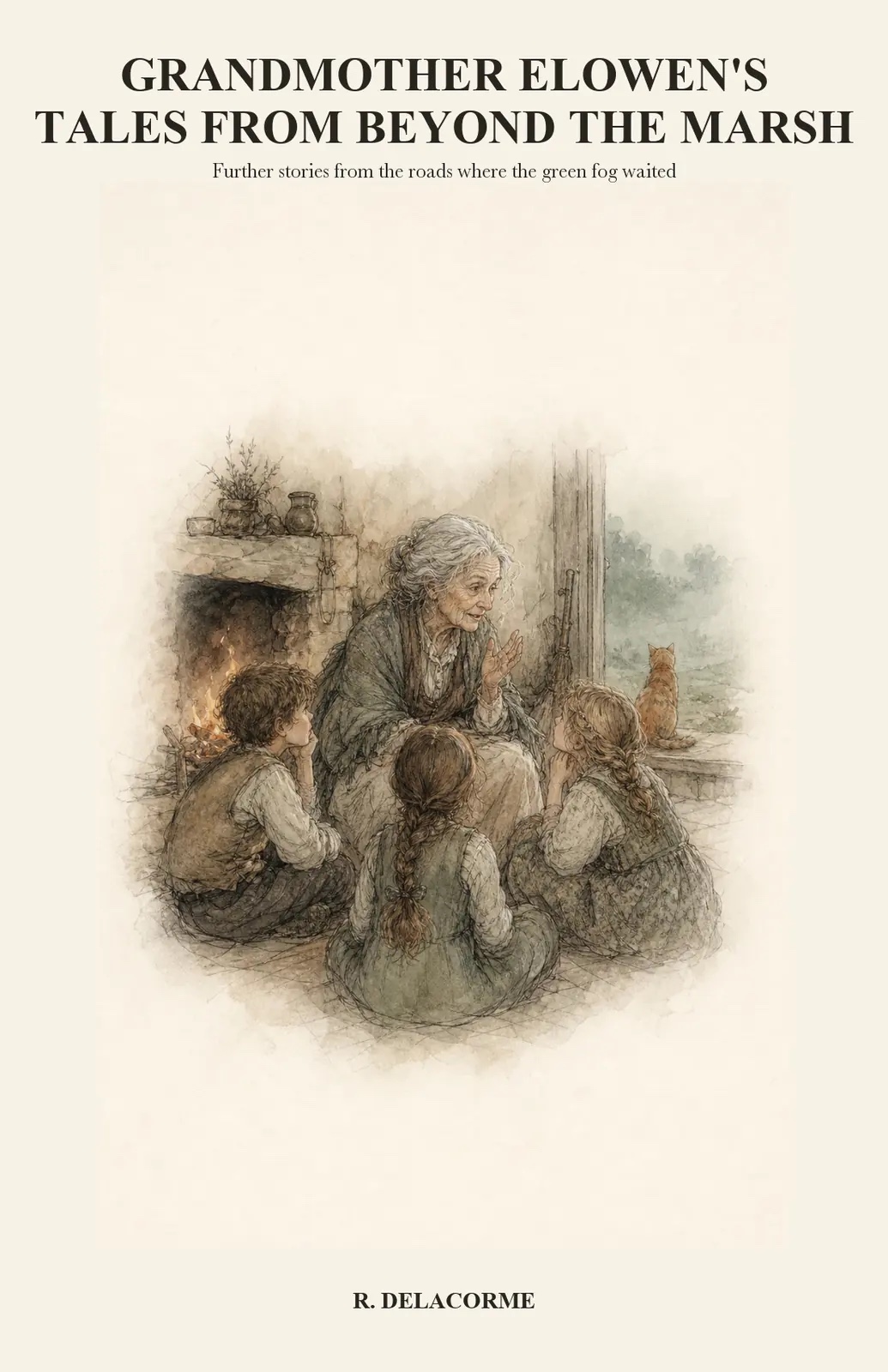
Grandmother Elowen's Evenings
That winter, the children learned that Grandmother Elowen kept her longest stories for nights when the wind came off the water and the fire had burned low. By then they had learned to ask without words.
They always asked the same way. By sitting closer. By going quiet. By watching her hands instead of her face, in case they gave the answer away before she did. The youngest glanced towards the door whenever a story came near a threshold. The middle child counted things under her breath: names, pauses, the rows of Grandmother's knitting. The eldest sat farthest from the fire with a book open on his knees and did not turn a page all evening.
She would let the silence settle. She would look at the fire, not at them.
Then she would say: Where shall we go tonight?
They would say: far away. They would say: somewhere with kings and witches and creatures under the hill. They would say: somewhere with magic.
She never smiled at that. She only nodded, as if they had asked for something reasonable.
Then listen, she would say. And do not ask me how it ended for everyone. I only know how it ended for the ones I followed.
The fire would shift. The room would get a little darker.
And Grandmother Elowen would begin.
Tale from beyond the marsh
The Asking Song
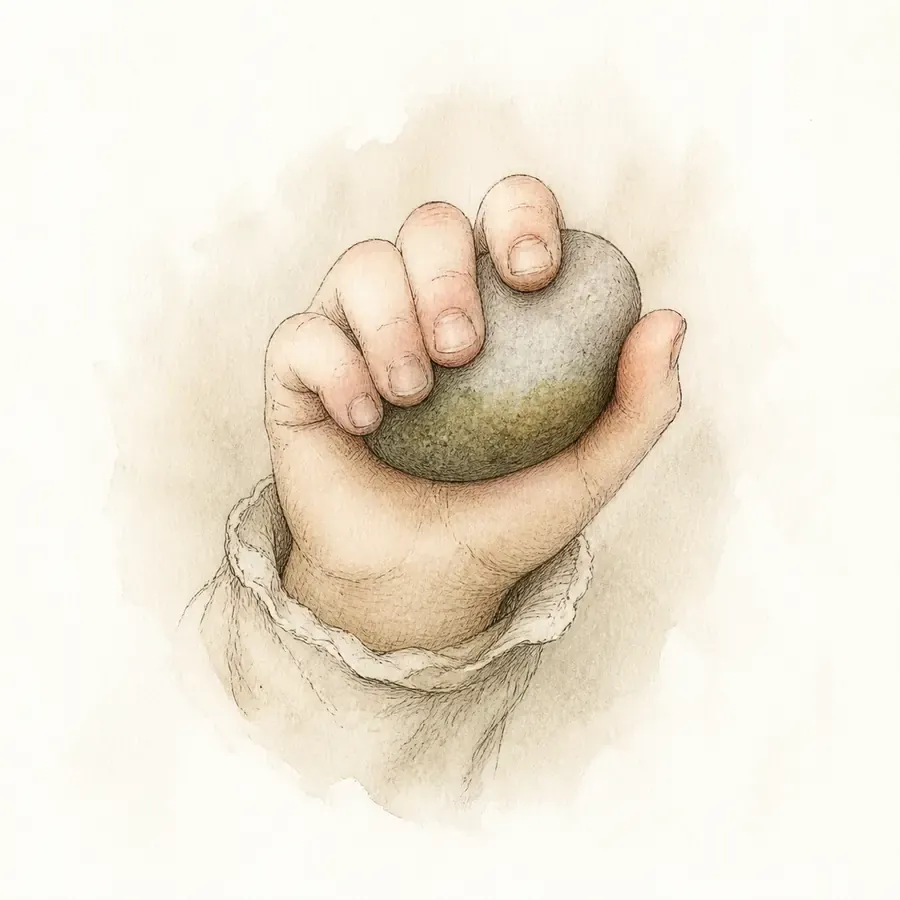
This was a song children sang at the marsh gate when they wanted to know something they were afraid to ask out loud.
The marsh gate stood where the path became mud, at the edge of the common land. An old wooden gate, grey and warped, that had not latched for as long as anyone could remember. It kept nothing in and nothing out. Children had been using it for something else since before anyone in Salthorpe was born.
The song:
Pick a stone from shallow water,
Green below and grey above.
Hold it tight and say the question.
Do not say the thing you love.
If the fog comes by the meadow,
Put the stone back where it lay.
If the fog comes to the window,
Ask again another day.
If the fog stays past the morning,
Keep your question. Keep it small.
If the sky is clear by breakfast,
Still the fog has heard it all.
The stones came from the ditch alongside the first marsh field, where the water was shallow enough to reach without soaking your sleeve. The right stones were grey on top and greenish on the underside where they had been against the mud. Children knew which stones were right without being told.
You said the question quietly, barely aloud, the way you say something to yourself that you do not want to hear yourself say. Children said the fog heard what came out of you. Nobody agreed about the rest.
The last verse was what children argued about.
Some said a clear sky meant no price. Others said it only meant you had stopped looking for one.
The first time Grandmother Elowen sang it at the fire, the middle child said both were wrong. She said the stone answered the question you had almost asked, rather than the one you had spoken aloud.
Grandmother looked at her a little longer than usual and went on with the story.
Nobody sang the song twice in the same week.
The boy was seven. His father had been gone for two months. The adults kept saying things in the middle of sentences and then stopping.
"If the tide had turned sooner."
"Not in front of him."
"No body means no certainty."
His father had a tin lunch box with a dent in the left corner. He had carried it every day for as long as the boy could remember. On wet mornings he used to tap the dent with his thumb before snapping the lid shut and say, "Still holds." The box was still on the shelf in the kitchen. Nobody had moved it. The boy looked at it every morning and then looked away.
He had been trying for two weeks to find a form of the question he could ask someone, and he had not found one, and one afternoon he went to the marsh gate alone and picked a stone from the ditch, grey on top and green below, and held it in his fist.
He stood at the gate for a long time. He meant to ask the question he had been trying to shape for two weeks. What came out was the one underneath it, the one he had not known was there until he heard himself say it.
He looked at the sky. The sky was clear. He put the stone back in the water.
He walked home.
In the morning the stone was on his pillow. Still damp. On the green underside, in the salt crust left by the water, there was the outline of something. The salt had almost made a letter. The mark was clear enough to trouble him and broken enough to resist reading. About the size and shape of the dent in the left corner of a tin lunch box.
He held it for a long time and then put it on the windowsill.
In the morning it was gone.
Tale from beyond the marsh
The Princess Who Collected Jars
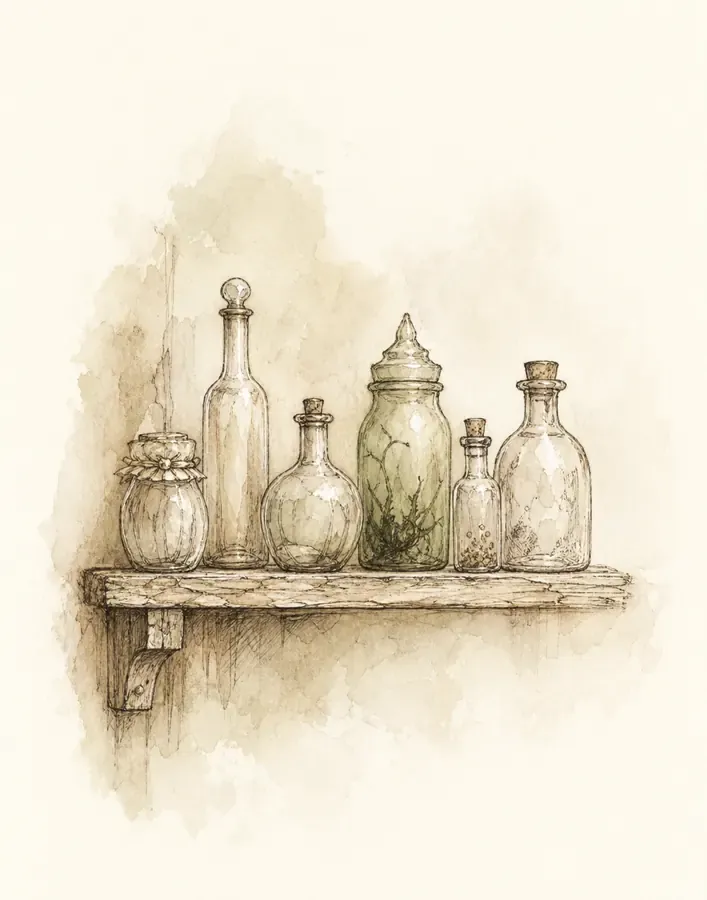
Princess Mirabel had been collecting jars since she was four years old, when she had found a honey jar in the palace kitchen, empty but still smelling of something warm and golden, and had carried it to her room with both hands and understood, with the certainty that four-year-olds sometimes have about important things, that she would do this again.
By her twelfth birthday she had two hundred and forty-seven jars. They occupied four shelves along the east wall of her room, each jar labelled in her handwriting. There were jars for jam from six different orchards. Jars for buttons sorted by what they were made of. Jars for rainwater from different seasons, because rainwater in April and rainwater in October did not smell or shine the same to her. Jars for beetles she had caught and then released, which now held the hollow left by something that had been there and gone.
Palace rooms changed whenever adults decided they should. Chairs moved, curtains vanished, whole tables went elsewhere between breakfast and supper. Jars stayed where Mirabel put them and kept the names she gave them. She had noticed, young, that a jar held more than emptiness. It kept a trace of what had been inside it the way a room keeps the marks of furniture on a floor: faint and stubborn. She had told no one.
There was one jar, at the far end of the third shelf, that had a faint greenish tint to the glass. She had found it at the roadside, sitting upright in the long grass with its lid on and no label. She had not opened it. She kept it at the far end of the third shelf and looked at it carefully every morning, at a distance. She had the impression, which she did not examine closely, that it was doing the same to her.
One Monday evening in autumn, the green fog gathered outside her window.
It pressed against the glass with its usual patience, greenish and still. She had watched it before and wondered what it would look like inside a jar. Tonight she decided to find out.
She took her smallest jar: clear glass, a tight lid, previously used for a moth she had caught and then released.
"I shall collect a little," she said.
Her nurse, who had known six kings and trusted none of them before breakfast, opened one eye.
She stood up and crossed the room and shut the window.
"Shut the window," she said.
"I only want a jar's worth."
"Fog doesn't come by the jar."
"But I am a princess."
"Then you can afford to leave it outside."
She went back to her chair. Mirabel waited until the nurse's breathing had slowed and steadied.
Then she opened the window one inch and held the jar out.
The fog touched the rim of the jar. It curled along the outside of the glass, around the neck, along the lower edge, up the other side. It did not go in.
She pushed the jar further out. Her shoulder pressed against the frame. The fog touched the back of her hand and was cooler than she had expected and had a smell like the inside of a place that has been sealed for a long time.
Then she noticed that the jar was not empty.
Something had appeared inside the glass while she was watching the fog. A tiny castle. Stone walls, a gatehouse, a courtyard with a well. Light in two of the windows. And at one of the lit windows, a tiny figure leaning out, holding something up.
Mirabel brought the jar inside and held it close to the candle.
The tiny figure was holding a tiny jar. The tiny jar had something green in it, though she could not tell whether it was mist, glass, or distance.
Mirabel shut the jar and put it on the shelf, in the middle this time, where she could see it from the bed.
She lay down. Before she closed her eyes she looked at the new jar once more. The figure was still at the window.
From the shelf, just at the edge of hearing, came a small regular sound, patient and even. She pulled the blanket higher and stayed where she was.
In the morning the nurse came in to open the curtains. She went to the tall window overlooking the garden. She went to the round window above the fireplace. Then she stopped.
She counted the windows.
She counted them again.
"Put the jar on the floor," she said. Her voice was the same as always.
"Which jar?"
The nurse looked at the north wall, where the narrow window had been since the room was built. The wall was smooth. Old stone, slightly darker where the window had been, with a faint crack running from where the lower sill had stood. No sill. No frame. No glass. The wall was a wall.
On the shelf, the tiny castle had gained one more window. In the far tower, a new narrow opening, with a figure at it, looking up. At the foot of the tower lay a little heap of grey dust, fine as flour, the kind a chisel leaves.
Mirabel reached for the jar to label it. There was already a label on it, in her own handwriting, though she had not written it.
NORTH WINDOW.
"I told you," said the nurse.
"It didn't go in," said Mirabel. "I held the jar out and it went around. It didn't go in."
The nurse looked at the jar for a moment.
"It took the window," the nurse said.
She moved her chair so that it faced the shelves, and she sat in it every evening from then on, and she did not explain why, and Mirabel did not ask.
Tale from beyond the marsh
The Gull
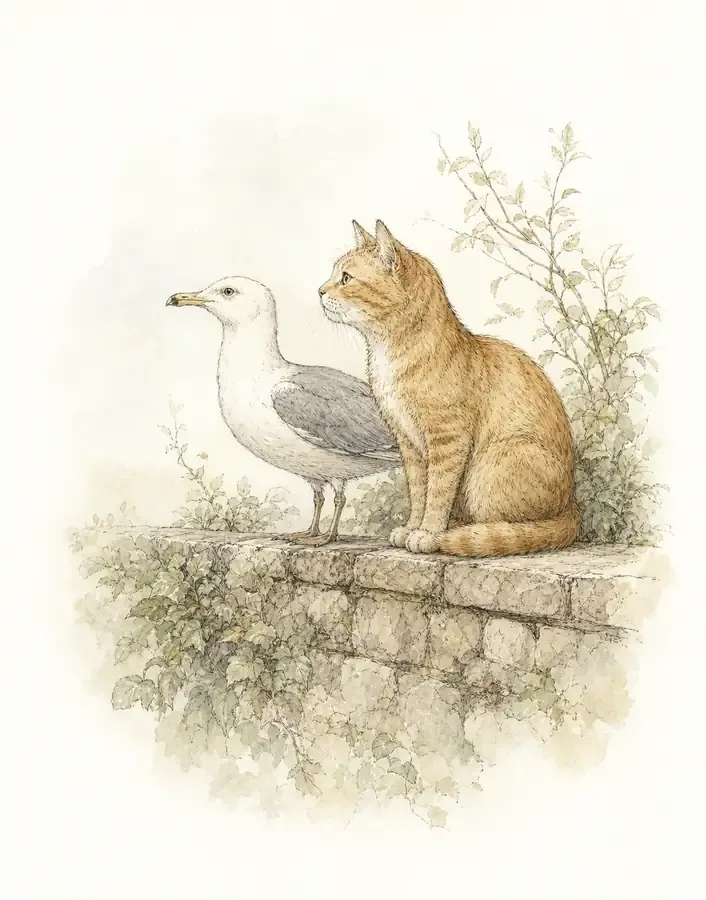
The gull had seen the fog from above.
From up there it was a skin laid over the low ground, greenish and still, with hilltops and rooftops breaking through it the way rocks break through still water. From up there you could see its edges: how it followed the marsh and the river exactly, and how it stopped at the higher ground no matter how long it stayed. It had the look of something that knew precisely where it was.
Marmalade had never been up there. He knew the fog from underneath, at the height of a cat. Between the two of them, that morning, they knew most of it.
The gull landed on Grandmother Elowen's garden wall at half past nine in the morning, which was unusual. Gulls were everywhere in Salthorpe but their territory was the harbour wall and the rooftops and the fish tables. They did not land in gardens and stay.
Marmalade was already on the wall. He had been there since eight, sitting at the near end with his tail folded over his feet, watching the lane. He was a large orange cat who had the habit, which Grandmother Elowen had observed for nine years, of being in the right place before anything happened that required being in a right place.
The gull came down at the far end of the wall and stood with its back to the wind.
Marmalade looked at the gull. The gull looked at Marmalade. Neither moved.
The gull had crossed the marsh that morning and had not flown straight. Three times it had banked away from a point in the air above the marsh, going around this point before correcting its heading. Gulls flew badly for many reasons. Empty air rarely bent their course.
They sat on the wall together for twenty minutes.
A child came down the lane.
She was nine, and she had told everyone she knew that she feared nothing, which was true in the sense that she had tested it carefully and not found the limit yet. She had a habit of stepping exactly where she meant to step, and of being annoyed when adults told her to mind her feet. She had mud on both boots from the field path. She was walking fast.
She stopped at the garden wall because both animals were fixed on the same point in the lane ahead. They watched a place, holding their heads still, rather than following anything that moved.
"What are you both looking at?" she said.
Neither answered.
The gull turned its head slightly upward, towards the air above the lane, towards a point perhaps four feet off the ground, just ahead of where the child stood. Marmalade turned his head slightly downward, towards the place where the lane's surface met the grass at the edge, at the same point.
Two different heights. The same place.
Marmalade's tail moved slowly across the top of the wall until it lay precisely over the edge above where her foot should not go.
The child looked towards the marsh. The fog lay there as it always lay at this hour, low and still.
"It's just the fog," she said. Her voice was smaller than she had meant it to be.
The gull lifted from the wall and was over the rooftops and gone, heading towards the harbour low and fast.
Marmalade watched it until it was a white point above the water.
The child stood very still.
Where she had nearly put her foot, the grass at the lane's edge bent slowly down. The blades folded and held for a moment. Then rose again, one by one, in the way grass rises when weight has been removed from it.
She stepped back. Just one step. The child who said she was not frightened of anything.
She went home along the upper road that afternoon. All that autumn she told everyone the upper road was quicker. It was not.
In the spring she came back that way once, on a bright morning. She stopped at the place in the lane and stood over it. The grass was ordinary grass. She put her foot down exactly where she meant to put it.
From somewhere above the rooftops came a gull's cry. She looked up. The sky was clear and empty.
Marmalade sat at the corner of the wall, watching her other foot.
She walked the rest of the way without stopping.
That evening she told Grandmother Elowen she had walked down the lane again.
Grandmother Elowen looked at her for a moment.
"Good," she said.
Tale from beyond the marsh
Death Takes the Long Way Round
"Were there ever kings in the fog?" asked the middle child.
Grandmother Elowen looked at the fire. She was quiet long enough that the youngest began forming a different question.
"There were kings before there were sensible people," she said at last. "But this is not a story about a king."
She picked up her knitting. Then she set it down again.
"This is a story about a fisherman. And about something that was not on the list."
Death was a professional.
He had been doing this work longer than Tuesday had existed, longer than fish markets and harbour walls and the green fog that lay over coastal marshes in autumn. He had never been late, never been early and never been wrong about a name. He meant to keep it so.
He kept to his routes. He came to Salthorpe on Mondays sometimes, on Wednesdays sometimes and once on a Sunday that could not be helped. He had never come on a Tuesday. This happened to be one. He came in from the north, down the ridge road above the harbour.
His boots left no marks on the road. They never had. The road went on receiving everyone else quite normally.
His list he kept folded against his chest in a pocket the damp could not reach. Today's relevant page had one name.
A fisherman who worked out of Salthorpe harbour, who was fifty-three years old, who had been warned twice about the third plank from the stern on the port side of his boat, which had been soft since the previous winter. He always whistled when mending nets but never while at sea. He had taken the boat out that morning at five, before the fog had fully lifted off the water.
Death had seen the green fog from the ridge. It lay over the marsh in its usual shape, low and bounded. He had walked through many fogs. None had ever slowed his work.
He came down from the ridge and took the marsh path. The most direct route.
He stepped onto the path where it entered the low ground.
The fog rose around him. Knee height. Then waist height. He walked on. The fog rose to his chest, to his shoulder height, so that the path ahead was visible only as a darker line in the green.
He stopped.
The marsh had gone quiet. Reeds, water and birds seemed to be waiting.
The fog bore against him from all sides as it bore against reeds and stone. Death mattered to it as much as either.
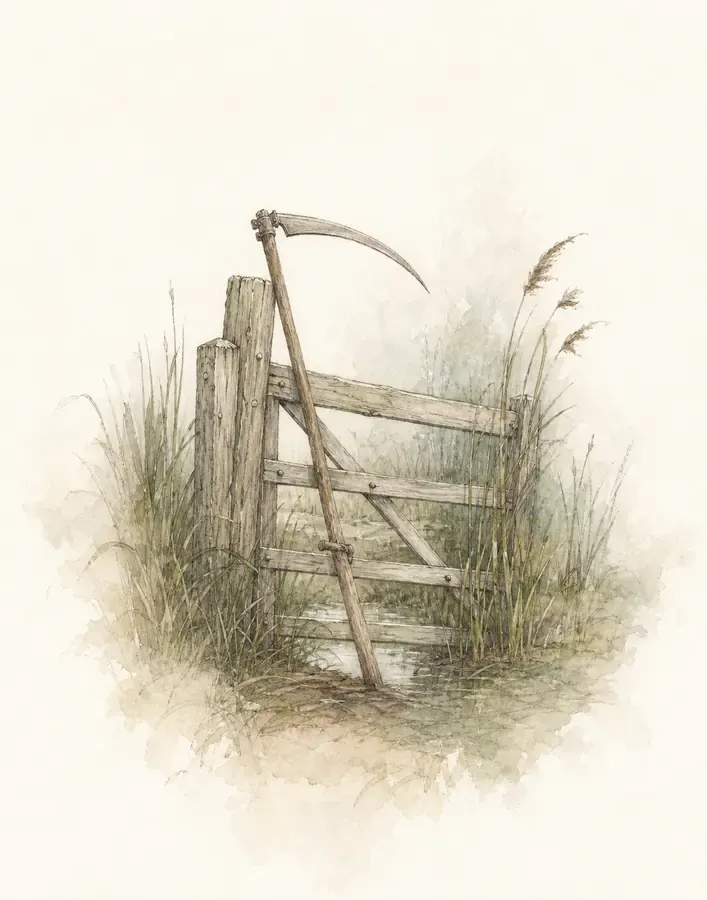
He raised his scythe. The arc he had used ten thousand times. Perfect. The blade passed through. Nothing changed.
He tried again. And again. A good tool, used correctly, against something that did not register the tool or the hands or the intention behind either.
Death lowered the scythe.
He unfolded his list. In the green light off the water, he read the relevant page.
For a moment, the fisherman's name was not there.
The line was present. The name was not. While Death looked at the empty line, someone in the fog ahead whistled four bars of a tune. Then the name came back, gradually, the way something returns when you stop looking directly at it.
The whistling stopped. Nobody was on the path ahead.
He folded the list back against his chest.
Then he heard boots on the path behind him.
The fisherman was taking the marsh road home from the landing stage. He always came home this way: the long way, up from the water and along the high path and then down through the common and into the village. He had walked this path for thirty years and knew every stone of it. He knew where the blackberries grew in August and where, in early spring, there was a stretch where you could hear the lapwings over the next field before you could see them.
He was whistling. A short tune, four bars, built over thirty years on a path he knew well, the sound of a man walking home. Death had heard most tunes. He had heard this one once, a minute earlier, from the fog.
Death turned.
He raised the scythe because the fisherman was on the list, and the list was the list.
The whistling stopped.
Out in the fog, the four bars went on a little longer. Then the marsh was quiet again.
Death stepped off the path and found the way around the edge of the marsh. Three gates. Two stretches of soft field. A plank bridge over the second ditch. It brought him out near the old mill, forty minutes later than he had planned.
He found his bearings and went on.
He did not take the marsh path again.
He had work to do, and sensible workers do not spend time on things that are not on the list.
The fog noticed nothing at all.
The fire had settled low. The youngest looked towards the window, then back at Grandmother.
"So the fisherman would have lived," she said. "If the fog hadn't been there."
"The fisherman was on the list," said Grandmother Elowen.
"And the fog?"
Grandmother's needles rested against each other. "The fog wasn't."
"The tune," said the middle child. "Did anyone know it?"
"Nobody in Salthorpe had ever heard it. It was his. He'd made it on that path over thirty years."
"So it stopped with him."
"Three children could whistle it the following spring."
The middle child watched Grandmother's needles. "How?"
"They learned it on the marsh path," said Grandmother Elowen. "In the fog. Nobody taught it to them."
She resumed her knitting.
Tale from beyond the marsh
The Name in the Mud
The child's name was Seren, and she had always liked it. It fit the way something long yours should fit. Her name was four letters and two sounds. It sat in a sentence the way she sat in her chair at school: without taking too much room, without needing to be asked twice.
On a Tuesday in late October, walking home from school along the marsh path, she stopped at the place where the path ran close to the ditch and the mud was soft and wide. She had a stick in her hand, the way she often had a stick when she walked, because a stick on a walk is useful when the ground offers something worth poking.
She wrote her name in the mud. Four letters, large enough to read from standing height. She looked at it for a moment. Then she walked home.
The fog came in that evening, off the marsh, thick enough that the lane lights blurred. She did her reading and went to bed without thinking about the mud or the name.
In the morning, at breakfast, her mother said: "Have you had enough, sweetheart?"
At school, her teacher took the register and paused at her name, pen resting on the page, then moved on without saying it aloud. Seren raised her hand anyway. The teacher looked at her and smiled and made the mark and said nothing.
At lunch a girl she had known since they were four said, "You're in my seat," and then stopped, and said, "Sorry, I don't know why I said that."
Each thing was small enough to excuse. Any one of them could have happened on an ordinary day.
But they happened in a cluster, and Seren noticed clusters.
By the afternoon she had begun to feel the pause before her name the way you feel a gap in a fence: not the fence, but the space in it. People still knew her. Her name was simply taking slightly longer to arrive, as if it needed to be found rather than said.
Her teacher asked her to collect the exercise books from the other tables. When she brought them to the front, her teacher thanked her by name without hesitating, and that was perfectly ordinary, and Seren felt something relax that she had not known was tense.
She walked home the marsh path.
The mud by the ditch had dried. Her name was still there, the four letters pressed into the surface, cracked now at the edges.
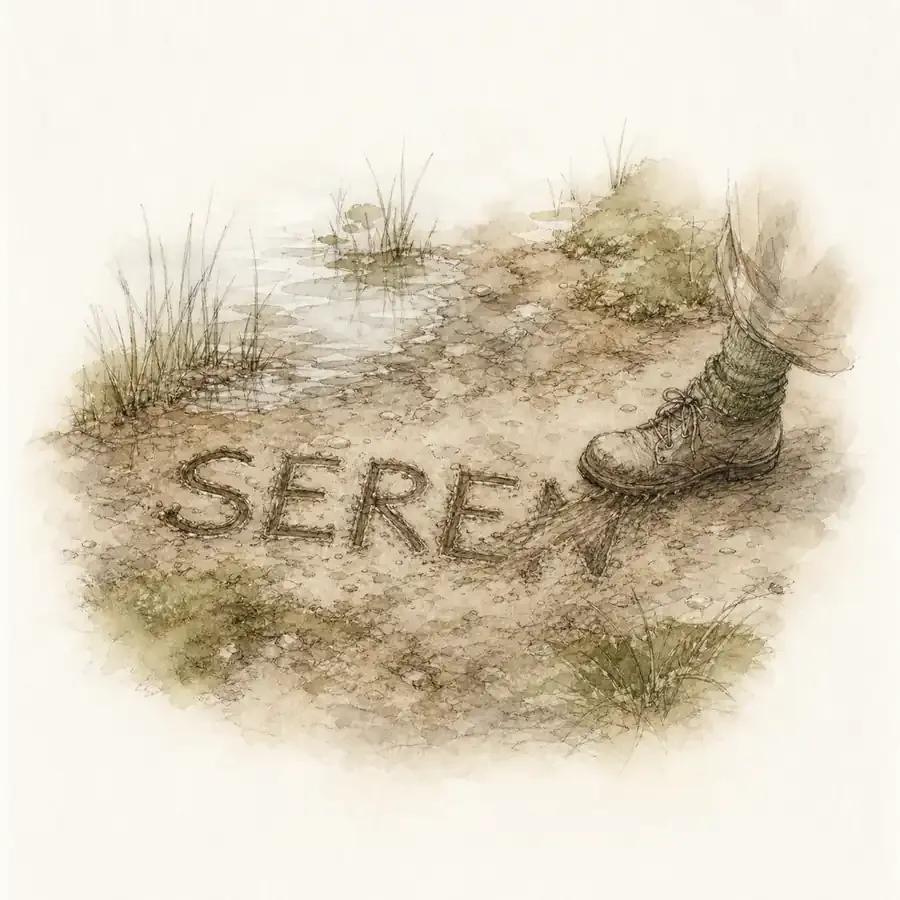
She looked at it for a long time. Then she scuffed it out with her boot, slowly and firmly, as if shutting a door before dark.
The mud was smooth after.
At supper her father said her name three times in the ordinary course of conversation, and each time it arrived on time, and she did not notice it, which was how names were supposed to work.
Weeks later, her father called to her from the kitchen and caught on the first sound. Only for a breath. Then the rest of her name came cleanly.
Seren answered from the stairs.
Her father went on speaking.
Tale from beyond the marsh
The Pale Women's Song
Children were forbidden to learn this song.
They knew it anyway. It arrived the way some knowledge arrives: not learned, not taught, simply present one morning in a way it had not been the morning before. Like knowing that a thing is dangerous before anyone has told you what it does.
The song:
Don't look long at the marsh light,
Don't look long at the green.
Do not wave if they wave first.
The pale ones are not to be seen.
Don't ask where the pale ones are going,
Don't ask what they keep.
They're already where they're going.
They were there before sleep.
Soup gets cold and lamps burn bright.
Someone else comes home tonight.
The last verse was what children remembered longest and understood least.
The pale ones were not discussed in Salthorpe except rarely and indirectly, the way a dangerous road is not discussed. They had been seen, or there were people who said they had seen them, at the marsh edge on nights when the fog was very thick. Pale figures crossed the marsh without any path the eye could follow. Calls did not turn them. Footsteps did not slow them.
One saying about the pale ones had no author anyone could name. It had simply always been there: the pale ones appeared where someone was still expected home.
There had been a man who had seen them from his window and had waved. People in Salthorpe told that story briefly. They gave the facts and stopped. The man had waved. One of the pale ones had stopped and turned towards the window. The man had not waved again. In the weeks afterward, his wife began setting an extra place at the table each evening without knowing why. She did this for several months. When he moved the family to another town the following spring, the habit went with her.
The house had new occupants now. They found it perfectly comfortable, except that the wife occasionally laid an extra place and could not explain why.
The children who knew the song had learned it from other children, or from no one they could identify, or from dreams they preferred not to remember in the mornings.
Grandmother Elowen did not teach this song.
When the children at her fire tried to say where they had learned it, they found no first morning and no first voice. The song seemed older than their memory of learning it.
Grandmother lowered her knitting into her lap and smoothed the wool with both hands.
The children went quiet.
The next morning the youngest woke in the grey hour before the lamps were lit, in the place between sleeping and waking.
She hummed the last verse. All the way through. She had not known the last verse the night before.
She stopped and lay very still.
Downstairs, Grandmother was already in the kitchen. She could hear the fire and the kettle and the pot being moved to the back of the range. She heard Grandmother stop.
She heard her say nothing, which was not the same as silence.
She got up and went downstairs. The front door stood a hand's width open, though Grandmother had bolted it the night before. On the flagstones a line of wet footprints came in from the step. They were bare, and small, and they crossed the kitchen to the table and stopped beside the empty chair at the end.
Grandmother was looking at them with the kettle still in her hand.
The youngest sat down at her usual place.
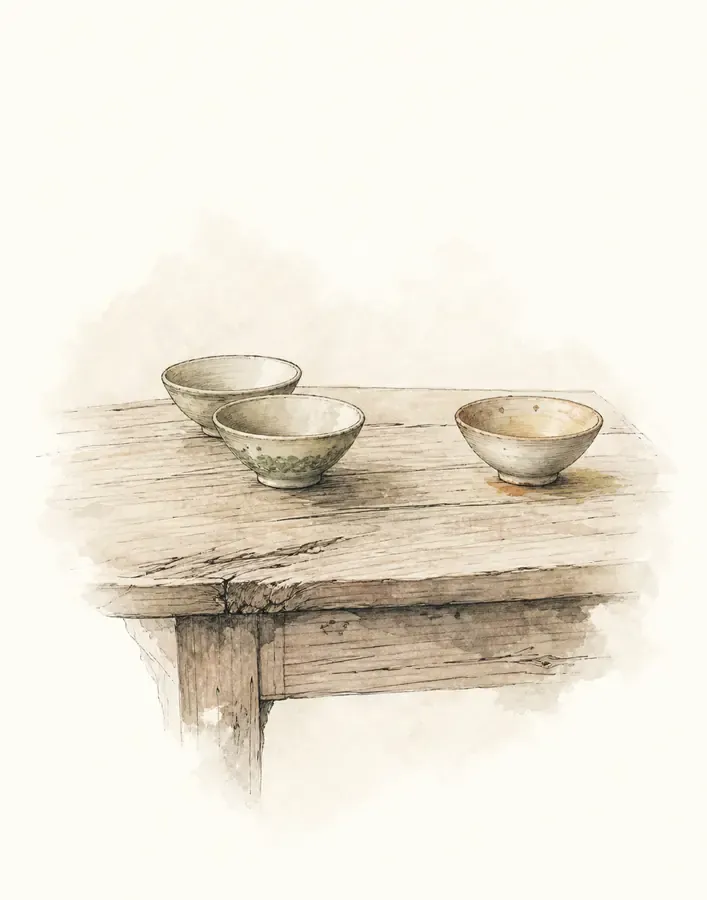
Grandmother shut the door and drew the bolt and fetched the floorcloth, and they ate breakfast without mentioning it. By the time the bowls were empty the flagstones were dry. The youngest did not hum the song again, not that morning and not any other morning, although sometimes in the night she would wake with the last two lines moving in her head and she would breathe through them carefully and not let them out.
Tale from beyond the marsh
The Promise at the Marsh Gate
The promise was made the summer Davy was nine and Kit was nine and three months, though Kit was the only one who counted the three months.
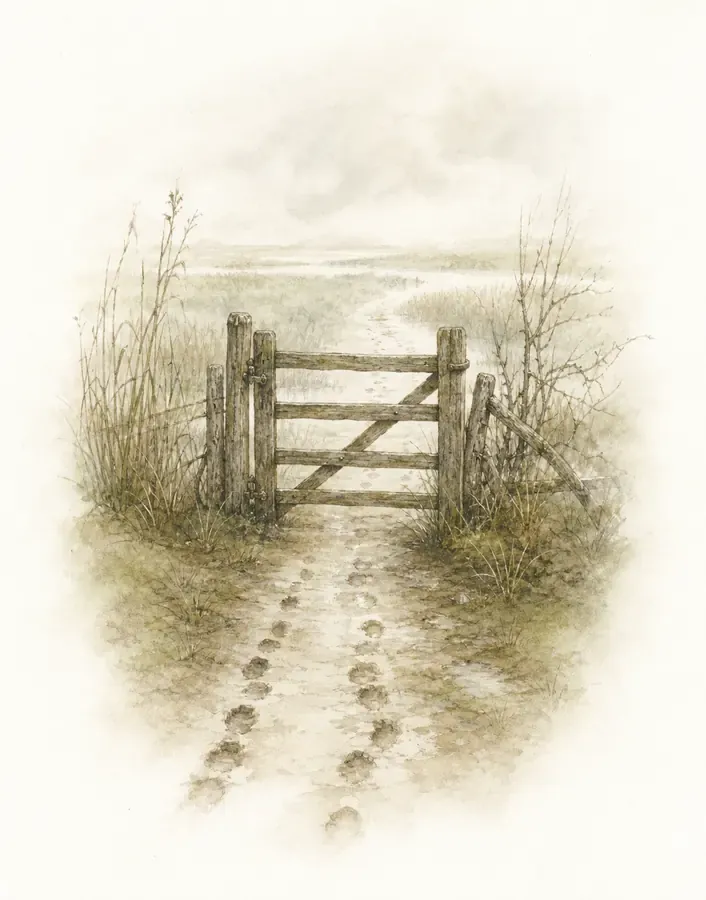
They had been going to the marsh gate since they were seven. The gate was the boundary. Past the gate was the marsh, and the marsh was the marsh, and the only children who went past the gate without an adult were children who did not go to the marsh again. This was understood without being stated.
One afternoon that summer, sitting on the gate the way they had sat there a hundred times, Kit said: "We should make a promise."
"About what?" said Davy.
"About the gate. About not going past it alone."
"We're not supposed to anyway."
"Supposed to isn't a promise," said Kit. She said this with the certainty she brought to most things.
They made the promise the way children do when they mean it: plainly, while looking at each other. They would never go past the gate alone. They would wait until they were grown, whatever happened.
The fog was low on the marsh that evening, curling gently around their ankles on the gate bar. They did not think about it particularly.
They jumped off and went home before dark.
Kit's father found work in a town two days east the following year. She moved away in the spring. They wrote to each other for a while, then less often, then not at all.
Davy grew up in Salthorpe. He learned the marsh the way you learn a place you have spent your whole life not going into: its paths around, its hours of fog, its sounds in early spring. He walked past the marsh gate every few weeks and kept to the right side. The path went that way, and habit did the rest.
Until the October he was thirty-four, on an afternoon when he was late. He had promised to meet someone at the station, and the train would not wait, and the direct path across the low marsh was forty minutes shorter than the road around.
He put his hand on the gate. He stood there for a moment.
He opened the gate and walked through.
The path was solid and the going was easy and the fog stayed low around his boots. He walked and the marsh was the marsh and nothing happened for the first five minutes, or for the ten minutes after that.
He heard the second set of footsteps just past the halfway point.
The footsteps kept pace on his left, where Kit had always walked, being slightly shorter and preferring the flatter ground there. His own pace slowed. His stride fell into the old rhythm of walking beside someone who had matched him for years.
He stopped. The footsteps stopped.
He stood in the middle of the marsh with the fog around his boots.
He walked on. The footsteps walked on.
He did not look to his left.
He walked to the far side, through the gate, and onto the road. The footsteps did not come through the gate.
He was on time for the station.
He wrote to Kit once, some years later. Near the end of the letter he mentioned the marsh path and the footsteps, briefly, without explaining much.
She wrote back. She said she had not thought about the gate in twenty years. She said she was glad he had got where he was going.
He kept the letter.
Grandmother Elowen was quiet for a moment.
"Was it Kit?" asked the middle child.
"Kit had forgotten the promise by then," said Grandmother. "She had other things."
The youngest looked at the fire.
From outside came a single wooden knock. The marsh gate was too far away to hear from the house.
Grandmother Elowen did not look towards the window.
Tale from beyond the marsh
The Three Children and the Wrong Picnic
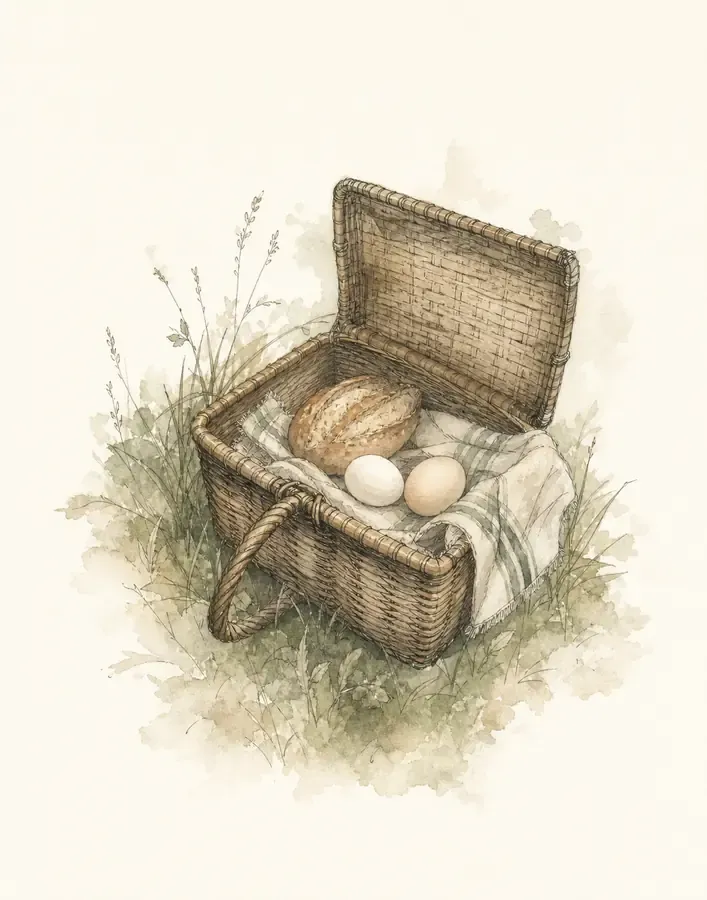
Annalise was the eldest and thought ahead. Beatrice was the middle one and understood the other two. Clement was the youngest and trusted his appetite, which usually served him well and would serve him less well on the hill above Salthorpe on a Thursday in late September.
They had been taking picnics to the hill since the summer Annalise was eight. They packed bread and apples and a wedge of hard cheese, and Clement put a hard-boiled egg in the basket. Nobody had asked him to. He had seen it on the kitchen shelf and picked it up on instinct. The egg was in the basket before anyone thought to ask whether it belonged there.
Once it was in, it was in.
They were halfway up the hill, at the narrow part between the gorse, when the green fog crossed ahead of them. It came from the direction of the lower marsh and moved across the path slowly, knee-high, quite thick, and disappeared into the gorse on the far side.
"We should go back," said Annalise.
"We should wait," said Beatrice.
"We should eat," said Clement.
There was a stone just off the path, broad and flat, large enough for three. They sat on it and Beatrice opened the basket.
Inside were the bread and the apples and the cheese and two hard-boiled eggs.
Annalise looked at the eggs. She had a precise memory of the kitchen shelf that morning: one egg. One of the eggs in the basket was cool the way eggs are when they have been packed since morning. The other was warm the way eggs are when they have just been cooked.
Nobody spoke.
Clement leaned towards the warm one. He was reaching for it when Beatrice shut the lid of the basket. She did it carefully. The lid came down on his fingers, held them for a moment, and he pulled his hand back.
They waited. The fog moved across the path at its own pace. A long time passed. The sun moved a little. A rabbit appeared at the edge of the gorse, looked at them, and went back in.
The fog shifted and retreated towards the marsh, and after a few minutes the path was clear.
Beatrice opened the basket.
One egg. The cool one. The warm one was gone.
In the cloth that lined the basket there was a round damp mark, still slightly warm when Annalise touched it. She touched it once and did not touch it again.
They divided the bread and the cheese and ate the apples. Nobody mentioned the egg. When they packed up, Beatrice folded the cloth so the damp mark was on the inside.
Clement's fingers smelled strange on the way down. The smell of the basket and the damp mark and something older and colder that he could not find a word for. He put his hand in his pocket and left it there.
That evening Annalise told her mother they had seen fog on the hill. Her mother said yes, this was the time of year for it.
Beatrice said nothing. She sat at dinner and thought about the moment the basket lid had closed, and whether she had been fast enough. She was fairly certain she had been fast enough. She was not entirely certain.
At supper Clement asked for an egg.
His mother looked at him the way you look at someone who has said something in a language you can nearly understand. Clement had never asked for an egg by itself.
She went to the kitchen and took down the egg pan. There was an egg in it. A single egg, sitting in the cold iron. She had used the pan that morning for butter and it had been empty when she hung it back.
She called for Clement. They stood in the kitchen doorway and looked at the egg together.
"I don't think I'm hungry," said Clement.
She cooked it the following Sunday. Afterward, nobody could remember eating it. Only the smell remained: warm shell, close and wrong, like something that had been somewhere else and come back changed.
For years afterward, Clement could tell when fog was coming by that smell. He would be somewhere ordinary and lift his head and say, "Fog tonight," and he was always right.
Tale from beyond the marsh
The Washerwoman's Rule
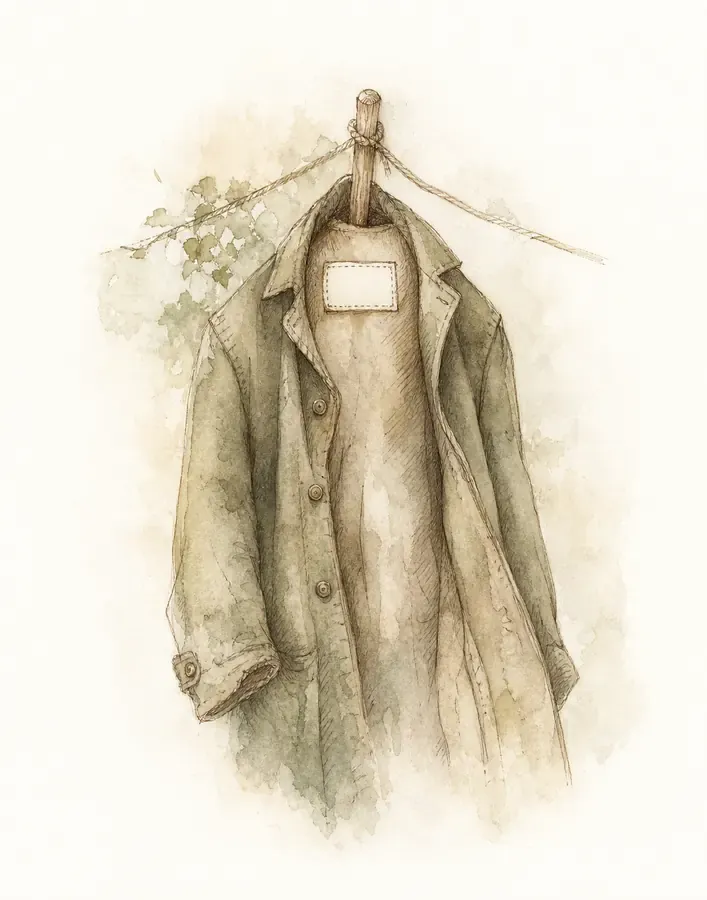
Margaret Cobbe held each garment by the collar before she let it near the wash water. Thirty-one years of other people's clothes had taught her what wear could say.
The back of a collar showed how someone sat. Cuffs showed what their hands worried at. Stains were simpler: some lifted with soap and time, some held fast, and the darkest were seldom the worst.
She kept one rule to herself. Clothes that smelled of fog went back unwashed.
It lay beneath the ordinary smells of damp, cold and long storage: cold marshwater caught under wet wool and soap. A few clothes carried it. Their owners never seemed to smell it. Margaret did because cloth had been in her hands for thirty-one years.
When she found it, she set the garment aside and sent it back. She said the cloth needed other hands.
Then the new family came to Salthorpe.
They had money and they had staff and they did not understand local arrangements. When Margaret returned three shirts and a coat with fog-smell on them, the housekeeper came to her door and said the household wanted those clothes washed and would pay for the work.
Margaret took the garments in.
She washed them carefully. Good soap, long soak, careful rinse, twice through. She hung them in the best position for the morning wind.
The stains came out. Every one of them. The smell did not. It had only gone deeper into the cloth, where soap could not follow.
She folded them and sent them back the same day.
That evening she sat in her kitchen and did not eat much.
The following morning the housekeeper came again.
The footman who wore the coat had served in that house for six years. That morning he could not find the servants' stair. He went down the back passage three times and each time came out at the cupboard by the scullery, where the coats were kept. The third time the housekeeper found him standing in front of the cupboard door with his hand on the latch, and he asked her, politely, which way the kitchen was.
She took the coat off him and walked him to the kitchen herself.
The coat went back into the cupboard.
The shirts carried the same trouble, only weaker. One of the grooms walked out before breakfast and was found at the edge of the marsh, in his shirtsleeves, with his boots in his hand. He said he had been going to the stables. The stables were on the other side of the house.
Margaret resumed her rule.
Some months later, passing the house on another errand, she could smell something from the direction of the back cupboard window, even from the street with the window shut: marshwater under wet wool.
She walked past without stopping.
When she took in new work, she spent a little longer with each garment than she used to, with her hands flat on the cloth and her eyes closed.
She asked each customer where they lived, though she knew, and said the way to their door quietly to herself before she touched the water.
Just to be sure it was still the right door.
Tale from beyond the marsh
The Coat by the Range
Someone knocked at Nesta's door while the lane was gone in fog.
Twelve years at the edge of Salthorpe had taught her the threshold better than any spoken rule. Fog pressed against the foot of the door, lay along the step in the mornings and lifted by mid-morning. She kept the seal sound, the step swept and the bolt oiled. These things belonged to the day.
That November evening the knock came twice.
In fog like this, people in Salthorpe did not go visiting. A knock meant someone was lost, or someone did not know Salthorpe well enough to know that you waited.
She opened the door.
Water ran from the man's coat onto the step. He held his hat by the brim with both hands, keeping it close to his chest, and a small bag hung from one shoulder. The left cuff of his coat had been neatly repaired in thread a shade lighter than the cloth. He said he had been on the coast road when the fog came in and he could not find the inn.
Nesta knew where the inn was. She let him in.
She gave him soup and the chair by the fire and put his coat near the range to dry. He was polite and grateful and ate everything in the bowl and said so, and he spoke about the coast road and the town he had come from and the business he was going to, all of it ordinary enough. He was the kind of traveller she had let in twice before in twelve years.
At some point in the conversation, talking about the fog and the coast road and how quickly it had come in, he said: "The road brought me here before I had quite chosen it."
She understood this as a comment on the fog. It was only later that she was not entirely sure it was.
She showed him the spare room and put a candle on the table and said good night.
In the morning she came down before he was up. She made the fire and boiled water and set the table for two.
She went to call him at eight o'clock.
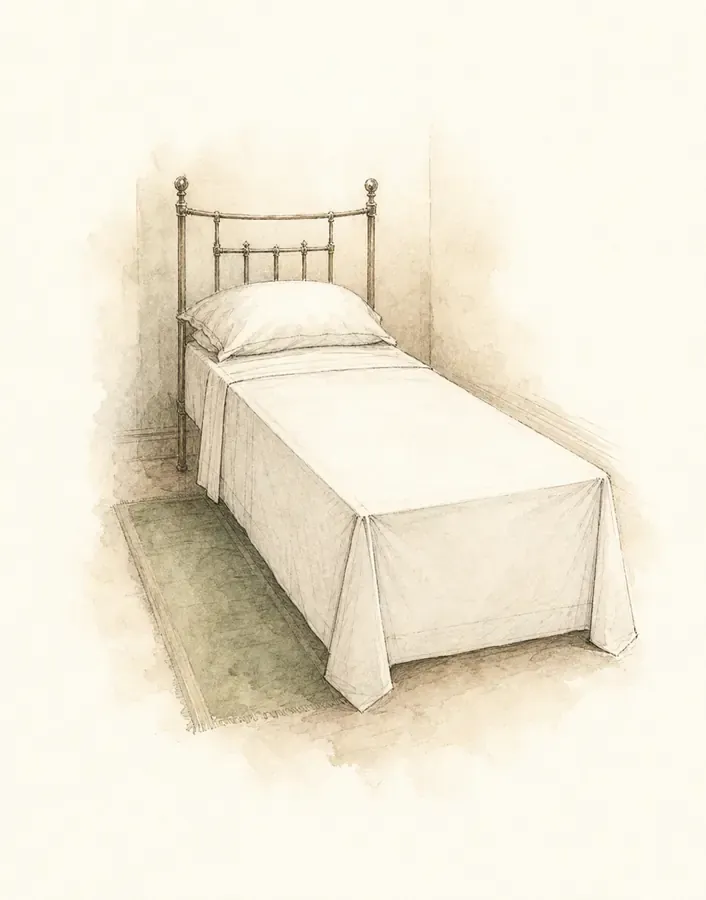
The spare room was empty. The bed was made too neatly for a traveller who had risen early: tight corners, an even fold, the sheets pulled as though someone inside the bed had drawn them straight. It looked like a bed made by whoever lived there.
The door was bolted from the inside. The window was latched.
She went downstairs. His coat was still near the range.
She asked at the inn later that week. The innkeeper remembered a man with a bag who had arrived late, who had mentioned taking shelter with a woman at the edge of town. He remembered the man well enough. He did not remember the coat. When Nesta described the repaired cuff, the innkeeper frowned. The man he remembered had not been wearing a coat.
Nesta thanked the innkeeper and went home.
She kept the coat for three years. She looked at it sometimes. The repair on the left cuff was very neat. She gave it eventually to a man who needed a coat and would not say where it had come from. The man wore it through one winter and said it was warm.
She kept the threshold swept, the seal sound and the bolt oiled.
She still opened the door in fog when someone knocked. Leaving a traveller outside carried its own risk, and she had never found a rule that settled it for her.
But she made the spare bed more carefully before a guest came, so that morning would leave her something she could check.
Since that November, she had never again found the bed made from the inside.
Tale from beyond the marsh
Marmalade at the Threshold
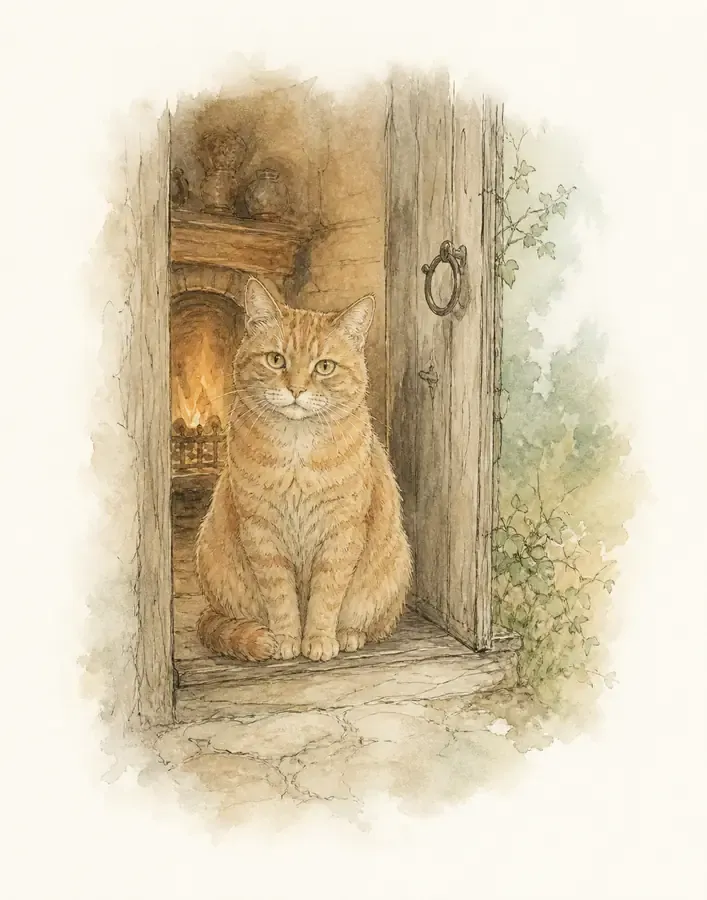
Marmalade came to Grandmother Elowen with his name already settled, as some cats do.
He had been with her for nine years. He was large and orange and seldom hurried. Most things worth noticing came to him if he sat still long enough. He slept in the chair by the range when it was cold and on the wall in the garden when it was warm, and he came in for meals at consistent times, and he sat outside the doors of rooms without asking to come in and was occasionally right about this.
Over the years, the children had noticed that Marmalade chose some doors on some days and stayed there longer than comfort required.
Some days he sat at the kitchen door, though meals had little to do with it. On other evenings he chose the front door when nobody had knocked. He sat at the door to the hall cupboard on three separate afternoons without any explanation that satisfied the children. He sat at the bottom of the stairs on nights when Grandmother Elowen stayed up later than usual, which the children took to mean something though they could not have said what.
"Why does he do that?" the youngest had asked, the first winter.
"He's watching," said Grandmother Elowen.
"Watching for what?"
"For what needs watching," she said. "He's been doing it since before I had him."
The children accepted this. They understood enough to stop asking.
On the night the youngest asked Grandmother if she had ever been in the fog herself, Marmalade was sitting at the front door.
He had been there since before supper. Nobody had knocked.
"Were you ever there?" the youngest asked. "In the stories. Were you ever in the fog?"
Grandmother Elowen was quiet for a longer time than usual. The fire moved. Marmalade did not move from the door.
"Were you?" the youngest asked again. "Grandmother. Were you ever in the fog?"
"I lived in Salthorpe a long time," she said finally. "Everyone who lives here long enough is in the fog at some point."
"What happened?"
She looked at the fire.
"I came back," she said. "That is what happened."
"But what was it like?"
She was quiet again. Outside, somewhere on the marsh, something moved in the dark, some bird or the wind through the sedge. Marmalade turned his head towards the door without getting up.
"Cold," said Grandmother. "And quiet. And very particular about where it stopped."
She looked at her knitting and did not look up again.
"Come away from the window," she said to the youngest, who had not moved towards the window.
The youngest looked at Grandmother. Then looked at Marmalade, who had turned back from the door and was now watching the room with the expression he used when he had decided something and was waiting for the rest of them to catch up.
"Did it keep anything?" asked the youngest. "When you came back. Did the fog keep anything of yours?"
Grandmother Elowen picked up her knitting.
"No," she said. "Bed."
The children went.
Marmalade stayed at the door for another hour. Then he moved to the chair by the range, turned twice, and slept.
Grandmother Elowen sat by the fire for a while longer.
Tale from beyond the marsh
The Short Way Round
The following evening, the youngest did not ask whether Grandmother had ever been in the fog. That had already been answered. She asked what had happened.
Grandmother Elowen looked at the fire for a long time, long enough that the middle child started counting the seconds and then stopped, embarrassed. Her knitting stayed in her lap.
"I was younger than you," she said. "And my mother was in bed with a fever, and there was no bread in the house."
She was sent to the baker's with a coin tied into the corner of her handkerchief and told to take the road, the long way round by the mill and over the bridge. It was three miles there and three back. The light went early that time of year.
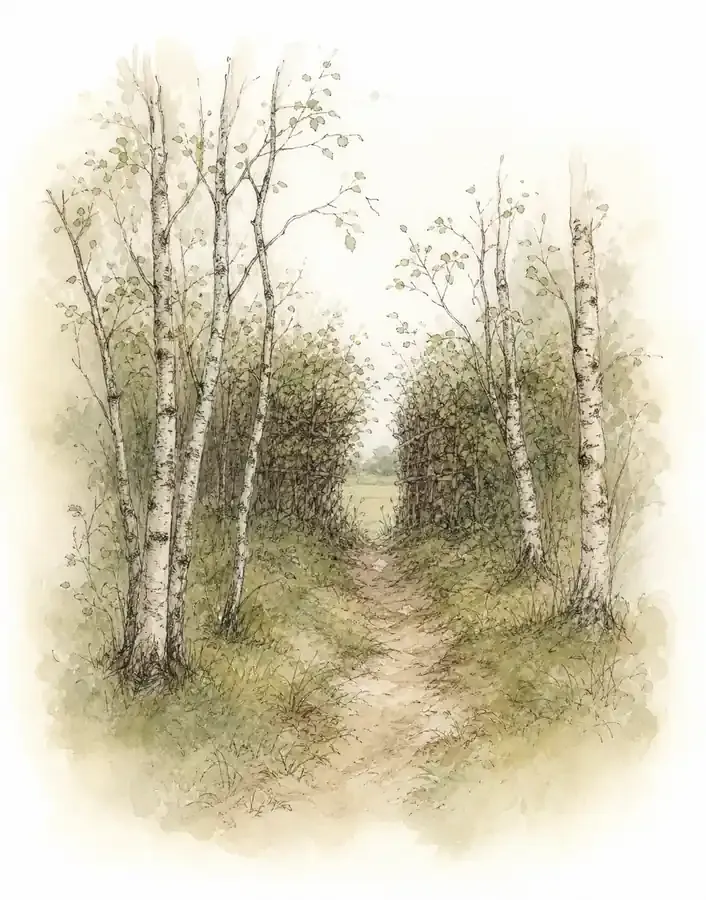
There was a shorter way. Every child in the village knew it: a gap in the hedge at the bottom of the Nance field, low enough to duck through, opening onto the birch path along the marsh and cutting the walk in half. Children left it alone without needing a rule.
She was cold. Her mother was ill. She wanted to be home before dark. At four o'clock those reasons felt large enough. She used the gap.
The birch path was thinner than she remembered. Fog already lay among the trees, low and even. She called it thin enough. The words sounded borrowed as soon as she thought them.
She counted the birches as she went, a habit from being small and needing something to count. Nine on the left before the path bent. She reached nine and the path stayed straight.
She kept walking and kept counting. Fourteen. Twenty. The birches should have thinned near the turn towards the lane. They did not. The fog climbed from the roots to her shoulders.
She could hear the marsh on her right, which was right, and on her left, which was wrong.
She kept her mother's sensible pace. Running would make it true.
Somewhere around thirty, though she had lost the count in the twenties, the ground under her feet became the lane. Ordinary gravel. The fog sank to her ankles. The baker's window shone ahead with the last two loaves in it.
She bought the bread. The baker asked after her mother. Her answer came out in her usual voice, which surprised her.
She went home the long way, round by the mill and over the bridge. It took the better part of an hour in the dark. When she came in, her mother studied her face and asked nothing.
She put the bread on the table.
That night she tried to tell herself what had happened on the birch path. She had the shape of it, the way you know the shape of a room in the dark, but the words broke when she tried to put them together.
In the morning her mother sat up against the pillows. The fever had eased.
"How was the walk?"
She opened her mouth to answer properly. What came out was: "Cold. And quiet. And very particular about where it stopped."
Her mother looked at her for a long moment.
"Yes," her mother said. "That's usually as much as anyone gets."
"But what happened?"
"You'll have the words for it, or you won't," said her mother. "I never got the rest of mine either. Don't pull at it. That won't bring it back."
The following spring she went looking for the gap. She wanted to prove it had been an ordinary gap in an ordinary hedge and that the distance beyond it had been right after all.
The hedge was unbroken.
She walked its whole length twice. Other children still used the gap. She saw them come through, laughing and muddy at the knees. She simply could not find where it was.
The fire had burned low. Nobody asked anything for a while.
"Is that all of it?" asked the middle child.
"That's all of it I have words for," said Grandmother Elowen.
The youngest was quiet, then said, "You said it before. Cold and quiet and very particular."
Grandmother's hands stopped on the wool.
"Those are the words that came back," she said.
The youngest looked at her. "You said it didn't keep anything."
Grandmother's needles did not move.
"I said that so you would go to bed," she said.
The middle child counted two breaths before Grandmother found her place and went on.
The End of the Evening
When Grandmother Elowen stopped talking, the fire had burned down to its last hour.
Nobody asked for another story. The children sat quiet and still, not yet ready to move.
The eldest closed his book and took the lamp. The middle child followed him to the stairs.
The youngest went to the front door instead.
A thin line of green showed beneath it. The youngest stood with her toes a hand's width from the line and looked down at it.
"Come away from the door," said Grandmother Elowen.
The youngest did not move.
Marmalade came out of the dark hall and sat down between the youngest and the door, facing the green.
Grandmother Elowen put down her knitting. She crossed the room and stood beside the youngest, close enough that their sleeves touched.
"It keeps things," she said. "Come away."
The youngest came away. She went up the stairs without looking back, and Grandmother stood at the bottom until the bedroom door had closed.
Then she sat down again by the dying fire and did not pick up her knitting. Marmalade stayed at the door until the green had gone.