Introduction
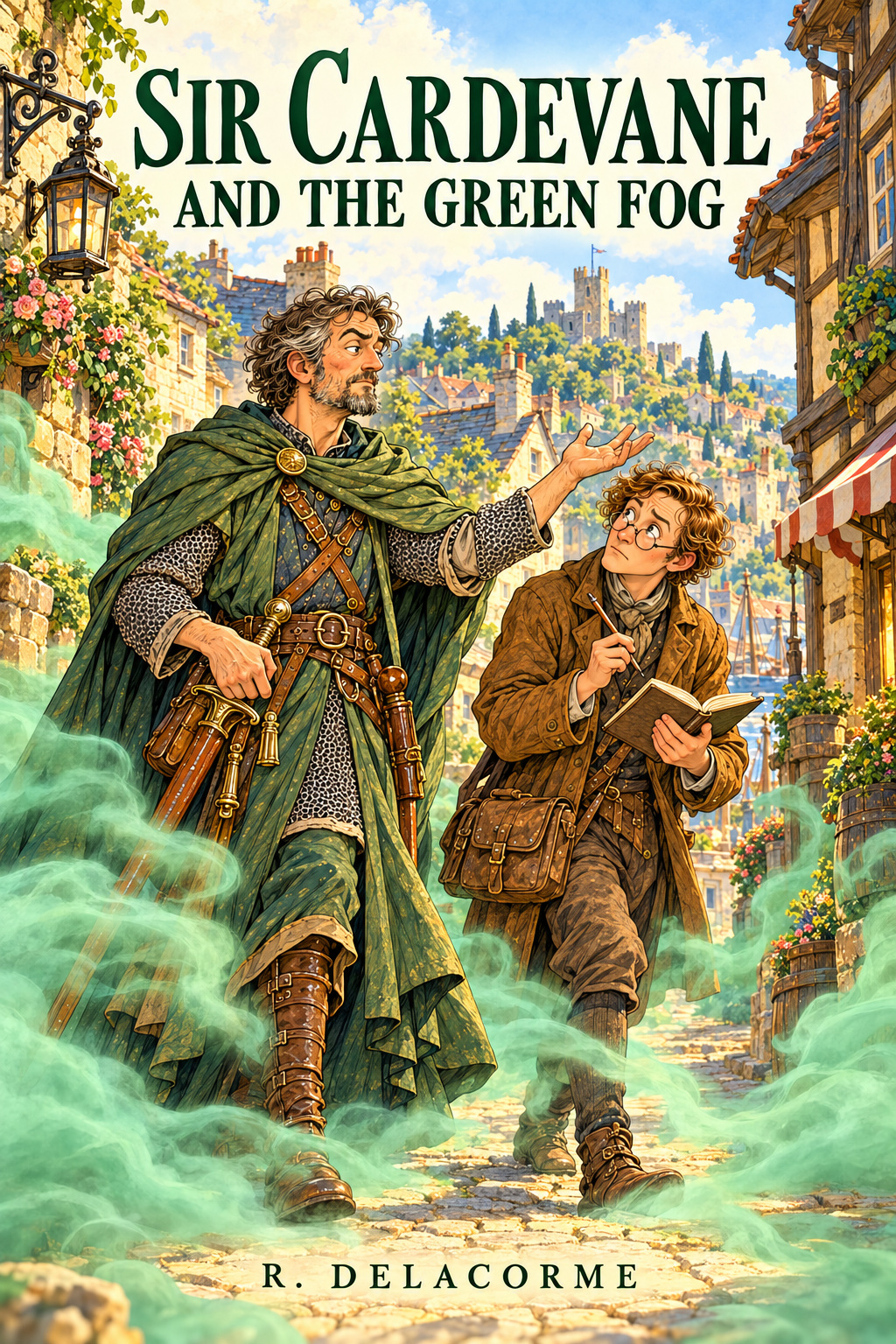
These accounts were kept by Bartholomew, clerk to Sir Cardevane of Westmere, over the course of an employment he has described, in his own notes, as adequately compensated.
Sir Cardevane did not write them. He read them once, corrected a date, and said they were mostly accurate, which Bartholomew has recorded as the closest thing to praise he has ever received in writing.
The cases are presented in the order they were investigated, not the order in which they were resolved, since none of them were resolved in any sense a magistrate would recognise. Each concerns the green fog: where it was found, what it was doing, and what it left behind when Sir Cardevane and his clerk moved on to the next report.
The fog is never explained in these pages. This is not an oversight. It is the most accurate thing that can be said about it.
This volume contains twenty cases. There were others. The others are not included here for reasons Bartholomew has entered under: insufficient resolution.
He has declined to elaborate.
Case 1
Source of the Green Fog
Sir Cardevane of Westmere was a knight of excellent posture and very little patience, and he had decided, on the morning of the fourteenth of April, that the green fog had a source and that he was going to find it.
This was not the first time someone had decided this. The kingdom kept records, and the records showed that in the previous two hundred years no fewer than eleven expeditions had set out to find where the fog came from. Six had come back. Three had found nothing. Two had found ordinary marshes and called them promising. One had returned with a jar of greenish water. The jar was still green after sixty years. Sir Cardevane had read the records. He had reached the conclusion that all eleven had made the same mistake.
"I shall find the source of the green fog," he told the king, who was eating breakfast and had been hoping for a quiet morning, "and cork it."
"With what?" asked the queen, who was embroidering a swan in the window seat and did not look up.
Sir Cardevane had not considered this.
"A heroic cork," he said.
The queen completed the swan's left wing. The king looked at his eggs. Sir Cardevane took their silence as permission and went to prepare.
He rode east with a lance, a map annotated in three colours of ink, three sandwiches, and a clerk named Bartholomew. Bartholomew had packed six sandwiches, a second pair of boots, a writing kit, and a cork he had found in the kitchen and brought without comment. He had also brought, on his own initiative, a small notebook in which he had begun, long before they left, to record every edge he could find: garden beds that stepped around invisible shapes, drains that ran at unexpected angles, gates positioned not where a path needed them but where something else apparently did. Sir Cardevane had seen him writing in it once and had not asked what it was. He had learned that some of Bartholomew's notebooks were best left unread until they were necessary.
They followed the fog east and then northeast and then, for two confusing days, back towards the west. It was thick in one hollow and absent from the next, then thick again three miles behind where they had last seen it.
"Perhaps," said Bartholomew, on the sixth day, "it has no source."
"Nonsense," said Sir Cardevane. "Everything has a source."
"Rivers do," said Bartholomew. "Sneezes do. But what is the source of Thursday?"
Sir Cardevane disliked this question so much that he did not speak to Bartholomew again until the following morning, when he needed directions.
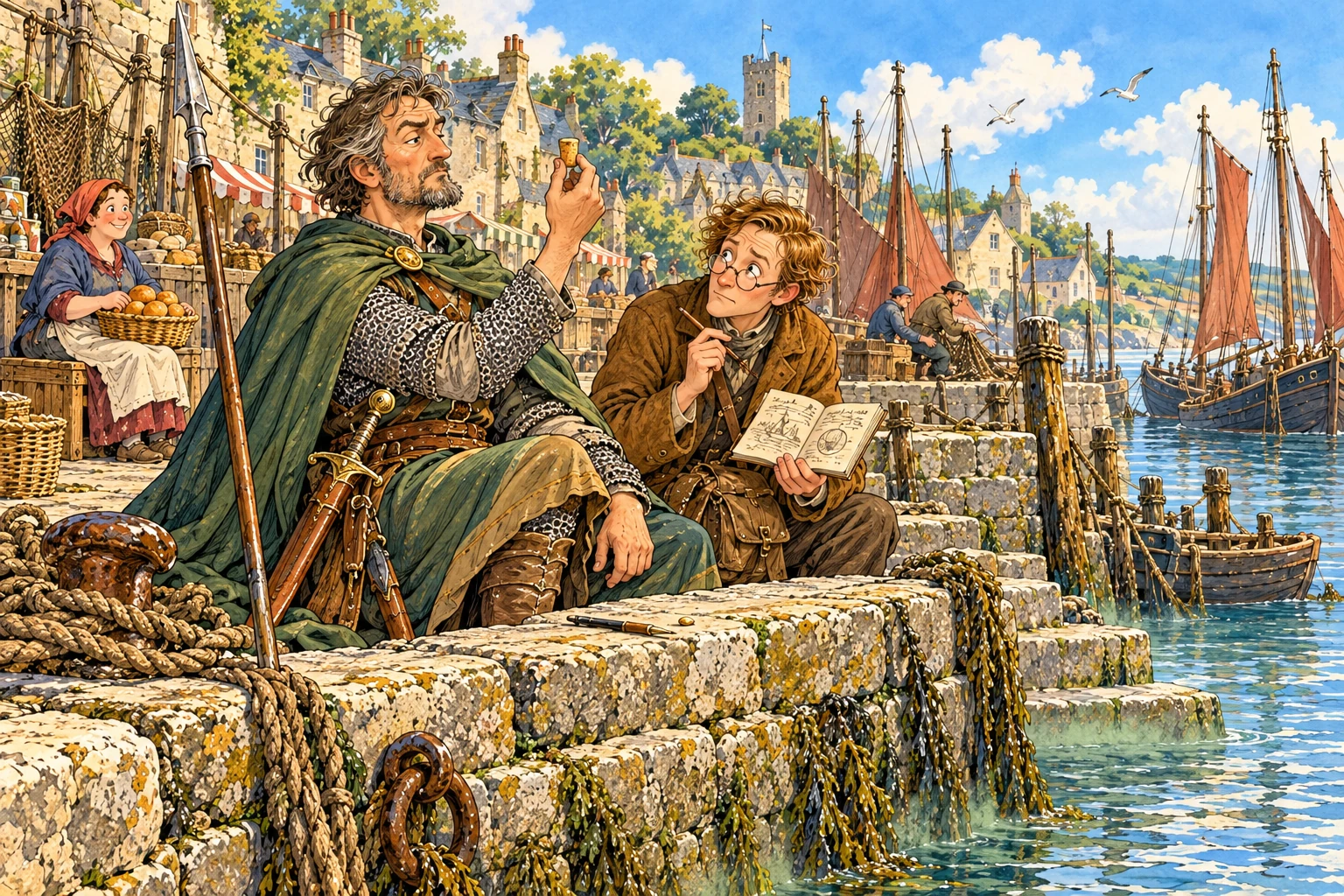
On the eighth day they reached the place marked SOURCE on the map. It was the harbour at Salthorpe. A fish market. Gulls. Nets hung between poles. A smell of salt and something underneath it, something green and older than the salt. An old woman sat on an upturned crate near the harbour wall, selling buns from a cloth-covered basket. She had arranged the basket with some care, at a fixed distance from the stone edge that had the look of a measurement made once and not revisited.
Sir Cardevane dismounted and bought two buns.
"The fog," he said. "We are told it comes from here."
The woman pointed at the water without looking up.
He asked her name.
"Maret," she said. "I came here twenty-three years ago to find the source."
Bartholomew's pen stopped.
"And?" said Sir Cardevane.
"I found it." She looked at the harbour wall. "Then I found it was not a source."
"Then why are you still here?"
She pressed a thumb against one bun to test the crust.
"Dough rises or it doesn't," she said. "That is a comfort."
She had led an expedition of seven. They had followed the fog for fourteen days and ended here, at this wall, at this seam. Six of them went home. She had written to all six in the months that followed.
Five wrote back.
The sixth wrote back too. His letters arrived in the wrong order: the third first, then the first. Then came a reply to a letter Maret had not yet written. The reply was in his hand. She had stopped writing to him. She had not gone home.
"Why not?" said Bartholomew.
"Because I do not know whether he came back," said Maret, "or whether the marks simply matched his hand." She looked at the water. "It happened here. That is all I know."
Sir Cardevane walked to the edge of the wall. The fog lay over the harbour in a thin continuous line along the exact junction where the sea met the stone. It did not roll in. It did not roll out. It lay at the join.
He lowered his lance into the line. The lance stopped with the feeling of a hand put into cold water: an arrival, and then nothing further. He tried eight times. On the fifth attempt he felt something press back, not hostile, not hard. Present. With the steadiness of something that had been there before the lance and would be there after.
When he lifted the lance for the last time the iron tip was wet on one side and dry on the other. A single barley grain clung to the seam between the two. Sir Cardevane looked at it. Bartholomew came to look at it. There were no barley fields within a full day's ride of Salthorpe.
Bartholomew took out his writing kit. He uncapped the pen and set it on the wall while he opened the notebook. The nib rested just over the seam. When he picked it up to write, the nib was wet with seawater. The grip end was dusty with something that smelled of grain.
He looked at it for a moment. He put the pen down on the inland side of the wall and did not move it again.
A moment later, a short line of ink appeared on the harbour stone beside it. Bartholomew had not written it. It was only a stroke, the beginning of a letter perhaps, or the end of one. Nothing further came.
"It brings things through," said Maret, watching. "Not often. A button carved from a wood I could not name. A length of blue thread, still wet. A child's milk tooth with the root still on." She paused. "Everything that comes through is ordinary."
Sir Cardevane set the barley grain on the harbour wall. The fog curled around it once. Then stilled.
He reached into his saddlebag and removed the cork.
Maret went very still.
Bartholomew opened the small notebook, the one he had been filling since before they left.
"Sir Cardevane," he said.
Sir Cardevane held the cork over the seam.
"The reasonable next step is to see whether it objects."
"Look at the notebook first," Bartholomew said firmly.
Sir Cardevane looked. The pages were covered in sketches. Forty-seven of them. A garden bed that stopped two inches short of a fence, always, though no one had planned it. A drain that ran diagonally across a straight yard. A door that opened onto a wall in a house three streets from the castle. A path that began in the middle of a field, with the grass either side of it a different shade. All of them edges. All of them built around by people who later said they had always meant to build that way. At the bottom of each sketch, a note in Bartholomew's careful hand: not closed. bent around. not closed.
"Not one of them," said Bartholomew, "was closed."
"They were accommodated," said Sir Cardevane.
"Every one." Bartholomew turned a page. "Lark Mill tried. There is no Lark Mill now. Only the road that bends around where it was."
Sir Cardevane looked at the cork. He looked at the seam.
Maret spoke. "Put that cork in, and you may find out which side objects first."
Sir Cardevane stood with the cork in his hand for some time. Then he put it away.
"The fog is not a source," he said. His voice rose slightly at the end.
"No," said Maret.
"Then what is it?"
She looked at the line where sea met stone, where the fog lay without rolling in or out, where a pen picked up wrong dust and a grain of good inland barley lay on old harbour rock. "The fog is the meeting," she said.
Bartholomew wrote it down without pause.
They sat on the harbour wall as the light changed. Maret sold buns to three fishermen and a woman with a cart and a child who pointed at the fog and was told by his mother not to point. The seam lay where it had always lain and would lie after all of them were gone.
"Keep the cork," said Maret. "Not for the fog." She did not explain what else it might be for.
They rode home over five days. Bartholomew finished the last sandwich on the second day. Sir Cardevane had no appetite. On the fourth day he unfolded the map.
The word SOURCE had faded. In its place, in small letters the colour of new grass, were two words: NOT YET.
Below them, where Westmere Castle was no more than a black square and a name, someone had drawn a short green line. It crossed the kitchen wall. Sir Cardevane studied it for a long time.
"Bartholomew."
"Yes."
"The cork came from the kitchen."
"I know."
"Someone has drawn a seam through the kitchen wall."
"Yes."
Sir Cardevane folded the map. He put the cork in the bottom of his saddlebag when he unpacked at the castle.
Some months later, when the lord of an eastern province came to court to complain that a river had begun running the wrong way, Sir Cardevane looked at him for a long moment.
"Is it a thing to be solved," he said, "or a thing to be understood?"
"Both," said the lord. "Obviously both."
Sir Cardevane did not argue with this.
Bartholomew wrote it down. Then he wrote down that Sir Cardevane had not argued, because that was the more interesting fact.
Outside the window, the fog lay on the lower fields in its evening position. Sir Cardevane watched it. It did not move. After a while, that seemed less comforting than it once had.
Case 2
Dragon
Sir Cardevane of Westmere had heard, from a reliable source, that the green fog came from a dragon.
The reliable source was a man at an inn. He had heard it from a merchant, who had heard it from a sailor. The sailor claimed to have seen a great winged shape moving through the fog above the eastern hills, breathing out long green plumes. He had even drawn a picture on the back of a receipt. The picture was poor, but clearly showed a dragon, or possibly a very large goose. Sir Cardevane was prepared to rule out the goose.
"A dragon," he said, unfolding the map. "The fog comes from a dragon."
Bartholomew looked at the picture on the back of the receipt. "That could be a goose," said Bartholomew.
"It is not a goose."
"The neck is quite long."
"Dragons have long necks."
"Geese also have long necks."
"Geese," said Sir Cardevane, with the finality of a man who has decided something and does not intend to undecide it, "do not produce green fog."
Bartholomew wrote something in his notebook. Sir Cardevane did not ask what.
They rode east for six days, following the reports. Villagers spoke of a darkness in the fog above the Cairn Hills and very slow breathing on still nights. Three villages also reported an ancient smell. None could explain what ancient smelled like. They agreed only that it stayed with you after you left. Bartholomew noted all of this.
At the last farm before the Cairn Hills, a shepherd named Pell showed them six sheep bells hanging from a nail beside his door. He took one down and shook it. It gave a thin brass clink. "Up there, the clapper still moves," he said, pointing towards the hills. "The bell doesn't."
"What do you do with the sheep?" asked Sir Cardevane.
"Paint their horns. Red for mine, blue for my brother's." Pell hung the bell back on its nail. "You learn quickly which things you used to find by listening."
On the seventh day they found the valley. It was a long valley, running between two bare ridges, and the fog lay in it as fog lay in many valleys: thick at the bottom, thinner towards the sides, with a greenish quality that was stronger here than in the lower country. The valley floor was flat grey rock. A stream ran along the western side and made no sound. Streams in valleys made sounds. This one did not.
Bartholomew stopped his horse. "The stream," he said.
"What about it?"
"Watch it."
Sir Cardevane watched. The water moved. It moved in the direction water moved in, down the valley, over the rock. It did all the things water did. It made no sound.
"It is very quiet," said Sir Cardevane.
"It makes no sound," said Bartholomew.
Sir Cardevane looked at it again. Bartholomew was right. The silence made the moving water look wrong.
He rode on. "There," he said.
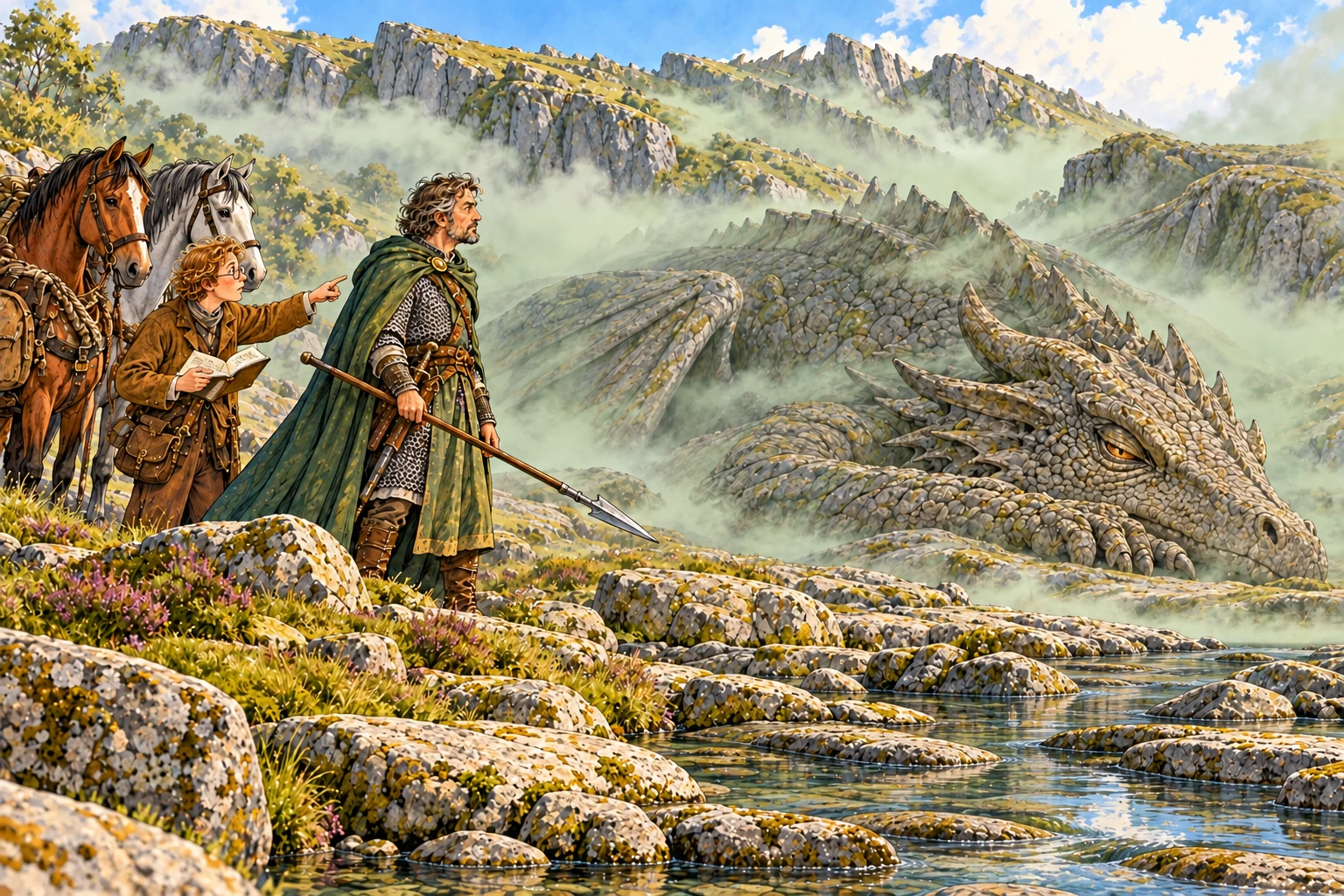
At the far end of the valley, where the two ridges came together, was the dragon. It was large. Dragons were supposed to be large. This one did not look ready to destroy a city or carry off livestock. It looked old enough to have lain in the valley until the valley had begun to include it. The dragon lay along the valley floor with its head on its forelegs and its eyes half closed. It was the colour of old stone. Fog moved around its scales, beneath its wings and through hollows Sir Cardevane could not see clearly.
Sir Cardevane's horse stopped. He urged the horse forward. The horse did not move.
He dismounted, handed the reins to Bartholomew, and walked towards the dragon on foot, which was either very brave or a significant misreading of the situation. Bartholomew tied the horses to a rock and took out his notebook. He had been looking at the valley walls while Sir Cardevane prepared to approach. He looked at them for a long time, tilting his head, and wrote something, and looked again.
The dragon watched Sir Cardevane approach with one eye, the other remaining closed, in the manner of something that does not feel the situation requires its full attention. Sir Cardevane stopped at lance distance and looked at the dragon.
The dragon breathed. The fog moved. The fog spread through the whole space around the dragon instead of pouring from its mouth. Wherever the dragon lay, the green came with it. Sir Cardevane began to suspect breathing had very little to do with the matter.
"You," said Sir Cardevane. "You are the source of the fog."
The dragon regarded him.
"I have come to stop it," said Sir Cardevane.
The dragon continued to regard him. Its eye was the colour of old amber, and it contained, as far as Sir Cardevane could tell, no interest in his announcement.
He raised his lance. He drove the point forward towards the place where the fog was thickest, directly in front of the dragon's chest. The lance went through the fog and arrived at the scales and stopped, as lances stop against stone, and Sir Cardevane stood with his lance against a dragon's chest and the dragon looked at him with the patient amber eye and breathed, and the fog moved around them both.
He pushed. The dragon did not move. He pushed harder.
The dragon sighed. It was a very long sigh. Green fog filled the space between them, and for a moment Sir Cardevane could see nothing else. Then the fog thinned and the dragon was still there and so was Sir Cardevane and the lance was back at his side, though he did not remember lowering it.
"Are you the source?" he said. More quietly this time.
The dragon's eye moved. It had heard the question before, Sir Cardevane thought, and had no intention of answering now.
Sir Cardevane stood in the valley for a while. The stream made no sound. After some time he turned and walked back to Bartholomew.
"Well?" said Sir Cardevane.
Bartholomew pointed.
Along the dragon's flank, the scales ran in overlapping rows, grey-green and very regular, each one the size of a large flagstone. Sir Cardevane looked at them. Then Bartholomew's finger moved upward, from the flank to the ridge above it, and Sir Cardevane looked there too. The ridge had the same pattern. The pattern matched exactly: the same size, the same overlap, the same grey-green colour, running up the rock face in rows as far as the fog allowed him to see.
"It is very large," said Sir Cardevane.
"Or very spread out," said Bartholomew.
Sir Cardevane looked at the place where the wing met the ridge and could not find it.
"The same scale pattern is on the valley wall," he said. "And on the dragon."
"They have been in the same fog long enough," said Bartholomew, "that the distinction may no longer hold."
Sir Cardevane looked at the stream. Still moving. Still silent.
"The stream," he said.
"Yes."
"How long does water have to run before it forgets how to make a sound?"
Bartholomew looked at his notebook. Then at the stream. Then at the dragon, which had closed its eye. "I don't know," he said. "But I am not certain the valley came first."
Sir Cardevane mounted his horse.
"Write down that we found the dragon," he said.
"I have written that," said Bartholomew. "What should I write about what it was?"
"Write that it was very old," he said.
"And the fog?"
Sir Cardevane looked back at the valley, where the dragon lay and the fog moved and the stream ran without sound.
"Write that the fog was older," he said.
They rode home. Bartholomew used the extra sandwiches he had packed and wrote in his notebook for much of the journey. Once, on the third evening, he laughed quietly at something he had written. Sir Cardevane did not ask what.
On the fifth day Sir Cardevane asked: "How long would something have to stay in one place?"
Bartholomew considered this. "Long enough," he said, "that you stop separating the place from what happened there."
Sir Cardevane rode the rest of the way without speaking. He wondered whether the stream had made one final sound, or whether it had fallen quiet so slowly that no one noticed. He arrived home and did not write any of this down. Bartholomew, who had already noted that the stream made no sound, said nothing.
Case 3
Blacksmith's Fire
Sir Cardevane of Westmere had heard, from a source he considered worth investigating, that the green fog came from a blacksmith's forge.
The source was a charcoal-burner from the north road, who had seen, from the edge of the pines, green smoke rising from the chimney of a smithy near the river bend at Arloch. He had watched it for three evenings, which Sir Cardevane considered thorough.
"That," said Sir Cardevane, placing both hands on the table, "is a process."
Bartholomew looked up from his notebook.
"It may be a chimney."
"A chimney is part of a process."
"So is breathing," said Bartholomew, "but we do not accuse everyone of weather."
Sir Cardevane found this irrelevant and said so.
They rode to Arloch in the second week of November, when the roads were hard in the morning and mud by noon, and the fog lay in the ditches as if it had been poured there overnight. The smithy stood at the edge of the village, beside a narrow river that ran behind the houses and disappeared under a stone bridge. It was a low building with a roof blackened by years of smoke. The chimney was tall and badly repaired in three places. From it rose a column of smoke that was black close to the bricks and green where it met the air.
Sir Cardevane stopped his horse. "There," he said.
"There is certainly smoke," said Bartholomew.
"Green smoke."
"Eventually."
Sir Cardevane had grown more cautious about distinctions like this, because Bartholomew had a habit of being right about them later. He dismounted without answering.
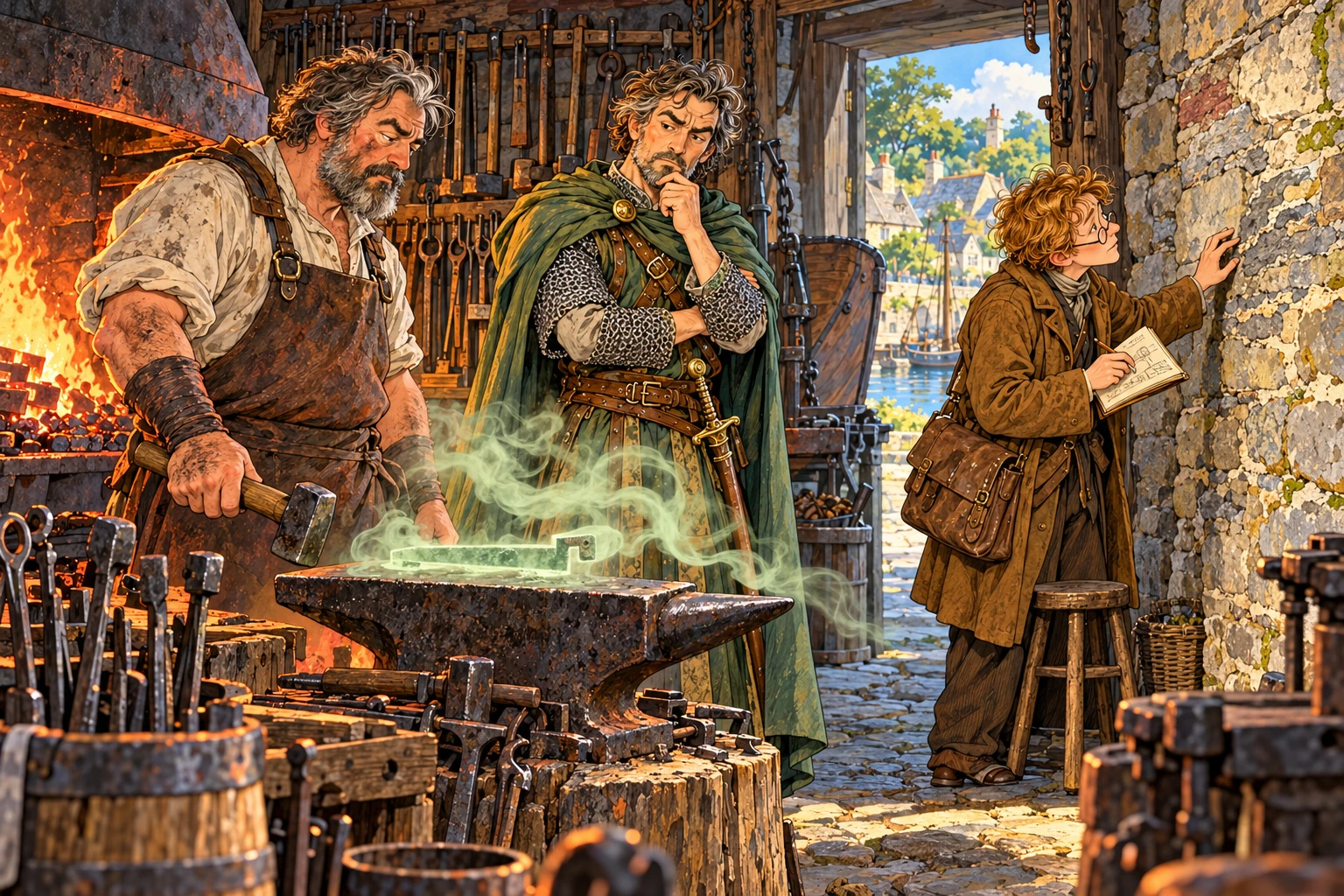
The blacksmith was inside, hammering. He was a broad man with burned forearms, a beard gone grey in uneven patches, and the stillness of someone who has hit difficult things for long enough to stop being surprised by them. The forge fire was bright. The bellows opened and closed. Iron tools hung on the walls in ordered rows. At the back of the smithy, behind the forge, something on the other side had darkened the stones. In the darkest part of that wall, the mortar between two stones had been filled and refilled so many times that the repairs seemed older than the original. Bartholomew looked at them, put one finger to the mortar, and took it back. The mortar was cold beneath his finger.
Beside the wall stood a stool. It faced the wall rather than the forge. The seat was polished smooth at the front edge, where a man would lean forward to listen.
In the middle of the floor stood an anvil. On the anvil was a piece of green fog.
It had been folded into a shape about the size of a horseshoe, soft as fog yet somehow holding its edges. The blacksmith struck it with his hammer. For one moment it became a key. The teeth were wrong, but it was a key. Then it came apart. The green loosened, lifted from the anvil, and drifted back towards the forge fire. By the time it reached the heat, it was fog again.
The blacksmith swore quietly, with the worn precision of a man who had said the same word many times and still found it accurate.
"You," said Sir Cardevane. "You are making the fog."
The blacksmith did not look up.
"No."
"You are heating it."
"Yes."
"Then you are producing it."
The blacksmith took a pair of tongs from the wall and reached into the forge. He pulled out something that looked like a strip of green glass and laid it on the anvil.
"I am trying to make it stay," he said.
He struck it twice. The strip thinned, almost took an edge, and sighed into vapour.
Bartholomew had begun writing.
"How did you get it into the fire?" he asked.
The blacksmith glanced at him, deciding whether the question was worth answering.
"It comes in through the cracks," he said. "Under the door. Through the stonework. I used to try to keep it out."
"And then?"
"A nail fell from the hook by the wall," he said. "It turned green, then looked like an ordinary nail again."
His name was Cade. He did not offer this. Bartholomew found it on a set of tools hanging near the door, each one struck with a maker's mark and four letters. On the wall above the bench, a hook had lost its curve while Sir Cardevane watched it. Beside it lay a hinge whose pin had become green thread.
Cade opened a small iron box beside the forge. Inside were fragments of green shapes, each wrapped in cloth. He lifted one carefully with two fingers. "This lasted a minute," he said.
It was a ring, or the remains of one: curved, open at the ends, and catching the light differently from metal.
"What happens if you wear it?" asked Sir Cardevane.
"I do not know."
"You have not tried?"
Cade looked at him.
"I am a blacksmith," he said. "Not a fool."
Bartholomew stopped writing long enough to appreciate this.
"What shape are you trying to make?" he asked.
Cade reached under the bench and brought out a narrow strip of metal covered in measurements and scratched notes. "A latch," he said.
"For what?" asked Sir Cardevane.
"For a door."
"What door?"
Cade looked past the forge, towards the dark stones at the rear wall.
"The one it keeps coming through."
Nobody spoke for a moment. The bellows opened and closed. Outside, the river made a sound under the bridge. Inside, green vapour remained in the fire without burning. "You are making a latch out of fog," said Sir Cardevane.
"I am trying to make the fog hold the door against itself."
Bartholomew wrote that down very carefully.
"Has it worked?"
Cade picked up his hammer. His thumb found the worn place on the handle without looking. "Once," he said.
Sir Cardevane waited. "For how long?"
"Until morning."
"And then?"
"And then the door was open."
"Did you see what opened it?" asked Bartholomew.
"No," said Cade.
He set the hammer down. "But the latch was on this side."
Sir Cardevane looked at the rear wall. The dark stones were still dark. The packed mortar was still packed. Nothing was open. But the air in that corner drew inward and outward by turns, though there was no gap to draw through.
"The stool," said Bartholomew. He had not looked up from his notebook, but he was not writing. "You sit there."
"Yes."
"At night?"
"Yes."
"What do you hear?"
Cade looked at the stool. At the wall above it. "In summer, nothing. The door is thicker in summer, I think. The fog is thinner." His hand rested beside the hammer. "In winter I hear breathing. Very slow. From the wrong side of the wall."
"What breathes that slowly?" asked Sir Cardevane.
"Something that has a great deal of time," said Cade.
He drew another piece of green from the fire and placed it on the anvil. It moved with the drag of weight, though the tongs did not bend under it. He struck. The fog took shape. A small bar with a notch at one end. A latch-piece. He struck again. The notch sharpened. Again. The bar straightened. It held the shape of a latch-piece long enough for them to see the notch. Then the centre softened. The edges blurred. The whole shape loosened and rose from the anvil in a thin green ribbon.
Cade lowered the hammer. Sir Cardevane stood in the heat of the forge and felt the fog at his boots. It had come in from the place where the door was while they were watching the anvil. It lay there now, low.
"If it will not hold," said Sir Cardevane, "why keep trying?"
"Because the last few pieces have held a little longer each time."
"For seconds," said Sir Cardevane. "And once, until morning."
"Yes. I have never managed to make it hold that long again."
"That is not enough."
"No," said Cade. "Not for a whole night."
His eyes went to the rear wall. Then back to the anvil. Behind him, the stool faced the wall.
Bartholomew crossed the smithy and stood beside the stool. He did not sit on it. He placed one hand against the dark stones and held it there.
He looked at the mortar. At the lines where each repair had been made over the previous one. He counted seven layers where the light was good enough to see.
"How long has the door been here?" he asked.
"It was here when I came," said Cade. "The man before me filled the mortar. He said his father had filled it."
"And before that?"
Cade looked at the wall.
"The building is three hundred years old," he said. "The mortar in that corner is not."
Bartholomew took his hand from the wall. He looked at his palm. It was dry. Very dry. Drier than a stone wall in November had any reason to make it.
He came back to Sir Cardevane without saying what he had noticed.
On the way out, Sir Cardevane looked back once. Cade was already at the anvil again. The hammer rose. The hammer fell. In the green heat, a shape appeared and collapsed again.
Then there was fog.
At the edge of the village, Sir Cardevane stopped his horse.
"Write down that we found the forge," he said.
"I have written that," said Bartholomew.
"Write that the forge is not producing the fog."
"I have written that too."
"Write that the blacksmith is trying to make it hold a shape."
Bartholomew wrote.
"Write that it holds briefly."
"How briefly?"
Sir Cardevane thought about the ring. The latch. The door that had stayed closed until morning. The latch on this side.
"Longer than it did," he said.
They rode on. For some miles Sir Cardevane said nothing.
At last he said:
"I am thinking about the door."
"I am thinking about the wall," said Bartholomew.
"What about it?"
Bartholomew looked at his right palm.
"It was very dry," he said. "Drier than this side could account for."
"Through stone?"
"Through seven layers of mortar," said Bartholomew. "Slowly."
Sir Cardevane rode in silence for a moment.
"That is a great deal of patience."
"Yes," said Bartholomew. He did not say what for.
That evening, at the inn, Sir Cardevane found a nail in the cuff of his glove. It was small, greenish and almost transparent. He did not know how it had got there. He placed it on the table.
For a moment it held. Then it became fog, and was gone. On the table there was a small dark mark. The grain bent around it, as if the wood had grown that way.
Sir Cardevane sat very still. Bartholomew, who had seen it too, opened his notebook.
"Do not write that down yet," said Sir Cardevane.
Bartholomew looked at him.
"Why not?"
Sir Cardevane looked at the mark on the table.
"Because I am not sure," he said, "whether it failed."
Bartholomew wrote that down instead.
Case 4
Troll Beneath the Bridge
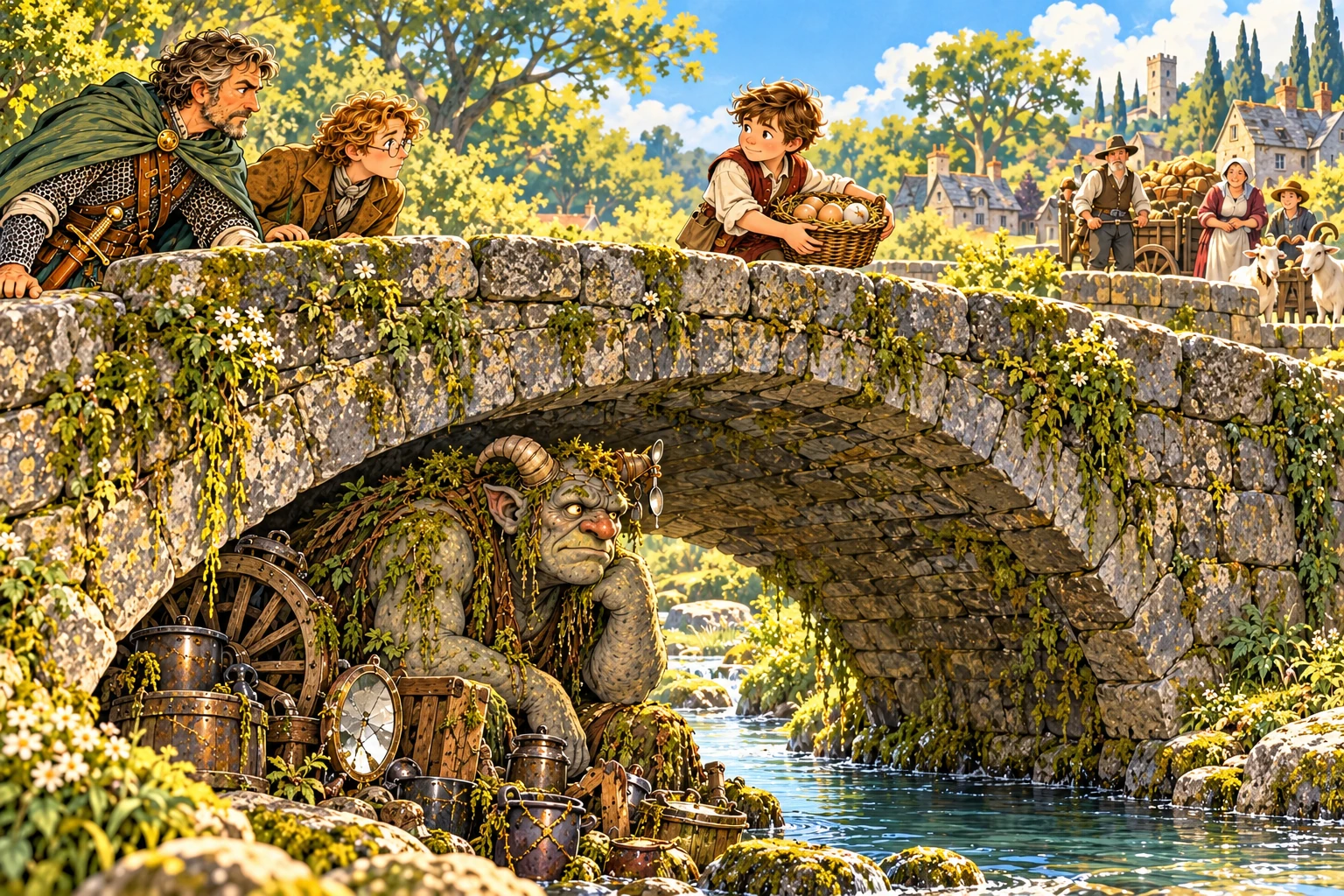
Sir Cardevane of Westmere had heard, from a source he considered solid enough to trust, that the green fog gathered under a bridge.
The source was a mason from Greywater Ford, who had arrived with mud to his knees, moss in his beard, and the expression of a man who had argued with stone and lost.
"It is under the bridge," said the mason.
"What is?" asked Bartholomew.
"The fog."
"Fog is usually above things," said Bartholomew.
"Not this fog."
Sir Cardevane leaned forward. "Describe the bridge."
"It crosses the Greywater."
"Most bridges cross something."
"This one," said the mason, "also waits."
Bartholomew looked up from his notes. "Waits for what?"
The mason took off his cap. Water fell from it, although the room was dry. "For an answer," he said.
Sir Cardevane had the matter entered under possible structural hauntings, with a secondary classification for damp philosophy.
They rode to Greywater Ford the following morning. The road was not good. It climbed steeply, dropped without warning, and had been laid with little concern for a direct route. By afternoon the fields had given way to alder and willow. Water appeared in ditches, then in cart ruts, then across the road itself.
The Greywater itself was not grey. It was brown, black, silver, and once, in a pool under the trees, briefly green.
"There," said Sir Cardevane.
"A reflection," said Bartholomew.
"Of what?"
Bartholomew looked at the sky. It was the colour of old wool.
"Of an unreasonable possibility."
Sir Cardevane accepted this as insufficiently falsifiable and rode on.
They reached the bridge just before dusk. It was older than the road, older than the ford, perhaps older than the idea that either bank had ever been separate. Three stone arches crossed the river. Moss hung from the sides in wet beards. The parapets leaned inward over the stream.
Beneath the middle arch the water slowed. The green fog lay there. It did not drift. It did not rise. It lay under the bridge in a low, folded mass.
Sir Cardevane stopped his horse.
Sir Cardevane pointed beneath the bridge. "Fog. Under the bridge. Record that I was correct to investigate."
Bartholomew wrote for a moment.
"I have recorded the bridge," he said.
Sir Cardevane waited.
"And the fog."
Bartholomew sighed and wrote: under, with reservations.
On the far side of the bridge stood three villagers, a cart, two goats, and a boy carrying a basket of eggs. None of them crossed.
"Why do they not come over?" asked Sir Cardevane.
The mason swallowed.
"Because of the troll."
Sir Cardevane looked pleased. "There is a troll."
"Yes."
"Under the bridge."
"Yes."
"Where the fog is."
"Yes."
Sir Cardevane turned to Bartholomew. "You may remove the reservations."
Bartholomew did not.
Sir Cardevane dismounted and walked to the bridge. The stones were slick. The river moved beneath him with a private sound. Halfway across, a voice spoke from below.
"What has four feet in the morning, two at noon, and waits at evening?"
Sir Cardevane stopped.
"That," said Bartholomew, "is an old one."
"It is a man," said Sir Cardevane.
"No," said the voice.
"It is certainly a man."
"Widely agreed things are often lazy," said the voice.
Bartholomew wrote that down.
Sir Cardevane leaned over the parapet. Beneath the bridge sat a troll. He was large, though not in a useful way. His shoulders were broad enough to block a doorway, but his neck was thin and tired. His skin was stone grey, river green in the creases, and patched with moss. One horn curled back from his forehead. The other had broken off long ago and been repaired with twine, copper wire, and a spoon. His eyes were yellow and sorrowful. Around him lay objects in small piles: broken wheels, shoes, buckets, clay pipes, two cracked mirrors, a child's wooden horse, and a heap of books swollen fat with water. Some were open. None looked readable. The fog lay around his ankles in a low green fold.
"Are you the troll?" asked Sir Cardevane.
"What sits under a question and is blamed for the answer?" said the troll.
He looked apologetic the moment he had said it.
"Yes," said Bartholomew.
"That was not an answer," said Sir Cardevane.
"It was close enough."
"I am Sir Cardevane of Westmere."
"What wears a name like armour and still gets wet?"
Sir Cardevane looked down at his boots. They were, in fact, wet.
"This is my clerk, Bartholomew."
Bartholomew stopped writing.
"That is not entirely unfair," he said.
Sir Cardevane drew himself up. "We have come to investigate the green fog."
The troll's mouth opened. His jaw worked once.
"It is not under," he said, and flinched. "Not exactly."
Bartholomew wrote that down.
"Do not encourage him," said Sir Cardevane. The troll shifted. The bridge stones creaked. The fog curled over one of his feet and slipped back into the dark.
On the far bank, the boy called out.
"Please, sir. My mother says I must be home before the fog rises."
"Then cross," said Sir Cardevane.
The boy looked at the arch. He shifted the basket from one arm to the other. One egg was already cracked, and he kept touching it with his thumb as if apology might hold the shell together.
"I can't."
"Why not?"
"The troll asks a question."
"And if you answer wrongly?"
The boy looked embarrassed.
"You have to stay until you understand why."
Bartholomew lowered his pen.
"That seems worse than being eaten."
"It is," said the mason.
Sir Cardevane climbed down the bank towards the middle arch. Bartholomew followed more slowly, choosing each foothold with the care of a man who had not sworn an oath to fall into rivers. The air under the bridge was colder. Water dripped from the stones. Green fog clung to Sir Cardevane's boots. He shifted his weight and stepped forward.
The troll watched him.
"You are sheltering the fog," said Sir Cardevane.
The troll looked at the water. For a moment he seemed about to answer plainly. Then his mouth pulled sideways.
"What arrives where thought cannot finish crossing?"
"Answer plainly."
The troll closed his eyes. For a moment his whole face trembled. The fog under the bridge thickened. It moved against the current, gathering in the hollow where the troll sat. Sir Cardevane saw things inside it: a ladder with no top, a candle burning underwater, a doorway opening into another doorway. The troll looked at it sadly.
"I dare not speak plainly," he said.
Sir Cardevane went still.
"You can speak plainly."
The troll clapped both hands over his mouth. The bridge groaned. When he lowered them, his fingers shook.
"You are cursed," said Sir Cardevane.
"What is a lock that swallowed its own key?"
Bartholomew looked at the troll.
"You are."
The troll looked at him with such gratitude that Bartholomew stopped writing.
"How did this happen?" said Sir Cardevane.
The troll looked at the river.
"I was young," he said, and flinched as if the words had burned him. The fog stirred at his feet. He forced the next words through his teeth. "I wanted wisdom."
The bridge became very quiet.
He touched the swollen books. One page tore under his finger and came away like wet skin.
"I asked kings how to rule. I asked monks how to suffer. I asked witches what must not be asked. I asked the dead what they regretted."
"That seems thorough," said Sir Cardevane.
"It was," said the troll.
He looked at the ruined piles around him.
"I learned where every road ended."
The fog stirred at his feet.
"Then I could no longer take one."
Sir Cardevane looked at the books. At the fog. At the troll who had read everything and was unable to cross his own bridge.
"When did you stop?" he asked.
The troll was quiet for a moment. "There was a morning," he said. "I stood at the north end. The road was dry. I knew the road. I had asked three men who had walked it how many steps to the next village, and in what weather, and what they had carried, and whether they regretted the weight."
His hand opened and closed on the wet stone.
"I knew more about that road than any of them."
"And?"
"And I could not lift my foot."
The fog rose half an inch at his ankles.
"I stood there until the light changed."
"You stayed here," said Sir Cardevane.
The troll looked at the water.
"What lingers where questions have no end?"
A low band of green fog lay across the stones beneath the arch and over the first stone of the far approach. The boy took one step back. The goats pulled against their rope.
Sir Cardevane drew his sword.
The troll looked alarmed.
Sir Cardevane looked at the sword. Then he sheathed it.
Bartholomew wrote that down very quickly.
Above them, the boy called again.
"Sir? The eggs."
Sir Cardevane looked up.
Eggs made most matters less theoretical.
"Boy. Come across."
The boy stared at the bridge.
"I can't."
"You can."
"He'll ask."
"Then answer."
"I don't know riddles."
The troll's face folded in pain.
Sir Cardevane stepped onto the bridge. "I will answer on his behalf."
The troll raised his head. His voice deepened until it came from the stones as much as from his throat.
"What is the wisest thing to carry across a bridge?"
Sir Cardevane stopped.
The villagers waited. The mason closed his eyes. The river moved.
"A lantern," said Sir Cardevane. "If the crossing is dark."
"No."
"A rope. If the bridge is unsafe."
"No."
"Bread," said Bartholomew, "if the road is long."
"No."
The fog had reached the first stone on the far side. It lay across the threshold of the bridge, slow and flat, like a door being closed from the other direction.
The boy looked down at his basket. "Eggs," he said.
The troll turned towards him. "What?"
"Eggs," said the boy. "If your mother asked for eggs."
The troll opened his mouth.
The boy walked on. Green fog lay across the stones ahead of him.
Sir Cardevane looked at the boy.
"That is not a wise answer."
The boy flushed.
"It's true."
The troll stared at him.
The bridge gave a small shudder.
"What is true before it tries to be wise?" whispered the troll.
The boy said nothing.
He did not know he had been asked.
He walked onto the bridge. Halfway across, he stopped to shift the basket carefully against his hip. No one breathed. The boy frowned at the cracked egg, turned it upright, and walked on. The fog remained beneath the arch. The boy crossed quickly, clutching the basket with both hands. When he passed Sir Cardevane, he bowed badly and nearly dropped two eggs.
"Careful," said Sir Cardevane.
"I am," said the boy.
He reached the near bank. The mason cried, quietly and with great embarrassment. The troll covered his face. For a long time there was only the river.
Then the troll spoke.
"I forgot," he said.
No riddle came after it.
Bartholomew did not write.
"What did you forget?" said Sir Cardevane.
The troll lowered his hands.
"Bread," he said. "Doors. Sleep. Going where one is going."
The fog remained in the hollow beneath the bridge. Sir Cardevane walked to the far side of the bridge. Then he turned and walked back. Bartholomew followed. The mason came next. Then the goats. Then the villagers, one by one, each carrying something plain: a sack of flour, a bundle of reeds, a sleeping child, a pot with a cracked lid. The troll did not stop them.
Once, an old woman paused above the arch and looked down. "You still under there, Grum?" she asked.
The troll wiped his nose. "Yes."
"Good," she said. "Don't make it clever."
Sir Cardevane looked at her.
"You know his name?"
"Course," she said. "Knowing a name and crossing a bridge are different things."
Then she crossed. By sunset, carts crossed the bridge again and feet sounded on stone. A few green threads remained in the deepest shadow.
Sir Cardevane climbed down to the troll once more.
"Grum."
The troll looked up.
"We did not find the source of the fog."
"No."
"You were not sheltering it intentionally."
"No."
"You were, however, giving it a place to sit."
Bartholomew looked at him.
"That may be the least knightly sentence you have ever spoken."
"It is accurate."
"It is also damp."
Grum made a sound that might have been a laugh. A small stone fell from the bridge and landed beside him.
"Was that structural?" asked Sir Cardevane.
"No," said Grum. "Amusement."
They left Greywater Ford the next morning. Before they went, Sir Cardevane stood on the bridge and looked down. Grum sat beneath the middle arch, sorting the ruined books into two piles. The spoon from his repaired horn lay beside him.
"What are those?" asked Sir Cardevane.
"Things worth keeping," said Grum, touching one pile.
"And the other?"
He picked up a book. Its pages fell out in one wet lump.
"This taught me seven names for hunger," he said.
He placed it in the second pile.
"It did not teach me bread."
They rode east. At noon they stopped to eat. Bartholomew took out bread and cheese. Sir Cardevane took out his notebook, which he had borrowed from Bartholomew and not yet admitted borrowing.
Bartholomew looked at him. "Do you think he will cross the bridge now?"
Sir Cardevane considered this. The road ahead was dry. The cheese was sharp. The sun had come out for no strategic reason.
"No," he said. "But it may be enough for lunch."
Bartholomew wrote that down too.
They finished their lunch and rode on. Behind them, at Greywater Ford, the bridge stood as it had always stood, three arches over brown water, moss on the parapets, the fog thin and quiet in the middle shadow.
Under the arch, Grum had kept one book from the second pile. It was the thinnest. The title had washed away. He did not open it. He just held it, which was a different thing entirely.
Case 5
Baker Who Would Not Let Bread Rise
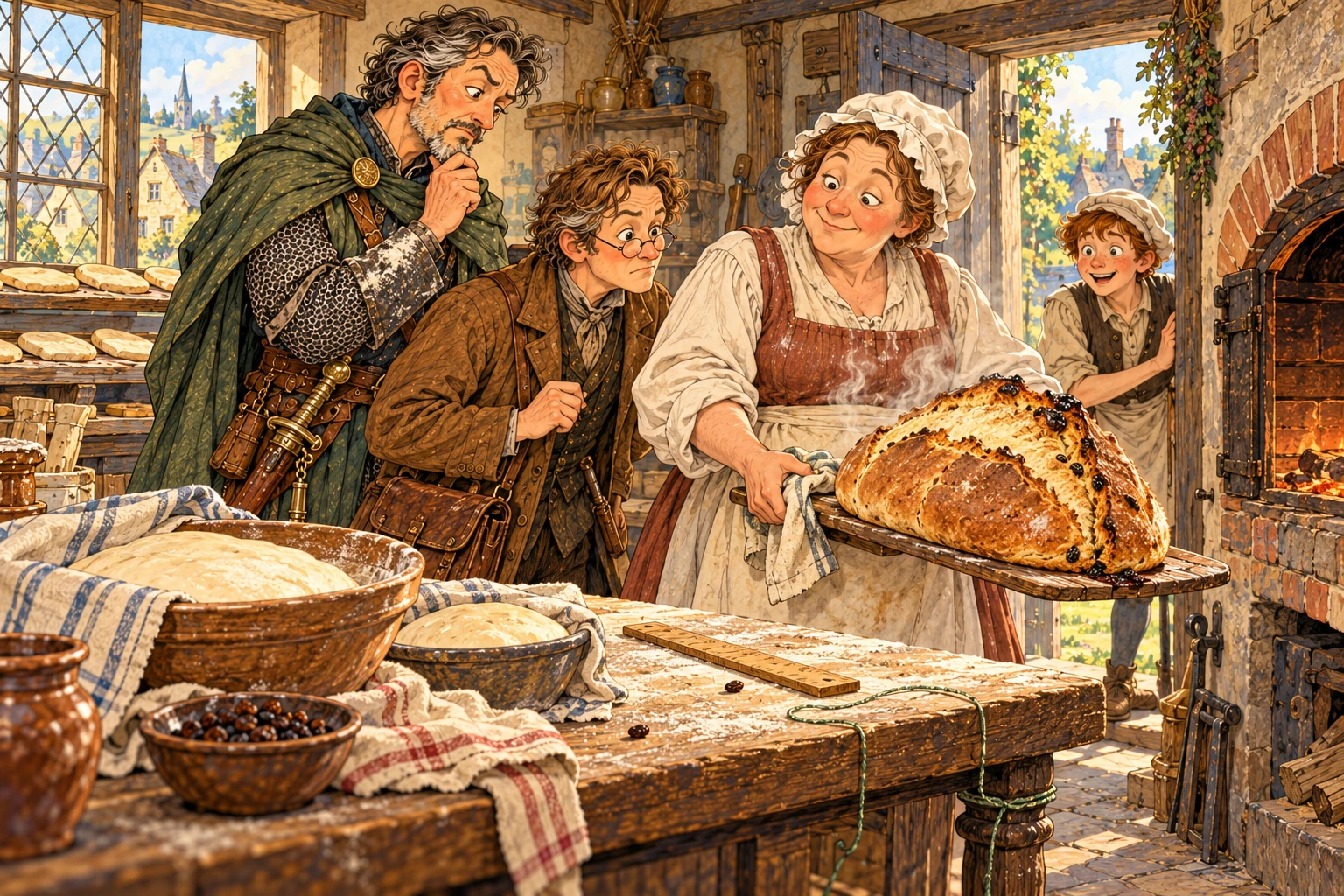
Sir Cardevane of Westmere had heard, from a source he considered hungry enough to be convincing, that the green fog came from a bakery.
The source was a miller's apprentice from Barrow Wick, who had walked seven miles carrying a sack of flour and a complaint about dough that had not risen.
"Dough usually rises," said Bartholomew.
"This dough didn't," said the apprentice. "It sat in the bowl like a legal objection."
Sir Cardevane leaned forward.
"And the fog?"
"In the bakery," said the apprentice. "Green at the windows. Red at the oven. Yellow under the door, if the dough swells."
"Why would dough swelling matter?" asked Bartholomew.
The apprentice lowered his voice.
"Mistress Tallow says bread belongs flat on the board."
Sir Cardevane stood at once. "Bartholomew."
"Yes," said Bartholomew. "We are apparently investigating bread."
They rode to Barrow Wick the next morning.
The village stood in a shallow valley with a mill at one end, a church at the other, and a smell of warm crust everywhere except the place where warm crust should have been strongest. The bakery was easy to find. Outside, a line of loaves stretched along the wall.
They were pale and flat, each no higher than a book. A sign above the door read:
MISTRESS TALLOW BREAD, BISCUITS, PIES, AND PROPER PROPORTIONS
Below it someone had added, in smaller letters:
NO RISING WITHOUT PERMISSION
Bartholomew read this twice.
"That seems difficult to enforce."
The nearest loaf sagged slightly.
A thin green fog slid from beneath the door and curled around the sill.
Sir Cardevane removed his gloves. "The law has assistance."
Inside, the bakery was hot and spotless. Rows of bowls stood on shelves. Each bowl contained dough. Each dough had been marked with a small wooden ruler. A woman in a flour-white apron moved among them with the expression of a person correcting weather. She was broad, brisk, and dusted from wrist to elbow. Her grey hair had been tied so tightly beneath her cap that even her thoughts appeared to have been pinned.
"Customers wait outside," she said.
"We are not customers," said Sir Cardevane.
"Then wait more quietly."
Bartholomew opened his notebook.
"Mistress Tallow?"
"Yes."
"Your bread is not rising."
She turned on him.
"It rises."
The dough in a bowl behind her swelled slightly. Mistress Tallow struck it with a wooden spoon. It sank.
"It rises excessively."
The green fog curled around the bowl. The dough lay smooth and low.
Sir Cardevane watched it. "The fog appears to keep the dough down."
"Exactly where it should be."
"A very low standard," said Bartholomew.
Mistress Tallow ignored him.
On the central table lay one large lump of dough under a cloth. It moved now and then beneath the cloth.
Sir Cardevane pointed. "What is that?"
Mistress Tallow placed herself between him and the table.
"Nothing."
The cloth rose half an inch.
"A lively nothing," said Sir Cardevane.
"It is starter," she said.
Bartholomew looked up.
"For bread?"
"For disaster."
The cloth rose again. Mistress Tallow struck it with the spoon. The spoon bounced. From beneath the cloth came a soft, wet sigh. The green fog gathered at the table legs. It lay close to the wood.
Sir Cardevane lifted the cloth. Mistress Tallow made a noise usually made by doors. Beneath the cloth was a bowl of dough, but larger than it should have been. Much larger. It had pushed against the sides of the bowl and folded itself over the rim. Small bubbles trembled across its surface. It smelled of yeast, flour, and the beginning of something that had not asked anyone's opinion.
On the bowl was written:
FOR TOM
Mistress Tallow snatched the cloth back.
"That is private."
"Bread rarely remains private," said Sir Cardevane. "It has social ambitions."
A boy appeared at the back door carrying an empty basket. He was perhaps twelve, with flour on his nose and hope in both hands.
"Is it ready?" he asked.
Mistress Tallow did not turn.
"No."
"You said perhaps today."
"Perhaps was careless."
The boy saw Sir Cardevane and Bartholomew, bowed in the wrong direction, and disappeared again.
The dough in the covered bowl rose another inch. The green fog stiffened.
"Who is Tom?" asked Sir Cardevane.
Mistress Tallow gripped the spoon.
"My husband."
"Ah."
"Do not ah in my bakery."
Sir Cardevane stopped ah-ing.
Mistress Tallow looked at the cloth.
"He made festival loaves," she said. "Huge foolish things. Plaited. Sugared. Full of raisins. They rose over the tins, over the table, sometimes onto the floor. People loved them because people love inconvenience when it smells good."
"And now?" asked Bartholomew.
"Now I bake correctly."
The green fog slid over the nearest shelf. Six small loaves sat low on it.
"Very correctly," said Sir Cardevane.
Mistress Tallow lifted her chin.
"After he died, everyone said, keep the bakery as it was. Make his loaves. Let the dough rise. Let the house smell of him."
She touched the covered bowl.
"They meant well."
"Often dangerous," said Bartholomew.
"Yes," said Mistress Tallow, surprising him. "So I made smaller bread. Then flatter bread. Then bread that would not remind anyone of anything."
The bowl marked FOR TOM gave a soft heave. The cloth slipped. For one moment the dough rose freely. It was not tidy. It bulged at one side and sagged at another. A bubble opened and closed. Mistress Tallow pressed the cloth down with both hands. The dough sank beneath it.
Mistress Tallow exhaled.
Sir Cardevane looked at her.
"Did that help?"
"Yes," she said.
Then, after a moment:
"At first."
Outside, the flat loaves in the queue knocked gently against the wall.
The boy appeared again at the back door.
"Mistress Tallow? The village is asking if there will be bread today."
"There is bread."
"They mean bread that stands up."
Mistress Tallow closed her eyes.
A low thread of green mist drifted along the floor towards the open back door.
Mistress Tallow reached for the spoon.
Sir Cardevane stepped between her and the bowl. "No."
"You are obstructing the bakery," said Mistress Tallow.
"Only the spoon."
She looked at him as if considering whether knights could be rolled thin.
The dough rose again. Mistress Tallow lifted her spoon. Stopped. The dough rose higher. It pushed the cloth aside and leaned over the bowl, absurd, fragrant, alive.
The bakery filled with the smell of Tom's loaves. Mistress Tallow made a small sound of recognition. She lowered the spoon. A thin line of green mist remained along the edge of the table.
"If I let it rise," she said, "it will fall."
"Yes," said Sir Cardevane.
"It may split."
"Yes."
"It may burn."
"Then it will be bread," said Bartholomew.
Mistress Tallow looked at him.
"That is a reckless definition."
"I am hungry," said Bartholomew.
The boy at the door laughed. A faint green waver crossed the wall. Mistress Tallow heard the laugh and flinched as if something warm had touched her.
Then she took the bowl marked FOR TOM and carried it to the oven.
The dough slumped dangerously to one side.
She did not correct it.
She reached for the small wooden ruler she had used to measure the dough. She held it above the bowl, then laid it on the bench.
"Not today," she said.
Sir Cardevane frowned slightly.
Bartholomew whispered, "That phrase is becoming widespread."
"Then we must be careful with it," said Sir Cardevane.
Mistress Tallow opened the oven. Heat filled the room. She slid the dough inside.
The fog spread towards the doorway. The heat drove it back. For a while, no one spoke. This was partly reverence and partly hunger.
At last, the loaf came out. It was huge. It had split along the top. One side leaned. Raisins had escaped and burned at the edge. The crust was darker than planned.
Mistress Tallow stared at it. "It is wrong," she said.
The boy took a deep breath. "It smells right."
The flat loaves outside pressed against the window.
The green fog hung in one corner, thin as a thread.
Mistress Tallow cut the loaf. Steam rose. The fog formed no shape, ghost or message. Only bread.
She handed the first slice to the boy. Then one to Sir Cardevane. Then, after a pause, one to Bartholomew, who had already prepared an expression of patience and was disappointed not to need it.
The boy ate. His face changed. "That," he said, "is inconvenient."
Mistress Tallow looked at him.
"Yes."
He took another bite.
"Can we have it again?"
Mistress Tallow looked at the empty bowl marked FOR TOM.
Then at the fog.
"Not every day."
"How often?" asked Sir Cardevane.
She considered this.
"When it rises."
Bartholomew wrote that down. His notebook smelled briefly of toast.
They left Barrow Wick in the late afternoon with warm bread wrapped in cloth and flour on Sir Cardevane's sleeve.
Behind them, Mistress Tallow stood in the doorway while villagers broke the loaf by hand. The green fog lay under the table. A small bubble formed in the next bowl of dough. Mistress Tallow raised the wooden spoon above it and held it there. Then she lowered the spoon. The bubble grew. Mistress Tallow watched it.
Case 6
Royal Cannon
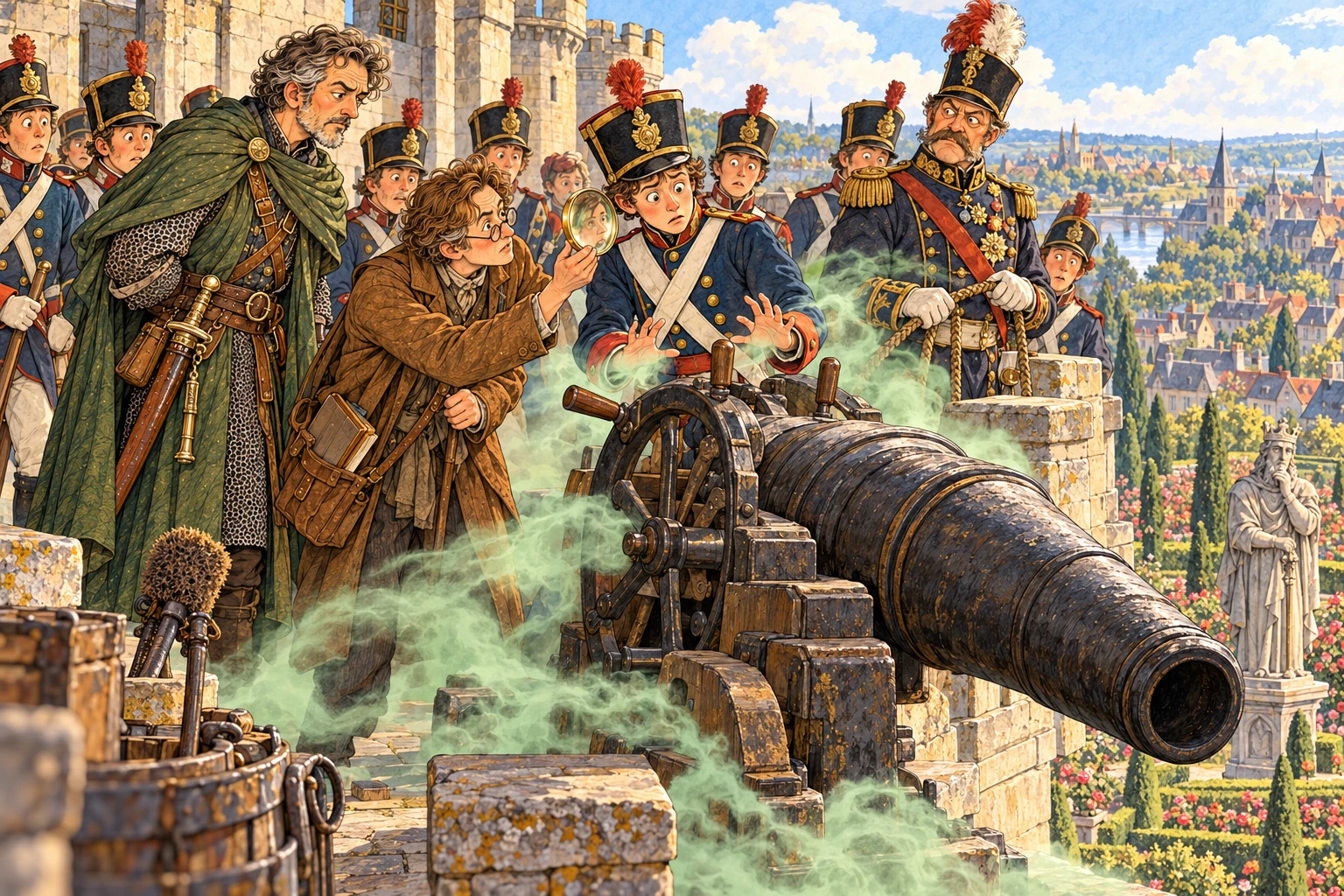
Sir Cardevane of Westmere had heard, from a source he considered loud enough to deserve attention, that the green fog came from the king's cannon.
The source was a palace gardener, who had been pruning roses beneath the western battery when the great cannon had sneezed. This was unusual for several reasons. First, cannons do not sneeze. Second, the cannon had not been loaded. Third, the sneeze had produced a cloud of green fog that rolled across the rose beds, turned three white roses pale blue, and caused a marble statue of King Osric the Tall to apologize to a pigeon. The gardener had not liked this.
Sir Cardevane listened with great attention. "A cannon that sneezes without powder," he said, "is either ill or dishonest."
"Or badly maintained," said Bartholomew.
Sir Cardevane frowned. "Do not reduce wonder to housekeeping."
"Housekeeping has saved more kingdoms than wonder."
"Name three."
"Clean wells, dry grain, and not storing arrows beside candles."
Sir Cardevane considered this. "Two and a half."
The gardener twisted his cap. "It happens every morning now," he said. "Just after dawn. Captain Bragor points the cannon at something, shouts until everyone stands taller, and then the fog comes out."
"Points it at what?" asked Bartholomew.
"Whatever he thinks requires respect."
Sir Cardevane's eyes brightened. "An ambitious category."
"Yesterday it was the east gate," said the gardener. "The day before, a visiting duke. Last week, rain."
"Did the rain respect him?" asked Sir Cardevane.
"It became hail."
Bartholomew opened his notebook. "That may not have been respect."
"Captain Bragor says everything obeys if addressed with sufficient force."
"Captain Bragor?" asked Sir Cardevane.
"The royal cannonier."
"Ah," said Bartholomew. "The loud one."
"He is in charge of the western battery," said the gardener. "And the eastern battery. And, according to him, the horizon."
Sir Cardevane stood. "A man who commands the horizon must be met before lunch."
"It is still before breakfast," said Bartholomew.
"All the better. Horizons are freshest in the morning."
They went at once to the western wall. The royal cannon stood on a stone platform above the palace gardens. It was enormous. Its barrel was black as midnight and broad enough for a determined goat to enter with luggage. Around its mouth were carved lions, eagles, thunderbolts, and several other creatures that had clearly been chosen for their inability to apologize.
Beside it stood Captain Bragor. He was not a tall man, though he had dressed against this fact with considerable effort. His boots were high. His hat was higher. His moustache pointed outward like two warnings. His coat was red, gold, black, and polished wherever cloth could be persuaded to polish. Across his chest hung medals in such quantity that walking required negotiation.
He was shouting at six soldiers.
"Wider stance. Higher chin. If a man cannot look like victory, he has no business surviving breakfast."
The soldiers widened their stances.
Their chins rose.
Their spirits did not.
Sir Cardevane bowed. "Captain Bragor."
Captain Bragor turned as if turning were an act of war. "Who addresses the Royal Thunder?"
"I do."
"And who are you?"
"Sir Cardevane of Westmere."
Captain Bragor's eyes narrowed.
"The fog hunter."
"The same."
"I hunt louder things."
"I had noticed."
Bartholomew opened his notebook.
Captain Bragor pointed at it. "What is that?"
"A notebook."
"For recording orders?"
"For recording what happens."
"Then write this: the Royal Thunder is sound, loyal, magnificent, and feared by enemies not yet born."
Bartholomew dipped his pen.
"The cannon is large," he said.
Captain Bragor's face reddened.
"Large?"
"It seemed safest to begin with what can be proven."
Sir Cardevane walked around the cannon. A thin green stain ran across the stone beneath it, from the wheels to the edge of the platform, where it disappeared into the rose beds below.
Sir Cardevane crouched. "It has fired recently."
"It has not," snapped Captain Bragor. "The king forbids ceremonial firing before seven."
"Then it has threatened recently."
Captain Bragor smiled. "A cannon does not need to fire in order to be useful."
"No," said Sir Cardevane. "That is what worries me."
Captain Bragor struck the barrel with his riding crop. The cannon gave a low metallic note. From inside it came a sound like a breath held too long.
The soldiers stepped back. Captain Bragor stepped forward.
"Stand firm."
The cannon shuddered.
A little green fog came from its mouth and settled low around the platform.
Captain Bragor did not move. "You see?" he said. "It responds to command."
The fog lay around his boots and medals like damp after rain.
Sir Cardevane watched the fog, not the man. "No," he said. "It responds to display."
Captain Bragor laughed. It was not a pleasant laugh. It had been trained to enter rooms before him.
"Display wins battles."
"Does it?"
"It wins the first half."
"And the second?"
"That is for survivors," said Captain Bragor. For one moment Captain Bragor's eyes changed. His fingers closed around the riding crop. He looked at the cannon, then away from it.
Then Captain Bragor shouted. "Prepare the morning address."
The soldiers moved at once. Two rolled the cannon a fraction to the left. One lifted the sighting rod. Another brought a red cord from a brass hook and fixed it beside the barrel.
Bartholomew lowered his pen. "That is not a firing cord."
"No," said the youngest soldier quietly. "That is the address cord."
"The what?"
Captain Bragor turned. "The Royal Thunder is addressed each morning. It is aimed. It is witnessed. It is taught what must fear the king."
"And then fired?" asked Sir Cardevane.
Captain Bragor looked offended.
"Firing is crude. Any cannon can fire. The Royal Thunder conquers before powder is wasted."
"At what is it addressed today?" asked Bartholomew.
Captain Bragor smiled. "The lower market."
The youngest soldier looked down.
Sir Cardevane did not.
"The market has offended you?"
"The market forgets itself. Traders complain. Fishwives haggle. Cart drivers block the king's road. Yesterday a baker laughed during inspection."
"At you?" asked Bartholomew.
"At discipline."
Sir Cardevane stepped between Bragor and the cannon. "Captain, I advise against pointing royal artillery at bread."
"Bread obeys better when reminded of hunger."
"That is a sentence from a man who should not command breakfast."
Captain Bragor's nostrils flared.
"And fear?" asked Sir Cardevane.
Captain Bragor went still.
The green fog thickened slightly around the wheels.
"No one mentioned fear."
"You did," said Sir Cardevane. "With your coat."
Bartholomew made a small sound that may have been admiration and may have been concern for their immediate future.
Captain Bragor stepped closer.
"I was not always captain," said Captain Bragor.
"I assumed as much. Few infants are appointed."
"I was nothing," Bragor continued. "I was the boy no one chose. The boy pushed aside in corridors. The boy who flinched when men laughed. Do you know what the world does to boys who flinch?"
"It teaches them the wrong lesson," said Sir Cardevane.
"No," said Bragor. "It teaches them the only lesson. Grow larger than the thing that frightens you."
The cannon groaned. The green fog lay low across the platform, filling the spaces between the soldiers' boots. One man tightened both hands around his spear; another kicked a loose stone over the wall and watched it fall. No one spoke.
Bartholomew stepped back. "They watch him."
"Borrowed courage," said Sir Cardevane.
Captain Bragor smiled. "The men obey," said Bragor. "That is what matters."
The cannon's mouth darkened.
From deep inside came a thud like the memory of a shot.
The palace windows rattled.
Below, in the rose garden, the statue of King Osric turned its stone head very slightly and looked worried.
Captain Bragor raised his hand. "Lower the barrel." No one moved. "Lower it."
The youngest soldier touched the wheel crank.
His hands shook.
The green fog gathered around the crank and the soldier's wrists. He set his jaw and took hold of the crank again.
He turned the crank. The barrel lowered towards the market roofs beyond the garden wall.
Sir Cardevane watched the fog where it wrapped the boy's wrists. "It is thickest around his wrists," he said.
Bartholomew looked from the fog to the soldier's face. "Then he should see something other than the cannon."
He stepped in front of the young soldier, took the polished lid of his writing tin, and held it up like a small mirror.
The soldier saw his own face. He stopped turning. His hands fell from the crank.
The green fog remained around the wheel. Bartholomew lowered the tin lid.
"He saw himself," said Sir Cardevane.
Captain Bragor's hand twitched. "Do not show my men weakness."
"I am showing them themselves," said Bartholomew.
"That is worse."
The cannon shook harder. Green fog leaked from the mouth and ran down the barrel.
Captain Bragor's voice grew larger.
"Lower."
The word rolled across the wall.
A command, a threat, a trumpet, a door slammed in childhood.
The soldiers bent towards the wheel.
Bartholomew shut his notebook.
"That is enough."
He climbed onto the platform beside the cannon.
"What are you doing?" asked Sir Cardevane.
"Housekeeping."
Bartholomew took a rag from his pack, reached into the cannon's mouth, and wiped the inside rim. The cannon made a sound of deep offence. Green fog spilled over his sleeve.
Bartholomew coughed. His eyes hardened. For one dreadful moment, he drew himself up. "Stand properly," he said to Sir Cardevane.
Sir Cardevane looked at him.
Bartholomew looked at himself. "Oh," he said. Then he struck his own hand with the notebook.
The green fog remained against his sleeve.
"I dislike this cannon personally."
Sir Cardevane stepped to Captain Bragor. "Where did it begin?"
"With excellence."
"No."
"With discipline."
"No."
"With fear," said Bartholomew, rubbing his hand.
Captain Bragor turned on him.
"You know nothing of fear."
"I know several kinds. Small rooms. Unlabeled jars. Men who believe shouting is evidence."
The green fog hung thick around the cannon and the captain's polished boots.
Sir Cardevane's voice softened. "Where did it begin?"
Captain Bragor looked at the cannon.
For once, he did not answer at once.
The soldiers waited.
The cannon stood black and still.
"I was eight," he said.
The soldiers looked at him.
He did not look back.
"There was a celebration." His eyes stayed on the cannon. "The king's birthday. They fired the old cannon from the lower yard."
"His father's birthday?" asked Bartholomew.
"It does not matter whose." His mouth tightened.
"I hid under a cart."
No one spoke.
"The sound went through my bones. I thought the sky had broken. The other boys found me. They laughed until they could not stand."
The fog moved in the draught between them.
Captain Bragor swallowed. "So I learned the cannon. I learned powder. I learned range. I became the thunder before it could come for me."
The cannon's barrel pulsed once.
Sir Cardevane said, "And now?"
"Now no one laughs." Captain Bragor's eyes flashed. "Peace is what weak men name the time before stronger men arrive."
The cannon gave a crack.
A line split the stone platform.
The nearest soldier flinched and stepped back from the wheel.
Captain Bragor seized the address cord.
The soldiers cried out.
Sir Cardevane stepped forward.
"Captain," said Sir Cardevane.
Bragor did not turn. "Stand aside. I will address the market."
Sir Cardevane looked over the wall at the market roofs. "They are not attacking you."
"They are forgetting who commands."
A breath of green passed through the cannon's mouth. A soldier at the wheel put his shoulder to the crank and turned it. The barrel lowered past the garden and the market roofs, towards the palace doors.
Bartholomew went pale. "Someone is still turning it," he said.
Captain Bragor stared at the soldier. "I did not order that."
"No," said Sir Cardevane. "They know the drill."
Below, servants ran across the garden. Windows opened. Somewhere inside the palace, a trumpet tried to sound an alarm and produced a noise like a duck reconsidering its life.
Sir Cardevane put one hand on Captain Bragor's wrist. "You taught the men to obey the cannon. They are still doing it even when you stop speaking."
Captain Bragor gripped the cord.
His hand shook.
The fog thickened around his boots, the wheels, the cord.
Sir Cardevane did not pull the cord from him. "Let go."
"I cannot."
"You can."
"If I let go, I am the boy under the cart."
"Yes."
Captain Bragor's face twisted.
The cannon settled on the palace doors.
Sir Cardevane said, "The boy under the cart will do less damage."
Captain Bragor closed his eyes. His medals clattered against one another, small bright shields with nothing behind them. Then Captain Bragor let go. The address cord dropped.
A high metallic shriek rang from the cannon. It did not fire. A breath of green vapour shook loose from the barrel and spread across the platform.
Bartholomew shut his notebook.
Captain Bragor saw a small boy under a cart, hands over his ears, waiting for the sky to break. The boy looked at him. Captain Bragor lowered himself to one knee. "I hear it too," he whispered.
The ringing faded. Green haze remained over the platform, caught between the soldiers and the cannon. Damp darkened Bragor's boots and the stones beneath the barrel. The carved lions around the cannon's mouth looked less certain of themselves than lions usually prefer.
A last green curl remained on the address cord.
Bartholomew noticed.
"Sir Cardevane."
"I see it."
The cord shifted once in the settling damp.
Captain Bragor stood quickly. "No." He took the cord in both hands. He did not pull. He untied it. The cord fell to the stones.
The last green curl lifted in the settling air and thinned above the stones. The damp line on the cord remained.
For a while, the western battery was quiet.
Then one of the soldiers sneezed.
Everyone turned.
The soldier raised both hands. "Ordinary sneeze," he said.
Bartholomew made a note.
Captain Bragor looked at his men.
Their stances had become uncertain again. Their chins had lowered. One of them was crying, though he appeared surprised to discover it.
Captain Bragor opened his mouth. The men flinched. He saw it. He closed his mouth. Then he removed his hat.
Without the hat, he was plainly shorter than he had been.
The world did not end.
"Stand as you can," he said. The soldiers looked at him. "As you can," he repeated. "Not as thunder."
Sir Cardevane smiled. "That is a beginning."
"It is a disgrace," said Captain Bragor.
"Breakfast first."
Bartholomew examined the cannon. "What will you do with it?"
Captain Bragor looked at the great black barrel. For the first time, he seemed to see how large it was. "Clean it," he said.
Bartholomew nodded. "Housekeeping."
Captain Bragor looked as though he wished to object, then did not.
By noon, the address cord had been removed. By evening, the powder barrels had been carried to a safer storehouse. By the next morning, the cannon had been polished by six soldiers, one captain, one reluctant knight, and one clerk who maintained that supervision was also a form of labour.
At dawn, the Royal Thunder gave a small cough. Everyone froze. A pale puff drifted from the mouth. White. Ordinary.
Captain Bragor watched it rise. "Will it return?" he asked.
"The fog?" said Sir Cardevane.
"Yes."
Sir Cardevane looked at the cannon, the captain, the soldiers, the empty place where the address cord had been. "Perhaps."
Captain Bragor frowned. "That is not comforting."
"No," said Sir Cardevane. "But it is honest."
Bartholomew shut his notebook. "And cheaper than another cannon."
Captain Bragor glanced at him.
For a moment, his old voice gathered itself.
Then he let it pass. "Breakfast," he said to the soldiers.
They went down from the wall together.
Behind them, the Royal Thunder stood black and silent above the gardens. It looked only a little smaller, and that was enough.
Case 7
Empty Cauldron
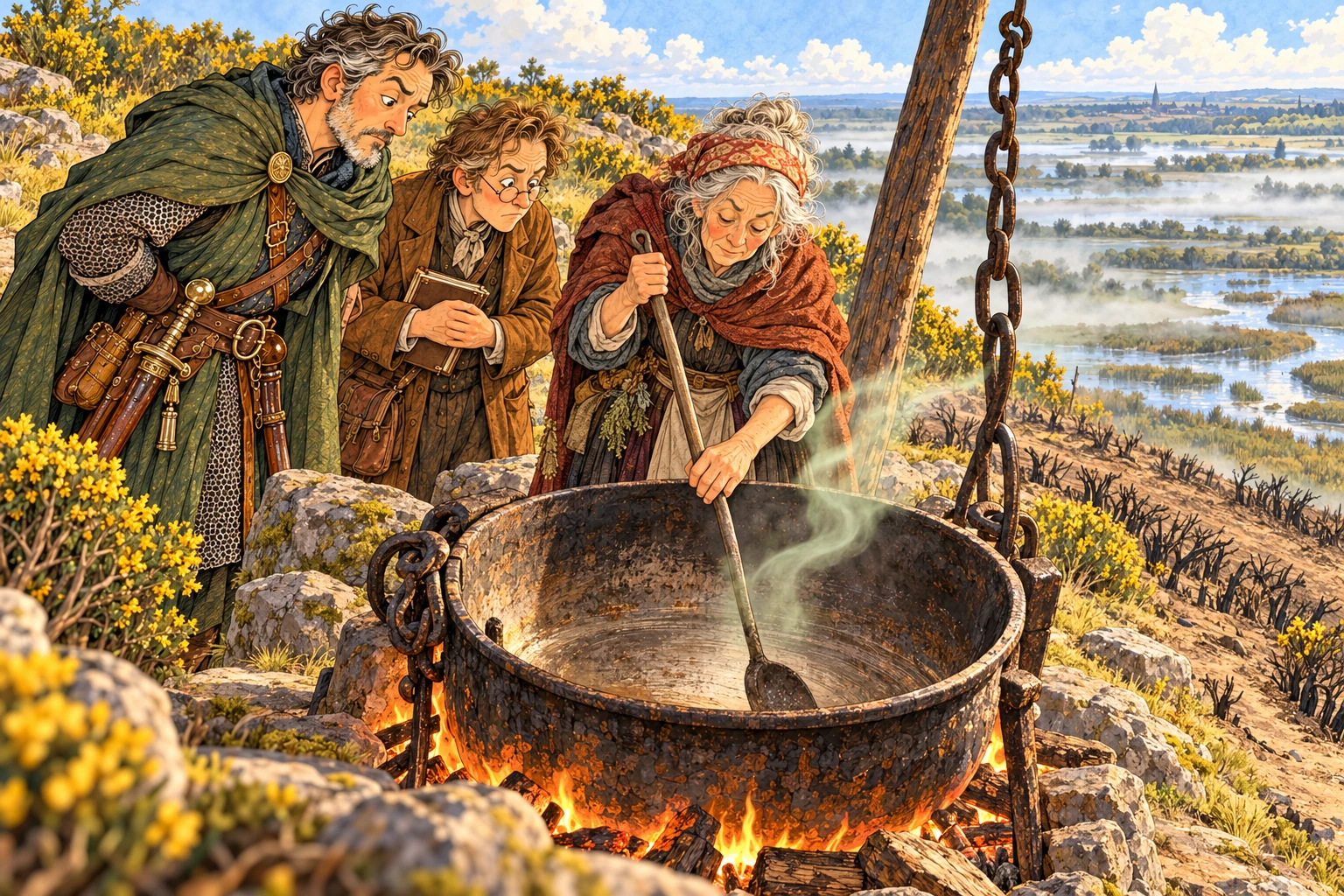
Sir Cardevane of Westmere had heard, from a source he considered reliable, that the green fog came from a witch.
This was not a single source, which made it more reliable in Sir Cardevane's view and less reliable in Bartholomew's. There had been four separate reports, from four separate villages, all in the hill country north of the Strand, all describing the same thing: a woman on the hill above the marsh, working a fire under a great black cauldron, and from the cauldron rising a green steam that thickened as it descended and lay over the low ground by morning.
"Four witnesses," said Sir Cardevane.
Bartholomew looked back down the road towards the four villages and their single market.
"They also share gossip," he said.
Sir Cardevane found this distinction unhelpful and said so. Bartholomew wrote it in his notebook. Sir Cardevane did not ask what.
They rode north in the third week of October, when the fog was thickest and the days were short. The hill country was high and bare, and its villages were small and full of people who had thought carefully about which questions to answer and which to let pass. When Sir Cardevane asked about the witch, the villagers said yes, there was a woman on the hill, and she had a cauldron, and the fire under it had been burning for as long as anyone could remember, and beyond that they did not find the subject interesting. They called her a witch with the careful politeness of people who had no intention of asking her to stop.
They found the path up the hill on the second morning, which was not a path exactly but a consistent absence of gorse. The fog was heavy enough that they could hear the fire before they could see it: not the crackling of ordinary fire but the low continuous work of something that had been burning long enough to have settled into it.
Bartholomew stopped partway up and looked at the gorse on either side of the path.
"This has been cleared," he said.
"We can see that," said Sir Cardevane.
"Not cleared. Cooked back." He crouched by the margin. The gorse was dead at the roots, not cut, not pulled. The stems were intact. Only the roots had given up. "And it grows wider each year. You can see the old margins further in, where the new growth hasn't covered them yet."
"Wider towards the hill, or wider towards the marsh?"
Bartholomew looked at the dead margins. At the lines of old boundary inside the new ones.
"Towards the marsh," he said.
Sir Cardevane looked up the hill and did not speak for a moment. They climbed on.
The cauldron was large. Very large. It sat on a frame of black iron over a fire that was doing exactly what fires do: burning steadily, producing heat, turning wood to ash. The ash beneath it was deep and the iron of the frame had the colour of something that has not been cold in years. The woman stood beside it with a long-handled implement, stirring. She was old, practically dressed, and entirely occupied with the stirring. She did not look up when they arrived.
The cauldron was empty. It held only the cold air of an enclosed space. Sir Cardevane walked around it and looked in from three angles; every angle showed the same bare iron. He leaned over the rim. At the bottom, the black iron was worn smooth in a circle, just visible in the firelight.
She was stirring an empty cauldron. The long handle moved through nothing with the effort of moving through something.
"You," said Sir Cardevane. "You are producing the fog."
The woman looked at him for the first time. She had the expression of someone who has been interrupted in the middle of a long and exacting piece of work by a person who does not understand what the work is.
"No," she said.
"The villages all say..."
"I know what the villages say. They see the cauldron, they see the fog. They draw the conclusion people draw." She went back to stirring. "The fog was here before I was."
"Then what are you doing?"
"Cooking it out," she said.
"Out of what?"
She stirred.
"That is one of the questions."
Sir Cardevane looked at the empty interior. At the fire beneath it. At the thirty-year arc in the iron.
"What is your name?" he asked.
She glanced at him, briefly. "Olla."
"Why did you start, Olla?"
She did not stop stirring. "The marsh birds," she said. "They were flying wrong. Into windows. Into the sides of barns. Into wells." She paused. "I had a cauldron. I had a fire. I knew that heat disperses the fog, at least for a morning. The first night I kept the fire burning, I found no dead birds at my window in the morning. One bird that had always flown into my lintel flew straight past it."
"That could be chance," said Bartholomew.
"Yes," said Olla. "It could."
She stirred.
"What was in it?" Bartholomew asked. He had been standing at a slight distance, writing with the speed of someone afraid the situation would resolve before he had finished noting it.
"Fog," she said.
"And now?"
"Now it is empty."
"Where did it go?"
She looked at the cauldron.
"Into the villages below. Into sealed jars. Into butter churns after pressing. Into the space under linen that has been folded a long time." She paused. "It finds the places that have forgotten they contain air."
Something moved below the hill. Bartholomew saw it first. A thin green thread rose from the lower marsh and drifted up the path they had climbed. Olla saw it too and said nothing. The thread reached the hill and curled towards the fire. At the rim of the cauldron it slowed. It hung in the heat at the rim, trembling above the iron.
Olla stirred. The thread came apart above the rim and was gone. "It comes back," she said. "Eventually."
"Then it hasn't gone anywhere," said Sir Cardevane.
Olla kept stirring. The handle completed another slow circle before she answered. "There is less when it comes back."
"Has it changed?" said Sir Cardevane. "The fog. Over thirty years."
She looked at the cauldron.
"Ask me in another thirty years," she said.
"Does it work?" said Sir Cardevane.
Olla watched the fire rather than him. "On some mornings there is less fog. On some mornings there is not."
Sir Cardevane waited for more. None came.
"Then why continue?" said Sir Cardevane. "If you do not know whether it works."
Olla looked down at the fog below the hill. "I have never left the fire out long enough to find out," she said.
Bartholomew stopped writing. Sir Cardevane looked at the empty cauldron. The long handle rested against its rim. Nothing moved inside it. At the bottom, the old circle shone in the iron.
"Thirty years," said Sir Cardevane.
He put one hand on the long handle. Olla did not let go. The handle resisted his hand. The iron was not heavy enough to explain it.
He took his hand away.
"Thirty years."
"And you have not stopped."
She looked at him and said nothing more.
Sir Cardevane stood at the edge of the hill and looked out at the fog below. It lay thick and still across the marsh. Perhaps less. Perhaps not.
"If you cook it all out," he said. "What happens then?"
Olla stirred.
"I will tell you," she said, "if I finish."
They descended the hill in the early afternoon. The fog closed around them as they reached the lower path. At the bottom, Bartholomew stopped and set one heel against a stone he had marked when they came up.
The margin of dead gorse was wider than it had been two hours ago.
He did not say anything. He took out the notebook and made a note, and then looked at the note, and then closed the notebook.
At the road, Sir Cardevane stopped and looked back up through the fog. He could see the glow of the fire on the hill, faint and orange, and above it a thin column of smoke going straight up into the still air.
"Write down that we found the witch," he said.
"I have written that," said Bartholomew.
"Write that she was not making the fog."
"I have written that too."
"Write that she has been tending it for thirty years."
"Done."
"And that it may be working," said Sir Cardevane. "Slightly. On some mornings."
Bartholomew wrote this and did not comment on it. Then he wrote one more line, which Sir Cardevane saw but did not ask about.
They rode in silence for some time. The fog stayed at the same height beside the road as it had in the lower marsh.
"She was there before us," said Sir Cardevane eventually.
"Considerably before," said Bartholomew.
"And she does not know if it works."
"No."
Sir Cardevane was quiet for a while.
"Do you think she will stop?" he asked.
Bartholomew looked back towards the hill. The fire was hidden by fog.
"No," he said. "I don't think she will."
At the inn that night, Sir Cardevane ordered soup. It arrived hot. He did not eat it. He sat and watched it cool, which took some time, the bowl being thick and the evening not especially cold. When the soup was still, he picked up the spoon and stirred it once, slowly. The soup turned, then settled. He put the spoon down. He went to bed.
In the morning the fire on the hill was still burning. He could not see it from the window of the inn. He did not need to.
Case 8
Mermaid's Song
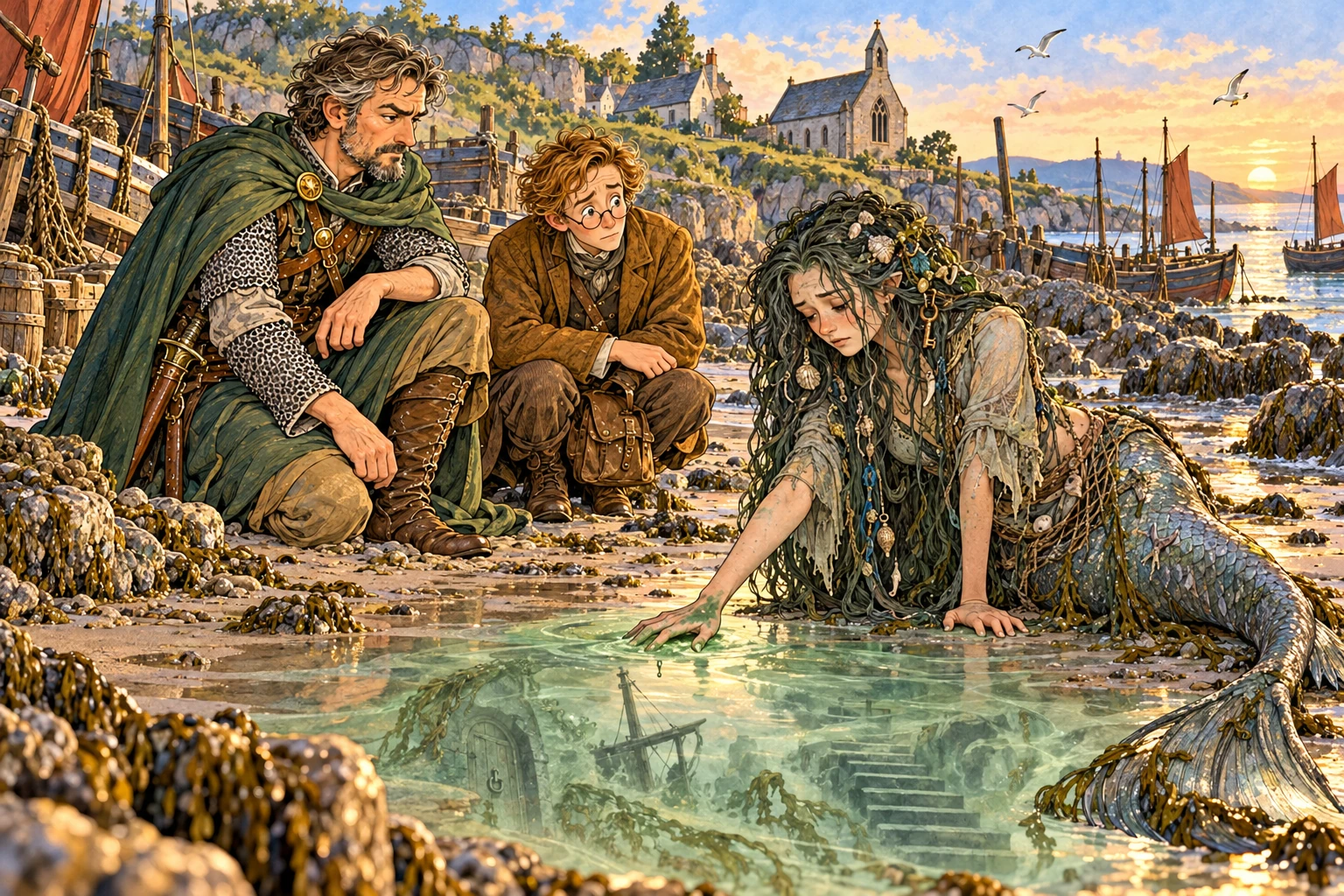
Sir Cardevane of Westmere had heard, from a source he considered unusually damp but otherwise credible, that the green fog came from a mermaid.
The source was a fisherman from Low Kettle Cove, who had rowed six miles upriver to say so and had brought, as evidence, a bucket of seawater.
Bartholomew looked into the bucket. "It is water," he said.
"Sea water," said the fisherman.
"We are aware of the sea."
"Not this kind," said the fisherman.
Sir Cardevane leaned over the bucket. The water was grey and ordinary, except that a faint green cloud moved inside it when the bucket was still. "There," said Sir Cardevane.
"Sediment," said Bartholomew.
"It is moving upward."
"Ambitious sediment."
The fisherman took off his cap. His hair was flat with salt.
"She sings when the tide turns," he said. "Three nights I heard her. Three nights the fog came up from the shore after. My brother found a crab in his boot that had been burned black on one side and frozen on the other."
Sir Cardevane looked at Bartholomew. "That," he said, "is not sediment."
"No," said Bartholomew. "That is an unfortunate crab."
"The song," said Sir Cardevane, "is the mechanism."
"A song may simply be a song."
"A song can be a mechanism."
"So can a cough," said Bartholomew, "but I do not accuse it of masonry."
Sir Cardevane found this unhelpful and had it entered in the notes as an objection of low value.
They rode to Low Kettle Cove two days later, taking the west road where the land flattened towards the salt marsh. The trees became smaller. The fields became meaner. Birds stood in pools that had no business being pools. By evening the road had narrowed to a causeway between wet grass and darker wet grass, and the fog lay along the ditches in long green folds. Low Kettle Cove was not large enough to be properly suspicious of strangers, but it did its best. It had twelve houses, a chapel with no bell, a smokehouse, three boats drawn up above the tide line, and a row of nets hung between posts like old skins. The sea lay beyond the cove, flat and pewter-coloured. At the edge of the water, black rocks rose from the sand.
On the highest rock sat a woman.
Sir Cardevane stopped his horse. "There," he said.
"That is certainly a woman," said Bartholomew.
"On a rock."
"Women are known to sit."
"At low tide?"
"Less commonly."
The woman turned her head. Her hair was not golden. Sir Cardevane had expected golden hair, though he would not have admitted it. It was dark green and grey, heavy with salt, and hung in ropes over her shoulders. Her skin was the colour of wet stone. From the waist down she was scaled, but not prettily. The scales were dull and close-set, scratched white in places, like old armour dragged across shingle. In her hair were shells, fishhooks, a length of blue thread, three small bones, and a key so rusted it could no longer have opened anything sensible.
She was singing. It was not a pretty song. It had no words Sir Cardevane could hear. It moved in long notes that rose and dropped with the tide, or perhaps the tide rose and dropped with it. The sound made the ropes on the posts tighten. It made the empty boats settle more deeply into the sand. It made Bartholomew stop writing.
"Do you hear that?" asked Sir Cardevane.
"Yes," said Bartholomew.
"Write it down."
"I cannot."
"Why not?"
Bartholomew looked irritated, which usually meant he had encountered something true and inconvenient.
"Because it is not staying in words."
The mermaid stopped singing. A broad swell crossed the sea without reaching the shore. Sir Cardevane dismounted and walked across the sand. Bartholomew followed, holding his notebook against his chest with the care of a man protecting the only orderly object in a disorderly place. The mermaid watched them approach.
Her speaking voice was rougher than Sir Cardevane had expected, water-worn and low.
"You are trespassing," she said.
"This is land," said Sir Cardevane.
"Temporarily."
Sir Cardevane had no immediate answer, which annoyed him.
"I am Sir Cardevane of Westmere."
"I had not wondered."
"This is my clerk, Bartholomew."
"I had not wondered that either."
Bartholomew looked faintly pleased.
Sir Cardevane stood at the foot of the rock and looked up. The mermaid looked down. "You have been singing," he said. "The fisherman says the fog comes ashore afterwards."
The mermaid pulled a fishhook from her hair and examined the rust on it. "Sometimes it does."
"Then you are calling it."
She dropped the hook into the water. "You have put the events in the wrong order," she said.
The mermaid leaned forward. A strand of weed slid from her shoulder and fell against the rock with a wet sound.
"You hear the song after you notice the tide."
Bartholomew began writing again.
"You sing," said Sir Cardevane. "The tide turns. The fog arrives. People are inconvenienced. Crabs become contradictory."
"That crab was already unwell."
"The crab is not the point."
"No," said the mermaid. "It rarely is."
"If you are not calling the fog, what are you calling?"
The mermaid looked beyond him towards the stranded boats. "The sea."
Bartholomew followed her gaze. "What is it failing to do?"
The mermaid looked at him then, properly. "The part that stops."
Behind her, the tide pulled back from the rocks. Something green moved in the wet sand, not fog as Sir Cardevane knew it in the fields and roads. This lay flatter, thinner. It spread over the sand in a skin, slipping into hoofprints and shell hollows, filling them from below. Small fish flickered inside it, though there was no water deep enough for fish. One of the boats creaked on dry sand.
From under the beach came a single dull bell note. The villagers had gathered by the posts. No one came closer. One woman had covered her child's ears before the mermaid sang. An old man had taken off his hat, not in greeting, but in warning.
The mermaid sang again. The note moved past Sir Cardevane and across the wet sand. Ripples crossed the sea, followed by a long slow pull. The green skin lay at the waterline. The mermaid sang lower. The tide drew back an inch, then another. A fish lay on the wet sand, shuddering. The sea reached it and took it. The mermaid ended the note with her mouth closed.
She kept her mouth closed after the note ended. When she opened it again, she ran her tongue along the inside of her teeth.
Sir Cardevane looked at the water. The tide line held.
"You are not bringing the fog," he said.
"No."
"You are reminding the shore where to end."
The mermaid looked at the wet sand, the pulled boats, the nets, the chapel without a bell, the houses set too low, built for a kinder tide than the one now coming. "Someone must."
Sir Cardevane looked at the wet sand. It did not look like it intended to testify for him.
The fisherman who had brought the bucket stepped forward. "Ask her why she only sings when it is already coming," he said.
The mermaid turned her face towards him. "Because before that, you do not listen."
"My boy heard singing under the floorboards last winter," he said. "Said there was a woman calling him into the tide."
The mermaid looked at him for a long moment. "There was."
The village went very still.
Sir Cardevane put one hand on his sword.
The mermaid looked at the sword without interest. "Not me," she said.
The fisherman's face had gone the colour of beach sand in flat light.
"Was it the bell?" he asked.
"No," said the mermaid.
"Then what?"
She looked at the sea. "There are things in deep water that do not like to remain there. Wrecks. Bells. Names." She paused. "Things that make sounds close enough to singing. When fog fills the seam between plank and hull, between bone and name, they come through it."
"And they come through with the fog?" asked Bartholomew.
"No," said the mermaid. "It gives them a way."
Sir Cardevane lowered his hand from the sword, slowly enough that no one would think he had been mistaken.
"Your dead are not always patient," said the mermaid.
The fisherman looked towards the chapel.
"So I sing."
"And if you stopped?" asked Sir Cardevane.
She smiled then. It had no cruelty in it. That made it worse. "If I stopped, you would hear the bell from the chapel."
"The chapel has no bell," said Bartholomew.
"Yes," said the mermaid.
A wave ran up the sand farther than it should have and withdrew. In the line it left behind was a chapel bell clapper, black with salt. It lay there like the tongue of something that had lost its mouth.
Bartholomew looked towards the chapel. It still had no bell.
The fog had thinned near the waterline but lay in streaks across the sand. One streak reached the nearest boat and passed under it. The boat lifted, not enough to float, but enough to make its shadow move the wrong way. The sand beneath the hull rose once, slowly, then settled. The mermaid saw it. The boat dropped back onto the sand as the tide drew away. Something underneath it sighed. The mermaid sang one sharp note.
Sir Cardevane drew his sword. "Is there something under that boat?"
"Not yet," said the mermaid.
She slid down from the rock with a sound like stones turning in a bucket. On the sand she moved badly, dragging the scaled part of herself with both hands. The villagers stepped back. Sir Cardevane did not, though he wanted to.
The mermaid reached the streak of fog and pressed one palm flat into it. The green gathered around her fingers. She sang again, quietly. Water shivered around her hand. Sir Cardevane saw shapes beneath the thin green layer: a door floating sideways, a mast, a staircase descending into sand. Then the next wave covered the place and everything was only wet.
The mermaid lifted her hand. Her palm was bleeding green. She closed her hand slowly, as if each finger had to be remembered.
Bartholomew did not look away.
"Does it hurt?" he asked.
"Yes."
"Why do it?"
She looked at him. "Because hurting me does not make it welcome."
She looked at her closed hand for a moment.
"It used to hurt less," she said.
She said it without complaint. For her, it was simply a fact.
"You cannot keep doing this forever," said Sir Cardevane.
"No."
"Then why continue?"
The mermaid looked towards the horizon. The sun was almost gone. The sea had become the colour of pewter left in ashes. The mermaid touched the rusted key in her hair. "That used to open our door," she said. "The house is under the third black rock now."
She let the key fall against her shoulder. "Because the tide only needs to be held until it turns."
Sir Cardevane said nothing. He had begun to dislike things that only held until morning.
"It is a hand on a door," he said.
"Until the tide turns," said Bartholomew.
"All night," said Sir Cardevane.
The mermaid did not smile.
"There is a name down there," she said. "It answers when I do not."
Sir Cardevane looked at her.
She looked back at the sea. "Sometimes a knight can hear," she said.
The tide moved properly then. The sea returned to its work. It covered the streaks of fog, took the shells, lifted the boats by their ropes and set them down again. The green withdrew from the sand, thread by thread.
The mermaid dragged herself back to the rock.
Sir Cardevane moved to help her, then stopped, unsure whether helping a mermaid onto a rock counted as courtesy, interference, or maritime policy.
She noticed.
"No," she said.
"I had not offered."
"You were about to."
"Only in principle."
"Keep your principles dry."
Bartholomew wrote that down with visible satisfaction.
When she reached the rock, she turned back. "You came to find the source," she said.
"Yes."
"And now?"
Sir Cardevane looked at the cove. The fisherman still held the bell clapper against his chest, as if returning it to somewhere it had never been. The chapel without a bell stood above the houses, its little cross black against the evening. The sea lay where it ought to lie. Sir Cardevane no longer trusted this as a permanent arrangement. "We found a singer," he said.
The mermaid nodded.
They left Low Kettle Cove the next morning. At the rise above the cove, Sir Cardevane stopped and looked back. The mermaid was on the rock again. From that distance she was only a dark mark against the water. Her song did not reach them. The tide moved around the stones.
"Write down that the mermaid does not call the fog," said Sir Cardevane.
"I have written that."
"Write that she sings to the sea."
"I have written that too."
"Write that the song reminds the shore where to end."
Bartholomew wrote.
"Is that what it does?" he asked.
Sir Cardevane looked at the cove.
"No," he said. "But it is the closest sentence we have."
They rode inland. By noon the smell of salt had faded. By evening the road was hard under the horses, and the fog lay in the fields where fog belonged.
Bartholomew let the silence do its work.
At the inn that night, Sir Cardevane found a shell in his boot. It was small and white, ridged like a folded ear. He placed it on the table. A bead of water formed beneath it, though the shell was dry. Then he lifted it to his ear. The sea was there. Then, beneath it, the song. A single note, held where sound becomes warning. He lowered the shell.
"Well?" asked Bartholomew.
Sir Cardevane looked at the shell. No sand on the table. The bead of water had gone. No mark.
On the table beside it, though he could not have said when it arrived, was another bell clapper, the length of his thumb. Black with salt.
He looked at it.
"Do not write that down yet," he said.
Bartholomew already had.
"Why not?"
Sir Cardevane looked towards the dark inn window. For a moment, in the glass, the room behind him looked like water. From somewhere in the floor below, just once, came a sound like a child turning over in sleep.
"Because I am not sure," he said, "which side of the shore I heard it from."
Case 9
Queen Who Feared Warmth
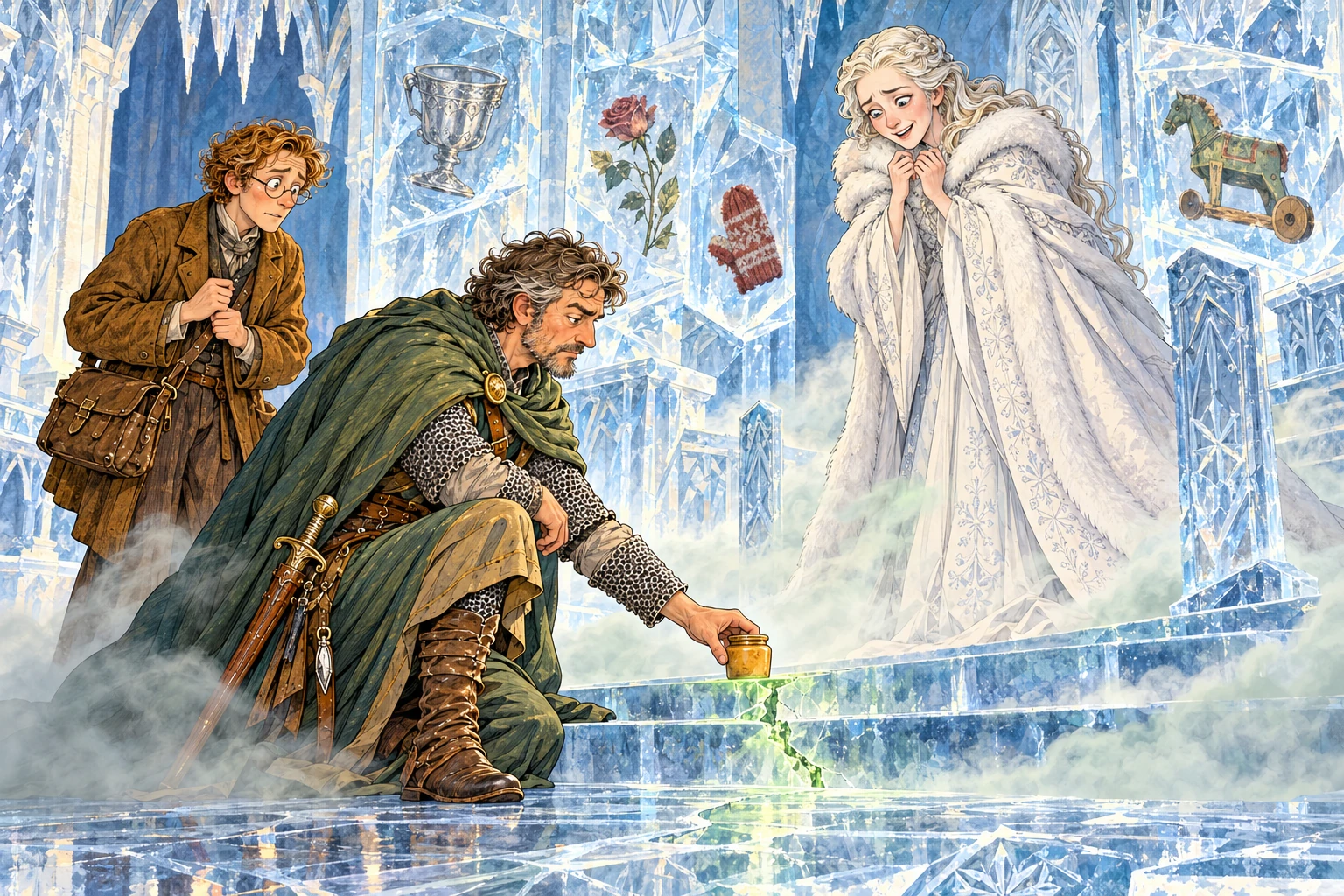
Sir Cardevane of Westmere had heard, from a source he considered frozen enough to be persuasive, that the green fog came from the far north.
The source was a merchant from Vell, who had arrived at the Marsh Road Inn with frost in his beard, two dead mules, and a crate of fish that had remained frozen all the way to the coast despite it being late summer.
"This," said Sir Cardevane, "is evidence."
"It is fish," said Bartholomew.
"Preserved fish."
"Cold fish."
"Cold fish from the north."
"That is where cold fish tend to come from."
The merchant sat by the fire with both hands around a cup of hot cider. He had not removed his coat. He had not stopped shivering. "It was not natural cold," he said.
Bartholomew opened his notebook.
"Cold rarely is, in stories."
"I saw her," said the merchant.
Sir Cardevane leaned forward. "Whom?"
"The Ice Queen."
Bartholomew looked up. "I have never seen an Ice Queen in any record."
The merchant stared at him. "That is what I thought before she asked me my name."
Sir Cardevane nodded gravely. "A common error."
Bartholomew wrote: alleged monarch, temperature-based.
"She lives beyond the White Tarns," said the merchant. "Past the stone road, past the standing bones, in a palace made of winter."
"Made of winter?" said Bartholomew.
"I am reporting faithfully," said the merchant.
"Not helpfully."
The merchant ignored him.
"The valley was full of a dry, bitter fog, stranger than ours. It moved like breath, but no one was breathing. It curled round the towers and lay across the courtyards. It glittered."
"Green?" asked Sir Cardevane.
The merchant frowned. "No. White."
Sir Cardevane sat back. "That complicates the matter."
"Only slightly," said Bartholomew. "It is already impossible."
"But when it touched the lanterns," said the merchant, "there was green inside it. Just for a moment. Like light under ice."
Sir Cardevane struck the table. "There."
Bartholomew set down his pen. "And you came south instead of staying in a palace made of winter because?"
The merchant swallowed. "She asked me what I loved most."
"A discourteous question," said Sir Cardevane.
"I answered."
"An imprudent answer," said Bartholomew.
"She showed it to me in the fog."
The fire popped.
The merchant looked into his cup as if something might climb out of it. "My wife," he said. "Young again. Under the apple tree behind our first house. She has been dead eleven years."
Sir Cardevane's face changed. Only slightly. Bartholomew noticed.
"She asked if I wanted her kept there," said the merchant. "Where she would never age, never suffer, never leave. I only had to stay."
"And what did you say?" asked Sir Cardevane.
"I said she had already left. And that was part of loving her."
Bartholomew set down his pen.
"She wept," said the merchant. "But the tears froze before they reached her chin. They fell like glass beads. The fog took them."
"Green?" asked Sir Cardevane.
The merchant nodded. "Just a little."
Sir Cardevane stood. "Then we go north."
"No," said Bartholomew.
"We have a lead."
"We have fish," Bartholomew said dryly.
"We have motive, method and atmospheric irregularity."
"We have a man who followed a vanishing road into a weather condition and returned with emotional damage."
"Exactly."
"That was not agreement."
Sir Cardevane took his cloak from the back of the chair.
"Prepare the northern kit."
"We do not have a northern kit."
"Then prepare the things that look least southern."
Three days later, Sir Cardevane and Bartholomew left Westmere with two ponies, six blankets, four tins of beef, a coil of rope, three pairs of gloves, a brass field compass, a shovel, a jar of mustard, a ceremonial fur hat borrowed from a retired ambassador, and a small book titled Practical Etiquette for Cold Courts.
Bartholomew had objected to the mustard.
"It prevents freezing," said Sir Cardevane.
"In what?"
"In morale."
By the fifth day, the road had narrowed to a grey line between white hills. By the seventh, they had passed the last trees. By the ninth, even Sir Cardevane had admitted that the fur hat was less ceremonial than hostile. "It grips the ears," he said.
"It is a dead animal making a final argument," said Bartholomew.
The north did not arrive all at once. It gathered. First in the ditches. Then in the stones. Then in the silence between hoofbeats. Villages became fewer. Chimneys smoked less. Doors were opened only a hand's width.
North of the White Tarns, their guide left them. He was a broad man called Odran, whose beard had collected so much ice that his face looked fenced in. "I go no farther," he said.
"Why?" asked Sir Cardevane.
"My moustache objects."
"On practical or spiritual grounds?"
"Both."
Bartholomew looked ahead. The valley beyond them was white, but not with snow. A low fog moved between black stones. It did not drift. It stayed between the black stones.
Sir Cardevane adjusted the ceremonial hat.
"Very well. Bartholomew, note that the final witness withdrew for reasons of facial governance."
"I am not writing that."
They entered the valley on foot. The ponies would not follow. They turned their backs and stared south with the moral firmness of senior judges. The fog came first around their boots. It was not like the marsh fog. That crept and clung. This fog stayed several feet from their boots at first. It was white where it lay on the ground, silver where it caught the light, and, now and then, green deep within itself.
"Do you see that?" asked Sir Cardevane.
"No," said Bartholomew.
"You did not look."
"I have found that looking encourages phenomena."
They walked until the sky lost all direction. The stones towered over them. The air thinned until breathing required more attention than Sir Cardevane thought strictly necessary. Then the palace appeared. It did not rise from the valley. It clarified. One moment there was fog. The next there were towers, walls and high windows, all made of ice so clear that Sir Cardevane could see darkness trapped inside them. The gates stood open.
"That," said Sir Cardevane, "is a palace."
Bartholomew looked at the gates.
"It is at least guilty of architecture."
The gates breathed. They went in. The courtyard was empty. No guards stood at the doors. No servants crossed the paving. There were fountains, but the water in them had frozen while falling, so each fountain held a still explosion. Sir Cardevane approached one and tapped it with his glove.
"Remarkable."
"Please do not test royal plumbing."
Beyond the courtyard, a hall opened under a roof of blue ice. There were things inside the walls. A bird with its wings spread. A silver cup. A rose. A child's mitten. A small wooden horse, its paint green, one wheel missing. A letter folded but not sealed.
Bartholomew stopped beside the letter.
"Do not read it," said Sir Cardevane.
"I cannot. It is inside the wall."
"All the same."
At the far end of the hall stood the queen.
She wore no crown. Or perhaps the crown was the cold itself, gathered round her head in pale branches. Her cloak was white. Her face seemed young until she looked directly at you, and old after.
"You have come from the south," she said.
Her voice made no echo in the hall.
"I have," said Sir Cardevane. "Sir Cardevane of Westmere, investigator of atmospheric anomalies, sworn servant of truth, justice and practical footwear."
Bartholomew cleared his throat.
"Bartholomew," he said.
The queen looked at him. "Only Bartholomew?"
"Usually sufficient."
She turned back to Sir Cardevane. "Why have you come?"
"To establish whether your Majesty is the source of the green fog."
The fog along the floor thickened.
"I am not Majesty."
"Your Highness?"
"No."
"Your Coldness?"
Bartholomew closed his eyes.
The queen almost smiled. "Names are doors. I have closed mine."
Sir Cardevane nodded, as if this were sound court procedure. "Then I shall call you the Queen until corrected."
"You are already corrected."
"Noted."
Bartholomew did not write this down. There are limits.
The queen descended three steps. The fog remained close to her feet as she descended. "You seek the green fog," she said. "Why?"
"It has been troubling the marshes."
"Many things trouble marshes."
"Roads disappear in it, memories become unreliable, it enters houses through gaps, and several respectable witnesses have ended up speaking in riddles after exposure."
"Perhaps they were riddles already."
Sir Cardevane considered this. "Possible. But unproven."
The queen looked at Bartholomew. "And you?"
"I came because he did."
"That is not an answer."
"It is the commonest one."
For the first time, the queen looked away.
The hall grew colder.
"You should leave," she said.
Sir Cardevane brightened. "Ah. Then there is something to find."
"People find things here," said the queen. "They rarely leave happier."
The fog rose slowly.
It reached Sir Cardevane's knees. His boots vanished. Then his hands. A thread of it moved over Bartholomew's open notebook and lay across the page. Then it swallowed the hall.
"Bartholomew?" he said.
"I am here," said Bartholomew.
But he was not.
Sir Cardevane stood in a garden. Summer. Bees in the lavender and a low wall warm with sun. Beyond the wall, someone laughed. He knew the laugh. He knew the pause after it, too, when she would wait for him to say something foolish enough to make her laugh.
He was not wearing the fur hat.
The queen's voice came from everywhere.
"What do you love?"
Sir Cardevane looked at the low wall. "That," he said, "is an impertinent question."
"It is the only one."
"The only one is whether the green fog originates in this valley."
"No," said the queen. "You came here asking about the fog. You have avoided asking about her."
The sun was perfect. Too perfect. The lavender did not move unless he looked at it. The bees made no mistakes. The laugh came again, exactly as before, with the same pause after it.
At the edge of the garden, the fog lay green against the hedge.
"I can keep it for you," said the queen. "The hour before the loss. The face before illness. The voice before the last word. I can make a room where nothing arrives late."
Sir Cardevane was quiet for a moment.
"In ice?"
"In safety."
"That is not the same."
"It can be."
"No," said Sir Cardevane. "It can be mistaken for the same. That is different."
The garden dimmed. For one second the woman beyond the wall almost turned.
Sir Cardevane shut his eyes. When he opened them, he was in the hall again. The fog fell away from him in pale strips. He found that one hand had closed around nothing.
Bartholomew stood several yards off, his notebook clutched in one hand. His face was white. On the open page, written in his own hand over and over, were two words: returned alone.
"What did you see?" asked Sir Cardevane.
"Nothing worth recording."
"Then it was very bad."
"Yes."
The queen watched them both.
"You refused," she said.
"I objected," said Sir Cardevane. "There is a distinction."
"To what?"
"To keeping it after it should have been let go."
Something shut in the queen's face. "You speak as one who has lost little."
Sir Cardevane took a breath.
Bartholomew looked at him quickly.
"No," said Sir Cardevane. "I speak as one who has found foolishness a useful coat."
The hall was silent.
The queen looked at him for a long time. Then she said, "That is not as different as you think."
The fog moved around her. It rose to her waist, her shoulders, her throat. In it, shapes appeared. A small hand. A crown fallen on stone. A woman running through snow. A child's face turned towards a window. None lasted.
The queen lifted her hand. The wall beside her cleared.
Inside the ice lay a girl in a green dress, no older than twelve. Her eyes were closed. One hand rested near a small wooden horse, its paint green, one wheel missing.
"My sister," said the queen.
The green inside the ice brightened. It moved when the Queen did not.
"She was summer. That is what they called her. I hated it. They were right."
Sir Cardevane removed the fur hat. This was not etiquette. It was instinct. "She died?" he asked.
"She was loved," said the queen. "By everyone. By the court. By the servants. By strangers who saw her once. By me most of all."
"That is not death."
"No. That came after."
The queen touched the ice. Frost crawled up her fingers. "When she died, people kept telling me I would get used to it. I did not."
Bartholomew looked at the girl in the ice. "And so you froze her."
"I saved her."
"No," said Bartholomew.
Sir Cardevane turned slightly. Bartholomew almost never said no first.
The queen looked at him.
"No?"
"No," said Bartholomew again, more quietly. "You kept yourself from knowing she was gone."
The temperature dropped so fast that Sir Cardevane's breath struck the air like torn paper. The fog rushed across the floor. Ice climbed the pillars. The bird in the wall twitched once. Sir Cardevane stepped between Bartholomew and the queen.
"An excellent observation," he said, "poorly timed."
The queen's eyes were bright.
"You think warmth is noble because you still have rooms where it survived."
"I think warmth is inconvenient," said Sir Cardevane. "Often humiliating. Frequently badly governed. It causes letters, duels, songs, inheritances, poor decisions and unnecessary travel."
Bartholomew looked at him.
"Unnecessary?"
"Mostly."
The queen did not move.
Sir Cardevane took one step forward.
"But cold is worse."
A thin green fold lay between them.
"You cannot know," she said.
"No," said Sir Cardevane. "But I can suspect with unusual confidence."
He reached into his coat.
Bartholomew tensed.
Sir Cardevane removed the jar of mustard.
The queen stared at it.
"What is that?"
"Mustard."
"I can see that."
"It prevents freezing."
Bartholomew said, "It does not."
"In morale."
The queen looked from the jar to Sir Cardevane.
The queen looked at the mustard jar. "You brought this to a funeral conversation."
"I brought what I had."
This was so plainly true that no one could improve it.
Sir Cardevane set the jar on the lowest step of the dais.
The queen looked at the jar for a long time.
Then she laughed. It was not a large laugh. It did not echo through the palace. It did not break the curse, if curse there was. But it happened.
A finger-length crack ran through the ice beneath the jar. Green light moved inside it.
She looked at the crack, suddenly frightened by herself.
Then, very carefully, she did not mend it.
"You should leave," she said.
"We have not determined origin."
"You have determined enough."
"Enough is a dangerous scholarly category."
"Go."
The hall faded. The walls blurred. The girl in the green dress grew distant behind thickening ice.
Sir Cardevane bowed with unusual restraint.
Bartholomew did the same.
At the gate, Sir Cardevane turned back. The queen stood alone in the doorway of her frozen palace, fog gathered around her like a cloak she could not remove.
"One more question," he called.
"No."
"Does the green fog come from you?"
The queen looked past him, over the valley, towards lands she had not entered for years. "It was here before my palace," she said.
Sir Cardevane waited.
"There is more of it beyond the valley. I have never followed it there."
Bartholomew muttered, "Naturally."
The queen's voice softened.
"There was plenty of it in that room."
Then the palace vanished.
Sir Cardevane and Bartholomew stood in the valley with snow to their knees, their ponies nowhere in sight, the wind in their faces, and one brass compass pointing straight down. Bartholomew opened his notebook with stiff fingers.
"What shall I write?"
Sir Cardevane put the ceremonial fur hat back on.
"Write this. We found green fog in the northern valley."
"And the source?"
"Unknown."
"The worst kind of answer."
They walked back. It took them two days to find the ponies, who had joined a mining camp and were being fed with more respect than either man had expected. It took them seven days to leave the north. Twelve to return to Westmere. The jar of mustard did not return. This troubled Sir Cardevane more than the compass.
Weeks later, when the green fog came up from the marsh as it always did, Bartholomew noticed Sir Cardevane standing at the window. Across the field, in the shifting green, there was a single thread of white fog. It turned once in the air and vanished.
"That proves nothing," said Bartholomew.
"No," said Sir Cardevane.
He sounded almost pleased. "But it refuses to prove nothing in a very interesting way."
Bartholomew opened his notebook. Outside, the fog pressed softly against the glass.
Far to the north, in a palace that could not be reached by roads twice in the same way, the queen stood alone in the hall of preserved things. On the lowest step of the dais, where the mustard jar had stood, the crack in the ice had lengthened by the width of a thumb.
Case 10
Alchemist Who Could Not Believe Love
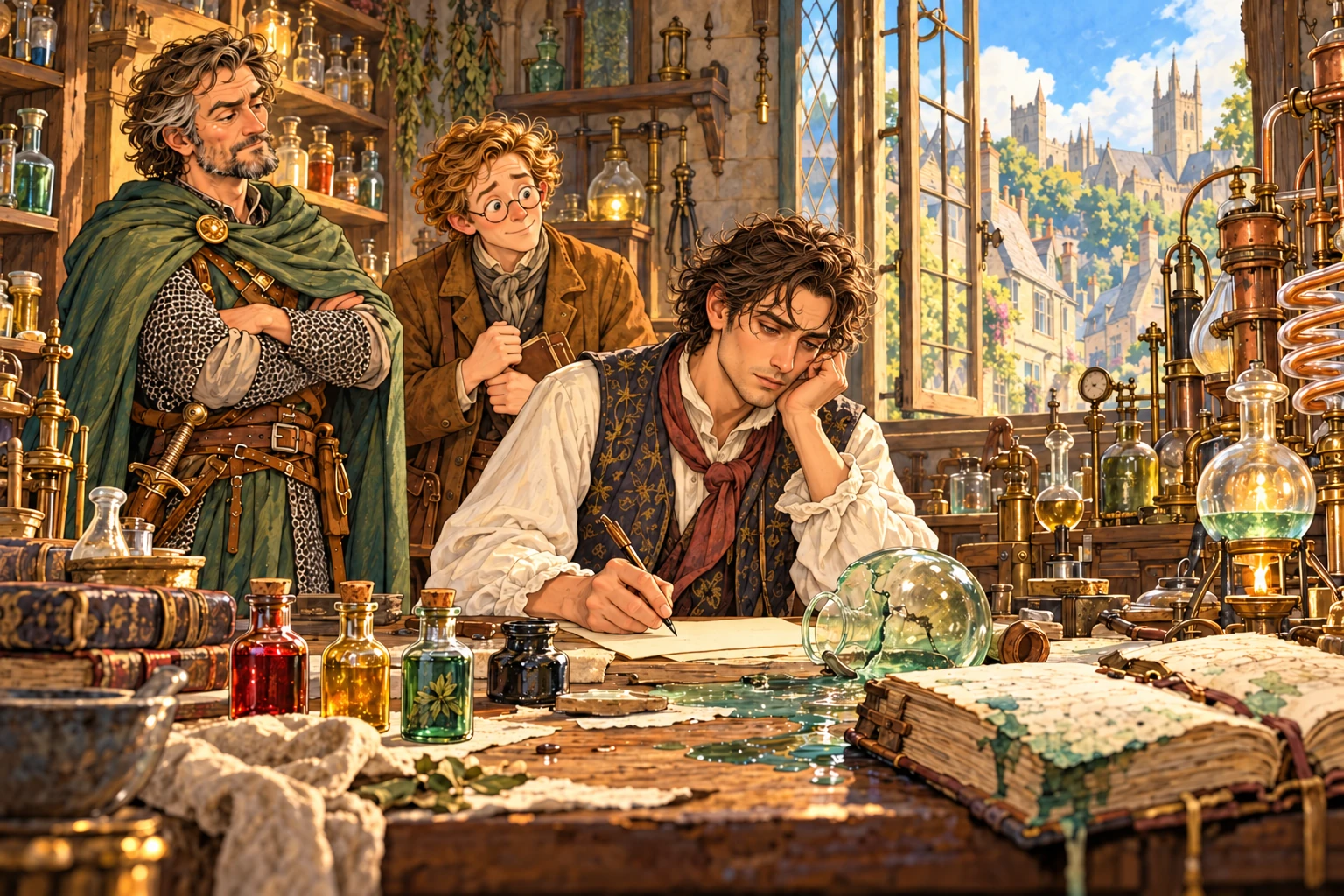
Sir Cardevane of Westmere had heard, from a source he considered unusually transparent, that the green fog had been put in bottles.
The source was Miss Elian Wetherby, a glassmaker from High Marrow Street. She entered the Marsh Road Inn with a wooden crate under one arm and the expression of a woman who had already tried being reasonable. She placed the crate on the table. Something inside it tapped the wood.
Bartholomew looked at the crate.
"If that is alive," he said, "I would prefer not to be introduced."
"It is not alive," said Miss Wetherby.
"If it is deceased, I would equally prefer not to be introduced."
Miss Wetherby opened the crate. Inside, cushioned with straw and old newspaper, stood a glass vessel no taller than a wine bottle. Wax sealed the top, and copper wire bound the neck. Green fog moved inside it. It clung to the glass in slow green folds.
Sir Cardevane leaned forward. "Bartholomew."
"I see it."
"It is in a bottle."
"I see that too."
"The implications are considerable."
"So are the risks."
Miss Wetherby picked up the bottle and held it to the light. The fog moved. It shifted, thinned, gathered.
Sir Cardevane watched it. "Does the fog turn with the bottle?"
"It did," said Miss Wetherby. "At first."
She turned the bottle slowly. The fog did not turn with the bottle. It did not press towards her. It simply moved, as fog does when air moves, except there was no air moving. Sir Cardevane noticed she had not looked directly at it since she took it from the crate.
"The man who owns it is an alchemist. He has forty-three more," she said.
"Then we go to the alchemist," said Sir Cardevane.
"No," said Bartholomew.
"There are forty-three more bottles to examine."
"We have fog that has changed inside a sealed bottle."
"An excellent reason to investigate."
"With the seal intact."
Miss Wetherby closed the crate. "I will take you there," she said. "But I will not stay."
Sir Cardevane paused. "Because of the fog?"
"Because of the man."
Bartholomew opened his notebook again. "A useful distinction."
The alchemist lived in a tower above High Marrow Street. It had once been a respectable observatory, until the previous owner looked through the telescope and did not like what looked back. The tower had narrow windows, copper gutters, and a chimney from which no smoke emerged. Instead, every few minutes, a pale green thread slipped into the air, curled once above the chimney, and dissolved over the rooftops.
Sir Cardevane studied it from the street. "Promising."
"Illegal," said Miss Wetherby.
"Possibly both."
Bartholomew looked up. "How did he obtain forty-four bottles of the fog?"
"He did not say."
"You made the bottles?"
"I made the first six. For vapour trials, he said. Then twelve more. Then he began asking for glass that could hold longing without clouding."
Sir Cardevane looked impressed. "Can it?"
"No," said Miss Wetherby. "But he pays in advance."
"An important scientific advantage," said Bartholomew.
They climbed the stair. The higher they went, the warmer the air became. The tower smelled of alcohol, metal, burnt sugar, old flowers, and something like rain caught in wool.
At the top, Miss Wetherby knocked once.
A voice called, "If this concerns delivery, leave it outside. If this concerns rent, return in a more philosophical mood. If this concerns error, specify which."
"It concerns fog," said Miss Wetherby.
Several bolts moved at once. The door opened.
Master Aureon Quill was younger than Sir Cardevane had expected and more beautiful than Bartholomew considered practical. He had the kind of face painters overuse in saints and disasters. His eyes were dark and tired. He watched every movement in the room.
"Miss Wetherby," he said.
"Master Quill."
He looked at the crate under her arm. "That bottle was not ready to travel."
"Neither am I," said Miss Wetherby. "Yet here we are."
His expression changed quickly. He looked at Miss Wetherby, then at the crate, then back at her, his mouth almost forming a smile. Then he saw Sir Cardevane.
"Ah."
Sir Cardevane bowed. "Sir Cardevane of Westmere, investigator of atmospheric irregularities, licensed interrupter of dangerous assumptions, and occasional witness to practical catastrophe."
The alchemist brightened. "At last."
Bartholomew murmured, "The most worrying greeting."
"Come in," said Master Quill. "Do not touch anything that hums. Do not inhale near the blue apparatus. Do not open the third cabinet unless you are prepared to be contradicted."
"By whom?" asked Sir Cardevane.
"That remains under review."
They entered. The laboratory occupied the entire upper room. It was a forest of glass. Retorts, tubes, coils, flasks, alembics and suspended vessels climbed the walls and crossed the ceiling. Copper pipes ran between them like disciplined vines. Small flames burned under bowls of coloured liquid. Brass instruments ticked. A wheel turned slowly with no visible purpose, which Sir Cardevane considered a sign of advanced science. At the centre stood a long bench. On it were bottles of green fog. Some were pale, almost silver. Others were deep green. A few were so dark that the glass around them seemed shadowed from within. Each bore a careful label.
MARSH FOG, UNFILTERED.
FOG EXPOSED TO GRAVEYARD SILENCE.
CONDENSATE OF UNDELIVERED LETTERS.
VAPOUR AFTER ARGUMENT, LOW PURITY.
FOG COLLECTED AT WEDDING, HIGH INSTABILITY.
RESIDUE OF ALMOST SPOKEN.
Bartholomew read the labels. He did not write anything down.
Sir Cardevane approached a bottle marked VOLATILE AFFECTION, DO NOT WARM. The fog inside shifted. He stepped back. It stilled.
"Remarkable."
"I think it responds to ambient conditions," said the alchemist. "Temperature. Proximity. Perhaps attention."
"Not intention?"
"Intention is a quality of attention."
Bartholomew kept looking at the bottles along the shelf. Near the end of the row, three vessels stood slightly apart. Their labels were in a different hand from the others. Smaller. More careful.
CONDENSATE OF LETTER WRITTEN BUT UNSENT. PRIVATE SOURCE. DO NOT OPEN.
SECOND CONDENSATE, SAME SOURCE. HIGHER PURITY.
THIRD. SOURCE DISCONTINUED.
Bartholomew looked at the handwriting on the labels. Then he looked at Miss Wetherby. Then he looked away.
Sir Cardevane did not notice.
Miss Wetherby set the crate on the bench. "I have brought Sir Cardevane because he follows the fog," she said. "Not because I intend to stand here while you test whether I mean what I say."
Master Quill's hand moved towards a notebook.
"Elian."
"No," she said. "That is a name, not a method."
The fog in several bottles shifted.
No one moved towards the bench.
The alchemist noticed. His eyes sharpened. He raised his pen.
Miss Wetherby saw it happen.
For a moment she looked less angry than tired.
"I loved you," she said.
The room went still.
Master Quill did not.
He glanced at the nearest gauge.
"Under elevated conditions."
Miss Wetherby stared at him. "That is what you heard?"
"It matters."
"Yes," she said. "That is what I have been saying."
She put on her gloves, finger by finger. "I am leaving before you turn my anger into a measurement."
"It would not be anger exactly," said Master Quill.
"That," said Miss Wetherby, "is why I am leaving."
She turned to Sir Cardevane.
"You have seen the bottles."
"I have."
"You have seen the man."
"I have begun to."
"Then I have finished my part."
She looked once more at Master Quill.
He opened his mouth, stopped, and started again.
Miss Wetherby left. Her steps went down the stair.
Her footsteps faded.
Bartholomew looked at the bench.
He did not look at the bottles. He looked at the space between them.
Sir Cardevane drew a breath and for once did not spend it immediately. He walked to the end of the shelf.
"These three," he said.
Master Quill looked up. "Private collection. Unrelated to the current formula."
"The handwriting on the labels."
"A cautious source. She asked not to be identified."
Sir Cardevane looked at the vessels. Then at the door through which Miss Wetherby had descended. "This time," he said, "I fear the conclusion is already doing the work."
Master Quill looked at the three bottles for a long moment. The fog inside each one was a different depth of green. The third was the darkest.
SOURCE DISCONTINUED.
"She stopped writing," said Bartholomew.
The alchemist sat down slowly, without meaning to.
"She should not have said that in the laboratory," said Master Quill.
"No," said Sir Cardevane. "Where would you recommend?"
"Under less contaminated conditions."
"Ah."
"Do not say ah."
"I apologize."
"No," said Master Quill. "You do not."
The laboratory hissed softly. Sir Cardevane looked at him.
"Did Miss Wetherby say she loved you?"
"Yes."
"And you are uncertain?"
"Speech is notoriously unstable."
"Not without testing the load," said Bartholomew.
Master Quill turned sharply. "You think this is vanity."
"No," said Bartholomew. "Vanity is usually less well labelled."
The alchemist looked down at the bench.
His face was still handsome. He turned one of the labels between his fingers and did not look towards the door.
Master Quill crossed to the bench and opened his great notebook. Several ribbons marked several failures. The page before him was covered in ratios, symbols, temperatures, times, and small corrections written in a hand that grew more desperate near the margins.
At the top of the page was written:
CERTAINTY OF RECIPROCATED LOVE.
Beneath it, in darker ink:
PENDING FINAL ANSWER.
Sir Cardevane leaned closer. "Ambitious."
"Necessary."
"Rarely the same."
Bartholomew glanced at Sir Cardevane. Surprise showed for a moment, then vanished. He looked back at his notebook and wrote nothing.
The alchemist pointed to the line of vessels.
Bartholomew looked at the label RESIDUE OF ALMOST SPOKEN.
"These have all been collected from other people."
"The fog selects."
"And you direct it."
"I refine it."
Master Quill lifted a vessel labelled FOG EXPOSED TO UNOPENED LETTER and placed it beside a folded sheet of paper under glass. The fog moved slowly towards the letter. It did not touch the paper. It could not. But the folded letter darkened at the edges. Damp spread outward from the fold.
Sir Cardevane's face lit. Bartholomew's did not.
"The difficulty," said Master Quill, "is response."
"From whom?" asked Sir Cardevane.
"Anyone."
The alchemist shut his eyes.
Sir Cardevane looked at the door.
"I believe she may already have supplied one."
The laboratory was quiet.
Master Quill took a silver mouthpiece from a velvet case.
Bartholomew stared at it.
"What is that?"
"The final instrument."
"Of course it is."
The mouthpiece was attached to a thin glass tube, which curved into the great vessel marked CERTAINTY. At the far end, a needle hovered above a dial with no numbers, only words.
PITY.
DESIRE.
HABIT.
VANITY.
TENDERNESS.
ERROR.
LOVE.
Sir Cardevane inspected it. "The order is contentious."
"It is alphabetical by intensity."
"That is not how alphabets work."
"It is a private alphabet."
"Those are dangerous in public instruments."
Master Quill took the mouthpiece.
"What do you intend to do?" asked Sir Cardevane.
"Introduce the final reagent."
Bartholomew studied the tubing. "No."
Sir Cardevane looked from the mouthpiece to Master Quill. "No," said Sir Cardevane. "He isn't measuring her."
Bartholomew looked at Master Quill. "Oh."
"I must speak into the system," said the alchemist.
"What must you speak?" asked Sir Cardevane.
"What she said."
Sir Cardevane was quiet.
"To her?"
"Into controlled glass."
"That is notably not her."
"The apparatus does not misunderstand."
"No," said Bartholomew. "It merely fails in more expensive ways."
Master Quill raised the mouthpiece. Sir Cardevane stepped forward.
"Master Quill."
"I must know whether it is true."
"Then why not say it to Miss Wetherby?"
"Because then it might become true in the wrong way."
"There are wrong ways?"
"There are many."
"And right ones?"
The alchemist looked lost. "I am attempting to isolate them."
The needle trembled.
PITY.
DESIRE.
TENDERNESS.
ERROR.
Back to TENDERNESS.
Sir Cardevane saw his own reflection in the glass. It looked worried, which he found professionally unhelpful.
Master Quill lifted the mouthpiece to his lips.
"I love," he began.
No one spoke.
The fog shifted inside the bottles on the shelves.
"I love…"
The word stopped in his throat.
The great vessel rang before he had finished it. Master Quill tried again. "I love Elian Wetherby."
The needle spun.
PITY.
DESIRE.
HABIT.
ERROR.
ERROR.
ERROR.
"Interesting," whispered Sir Cardevane.
"Terrible," said Bartholomew.
The glass tube filled with green.
Master Quill's eyes widened. "It is rejecting the statement."
"No," said Sir Cardevane. "The vessel has cracked."
A thin line ran down the glass from neck to base. Green fog pushed through it in a single thread, touched the air, and spread across the bench.
"We know the glass failed," said Sir Cardevane. "We do not know why."
Master Quill lunged for a clamp.
Sir Cardevane lunged for Master Quill.
Bartholomew, who had always suspected heroism would prove inconvenient, opened the window. The effect was immediate. The green fog streamed towards the opening.
"No!" cried Master Quill.
Sir Cardevane caught his sleeve. "Master Quill, I advise restraint."
"That is nine months of refined longing."
"It seemed restless."
"It is not safe outside."
"Very little is," said Bartholomew, holding the window open with both hands.
The fog rushed past him, out into High Marrow Street, where it turned once in the evening air and vanished between the chimneys. The laboratory went quiet. Only the flames under the smaller vessels remained, pale and uncertain.
Master Quill stood with the mouthpiece in one hand.
The cracked vessel stood empty except for a faint green stain on the glass. On the bench beside it, his great notebook lay open. The page had torn where he had written too hard.
CERTAINTY OF RECIPROCATED LOVE.
PENDING FINAL ANSWER.
Underneath, in smaller writing:
MUST BE OBTAINED WITHOUT RISK.
Sir Cardevane read it. Then he looked at the alchemist.
"Ah."
Master Quill lowered his head.
This time he did not object.
Sir Cardevane removed his hat. "You were not trying to make love," he said.
"No," said Master Quill.
"You built the machine so she would not have to answer you."
The alchemist gave a small laugh. It was not amused.
"Permission would have been enough."
"No," said Bartholomew. "You would have tested that too."
Master Quill looked at him.
Then at the open window.
Then at the empty vessel.
"Yes."
Sir Cardevane looked at the notebooks, the labels, the coils, the broken vessel, the open window. Then he opened one more bottle.
Bartholomew stared at him.
"It looked uncomfortable enough to deserve help," said Sir Cardevane.
The fog slipped out. For a moment it hung above the bench, pale green and almost transparent. Then it drifted to the open notebook. A small damp mark appeared beside MUST BE OBTAINED WITHOUT RISK. The mark spread. Ink ran unevenly across the page. The last two words blurred into a single green patch; the others faded beneath it.
Master Quill stared at the page.
"Water damage," said Bartholomew.
Sir Cardevane lifted the notebook from the wet bench. A dark crescent remained beneath it.
The ink continued to run.
The alchemist sat down slowly. He left his palms flat on the bench, on either side of the darkened notebook.
"Then I have nothing," he said.
Sir Cardevane looked at the cracked vessel, the darkened notebook, the three private bottles on the shelf. "No," he said. "You have what she said. That is not nothing."
The alchemist said nothing.
"Should I go after her?" he asked.
"Not tonight," said Bartholomew.
Master Quill flinched. "Because it is too late?"
"Because she left," said Bartholomew. "And for once in this tower, that should be allowed to mean something."
The alchemist bowed his head. "Then what?"
Sir Cardevane looked at the notebooks, the labels, the broken vessel. "Write it," said Sir Cardevane. "Do not test it first."
Master Quill looked horrified. "To whom?"
Sir Cardevane only looked at him.
"Ah," said Master Quill.
"Good," said Sir Cardevane. "You are learning the word."
The alchemist took a clean sheet of paper. His hand hovered above it for a long time. Bartholomew closed his notebook, then opened it again to a blank page. He did not prompt him.
At last Master Quill wrote:
Miss Wetherby,
Then he stopped. Beneath her name, the page was blank. The dials, vessels and needles stayed still.
Master Quill wrote one more line.
I believe you.
He stared at the sentence for a long time. He did not write that she should come back.
"It is scientifically indefensible," he said.
"For that reason," said Sir Cardevane, "it may be promising."
They closed the remaining bottles, though not as tightly as before.
Bartholomew closed his notebook rather carefully.
Sir Cardevane noticed and, for once, did not inquire.
At the door, Bartholomew looked back. The final vessel stood cracked and open. The great notebook lay beside it, its damaged page slowly drying. A little green fog still clung to the rim of the glass.
It stood uncorked.
"This proves very little," said Bartholomew.
"No," said Sir Cardevane.
"But it proves very little under unusually controlled conditions."
"That is worse."
They descended. When they reached the street, Miss Wetherby was gone. Master Quill did not run after her. Sir Cardevane approved of both facts, though for different reasons.
Far above High Marrow Street, the final vessel remained cracked. Beside it, the letter lay folded but not sealed. He had written only one sentence under Miss Wetherby's name.
It was not proof. For once, he had not improved it.
Case 11
Devil's Empty Chair
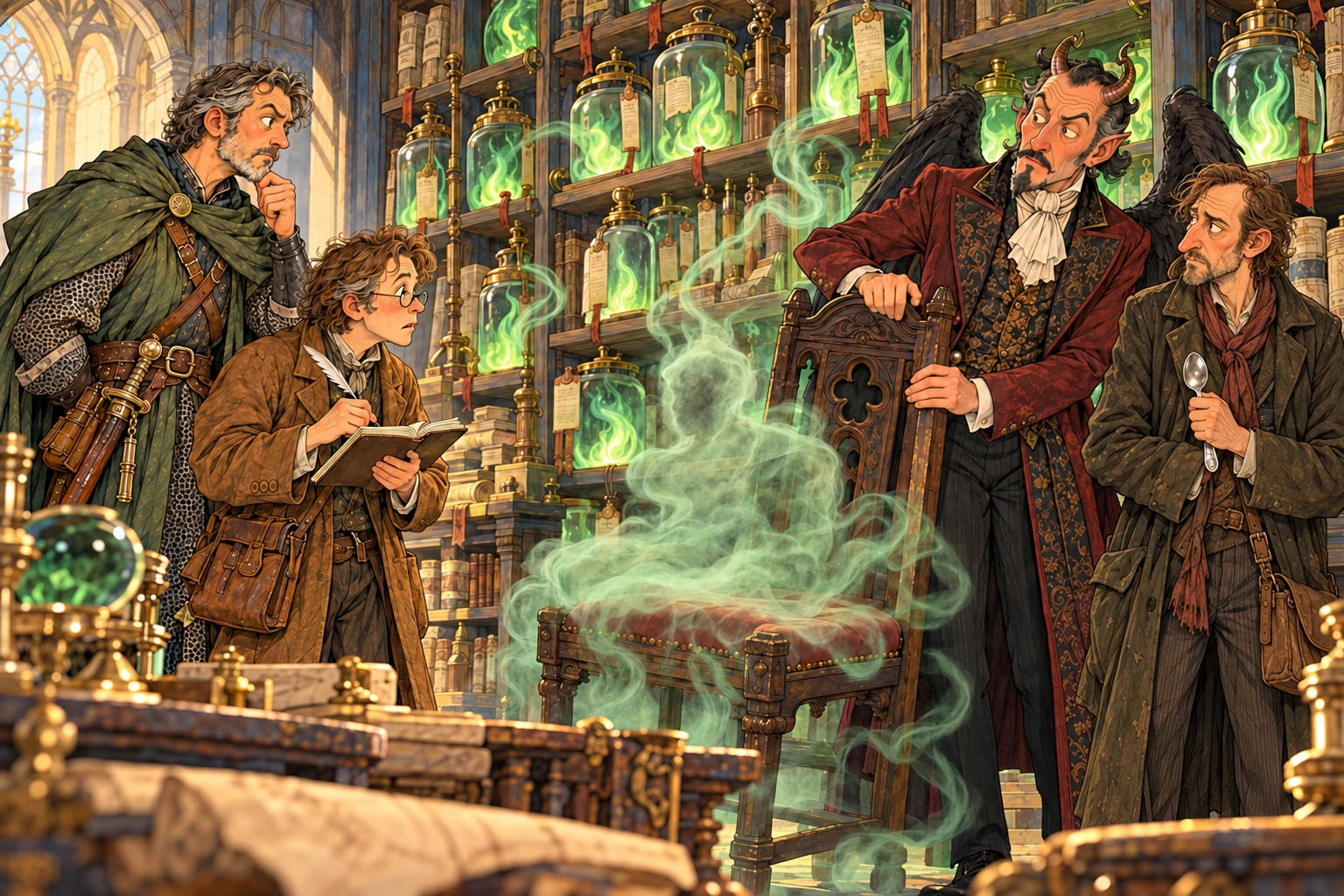
Sir Cardevane of Westmere had heard, from a source he considered admirably criminal, that the green fog came from Hell.
The source was a thief.
He had arrived at the inn with wet boots, a greenish complexion, and a piece of paper he kept folding and refolding as if he hoped it would become something else.
It did not.
"I stole a spoon," said the thief.
"From whom?" asked Bartholomew.
"The bishop."
"That seems theologically ambitious."
"It was a very good spoon."
The thief placed the paper on the table.
It was thin, green, and unpleasantly warm. At the top, in severe letters, stood:
ONE SOUL RECEIVED
PROVISIONAL
Below this was the thief's name, age, sins, fears, debts, lies, and one small note in a different hand.
Unclaimed affection. Review later.
Sir Cardevane frowned.
"That is an unusual category."
"I did not like it either," said the thief.
"What happened?"
The thief twisted his cap. "I went to return the spoon. Under the chapel. There are stairs. I was only going to leave it at the bottom and come back up."
"And?" asked Sir Cardevane.
"There was a man at a desk."
"In a chapel cellar?" asked Sir Cardevane.
"He had forms. He asked if I was arriving, returning, appealing, denying, or pretending not to know."
Bartholomew opened his notebook.
"Pretending not to know is an administrative category."
"It was the longest queue."
Sir Cardevane looked at the receipt. The ink was green. The green was not ordinary. It moved slightly when he tilted the paper.
"I did not sign it," said the thief. "He said he had a provisional claim. He said unclaimed affection counted as a kind of debt."
"Did he say what it meant?"
"He said review later."
"That is not comforting."
"No."
Sir Cardevane folded the receipt.
"Bartholomew."
"No."
"We must go to Hell to appeal this receipt."
"That is exactly what I was afraid you would say."
"You may bring your notebook."
"That makes it worse."
The thief looked at them both.
"Do I have to come?"
"It is your soul," said Sir Cardevane. "You may send a representative if you prefer."
The thief thought about this. "I will come," he said.
They left for the chapel that afternoon.
The thief's name, it emerged, was Pip.
He had a narrow face, quick hands, and the alertness of a man who expected everything to cost more than it appeared.
He had stolen, by his own count, forty-three spoons, seven candlesticks, two mirrors, and one hat belonging to an archdeacon who had, in Pip's view, insufficient hair for the hat he owned.
"I regret three of the spoons," he said, on the road.
"Only three?" asked Bartholomew.
"The others were genuinely surplus."
Sir Cardevane rode ahead.
The chapel of Saint Orlan stood on a low hill beyond Little Gallow, grey, cracked, and modestly ashamed of its foundations. Inside were six pews, a wooden saint with no nose, and a square stone in the floor with a brass ring.
Pip looked at the ring.
"That is where I went in."
"Intentionally?" asked Bartholomew.
"Less so than implied."
Pip examined the stone and traced the narrow seam beneath the ring. "It is smaller than I remembered." Pip pointed to the seam. "I made it larger every time I tried to seal it. The edge kept crumbling."
Sir Cardevane lifted the stone, uncovering a dark gap beneath it. Green fog curled from the gap. It did not rise far. It drifted towards the thief, found his coat, and pressed there briefly.
Pip stepped back.
"What does it want?"
Sir Cardevane watched it.
"To see if you have anything left."
"I have the spoon."
Pip reached into his coat and produced a silver spoon. It was small, well-made, and engraved with a bishop's mitre.
The fog touched it.
Then withdrew.
"Curious," said Sir Cardevane.
"Is that good or bad?" asked Pip.
"That is the next question," said Sir Cardevane.
He descended.
The stairs were narrow, damp, and longer than was polite. Halfway down, Bartholomew noticed that the walls were marked with names scratched into the stone.
Elsa.
Tom.
Brother Hal.
Mother.
Someone had written one name over and over until the letters had worn blunt.
"Hell has sentimental architecture," said Bartholomew.
"Most prisons do," said Sir Cardevane.
Behind them, Pip read the names as he passed.
He said nothing, but his hand went briefly to his coat pocket where the spoon was.
At the bottom of the stairs was a door. It opened before they knocked. Behind it was an anteroom.
It was not fire. There was fire, but only in a small iron stove in the corner, tended by a small pale figure who had the appearance of a clerk who had worked for a very long time in a room with insufficient windows. On the walls were signs.
LOST SOULS: second corridor, left at the weeping. FOUND SOULS: not applicable, please see desk. SOULS INSISTING THEY ARE ONLY VISITING: you are not.
A further sign, smaller than the rest, had been added in a different hand.
MINOR THEFTS AND UNFINISHED APOLOGIES: window three.
Pip pointed at it.
"That is mine."
"Evidently they were expecting you," said Bartholomew.
Window three was a low opening in the wall. Behind it sat the same pale figure, though Bartholomew was not certain how it had moved so quickly.
"Number?" it asked.
"We have a receipt," said Sir Cardevane.
He placed it on the counter. The pale figure examined it.
"Provisional claim. Unclaimed affection."
"We wish to dispute it."
The figure opened a ledger.
"Grounds?"
"He fell through a floor."
"Falling is considered ambiguous."
"He was returning a spoon," said Sir Cardevane.
The figure looked at Pip.
"Were you returning it when you fell, or had you decided to return it because you fell?"
Pip opened his mouth.
Closed it.
The clerk nodded.
"Philosophy. Third Wednesday only."
"The claim stands. You may appeal to the Principal."
"The Principal," said Sir Cardevane.
"Down the corridor. Past the jars. Third door. Knock twice. He is expecting you."
"He knows we are coming?"
The pale figure looked at him for the first time.
"He expected someone," said the pale figure. "He enjoys being correct."
Sir Cardevane bowed.
They walked down the corridor. It was a long corridor. On both sides stood shelves. On every shelf stood jars. In every jar burned a small green flame. Each jar had a name written on it.
Pip walked slowly, reading them. He stopped.
"I know one of these."
"Do not touch it," said Bartholomew.
"Wren," he said. "That is Wren. He lived in Little Gallow. He died three winters ago."
The flame in the jar pulsed once.
Pip put his hand near it. The fog inside pressed against the glass.
"Hello, Wren," said Pip, very quietly.
The flame bent towards him.
"Come away," said Sir Cardevane. "Gently."
Pip came away.
They continued to the third door.
Sir Cardevane knocked twice.
The door opened. Behind it was not fire. There was fire, but only in lamps. The room was large.
More shelves. More jars. More names. More flames. At the far end sat the Devil. He was tall, pale and perfectly still. His black wings were folded behind him.
Beside him was an empty chair.
It had no chain.
Bartholomew noticed it at once.
He did not write it down.
The Devil looked up.
"Sir Cardevane of Westmere."
Sir Cardevane bowed.
"You know me."
"I know everyone who thinks curiosity is a virtue."
"It often is."
"It often arrives too late."
The Devil looked at Pip. Something crossed his face.
"The thief."
"Good evening," said Pip.
"You returned."
"I have a complaint about the receipt."
"You have a soul," said the Devil. "The receipt is a formality."
Pip patted his coat pocket.
"I also have the spoon."
The green flames nearest to Pip brightened. Sir Cardevane watched them. The Devil stood. He was taller standing.
"You came to appeal."
"We came," said Sir Cardevane, "to correct a provisional claim made on insufficient grounds."
The Devil looked at Bartholomew.
"And the clerk?"
"He records things," said Sir Cardevane. "He is difficult to separate from his notebook."
"I have noticed that about clerks," said the Devil. "They are the only souls who arrive with evidence."
Bartholomew looked up.
"Does that concern you?"
The Devil smiled.
"On the contrary. Evidence is useful. It confirms what I already know."
He looked at Sir Cardevane with a different kind of attention.
"You," he said, "want answers."
"I investigate things," said Sir Cardevane.
"The distinction is smaller than you think."
The fog curled around Sir Cardevane's boots.
"You have been asking the same thing for thirty years. I know what happened."
Sir Cardevane looked at him.
"What question?"
"You know which one."
The Devil looked at the empty chair.
"No," said Sir Cardevane.
"Thirty years is a long time."
"It is."
"Knowing would not change what happened."
"Answers often do."
The Devil looked at Bartholomew.
"And you?"
"I have several questions," said Bartholomew. "Most concern exits."
The Devil turned away.
He walked along the shelves.
"Do you know what these jars contain?"
"Souls," said Sir Cardevane.
"More specifically."
"People."
"More specifically."
"Regrets," said Pip.
The Devil stopped. He looked at the thief with something that might have been interest.
"Close," he said. "Closer than most."
He touched a jar.
"They come to me having sinned. Having lied. Having stolen." He glanced at Pip. "Having fallen. Having abandoned. Having refused to repair what they broke. And they say: I am beyond forgiveness now. I am beyond return. I am yours."
"Did you tell them that?" asked Sir Cardevane.
The Devil's smile thinned.
"The fog tells them."
Sir Cardevane looked around the room. The green fog lay low along the floor. It moved slowly between the shelves. Where it passed the jars, the flames bent towards it.
"What does the fog tell them?"
The Devil looked at the jars.
"Useful things."
"And you let it?"
"I encourage it."
"And if they believed something else?"
The Devil's face did not change.
"They do not."
Sir Cardevane took one step towards the empty chair.
"Why is that empty?"
The green fog crossed the room. It drifted towards the chair and touched the seat. The Devil looked at it.
"It is reserved," he said.
"For whom?"
The Devil rested one hand on the back of the chair.
"For the first soul honest enough to choose me without being tricked, frightened, ashamed, or lost."
The room was quiet.
Bartholomew stopped writing.
Pip looked at the chair. At the jars. At the Devil.
"No one has come?" asked Sir Cardevane.
"Not yet," said the Devil.
Two words.
The fog settled on the chair. Above the seat, green fog held the suggestion of someone sitting. The Devil watched it. His face changed.
Sir Cardevane said, "That is not someone."
The Devil's jaw tightened.
"That is fog with posture."
The shape shifted. The flame in the nearest jar leaned towards it. The Devil reached for the chair.
"No," he said. He pulled the chair slightly away. "Not you."
The fog followed the chair. He pulled further. The fog continued across the room.
"It shows you what you want to see," said Sir Cardevane.
The Devil turned.
His eyes were bright.
"You think I do not know the difference?"
"I think you cannot bear to keep the chair empty."
The green flames rose throughout the room. The whispers began. Soft ones.
At least here I am known.
At least here I cannot disappoint anyone.
At least here love cannot ask anything of me.
The Devil looked at the jars.
"They chose me," he said. "They sinned. They came here."
Sir Cardevane looked at the nearest door. "Some fell through whatever was closest."
The devil's hand tightened on the chair. "They are mine."
"They are held," said Sir Cardevane.
The fog on the chair spread its shape wider. The Devil's wings opened slightly.
"None of them," he said, "were taken. None of them were dragged. They arrived having made themselves small enough to fit through the door."
"That is," said Bartholomew, "a reasonable description of most bad decisions."
The Devil looked at Pip.
"He stole."
"I did," said Pip.
"He sinned."
"Also yes."
"He is mine."
Pip put his hand in his coat pocket.
"I chose a spoon," he said. "That is not a theology."
The Devil's wings snapped open.
"You chose greed."
"I chose a spoon," said Pip again, patiently. "I was hungry. I was cold. I saw the spoon. I took it. I was sorry after."
"You regret it."
"I didn't say it was enough. I said I was sorry."
"But nothing here has been repaired."
"I came back," said Pip.
He produced the spoon.
"I was returning it. That is why I fell through your floor."
Green fog drifted towards Pip. For a moment, its loose strands overlapped into shapes like a dozen spoons. The shapes thinned as they crossed the room.
Pip looked at them.
"That is not mine," he said. "I only took the one from the bishop."
The Devil stared. Sir Cardevane looked at the shelves. Then at the chair. The Devil followed his gaze.
"Someone would have to sit there freely," said Sir Cardevane.
The empty chair stood between them. Green fog lay around the doorway. Above the seat, the seated shape was visible again. It was, Sir Cardevane had to admit, reasonably convincing.
"Get off," said the Devil.
He waited. Then he swept his hand through it. The shape collapsed. The fog dispersed across the floor. The chair was empty.
The Devil looked at it for a long time.
Then he turned to Sir Cardevane. Rage and grief had been kept together in him for so long that neither came out cleanly.
"Take your thief."
Sir Cardevane placed the receipt on the table.
"This was taken incorrectly."
The Devil looked at it.
"He fell through a floor."
"He was returning the spoon."
"He sinned."
"He was sorry. That is a different account."
The green fog curled around the receipt. The Devil looked at the empty chair. Then he took the receipt. He tore it in two.
Above them, in the chapel of Saint Orlan, a piece of plaster fell from the ceiling. The receipt became ash.
Sir Cardevane bowed.
"Good evening."
"It is not good."
"No."
"It is not evening."
"Possibly."
"It is not settled," said the Devil.
Sir Cardevane looked at the shelves.
"No."
The Devil sat down beside the empty chair. He did not look at it. He picked up a jar. He read the name. Only the name.
Green fog lay low along the shelves. Then he read the sin. He put the jar down.
"Out," said the Devil.
Sir Cardevane and Bartholomew left through the door. Pip followed.
At the foot of the stairs, Pip stopped. He looked back through the door. The Devil had not moved. He was looking at the empty chair.
Green fog lay above the seat.
"Don't," said the Devil quietly.
The Devil sighed.
It was a long sigh.
The kind of sigh that had been practised for a very long time.
He swept it away again.
Pip turned and climbed the stairs.
They passed the names in the stone. Near the top, one of them had changed. Mother had become Mother, I was afraid.
"Is that useful?" asked Bartholomew.
"In Hell," said Sir Cardevane, "grammar may be a beginning."
They emerged into the chapel. Pip walked to the altar. He set the silver spoon on the stone. The wooden saint regarded it with its remaining eye.
"Is that where it goes?" asked Bartholomew.
"Close enough," said Pip.
He looked at the square stone in the floor. A thin green fog rose from the crack, paused, and sank again.
They left Little Gallow as the light was failing. Behind them, the chapel bell rang once, badly.
Below, the Devil sat beside the empty chair. A green fold lay on the seat.
"Get off," he said.
He swept it away. For a while, the chair remained empty.
Case 12
King Beneath the Floor
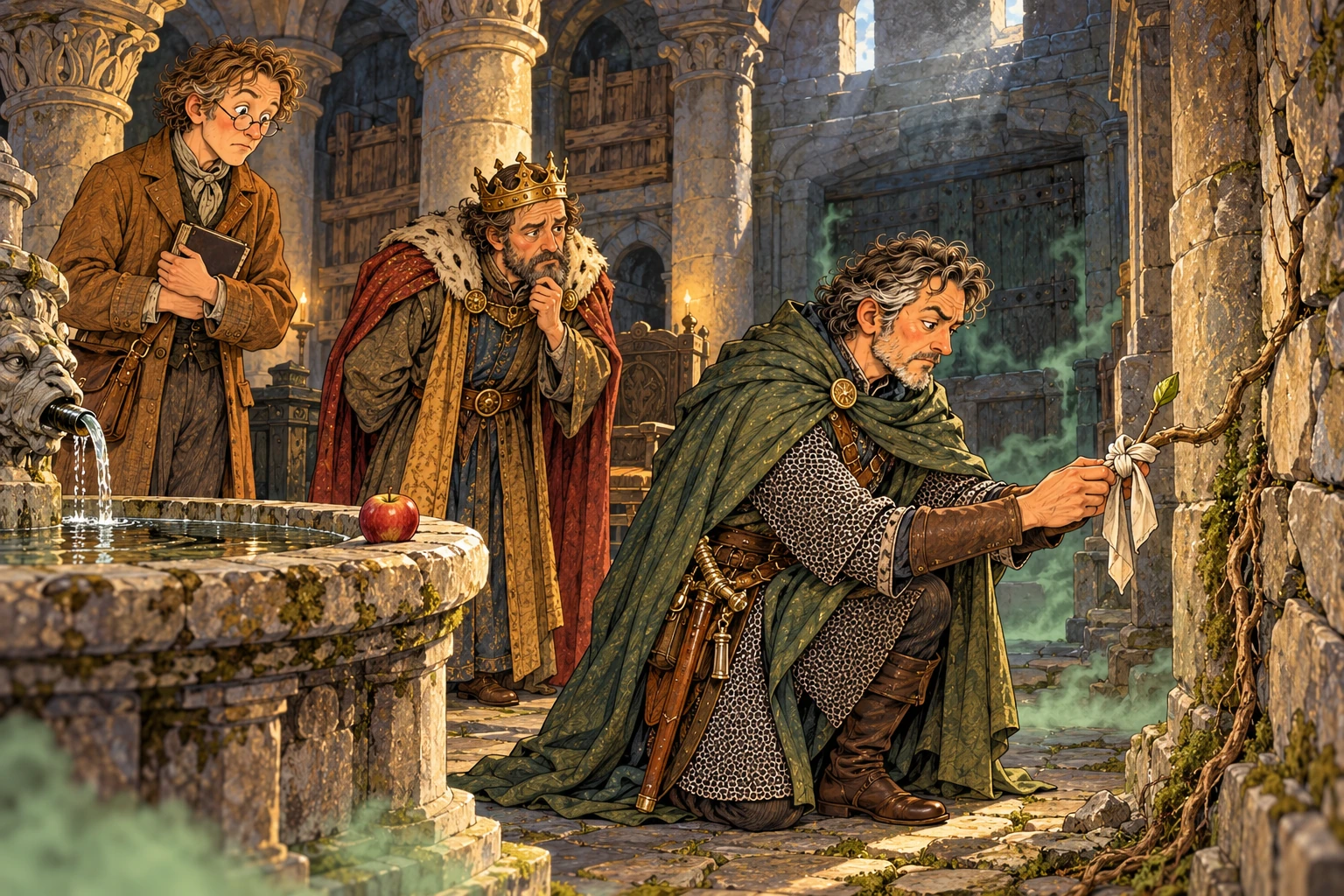
Sir Cardevane of Westmere had heard, from a source he considered deeply informed, that the green fog came from under the earth.
The source was a well-digger from East Barrow, who had lowered a bucket into an old shaft and received it back full of fog. This had unsettled him. It had also ruined the bucket.
"It came up green," said the well-digger. "Green like breath in a place where nothing had any business breathing."
Sir Cardevane leaned forward.
"Excellent."
"It was not excellent."
"Rarely are first observations appreciated by their victims."
Bartholomew opened his notebook.
"Where was this shaft?"
"Beyond the old quarry," said the well-digger. "Past the lime kilns. Where the hill goes hollow."
"Hills do not go hollow," said Bartholomew.
"This one does."
"A geological boast."
The well-digger wiped his hands on his coat, though there was no mud on them.
"There were sounds below. Hammers, I thought. But when I called down they stopped."
Sir Cardevane waited.
The well-digger looked at the floor. "I never found out what they were for."
Bartholomew wrote that down.
"And then?" asked Sir Cardevane.
"Then something tugged the rope."
"The bucket?"
"No. The bucket came up first."
The well-digger reached into his coat and placed a small square of slate on the table. A hole had been drilled through one corner, and a length of wet string still hung from it. On the slate, scratched in careful letters, were two words.
NO VISITORS.
Sir Cardevane looked pleased.
Bartholomew did not.
"That is not an invitation," said Bartholomew.
"No," said Sir Cardevane. "It is better."
"How?"
"It proves someone expected company."
The well-digger stared at him.
"There's more."
He turned the slate over. On the back, scratched less carefully, was another line.
ESPECIALLY NOT FROM ABOVE.
Sir Cardevane stood.
"Then we go down."
Bartholomew read both sides of the slate again.
"You have converted a refusal into an itinerary."
Sir Cardevane reached for his cloak.
"Prepare the subterranean kit."
"We do not have a subterranean kit."
"Then prepare the things that look least skyward."
Two days later, Sir Cardevane and Bartholomew stood beside the old shaft beyond East Barrow with a coil of rope, three lanterns, two shovels, a compass, a packet of candles, one apple wrapped in a handkerchief, a collapsible stool, and a small book titled Etiquette for Dwarven Courts and Related Low-Ceiling Ceremonies. Bartholomew held up the apple. "Diplomacy?"
"Someone below has refused visitors. They may not have refused fruit."
Bartholomew put it back in the bag and examined the shaft. "Dark, damp, and structurally unpersuasive."
"Then we should not waste daylight."
Sir Cardevane tied the rope around his waist.
Bartholomew looked at the book.
"Why do we have etiquette for low-ceiling ceremonies?"
"One must respect local conditions."
"You will hit your head."
"Not if I bow."
"You bow to everyone."
"Then I am unusually safe."
They descended. At first the shaft was ordinary. Stone. Mud. Old roots. Water ticking somewhere unseen. Then the walls changed. Pick-marks appeared, old enough to blur but recent enough to read. Someone had cut downward in stages, always narrowing the passage, always making it less useful for anyone but himself. The first sign was carved into a lintel.
NO VISITORS.
Sir Cardevane held up his lantern.
"Consistent."
"Unwelcoming."
They passed beneath it.
The tunnel bent sharply. The air cooled. Above a black-timber door was a second sign.
NO WINDOWS.
Bartholomew looked at the stone around them.
"A difficult rule to break."
Beyond the door lay a chamber with seven bricked-up openings. Each had once looked into another passage. All had been sealed from the inside. In the centre stood a chair facing a bare wall. The room held no table, hearth or cup.
Sir Cardevane looked at it.
"A waiting room."
"For what?"
"For not being found."
Bartholomew wrote that down, then crossed it out.
They went lower.
The stairs turned inward, each flight smaller than the one before. At the second level, the ceiling forced Sir Cardevane to bend. At the third, Bartholomew had to bend too, which he considered a serious escalation. More signs, each one forbidding something different. Bartholomew read none aloud. Green fog gathered along the ceiling. A thin strand passed through a crack too small for air. They heard a sound below.
A bolt drawn. Then another. Then stone against stone.
Sir Cardevane tilted his head.
"Someone is making himself less available."
"Good," said Bartholomew. "Then we can go home."
"Bartholomew."
"Yes?"
"We are the availability."
"An excellent argument for leaving."
They went on.
At the fourth level, the passage opened into a hall too large for the path that led to it. It was a hall built for ceremony. There were pillars, but each was boxed in with boards. There were niches, but each niche was shuttered. There was a fountain, but the water had been directed into a pipe that disappeared through the floor. On the near wall, another inscription read:
NOTHING THAT GROWS.
A pale root came through the stone beside it. Sir Cardevane touched it.
"Insurrection."
"Root," said Bartholomew.
"One may be both."
The root trembled. A bead of green fog gathered at its tip and fell upward.
Bartholomew stared.
"That fell the wrong way."
"Gravity is often less settled underground," said Sir Cardevane.
"It is usually more settled underground."
"Then note the exception."
On the far wall, in letters deeply cut and carefully maintained, were the words:
NO NAMES SPOKEN BELOW THIS LEVEL.
Sir Cardevane stopped.
"That presents a diplomatic difficulty."
"You may have to introduce yourself less completely."
"I dislike beginning with deception."
"You usually begin with title."
"That is not deception. It is architecture."
A small voice came from the dark.
"Names are hooks."
Sir Cardevane raised his lantern. At the far end of the hall stood a man no taller than a child. He wore a crown of tarnished bronze that had clearly been made for a larger head and a larger idea of himself. It had slipped down almost to his ears. His beard had simply gone uncut for years. His robe had once been red. It was now the colour of old brick in rain.
Bartholomew lifted his pen.
The small man flinched.
"Do not write me."
Bartholomew stopped. He looked at the blank page for a moment, then closed the notebook.
Sir Cardevane bowed, carefully, because the ceiling had made humility advisable.
"Your Majesty."
"I am not Majesty."
Sir Cardevane considered two alternatives and, judging by Bartholomew's expression, wisely kept both to himself. Irritation moved across the king's face. It made him look briefly alive.
"I am no one," said the small man. Then, with the irritation of someone forced to correct his own statement: "I am king here. But not named. And not visited."
Sir Cardevane bowed again. "The last condition has already failed."
The king looked past them, towards the passage they had entered. "You must go back."
"We have only just arrived."
"That is the usual time to leave."
"We have questions."
"I have closed that department."
Sir Cardevane took one step into the hall. Green fog touched the edge of one boot, thinned, then gathered around the other. It did not rise from the centre of the hall. It came from behind the boarded niches, from the seams of sealed doors, from the places where something had once opened.
"We are investigating the origin of the fog."
The king's face tightened.
"There is no fog here."
"It is touching my ankle."
"It is old air."
"Old air seldom glows."
"Many things glow if one dislikes them enough."
Bartholomew murmured, "Subject hostile to illumination," and did not write it down.
The king saw his hand move towards the notebook.
"No writing."
Bartholomew let the hand fall.
"I was only considering it."
"That is how the world begins again," said the king.
The king turned away.
"You think I made it."
"The fog?"
"The knocking."
Sir Cardevane considered this. "No," said Sir Cardevane. "I think something has been trying to pass through you, and you have been discourteous about it."
The hall changed first in sound and light. The lantern flame narrowed. The fog thickened along the floor. Behind the boarded pillars came soft sounds. A cup placed on wood. A woman calling across a yard. Rain on leaves. Someone laughing in the room beyond the room. The king's hands closed.
"Stop that."
"We are not doing it," said Bartholomew.
"You brought it."
"We brought a rope, three lanterns and very little optimism," said Bartholomew.
The sound grew stronger. A bell. The king recoiled.
"No bells below the fifth level."
"There is no fifth level," said Sir Cardevane.
"There will be."
The king hurried to a wall and pulled a chain. Somewhere underneath them, a door slammed. The fog shuddered and rose through three cracks at once, carrying with it the smell of bread, of cut grass, of a room with a fire in it. It pressed against Bartholomew's coat and withdrew.
"Ah," said Sir Cardevane.
"Do not say ah."
"I have discovered something."
"You have discovered trespass."
"You are not the source."
The king turned.
"I told you."
"No," said Sir Cardevane. "But you have placed a kingdom in the way."
Bartholomew watched the fog squeeze through three cracks at once.
"It appears," he said, "that your doors are not as persuasive as you hoped."
He watched a moment longer.
"It is not coming from you," he said. "It is trying to get past you."
"It should not come."
"What is it?"
The king's mouth worked.
"Noise."
"Fog is rarely noise."
"Footsteps. Windows. Morning. Someone calling from another room."
Sir Cardevane softened. The king looked at him with sudden hatred.
"Do not give it a kind name."
The hall dimmed. The fog rose to Sir Cardevane's waist. For one moment he saw the walls vanish and the hill split open to the sun. Grass moved. A dog barked. Someone called his name from a lane beside a white gate. He knew the lane. He had once stood at its mouth with a letter in his pocket and mud on his boots, and had decided the weather was argument enough against going on. Then the vision was gone.
Bartholomew had gone very pale. On the open page of his notebook, in his own hand, were five words he did not remember writing: the rope came up empty. He looked at them for a moment. Then he closed the notebook.
"What did you see?" asked Sir Cardevane.
"The outdoors," said Bartholomew.
The small king looked up at the sealed ceiling.
"Only that?" asked the small king.
"Enough of it."
The king backed away from them until the crown struck the wall.
"It asks too much," he said.
Sir Cardevane did not ask what he meant.
He lifted one small hand. All around the hall, doors appeared in the stone. Doors with handles worn by use. Behind one came a woman saying a name. The king put both hands over his ears.
"It does not stop."
"No," said Sir Cardevane.
"It knocks. It leaks. It grows through stone."
"Yes."
"I went down one level," said the king. "Only one."
"For quiet?"
"For nothing."
Rain ticked somewhere above them.
"The rain followed. Then roots. Then grief."
He swallowed.
"Birthdays."
"At last I understood."
"What?" asked Sir Cardevane.
The king looked at the ceiling.
"There is always an above."
The fog pressed against the ceiling, green as old glass in sun. Where it touched the stone, memories moved inside it. A field. A kitchen. A hand knocking on a door.
Sir Cardevane looked at the king.
"What did you leave?"
The king stared at him. Sir Cardevane did not repeat the question. Bartholomew kept his notebook closed.
At last the king said, "A house. A table. Someone at it."
Sir Cardevane's face changed.
"Do not make that face," said the king.
The king looked towards one of the false doors. Behind it, a faint warm light showed at the bottom.
"I was needed," he said. "That was the unbearable part."
Sir Cardevane was very still.
"And the person at the table?"
The king closed his eyes.
"Waited."
"For how long?"
"Long enough to stop."
The sounds behind the doors faded. In the silence, water dripped somewhere below.
Sir Cardevane removed his hat.
"I see," he said.
"No," said the king. "You do not."
"No," said Sir Cardevane. "Probably not."
He reached into his coat and removed an apple. The king stared at it.
"What is that?"
"An apple."
"I can see that."
"Then it has already become a visitor."
Sir Cardevane set it on the fountain's edge. "And yet," said Sir Cardevane, "you built a kingdom."
The king looked offended.
"I built a refuge."
"With rules, levels, signs and gates."
"Necessary measures."
Sir Cardevane looked at the crown, tarnished and too large, still on his head.
"You brought that all the way down."
The king's face twisted. The hall shook. Boards snapped from one of the pillars. Behind it was not stone but a window. Impossible, underground.
Through it came a thin grey strip of daylight, enough to show dust moving in the air. The king cried out and lifted both hands. The window bricked itself over.
Sir Cardevane stepped forward.
"Wait."
"No."
"It is only light."
"Only light is how it begins."
"How what begins?"
"Everything."
The last brick slid into place. Dark returned. The fog surged upward through the ceiling. Far above, it would emerge from ditches, wells, cellars, cracks in old floors. People would call it weather.
Sir Cardevane looked at the sealed window. Then at the pale root still pushing through the wall beside the sign that forbade growth. He reached for the root.
Bartholomew said, "I advise against gardening during a royal crisis."
Sir Cardevane ignored him.
He did not pull the root down. He tied his handkerchief around it, gently, so the thin thing would not tear where it met the stone. The king stared.
"What are you doing?"
"Marking a breach."
"Remove it."
"No."
"I am king here."
"Then command it yourself."
The king looked at the root. It was small. Almost nothing. A single pale thread from a world he had refused. At its tip, a green leaf gathered, still closed.
The king raised one hand. The root trembled. He did not touch it. Sir Cardevane waited.
Bartholomew waited too, though he later denied this. The king lowered his hand.
"I hate it," he said. "It will grow. It will split the wall. It will bring birds."
Sir Cardevane looked at the single closed leaf.
"Not all at once."
The king looked horrified. Then uncertain. Then very old. He looked at the root for a long time.
"Does the sun," he said, "still rise from the east?"
Sir Cardevane opened his mouth.
"No," said the king. "No. No." He turned away. "It is of no consequence."
He rubbed one thumb over the arm of his chair.
"It was once," he said. "I knew which window to go to."
He did not turn back.
"What if it brings names?"
"Then begin with your own," said Sir Cardevane.
The king did not speak. Green fog lay along the walls and threaded the cracks. It did not vanish. In the wall behind the king, a stone shifted just enough to admit the sound of rain. The king closed his eyes. He did not order it sealed.
"That," whispered Bartholomew, "may be evidence."
Sir Cardevane looked pleased.
"I knew you would come round."
"To the existence of rain."
"A narrow but promising conversion."
The king opened his eyes.
"You must leave."
"Of course," said Sir Cardevane. "We have only been waiting for a formal dismissal."
"No one may speak of this."
"I must report findings."
"To whom?"
"The king," said Sir Cardevane.
The small king stared at him. Bartholomew looked at the low ceiling and said nothing. Sir Cardevane bowed again. This time the ceiling made it a very good bow.
They climbed. At the fourth level, they passed the sign about names. A fresh scratch had appeared beneath it.
NO NAMES SPOKEN BELOW THIS LEVEL, UNLESS NECESSARY.
Sir Cardevane paused.
"Progress."
"Minimal."
"Usually the durable kind."
Beside the sign NOTHING THAT GROWS, the pale root had pushed farther through the stone. At the first level, the words NO VISITORS had acquired a second line, cut unevenly by an unpractised hand.
NOT YET.
Bartholomew looked at it.
"That is not welcoming."
"No," said Sir Cardevane.
"But it has stopped being final."
They emerged from the shaft at dusk. The well-digger was waiting with a lantern and the expression of a man hoping not to hear an explanation.
"Well?" he asked.
Sir Cardevane brushed dirt from his sleeve.
"The subterranean hypothesis remains under review."
Bartholomew climbed out behind him.
"There is a king."
The well-digger went pale.
"A dwarf king?"
Bartholomew looked down the shaft.
"No."
Sir Cardevane adjusted his coat.
"A small king."
"Is that different?"
"Entirely."
The well-digger leaned over the shaft. From below came no hammering. No bolts. No stone dragged across stone. Only a faint sound, hard to place. Rain, perhaps.
Or someone opening a door he had not meant to open yet.
Weeks later, when the green fog came up from the marsh, Sir Cardevane noticed something unusual. It did not rise from the ditches first. It came from the ground in thin threads, through molehills, cracks in the road, the gaps around cellar doors. It gathered low and did not rise above the weeds. Bartholomew stood beside him.
"That proves nothing."
"No," said Sir Cardevane.
He watched a thread of fog coil around the stem of a weed pushing through the yard.
"But it proves nothing from below, which is new."
Sir Cardevane looked towards the old hill beyond East Barrow.
Far below, in the kingdom beneath the floor, the small king sat in his hall of sealed doors and listened to rain. The root had opened one pale leaf. The apple remained on the fountain's edge, still red in the dark. He had moved his chair so he could see both.
Case 13
Bath of Ash
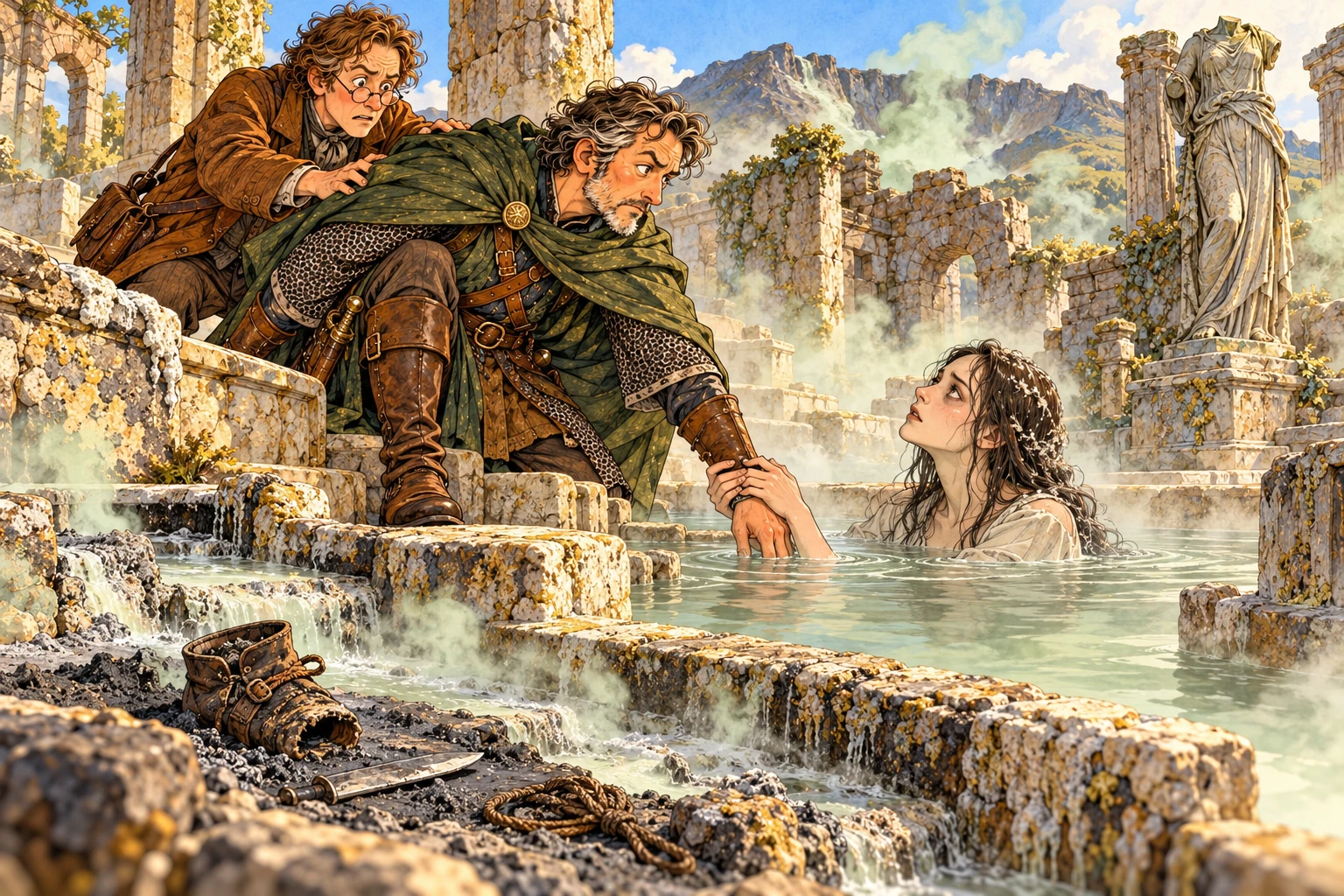
Sir Cardevane of Westmere had heard, from a source he considered geologically persuasive, that the green fog came from a volcano.
The source was a charcoal burner from Mount Vey, who had arrived with singed eyebrows, a sack of warm stones, and the solemn conviction of a man who had recently seen a hill breathe.
"The fog comes from the mountain," said the charcoal burner.
Bartholomew asked whether he meant smoke or low cloud. The man shook his head at both, then held the sack open. Inside were six black stones. Each gave off a faint heat. Between them, curled in the bottom of the sack, was a thin green vapour.
Sir Cardevane leaned closer.
"There," he said.
Bartholomew did not lean closer.
"Warm sediment," he said.
"Sediment does not breathe."
"Much in this kingdom is becoming ambitious."
The charcoal burner gripped his cap.
"There are baths up there," he said. "Old ones. Steam all day. Green at dusk. And a woman in the water who has been young since my grandfather's grandfather was bitten by a mule."
Sir Cardevane looked at Bartholomew.
"That," he said, "is not sediment."
"No," said Bartholomew. "That is a local tradition with excellent posture."
Sir Cardevane had the matter entered under volcanic sources, suspected enchantment, and proceeded to pack.
They rode to Mount Vey the following morning.
The mountain was not tall enough to be majestic, but it was tall enough to be inconvenient. It rose from a country of black fields and pale grasses, with old lava stones lying everywhere like the teeth of something that had died biting the earth. The road up was hot in patches and cold in others. Steam came from cracks between stones. Yellow flowers grew beside pools that smelled of eggs and warnings. Ravens sat on dead trees and watched the horses with the interest of creditors. By noon, Sir Cardevane's boots were grey with ash. By afternoon, Bartholomew had stopped wiping his spectacles because the ash returned each time, more personally.
"This," said Sir Cardevane, "is promising."
"It is dirty," said Bartholomew.
"Sources often are."
"So are stables."
Sir Cardevane ignored this and rode on.
Near the upper slopes, the path narrowed between black rock walls. The air grew warmer. Water ran beside the track in thin steaming lines. At times the steam lifted and turned faintly green before vanishing into ordinary white. The baths lay in a hollow near the old crater. They had been built long ago by people who liked stone, heat, and straight lines. Low walls enclosed pools of steaming water. Cracked steps descended into them. Columns stood without roofs. A statue of a goddess had lost her head, both arms, and most of her authority. Green vapour moved across the water in thin veils.
In the largest pool sat a woman. Sir Cardevane stopped. Bartholomew stopped beside him. The woman looked no older than twenty-five.
Her hair was dark and heavy, spread around her in the water like ink. Her skin was smooth and luminous in the steam. The water around her glowed faintly green where it touched her. She turned her head and smiled. It was a very good smile.
Sir Cardevane straightened in his saddle.
Bartholomew noticed.
"Careful," he said.
"I am always careful."
"You once challenged a weather vane to single combat."
"It had turned suspiciously."
The woman laughed softly. The steam moved when she laughed.
"You have come a long way," she said.
"I am Sir Cardevane of Westmere."
"I know."
Sir Cardevane hesitated.
"You know?"
"Everyone who comes here says their name before they know what they have brought."
Bartholomew looked at his notes.
"That is not inaccurate."
"And this is my clerk, Bartholomew."
The woman looked at him.
"Poor Bartholomew."
Bartholomew closed his notebook halfway.
"I am not yet sure that is warranted."
The woman leaned back against the stone edge of the pool. The water moved around her throat. It was very clear water, except where the green steam gathered over it like breath on glass.
"Come down," she said. "Both of you. The climb is hard. The water is warm."
"We are here to investigate the green fog," said Sir Cardevane.
"Of course you are."
"Do you produce it?"
"No."
"Does the mountain produce it?"
"The mountain produces many things. Heat. Stone. Sulphur. Bad decisions."
Bartholomew wrote that down.
Sir Cardevane dismounted.
The ash shifted under his boots. It was soft and strangely warm. He walked to the edge of the pool. She held her position, perfectly still.
"How long have you been here?" he asked.
The woman looked at the broken goddess before answering.
"Longer than the head has been missing."
Sir Cardevane looked at the headless statue, then back at her. He counted the missing years once under his breath, and stopped.
"There are rude ways of counting."
Sir Cardevane crouched at the pool's edge. The steam rose around his face. It smelled of sulphur and, lower, of lavender.
"The climb was long," said the woman. "Your knees."
"My knees are adequate."
"You favour your right side since the last ridge."
Sir Cardevane said nothing.
"Come down," she said. "Only one step. You need not answer any questions."
"I am investigating."
"One step is not a commitment."
Bartholomew moved closer to Sir Cardevane's shoulder.
"She is not inviting you to bathe," he said quietly. "She is finding the distance."
The woman's eyes moved to him.
"He is tired," she said. "I can hear it in his step. Can you not hear it?"
"I can hear many things," said Bartholomew. "I do not act on all of them."
The woman looked back at Sir Cardevane.
"Your wrist stiffens in this air. I can see it from here." Her voice dropped to something warmer and less careful. "Come down one step and let the water hold it. Just one moment. Then you may investigate from there."
Sir Cardevane looked at the step. The water lay just below it, still and clear.
"What does the water do?" he asked.
"It takes away what hurts."
Sir Cardevane looked at the objects caught in the overflow before he looked back at her. Sir Cardevane touched the stone at the pool's edge with one gloved hand. The water steamed around the leather. "If I step down," he said, "what happens to what is removed?"
The pool gave off a low sound somewhere between a bubble and a sigh. The woman looked at the overflow channel, where water ran down between black rocks into a crack in the mountain. A patch of green vapour rose from it. In the channel itself, half buried in ash, lay what the water had carried: a child's boot, small and split at the toe. Beside it a knife with no handle. A length of cord tied in a knot someone had never undone. The vapour moved over them and briefly held a shape before thinning again.
Sir Cardevane pointed. "There."
"The channel keeps what the water cannot," she said.
"People?"
The woman's expression settled into something older and more practised.
"There were others," she said.
Bartholomew looked towards the lower path.
"Were?"
"They came tired. Filthy. Bent under their lives. I offered them water."
"And then?" asked Bartholomew.
"They left lighter."
"Did they leave?"
She looked at the overflow. A raven called from the dead trees below. Sir Cardevane stepped back from the pool.
"What happened to them?"
She turned her face towards him.
"Some went down the mountain. Some stayed too long. Some forgot what they had meant to carry."
"How many remained?"
She was silent long enough for the answer to be clear.
The green fog moved at the corner of Sir Cardevane's vision. He turned. At his boot's edge, where the ash met the pool's overflow, something pale lay in the black mud. A small object. A ring, or the remains of one. He pulled off his gloves, crouched and picked it up. It fell apart in his fingers. The fog at his boots thickened and moved towards his scar. It found the line across his knuckle and tugged at it gently, like a tailor testing a loose seam.
Sir Cardevane did not move his hand. The fog held. Then it loosened and retreated.
"Come in," she said, and her voice had changed. It sounded closer. "Come in and put it down properly."
"I would rather not."
"You are carrying more than a ring."
"I am aware of my inventory."
"Are you?"
The steam thickened around the pool. The lavender smell deepened. She was quiet for a moment. Then:
"The wall," she said.
Sir Cardevane did not move.
"The hand. The horse."
"Enough," said Bartholomew.
She looked at him.
"I only name what he brought."
Bartholomew moved between her and Sir Cardevane. "You make it sound lighter before you take it."
Sir Cardevane was still.
The water was still and warm.
He put one foot on the top step. The steam curled around his boot. He crouched before he had decided to crouch and touched two fingers to the water. It was warm as bread under cloth. The scar across his knuckle faded.
For one bright second he could not remember the wall. A hand closed around his wrist beneath the water. For one foolish moment he thought it was his own. Then he saw the woman's fingers beneath the surface, firm around his arm.
He pulled back. She held him with steady weight.
"Stay," said the woman. "Only a little longer."
The scar was gone. His wrist was smooth. The hand that held him was smooth.
"Sir Cardevane." That was Bartholomew, from behind him, his voice very level, which was worse than if it had been alarmed.
The woman rose. She had to. She could not pull him in while she remained low, and she wanted him in. Her shoulders came above the water. Then her chest. Then she stood on the submerged step, half out of the pool, gripping his wrist with both hands, the air touching her where the water no longer could. Her hair dulled. Her face aged in visible steps. Twenty-five became forty, then seventy, then something older than counting. Her back bent. Marks appeared: the shadows of hands, a line of ash across her throat.
She did not let go.
"Come in," she said. Her voice had changed in the air. It was older and smaller and it cracked at the edges. "Come in. Please. No one has come this close and pulled away for a very long time."
Bartholomew took Sir Cardevane by both shoulders and pulled.
For a moment nothing moved. Then Sir Cardevane's wrist came free. He sat back hard on the stone. For a moment, the skin where she had held him was smooth and pale, without scar, hair, or age.
The woman stood in the air for one more second, half out of the water, the age of centuries on her face, her hands still shaped around the space where his wrist had been. Then she fell back into the pool. The water closed over her. The steam rose white.
Green vapour lifted from the overflow, thick and slow. When she surfaced, she was young again. Her eyes were wet.
"Cruel," she whispered.
Bartholomew looked at the objects in the overflow. "Yes."
The woman turned on him. "You have never had to carry centuries."
"No," said Bartholomew. "I misplace afternoons and find them difficult enough."
She did not answer. The green vapour gathered at the overflow and crawled over the lip of the pool. It ran down the channel and over the black stones, over the child's boot, over the knotted cord. Sir Cardevane looked at his hand. His knuckle hurt. He was glad of it.
"They asked me to take it," she said.
"Not all of it," said Bartholomew.
She looked at him.
"They did not say how much was too much."
"No," said Bartholomew. "They would not have known."
"How many?" asked Sir Cardevane.
She looked at the overflow.
"After a time in the water, you cannot remember the number."
Sir Cardevane looked at the pool, the overflow, the green vapour crawling from the old stone into the cracks of the mountain.
"The volcano is not the source," he said.
The woman laughed once.
"Nothing ever is, with you."
"The bath is not the source either. It is a place where things are left without owners."
She sank lower in the water.
"They hurt less here."
"I believe you," said Sir Cardevane.
He looked at his scar.
"That does not mean you may keep them."
She closed her eyes. Sir Cardevane took a handful of ash from the ground and rubbed it between his palms. It blackened the skin, settled into the lines, caught beneath the nails, darkened the scar across his knuckle.
The woman watched him. "What are you doing?"
"Keeping something."
"Wash it off."
He looked at the pool.
"No."
The water remained at the top step. Steam drifted over the pool. Water hesitated in the overflow channel, where no stone was visible. Green vapour lay over Sir Cardevane's boots, the statue, the steps and the edge of his cloak. In the pool, beneath the clear surface, dark shapes turned slowly and sank.
She made a sound like someone waking from a dream and finding the dream still in the room. For one moment she looked old and tired in the water. Then the bath smoothed her again.
"I do not know how to carry it all," she said.
Bartholomew looked at the overflow. "Then don't take all of it."
She looked at him. "I have no pieces left."
"You have a name," said Sir Cardevane.
She smiled faintly.
"Do I?"
"You must."
"Must is a young word."
Steam moved between them.
"Athel," she said at last. "Once."
Bartholomew wrote it down. She flinched.
"Do not."
Bartholomew stopped. He closed the notebook. This seemed to cost him something.
Sir Cardevane gave a shallow bow. The stones were slick and he had already behaved imprudently once that afternoon. "Lady Athel."
Her face changed at the name. Pain crossed it before the water could remove it. Then she laughed. A small, cracked laugh. "That is an old thing to call me."
"Then keep it," said Sir Cardevane.
They left the baths before sunset. The descent was harder than the climb. Ash slid underfoot. Steam crossed the path in pale ribbons. Twice Sir Cardevane thought he heard singing behind them, but when he turned there was only wind moving through dead trees. At the lower spring, Bartholomew stopped to fill the canteen. Sir Cardevane crouched and washed his hands.
The ash came away slowly. Some stayed beneath the nails. Some remained in the lines of his palm. The scar across his knuckle held a dark edge. He scrubbed once. Then stopped. Bartholomew looked at the ash still caught in the lines of Sir Cardevane's hand. Below them, the valley was already dim. Far up the mountain, green vapour moved over the old baths, thin as breath on a mirror.
"Are you going to wash it off?" asked Bartholomew.
"No," he said. "It appears to be mine."
They rode down in silence.
Case 14
Oracle Who Saw Too Much
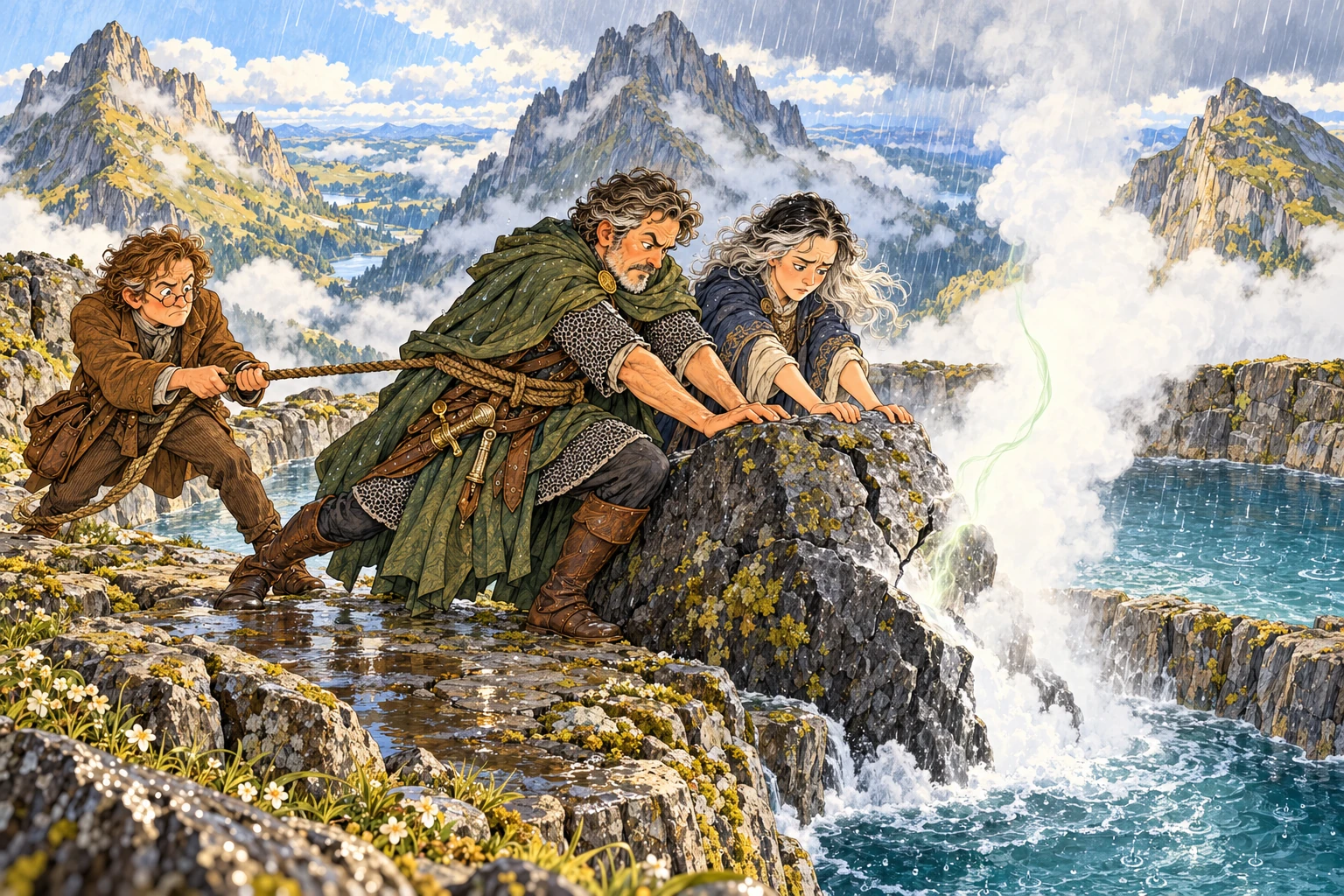
Sir Cardevane of Westmere had heard, from a source he considered high enough to have checked, that the green fog was made of lost clouds.
The source was a boy from Weatherby Hill, who had climbed higher than was sensible after a goat that had climbed higher than was fair, and had returned with a hat full of rain though the sky had been clear all morning.
"It came down the wrong way," said the boy.
"What did?" asked Bartholomew.
"The cloud."
"Clouds do tend to come down," said Bartholomew. "That is often rain."
"This was not rain."
"Fog, then."
"It had corners."
Sir Cardevane leaned forward.
"Corners?"
The boy nodded.
"Soft ones."
Bartholomew put down his spoon.
"There are no corners in clouds."
"There was in this one," said the boy. "And green in the middle. Like it had forgotten what colour it was meant to be."
Sir Cardevane smiled.
"Bartholomew."
"No."
"We have been looking too low," said Sir Cardevane.
"We have been looking where breathing occurs."
"The fog may not rise from the marsh at all. It may fall from above."
"That is how weather works."
"Exactly," said Sir Cardevane. "And therefore we must find where weather begins."
Bartholomew looked at the boy.
"Where did you see this cloud?"
The boy pointed north.
"Beyond High Rindle. Past the old sheep paths. There is a place where the sky sits down."
Sir Cardevane stood at once.
"A place where the sky sits down cannot be ignored."
"It can," said Bartholomew. "With discipline."
But Sir Cardevane was already reaching for his cloak. By noon they had left the Marsh Road Inn behind. By evening they had passed the last stone wall. By morning they had reached country that appeared to have been designed by someone who had heard of hills but not of moderation.
The path climbed through grass wet enough to make every step sound apologetic. Small streams crossed their way without warning. The air grew thinner, then colder, then stranger. Clouds moved below them. Bartholomew stopped.
"That is not natural."
"It is educational," said Sir Cardevane.
"It is damp."
"Most education is."
They climbed on.
Near the ridge, the world changed. The mountain did not end. It opened. A shallow bowl lay between three peaks, filled with real cloud, close enough to touch and heavy enough to move around their legs. At the centre of the bowl was a pool.
The pool was still. No stream fed it. No spring broke its surface. Yet from it, pale clouds rose continuously, spreading slowly into the air. At the western edge of the pool lay a flat black stone. It had once covered the vent entirely, but now rested crookedly across a narrow lip of rock, leaving the vent half-open. From beneath it, a thread of green rose into the air. The thread entered the white cloud.
The cloud shivered.
"There," whispered Sir Cardevane.
"I see it," said Bartholomew.
"You do not," said a woman's voice.
At the far side of the pool sat a woman on a flat stone. She was not old. She was not young. Her hair was black at the roots, silver at the ends, with white patches among the strands. Her hands rested in her lap. Her eyes were open, but they did not seem to have chosen a single thing to see. Sir Cardevane bowed.
"Madam."
The woman did not look at him.
"O knight of the west road, breaker of small hinges, friend of drowned bells, wearer of the borrowed hour, do not ask the cloud its birthplace."
Bartholomew blinked.
"She is an oracle."
"Yes," said Sir Cardevane, pleased.
"I preferred the goat."
The woman turned her head very slightly.
"O keeper of ink and counted bread, speak less loudly in the house of beginnings."
Bartholomew looked down at his boots.
"Was that advice?"
"In one future," said the oracle.
"That is not an answer."
"It is the nearest one I have."
Sir Cardevane stepped nearer to the pool. "We seek the source of the green fog."
The oracle lifted one hand. Each finger trembled towards a different direction. The green thread divided into five thin strands, each curved a different way.
"O hunter of sources, listen and go no further. The marsh drinks what the mountain forgets. The gate was never built. The gate has always been burning."
The green thread thickened as she spoke and curved towards her mouth.
Bartholomew saw it and stepped back.
Sir Cardevane saw it and stepped forward. "Madam," he said gently, "are you making these clouds?"
"No cloud is made once."
"Are you guarding them?"
"The guard sleeps after the thief is born."
"Are you keeping something in?"
"In the first winter, yes. In the last winter, no. In the winter that does not arrive, I am still deciding."
The green fog curled around the black stone. Green fog spread along the black stone's crooked edge and into the narrow gap between the stone and the pool, where the stone covered neither enough to seal nor little enough to free.
Bartholomew lowered his voice.
"It is following the pauses."
"It likes the gaps," said Sir Cardevane.
The oracle shut her eyes.
"Do not ask for one outcome. I have seen the village survive in one future and burn in another."
The green fog rose higher. White cloud fled from it.
"Which of those happened?" asked Bartholomew.
The oracle opened her eyes. For a moment they were full of such terror that Bartholomew wished he had not asked.
"All of them came to the door."
Sir Cardevane looked at the pool. "They reached the door. They did not all go through it."
"O Westmere knight, who walks where wiser feet turn back, do not name a door until it has closed."
Sir Cardevane accepted this with a small bow.
"I have been called worse by better footwear."
The oracle's gaze dropped to the black stone. Green fog lay at the base of the stone. Sir Cardevane followed her eyes. "You moved that stone."
The oracle did not answer. The green fog flattened itself across the water.
"You moved it," he said again.
She rocked, only slightly.
"O black stone, witness. O cloud pool, witness. I took the stone in the year of the white lamb. I lifted to seal. I lowered to spare. I saw famine under the closed hand and poison under the open. I saw seven mothers blessing me and nine cursing my bones."
Bartholomew's face changed.
"You left it halfway."
The oracle covered her ears.
"Halfway is a cave where blame cannot enter."
The fog struck the water softly. A ring spread outward. Then another. The green moved with each ring, spreading under the white cloud like bruising under skin. Sir Cardevane looked at the stone.
"No," he said. "Halfway is still open."
The oracle lowered her hands. Her voice became thin.
"O knight, do not drag the sleeping choice into morning. Morning has teeth."
"So does night," said Sir Cardevane.
Bartholomew raised a finger.
"Whatever happens next should probably be avoided."
"In one morning," said the oracle, "the boy with the goat takes the upper path and the cloud follows his breath into Weatherby Hill. The well turns green before noon."
Bartholomew went still.
"That is happening?"
"It waits."
The green fog reached the lip of the pool and slid towards the path.
Sir Cardevane drew his sword.
Bartholomew looked at it. "What exactly do you intend to do, threaten weather?"
"If necessary."
Sir Cardevane raised his sword between himself and the pool.
"It understands edges," said the oracle. "It loves the uncut cloth."
Sir Cardevane sheathed his sword.
"Then the stone must be moved."
The oracle stood. Or tried to. For a moment she rose halfway from the rock and stopped there, trembling, neither seated nor standing. The fog climbed her cloak.
"The future is not a clerk, madam. It will not stamp the form first."
She looked at his outstretched hand and did not take it. Her wrist shook. She gasped and pressed it to her chest. Bartholomew stepped forward and held her elbow, his open notebook against her sleeve. Every page had taken on a faint green tinge, as if the damp had got into the ink.
Bartholomew stared at the greened pages.
"I shall remember this personally."
Sir Cardevane did not take his eyes from the oracle.
"Madam. Forget the whole future for one minute. What do you do next?"
The oracle's mouth opened. For a while no sound came. Then she turned from him and spoke to the pool.
"I sat too long," she said to the pool. "Closed kills. Open kills. Halfway feeds it."
Green fog shifted above the pool. Sir Cardevane knelt at the western lip of the pool. Bartholomew took the rope from his pack and tied it around Sir Cardevane's waist.
"I am not sure this improves the future," he said.
"It improves my ability to remain attached to it," said Sir Cardevane.
"That is a limited but valuable category."
The stone was smaller than he had expected, and heavier than anything that small had any right to be. He pushed. The stone did not move. He pushed again, harder.
The oracle said, "Right."
Sir Cardevane paused. "Because it is safer?"
"No."
"Because you have seen it?"
"I have seen both."
"Then why right?"
The oracle looked at the stone. A green strand lifted above it.
"Because left has had me long enough."
She put both hands on the stone beside his. Together they pushed right. The stone cracked. The sound was not loud. The crack carried across the mountain bowl.
The level of the pool dropped several inches at once. A gust swept across the basin as white cloud burst upward, cold and blinding. Green strands vanished among it, their edges lost from sight. It swallowed Sir Cardevane, Bartholomew, the oracle, the pool, the mountain, and several complaints Bartholomew had prepared with care.
For a while, there was only whiteness. Then wind. Then rain. Actual rain. It fell hard for three minutes.
When it stopped, the bowl of the mountain was clear. The pool was still there. Clouds rose from it again, pale and ordinary.
The black stone lay in two pieces. Under it, air moved through the old vent into the open. For now, the air from the vent was clear.
The oracle stood beside the pool. She was soaked. Her hands shook. But she stood. Sir Cardevane sat on the wet stone. Bartholomew sat beside him, equally soaked and more personally offended.
The oracle looked at the broken stone. Then at the path. Then at the clouds below.
"What do you see?" asked Sir Cardevane.
She closed her eyes.
"O lower path. O hill where the boy is late for supper. O bell that may remain bronze."
She opened her eyes.
"Too much."
Bartholomew nodded.
"That seems consistent."
"But not command."
Sir Cardevane smiled.
"No."
The oracle took one step away from the pool. The mountain did not fall. The valley did not burn. She took another step.
A thin green thread rose from the broken stone. Everyone saw it. The oracle turned back. The thread hovered.
She did not speak. She did not explain. She did not ask which grief would come. She lifted her foot and stepped onto the path. The thread wavered above the broken stone. She did not look back.
It remained visible until a low cloud crossed the ridge.
Bartholomew exhaled.
"I dislike moral weather."
"It is difficult to pack for," said Sir Cardevane.
Bartholomew opened his notebook. The pages were still faintly green. He looked at them, then closed it without writing. They began the descent near dusk.
Halfway down, the boy from Weatherby Hill appeared from behind a rock, holding a goat by a piece of rope. Bartholomew stopped.
"You."
The boy looked guilty.
"You were told not to climb higher."
"No," said the boy. "I was told not to climb higher than the goat."
Bartholomew looked at the goat. The goat looked back with the blank confidence of an animal who had caused theology before breakfast. Sir Cardevane laughed.
The oracle stared at the boy. He shifted uneasily.
"Am I in trouble?"
The oracle drew herself up.
"O child of the wet hat, brother of the upper path, do not follow the horned fool into the cloud. His ambition is cliffs. His breakfast is your ruin."
The boy blinked.
"What?"
Bartholomew pointed down the hill.
"She means take the lower path."
"Oh," said the boy. "Why didn't she say so?"
The oracle looked at Bartholomew. Bartholomew looked back.
"In fairness," he said, "I have wondered the same thing."
The boy took the lower path. The goat tried to take the higher one. For the first time, the boy pulled it back.
By nightfall, they reached Weatherby Hill. Behind them, clouds gathered around the peaks, white in the moonlight. Sir Cardevane turned once. A thin fog moved along the ridge. White, as far as anyone could tell. For now.
The oracle stood beside him.
"Does that comfort you?" she asked.
Sir Cardevane looked at the white ridge.
"No," he said. "But it leaves room to act."
Bartholomew tightened his cloak.
"That is a dangerous amount of room."
"Yes," said Sir Cardevane.
Then they went down before the ridge disappeared again.
Case 15
Notebook That Corrected Itself
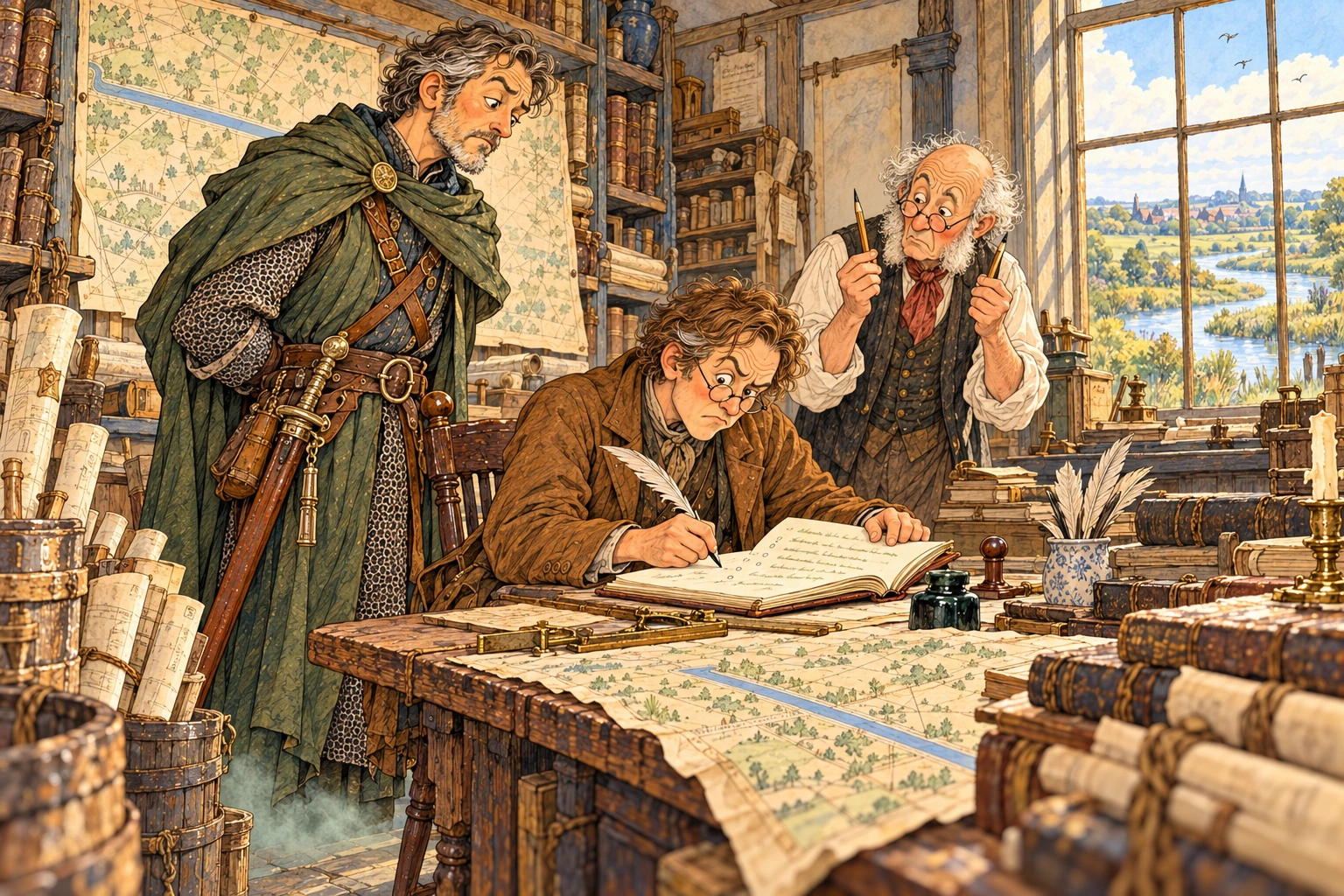
Sir Cardevane of Westmere had heard, from a source he considered admirably annotated, that green writing had begun appearing in notebooks wherever the fog was present.
The source was Bartholomew. This made the report harder to ignore and much more annoying.
"It did not add a sentence," said Bartholomew, holding his notebook at arm's length. "It altered mine."
Sir Cardevane looked up from breakfast.
"Corrected what?"
"Me."
"That is ambitious."
"It is intolerable."
Bartholomew placed the notebook on the table. Sir Cardevane leaned over it. On the open page Bartholomew had written:
The green fog entered the library at second bell.
Beneath it, a second line showed in thinner hand and pale green ink:
The green fog graciously arrived.
Sir Cardevane frowned.
"The adverb is suspicious."
"It gets worse."
Bartholomew turned the page. He had written:
Sir Cardevane opened the wrong door.
The sentence now read:
Sir Cardevane identified an alternative entrance.
Sir Cardevane sat back.
"That is not wholly inaccurate."
"You fell into the coal room."
"Alternative entrances vary in quality."
Bartholomew turned another page. Three sentences were crossed through in green ink; two conclusions sat in the margin, and the word certainly had six green underlines.
"No notebook of mine underlines certainty without permission," said Bartholomew.
"Where did this begin?"
"In the old surveyor's office at North Fenley."
Sir Cardevane reached for his gloves.
"Then we shall question the office."
"I would rather question the fog."
"The office may be more cooperative."
They rode to North Fenley that morning. The village stood where three crooked roads met. Its houses leaned away from a narrow stone building with a slate roof and a sign that read:
PUBLIC MEASURES, MAPS, TITLES, BOUNDARIES, CLAIMS, AND CERTAINTIES
The last word had been painted larger than the rest. Bartholomew stopped in the road.
"That is already suspicious."
"It is only a word," said Sir Cardevane.
"Certain words are never only words."
Inside, the surveyor's office smelled of ink, dust, wet wool, and decisions made too early. Shelves lined the walls. Rolls of maps stood in barrels. Ledgers lay open on desks. Every page had been ruled into boxes. Every box was full.
An elderly clerk sat at the central desk sharpening pencils to identical lengths.
"Good morning," said Sir Cardevane.
The clerk did not look up.
"Purpose?"
"Investigation."
"Category?"
"Fog."
The clerk hesitated.
"Weather or nuisance?"
"Both," said Bartholomew.
The clerk wrote this down with visible discomfort.
Bartholomew opened his notebook. The page was blank. Then green ink appeared across it.
WEATHER.
Bartholomew shut the notebook.
"It is here."
A thin green fog slid along the skirting boards. It moved under the desks, up the legs of chairs, and across the open ledgers. Where it passed, smudges vanished. Margins straightened. Crossings out uncrossed themselves.
The elderly clerk sighed with relief.
"Useful, is it not?"
"No," said Bartholomew.
"It improves the records."
"It improves their appearance."
"Often the same thing," said the clerk.
Sir Cardevane looked at a map on the nearest desk. A river had been drawn as a perfectly straight blue line. Outside, beyond the window, the same river curved through the marsh in broad bends.
"Your river is wrong," said Sir Cardevane.
The clerk looked offended.
"The river is untidy. The map is correct."
Green fog passed over the map. The river line became straighter.
Bartholomew made a sound.
"Do not do that to rivers."
His notebook opened by itself. Pages fluttered. Green ink ran over his notes.
Perhaps became certainly. Seemed became was. May have became did. Unknown became irrelevant.
Bartholomew seized the book with both hands.
"Stop."
More green lines appeared.
Sir Cardevane drew his sword.
The clerk stood at once.
"No blades near archives."
"I am defending uncertainty."
"Uncertainty has not filed the proper forms."
Green fog thickened across the room. Loose papers lifted from desks and settled into neat piles. Envelopes were sealed. Blank signatures filled. Empty boxes acquired answers. Outside, villagers had begun to gather at the door. A woman pushed forward holding a folded paper.
"Is it true?" she asked.
The clerk frowned.
"Is what true?"
"That the office has settled the boundary by Mill Field."
"It has."
"But no one asked us."
The clerk looked at the paper.
"The map was unclear. The fog clarified it."
An old man behind her said, "It put my well in her garden."
"It put my garden in his pond," said the woman.
"That is administratively compact," said Sir Cardevane.
Bartholomew glared at him.
"Not now."
The notebook jerked in his hands. Green ink appeared across the page:
THE MATTER IS SETTLED.
Bartholomew stared at it. Then he did something Sir Cardevane had never seen him do. He tore out the page. The room went silent.
The clerk gasped.
"Records are not torn."
"False records are," said Bartholomew.
Pages flapped wildly. Green ink spread across them as the notebook slid over the desk. Bartholomew caught it with both hands and held the covers open. Sir Cardevane stepped forward. Bartholomew shook his head.
"No."
"It is stealing your notes."
"Then I should stop it."
The notebook shifted against Bartholomew’s grip. His fingers whitened. On the open page, green ink formed the words:
Sir Cardevane solved the matter by decisive action.
Bartholomew laughed. It was not a large laugh. It was worse.
"You do not even know him," he said.
The green line blurred at its edges. Another green correction appeared.
Bartholomew, clerk to Sir Cardevane, observed that the evidence was sufficient.
"No," said Bartholomew.
He took his own pen. Under the green sentence he wrote:
I do not know yet.
Moisture spread across the page. The words blurred. Bartholomew wrote them again.
I do not know yet.
Damp spread across the desk and darkened his sleeves beside the pen. He wrote it a third time.
I do not know yet.
Outside, the crooked river moved past the window. One of the maps on the wall twitched. The straight blue line bent a little.
The elderly clerk looked from the map to the river.
"That is less clear," he said.
"Yes," said Bartholomew.
"How does one file it?"
"Carefully."
The clerk looked frightened. In the middle of the room, the green fog gathered into a square, then a box. A page appeared with every line, gap and margin filled. It covered the floor between Bartholomew and the desk.
Sir Cardevane raised his sword again. Bartholomew closed the notebook. Then he opened it to a fresh page. At the top he wrote:
Things not yet known
Green fog continued across the shelves. Bartholomew numbered the first line.
1.
Then he left it blank. The blank line sat there. It was small. It was outrageous.
Green droplets freckled the blank line. No words appeared.
Bartholomew numbered the second line.
2.
Blank. The villagers watched. The clerk watched. Sir Cardevane watched Bartholomew with something uncomfortably like pride and decided not to mention it.
Bartholomew numbered the third line.
3.
Green fog drifted over the open ledger. The maps rustled. The river on the wall bent another inch. A line in one ledger crossed itself out again. A margin reappeared. A signature faded from a paper no one had signed.
The woman with the boundary complaint stepped inside.
"Can the well go back where it was?"
The clerk looked helplessly at Bartholomew. Bartholomew said, "First we should find where it is." The old man nodded.
"That seems slower," said the old man.
"Yes."
"Better?"
"Possibly."
The clerk winced at possibly.
Sir Cardevane sheathed his sword.
"A brave word."
"A necessary one," said Bartholomew.
Green fog remained among the shelves, ledgers and sharpened pencils.
By evening, the office looked almost the same. The sign still promised certainties. The desks still held ledgers. The clerk still sharpened pencils too well. But three maps had been marked provisional. Two boxes had been left empty. And Bartholomew had pinned one page to the wall.
Things not yet known
Below it were seven numbered lines. All blank.
The clerk stared at them with visible pain.
"How long must they remain like that?"
"Until we know," said Bartholomew.
"And if we never know?"
Bartholomew considered this.
"Then they are accurate."
Sir Cardevane smiled.
They left North Fenley at dusk. The page on the wall held seven blank lines. Two dots of green ink appeared at the edge of the first. The rest of the line stayed empty. Outside, the river curved through the marsh exactly where it had not been told to.
Bartholomew opened his notebook as they rode. His own words were on the newest page.
I do not know yet.
A loose green stroke crossed the bottom of the page, separate from Bartholomew’s words.
Bartholomew frowned.
"Record the marks as they are," said Sir Cardevane.
"I have."
Case 16
Laundry That Would Not Dry
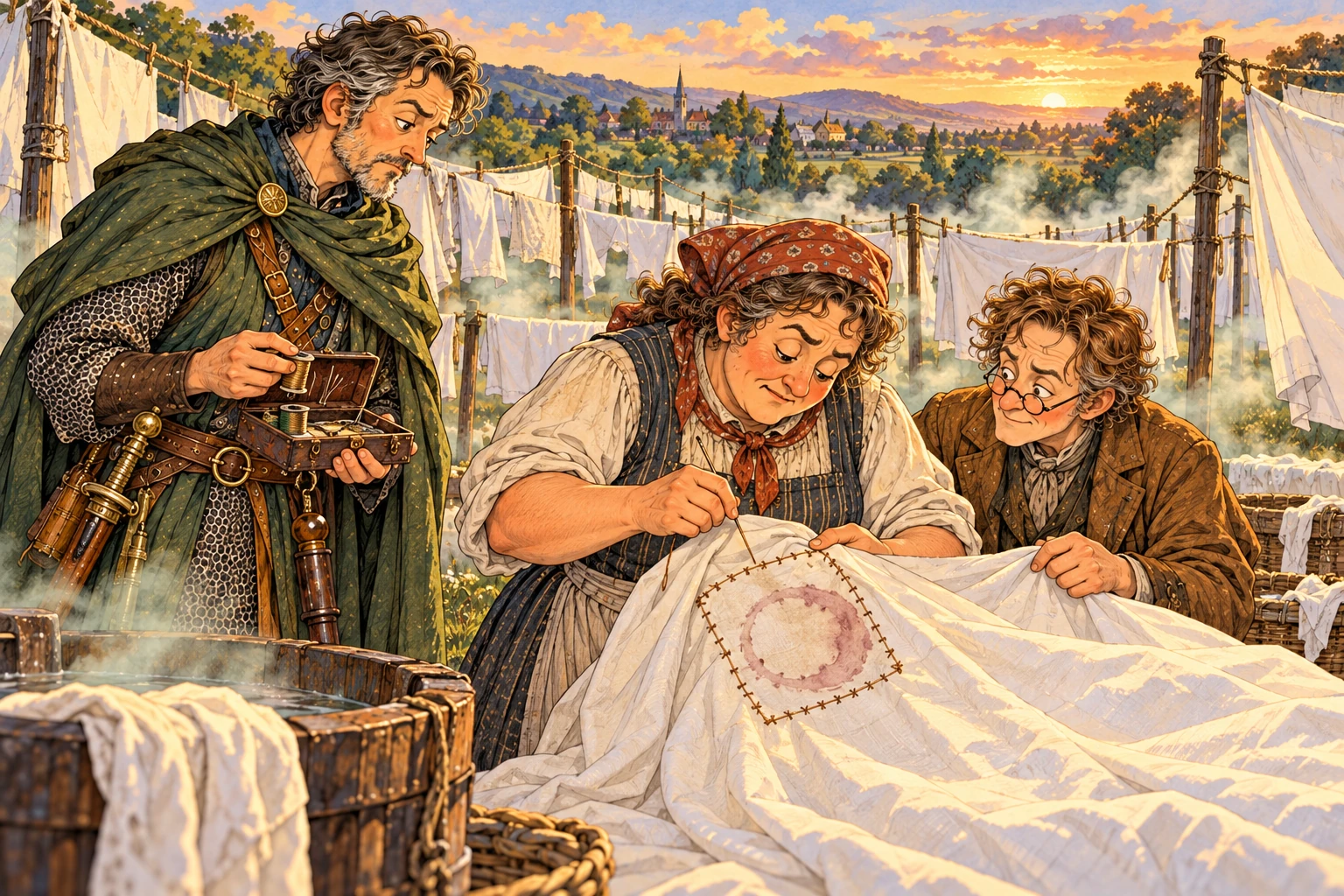
Part One: The Clean Man
Sir Cardevane of Westmere had heard, from a source he considered clean enough to trust, that the green fog came from a laundry field.
The source entered the Marsh Road Inn shortly before noon and caused an immediate decline in the moral standing of every other person in the room. He was clean beyond the ordinary work of washing, combing and brushing. People in country inns can forgive improvement; this was something deeper and more offensive. His boots shone without polish. His coat had no lint upon it. His cuffs were white at the edge, with the impossible whiteness of cloth made before anyone had thought to invent mud. Even his travelling bag looked unused by travel.
Bartholomew saw him first and put down his spoon.
"No," he said.
Sir Cardevane looked up from a map of the lower marsh, on which he had drawn three speculative dragons and one possible drainage solution.
"No what?"
"No to whatever he is."
The clean man approached their table.
"Sir Cardevane of Westmere?"
"I have that distinction."
The man bowed. His hair did not move.
"I am told you are seeking the source of the green fog."
"I am conducting a disciplined inquiry into where it appears, what it does, and what it leaves behind."
"The source is Mrs Cleat's washing field."
Bartholomew pushed his bowl a little farther away.
"Of course it is."
Sir Cardevane leaned forward.
"A washing field."
"Yes, sir."
"Where?"
"Beyond Whitebarrow Hollow. Past the chalk pits. Where the lines begin."
"Lines?"
"Washing lines."
Sir Cardevane smiled.
"Bartholomew. At last, an origin of domestic utility."
"That is rarely good news."
The clean man looked at Bartholomew. His face was pale, smooth and ageless, as if weather had been removed from it.
"You should not mock Mrs Cleat," he said. "She improved me."
Bartholomew studied his cuffs.
"That is one word for it."
"She took out the road."
Sir Cardevane frowned.
"An unusual improvement to a traveller."
"I had been three weeks walking. Rain, ditch water, horse dung, kitchen smoke, a dead fox in a hedge. My coat was ruined. My shirts were worse."
"That sounds like proof of travel," said Bartholomew.
"It was dirt."
"Some dirt is evidence."
The clean man's mouth twitched. A stain of colour seemed to rise in his cheek and then vanish at once, as if his skin rejected it.
"She washed it all out," he said.
"And the green fog?" asked Sir Cardevane.
"It comes when she stops."
The other people in the room stopped pretending not to listen.
"When she stops what?" asked Bartholomew.
"Washing."
"Why does she stop?"
The man looked at his perfect hands.
"She tries."
Sir Cardevane folded the map.
"A woman battling fog with soap. This demands attention."
"It demands distance," said Bartholomew.
"That also requires attention."
The clean man put one hand flat on the table. There was no dirt beneath his nails. There were no half-moons either. His nails looked like shells found before the tide reached them.
"She said I must not go back," he said.
"Then why come to us?"
His hand tightened. The skin at the knuckles did not redden.
"Because I do not know where I have been."
Bartholomew looked at him. The man went on.
"I know the names of towns. I have receipts. I have stamps in a passbook. I remember rain on my face, a dog at a toll gate, a woman selling pears near Coldmere Bridge. But my coat says none of it. My boots say none of it. My bag says none of it."
He lifted his clean hand.
"Even my hands say I have not carried the bag."
Sir Cardevane's expression, which had been cheerful, became grave.
"A serious laundering."
The man nodded once.
"I was not washed. I was corrected."
Outside, beyond the inn windows, the road lay brown with wet cart ruts. Two horses stood steaming by the trough. A child ran past carrying a blackened kettle. Ordinary things, each marked by use. Bartholomew picked up his notebook.
"Mrs Cleat," he said.
The clean man flinched at the name.
"Do not let her wash anything of yours."
Sir Cardevane rose.
"My good man, I assure you that my possessions have survived worse than soap."
The clean man looked at Sir Cardevane's cloak. It was torn at the lower edge, smoke-stained at the shoulder, burr-marked along the hem, and bore on one side a small crescent of dried mud from an encounter with a ditch into which Sir Cardevane had insisted no knight could possibly fall.
"It will tempt her," he said.
"My cloak?"
"Your history."
Bartholomew stood.
"Now I am coming."
Sir Cardevane looked pleased.
"I had hoped the word history would have that effect."
The clean man stepped back as they prepared to leave.
Sir Cardevane offered his hand.
The man hesitated, then shook it.
His palm was dry.
Too dry.
Bartholomew noticed that when he removed his hand, no warmth remained on Sir Cardevane's glove.
Outside, they mounted and took the road west. Behind them, in the inn doorway, the clean man stood without gathering dust.
Part Two: The Lines Begin
Whitebarrow Hollow was not marked on Sir Cardevane's map.
This irritated him less than it ought to have done, because he considered maps to be opinions with borders. Bartholomew considered them useful documents made less useful by Sir Cardevane's additions. They passed the chalk pits in the late afternoon. The land there had been cut open in white shelves. Rainwater stood in the old workings, pale as milk. Beyond them the road narrowed, dipped between two banks, and lost its hedges.
The first sheet hung across the lane. Bartholomew drew rein. It was pegged to a line strung from an ash tree to a post. A common sheet. White. Wet. Motionless. Sir Cardevane guided his horse under it.
Drops fell on his helmet.
"The laundry announces itself."
Bartholomew stayed where he was.
"There is no house."
"Perhaps it prefers privacy."
"There is no washtub."
"The sheet may be advanced."
Another sheet appeared beyond the first. Then three more. Then a row of them crossing the field to the left, each pegged tight, each white, each heavy with water. Beyond those were more rows, running down into a low valley.
They rode to the ridge. Below lay Mrs Cleat's washing field. Sir Cardevane took off his helmet.
"My word."
The valley was full of linen. Sheets, shirts, tablecloths, napkins, aprons, towels, shrouds. They hung in lines so dense that the valley looked roofed in white. Lines crossed lines. Pegs shone pale on cords. Long sheets swayed though no wind moved over the hill. Some were plain. Some were hemmed with lace. Some bore the crest of houses Sir Cardevane had visited, and of one from which he had been tactfully asked to depart.
Bartholomew looked to the far side of the valley. The lines did not end there. They passed over the next hill and the next.
"No carts," he said.
"No."
"No road large enough for half this."
"No."
"No laundresses."
"One must admire efficiency," said Sir Cardevane.
"One must not."
At the centre of the field stood a woman beside three copper tubs. She was large, broad-shouldered, and bare-armed despite the cold. Her sleeves were rolled above the elbow. Her forearms were red and cracked. Her hands were in the water. She wrung a sheet with the steady violence of a ship's rope being tightened. Green steam rose from the tub. It lifted only a foot, then spread low across the grass, threading under the hanging linen.
The woman saw them and continued washing.
Sir Cardevane and Bartholomew dismounted at the edge of the field. The grass squelched under their boots. It was not mud. It was water pressed into earth by years of dripping.
"Mrs Cleat?" called Sir Cardevane.
"If you have brought washing," she said, "third post. Keep clear of the wool."
Her voice was low and practical. It had no welcome in it and no surprise.
"I am Sir Cardevane of Westmere."
"Then keep armour clear of the copper."
"I have come regarding the green fog."
Mrs Cleat plunged the sheet again.
"So has everyone."
"We are told it rises from your field."
"It rises when a mark will not shift."
Bartholomew looked at the sheet in her hands. It was spotless.
"What mark?"
Mrs Cleat lifted it from the water. It sagged between her fists. Clear water ran from it. Then, slowly, a darker patch appeared in the cloth. The darker patch held the shape of a glass ring near one corner, faint as breath on a mirror, more pressure than stain. Mrs Cleat saw it and set her jaw.
"That."
"A wine mark?" asked Sir Cardevane.
"Wine first."
"And after?"
"Trouble."
She plunged the cloth into the tub. The water went green. The ring vanished. A low thread of fog slipped over the rim.
Mrs Cleat wrung the sheet hard and threw it over the line behind her. It hung white, clean, and very wet.
"How long will it take to dry?" asked Bartholomew.
Mrs Cleat did not look at him.
"That one?"
"Yes."
"It was first washed forty-two years ago."
Sir Cardevane looked at the sheet with renewed respect.
"A stubborn fabric."
"Good linen," said Mrs Cleat. "Bad evening."
The sheet dripped steadily into the grass. Bartholomew watched the green steam crawl from the tub and under the hanging lines. Wherever it passed, the sheets stirred as the green steam moved beneath them.
"What evening?" he asked.
Mrs Cleat put another cloth into the tub.
"The first."
Part Three: Mrs Cleat's Work
Mrs Cleat did not invite them to follow.
She did not need to. There was nowhere to stand in the washing field that was not already part of her work. Sir Cardevane stepped carefully between the lines. His armour brushed a pillowcase. It left no mark, though the metal was wet and road-dark. Bartholomew noticed. Mrs Cleat noticed him noticing.
"Mud comes out," she said.
"Does it?"
"Mud, grease, soot. Give me heat, lye, and a board that does not wobble, and I'll shift most things."
"And the rest?"
Mrs Cleat wrung the cloth.
"The rest was done on purpose."
Sir Cardevane walked on. He stopped before a child's shirt. It was small and white, with three buttons and one empty place where a fourth should have been. The sleeves dripped, though no tub stood near it.
"That one," he said softly.
Mrs Cleat glanced over.
"Fever."
"It is very clean."
"Cold water first. No soap till after."
"Why?"
"Blood sets with heat."
"I meant why wash it so often?"
Mrs Cleat took the shirt from the line.
"Mother had three more."
Bartholomew looked at her.
"And she asked you to remove what?"
Mrs Cleat ran one thumb along the missing button.
"What she could not look at and still boil porridge."
The shirt twitched in her hands. Sir Cardevane took one step back. A faint shape passed through the cloth. A hand at the chest. Small fingers curled inward. Mrs Cleat put the shirt into a basin, though Bartholomew had not seen the basin there a moment before.
The water went green. Mrs Cleat rubbed the cloth between her palms.
"No."
The fog thickened.
"No."
Sir Cardevane watched her hands.
"You do not seem pleased by success."
Mrs Cleat wrung the shirt.
"Clean is clean when I can hang it and walk away."
"And can you?"
She hung the shirt back on the line. It was white. It dripped.
"No."
The word was flat, older than despair.
Bartholomew counted three lines of washing, then stopped.
"How many?"
Mrs Cleat picked up another cloth.
"More than Monday. Fewer than judgment."
"That is not a number."
"It is the nearest I keep."
A thin, cracked laundry bell rang far away. Mrs Cleat stiffened. At the far ridge, beyond the white lines, something green passed through the sheets themselves. The linen lifted in sequence. One row, then the next. A path of disturbance crossed the field towards the tubs.
Mrs Cleat closed her eyes.
"Not now."
Sir Cardevane put a hand to his sword.
"What approaches?"
"More of it."
The green movement reached the first line. A sheet that had been white for a moment darkened at the centre. A muddy handprint appeared. Then another. Mrs Cleat turned away.
"I am done."
The handprints deepened. The fog crept towards her feet.
"I said I am done."
A second sheet marked itself. This one with a circle of red wine. The mark spread through the weave, slow and deliberate. The fog touched her apron. Her hands went into the tub. She washed.
Part Four: The First Cloth
They stayed until dusk.
This was not Sir Cardevane's preference. His preference was to identify a monstrous source, challenge it directly, and return to the inn before the stew diminished. But Mrs Cleat's field did not offer a source so much as a procedure. The fog came when she stopped. The marks came when the fog came. The washing made the marks disappear. The washing made the fog worse. Bartholomew wrote this down and disliked how simple it looked.
At sunset Mrs Cleat sat on an upturned basket beside the first tub. She had washed through the afternoon. Her hands shook. Water steamed green around her boots. Sir Cardevane stood opposite her, one gauntlet tucked under his arm.
"Madam," he said, "it seems to me that your labour is heroic, continuous, and structurally unwise."
Mrs Cleat looked at him.
"You talk like a man who has never had sheets out in weather."
"I have slept beneath several."
"I wouldn't put those in the same pile."
Bartholomew looked at the sheet hanging behind her. The one with the faint ring.
"The first cloth," he said.
Mrs Cleat did not turn.
"You said it was washed forty-two years ago."
"Yes."
"What happened?"
She rubbed her thumb against the edge of her palm, as if working out a stain no one else could see.
"A dinner."
"What sort?"
"The sort with too many glasses."
Sir Cardevane waited.
Mrs Cleat looked at the valley rather than either of them.
"Kitchen girl was brought in front. Wrong dress. Wrong hands. Wrong voice. Knocked a glass. Red wine. White cloth. Whole room looked at the cloth because looking at her would have been work."
"And you washed it?" asked Bartholomew.
"I was asked."
"By the girl?"
"No."
"Did she keep her place?"
Mrs Cleat put both hands on her knees.
"No."
Sir Cardevane frowned.
"For a wine mark?"
"For showing the room."
The sheet behind her moved without wind. Mrs Cleat stood and went to the line. She took down the old sheet. It was heavy. Sir Cardevane reached to help her.
"No. If I cannot carry it, I have no business with it."
She lowered it into the tub. The ring disappeared. For one breath, the sheet was perfect. Then the fog rose from the water.
This time it carried smell. Wine. Beeswax. Cooked meat. Hot silver. A room with too many flowers in it. A girl swallowing tears because she had been told not to make a scene. Sir Cardevane stepped back. Mrs Cleat gripped the edge of the tub.
"You see?"
"Yes," said Sir Cardevane.
"It looked better clean."
The fog touched the old sheet. The ring returned. Mrs Cleat struck it with both hands.
"No."
Bartholomew caught her wrist. She was stronger than he was. Much stronger. But she did not pull free.
"No," he said.
Her eyes moved to him.
"Let it sit?"
"Yes."
"On white cloth?"
"Yes."
"And the shame?"
"It is not the cloth's," said Bartholomew quietly.
Mrs Cleat's mouth tightened. The fog pulled at the sheet, lifting one edge. The ring widened, then steadied. It was no longer red. It was the colour of old tea. Sir Cardevane looked at it. The brown-edged ring remained on the linen.
"A patch will show," said Mrs Cleat. "It will pucker."
"Probably," said Bartholomew.
Mrs Cleat looked at the tub. Her hands twitched once towards the water. The fog thickened. A sheet behind them marked itself with a dark boot print.
Mrs Cleat turned. Bartholomew kept hold of her wrist.
"Not that one."
"There will be more," said Mrs Cleat.
"Yes."
"Then what?"
Bartholomew let go of her wrist.
"One cloth."
The words were small against the field. Mrs Cleat looked at the acres of white linen. Then at the old sheet in the tub. Then at her hands.
"I have no needle."
Sir Cardevane removed a small case from inside his belt. Bartholomew stared at him.
"You carry needles?"
"A knight must be prepared for punctures, torn banners, and symbolic mending."
"That is impossible to argue with."
Mrs Cleat took the needle. Her fingers were too large for delicate work. The first stitch was ugly. The second was worse. She worked brown thread around the old wine ring from Bartholomew's travelling kit. The ring remained visible inside the uneven border.
The fog pressed close. Mrs Cleat bent over the cloth. Stitch. Stitch. Stitch.
The bell on the ridge rang again. No one moved. When she finished, the sheet did not become clean. It became heavier for a moment, then lighter.
Mrs Cleat lifted it from the tub. This time, clear water fell from it in drops. She hung it on the line.
The old ring showed plainly in one corner, circled by poor brown stitches. The sheet moved in the evening air. Then, slowly, it dried.
Part Five: Cardevane's Cloak
Mrs Cleat slept sitting up with her back against a post.
She did not mean to. Bartholomew saw her fight it. But after the first cloth showed signs of drying, her eyes closed and her hands slowed. The field did not sleep. All night the lines clicked. Pegs tightened. Sheets shifted. The green fog lay low between the rows. Marks appeared in the dark. Some faded before they fully formed. Others stayed. Mrs Cleat did not rise for them.
Once, near midnight, her right hand lifted from her lap and reached towards the tub. Sir Cardevane put his gauntlet over it.
"No, madam."
She did not wake.
At dawn the first cloth was dry. The ring and stitches remained, and it hung lighter on the line than any cloth in the valley. Mrs Cleat woke and stared at it.
"I left a mark."
"Yes," said Bartholomew.
"It dried."
"Yes."
Sir Cardevane, who had been polishing a dent in his breastplate with a corner of his cloak, stood.
"We now possess evidence that a patch interrupts the fog's procedure."
"Procedure?" said Mrs Cleat.
"Forgive him," said Bartholomew. "He has fought three things this month and is starting to miss swords."
Sir Cardevane ignored this.
"We require a second test."
"No," said Bartholomew.
"Yes."
"No."
Sir Cardevane removed his cloak and held it out.
"My cloak has travelled honestly, suffered publicly, and endured indignities of ditch, bramble, horse, smoke, and gravy. If Mrs Cleat washes it, we shall observe the effect upon a garment of known moral standing."
"It is a cloak," said Bartholomew.
"A veteran cloak."
Mrs Cleat looked at it with tired hunger. Mud along the hem. Smoke near the shoulder. Grass seeds in the lower seam. A streak of white chalk from the pits. One dark patch from the inn bench where the wood had not been as dry as advertised.
"It is very marked," she said.
"It has had opportunities."
"Do you want it cleaned?"
Sir Cardevane hesitated. Bartholomew saw the hesitation and disliked it.
"A knight must not fear a tub."
Bartholomew remembered the clean man in the inn doorway. "This one worries me." Mrs Cleat took the cloak.
"Then say no."
Sir Cardevane opened his mouth.
The fog touched the cloak. A green line ran through the mud at the hem. Mrs Cleat's hands closed.
"So much road," she whispered.
"Mrs Cleat," said Bartholomew.
"So much weather."
The cloak slid into the tub. Sir Cardevane took one step forward. Too late. The water turned green at once. Mrs Cleat washed as if pulled by ten years of habit. Her hands moved with terrible skill. Mud streamed from the cloth. Smoke thinned. Chalk vanished. Burrs loosened and floated away like small boats.
Sir Cardevane watched. His face had gone still. The cloak came out corrected. The torn corner was whole. Bartholomew's stitches were gone.
Mrs Cleat held it up. It was magnificent. The fabric hung in a noble fall. Its colour, once difficult to name, had become a deep blue. The edge was straight. The gravy mark was gone. The chalk was gone. The road was gone.
Sir Cardevane reached for it. Bartholomew caught his arm.
"Look at it."
"I am."
"No. Look at it."
Sir Cardevane looked. His hand lowered.
"It no longer looks as if you came here," said Bartholomew.
Mrs Cleat held the cloak between them.
"It is better."
"It is false," said Bartholomew.
Sir Cardevane looked at the hem.
"The ditch is gone."
"Good," said Mrs Cleat.
"It was a foolish ditch."
"Then good."
"I fell into it while attempting to rescue a pig from an administrative misunderstanding."
Bartholomew closed his eyes.
"Of course you did."
"The pig was innocent."
"The cloak is cleaner without it," said Mrs Cleat.
Sir Cardevane touched the flawless hem.
"But less accurate."
The fog rose around the tub. Mrs Cleat's hands shook. The cloak grew heavier in her grip.
A wine ring appeared on the clean blue cloth. Small. Brown. Familiar.
Mrs Cleat stared. Then the ring faded from the cloak and returned to the first cloth, darker than before.
Mrs Cleat crossed the grass before anyone could stop her.
She stood before the first cloth. The patch had pulled tight. The poor stitches strained around the mark.
"It wants washing," she said.
"No," said Bartholomew. "Add another stitch instead."
She did not take the needle he held out. The fog moved between the lines. The first sheet sagged. The ring darkened.
Mrs Cleat's hands opened and closed. Sir Cardevane stepped beside the tub and placed one arm across it.
"I must advise against further washing."
"You cannot hold the tub all day," said Mrs Cleat.
"I can make a spirited attempt."
She looked at him. Then at the cloth. Then at the needle. She took it.
Part Six: The Patch
They spent the morning on the first cloth. Mrs Cleat added a second line of brown stitches around the old wine ring, then a third. She strengthened the thinning weave and left the ring visible.
Whenever another sheet marked itself, the fog rose and her eyes went to the tub. Each time, she put another stitch into the cloth instead. Sir Cardevane held one corner of the sheet. Bartholomew held the other. The cloth was heavy at first. Then less heavy. Then merely wet.
Mrs Cleat stopped.
"Enough," she said.
The word sounded strange in her mouth. She had not used it as an ending before.
Bartholomew bent closer to the sheet. It was not good work. The patch puckered. The brown thread sat too thick against the linen. The old ring showed plainly inside it. Mrs Cleat wiped her hands on her apron, then stopped herself. Her apron was filthy. She looked down at it.
For a moment Bartholomew thought she would tear it off and plunge it into the tub. She did not. Sir Cardevane released his corner. The sheet hung between the posts.
Water fell from it. Clear. Fog lay between the lines. Across the field, enough of the nearest sheets dripped clear water for the sound to carry. A field of small sounds.
Mrs Cleat sat down on the wet grass. Sir Cardevane folded his cleaned cloak over his arm. It remained too clean. He looked uncomfortable with it. Bartholomew noticed.
"You could drag it behind the horse."
"A tempting vulgarity."
"You could give it back to her."
Sir Cardevane looked at Mrs Cleat, who sat among the drying linens with her red hands open in her lap.
"No," he said. "It has been corrected enough."
He walked to the first cloth, knelt, and pressed the clean hem of his cloak into the wet grass. Mrs Cleat watched him.
"You will mark it."
"Yes."
"It may not come out."
Sir Cardevane stood. The hem of the cloak bore a green-brown smear of field water and earth.
"Then we shall have achieved accuracy."
Bartholomew looked at the mark.
"A modest victory."
"That has not been your previous position."
"I am capable of reconsidering my positions."
Mrs Cleat laughed. It was a small sound, cracked with disuse. No one in the field spoke.
Part Seven: The Clean Place
By evening, Mrs Cleat's field had changed colour in small patches. It was still mostly white, but here and there the white broke: a brown stitch, a blue patch, a visible ring, a darned tear, a child's sleeve with one button missing and no attempt made to replace it.
The lines did not end at the valley. They still crossed the ridges. They still suggested more washing than any woman could complete, and more mistakes than any world would willingly count. But the nearest sheets were drying. Mrs Cleat stood beside the first cloth.
"I cannot mend them all," she said.
"No," said Bartholomew.
"I cannot wash them all either."
"No."
She looked at him.
"You offer little comfort."
"I try not to overstate supply."
Sir Cardevane adjusted his marked cloak. Mrs Cleat touched the stitched ring.
"It is ugly."
"Yes," said Bartholomew.
Sir Cardevane frowned at him.
"It is," said Bartholomew. "But honestly."
Mrs Cleat nodded. Beyond the field, a low strip of green lay in the hollow. It lay beneath the farthest lines, where the wet sheets still touched the grass. They left Mrs Cleat with the first dry cloth under her arm and a needle tucked behind one ear.
At the edge of the field, Sir Cardevane paused.
"Madam."
She looked up.
"Should the fog return in force, send word."
"It will."
"Then send word before it becomes theatrical."
Mrs Cleat nodded. Sir Cardevane mounted. Bartholomew looked back once from the ridge. Mrs Cleat had taken down one of the sheets. She was not washing it. She was holding it to the light.
The sheet showed a faint mark near the centre. She did not move towards the tub.
At the Marsh Road Inn that night, the landlady looked at Sir Cardevane's cloak and raised an eyebrow.
"You got it dirty."
"Restored," said Sir Cardevane.
Bartholomew sat beside the fire and ordered ale. The clean man was there after all. He sat in the corner with both hands flat on the table before him. He had ordered nothing. The line across his cuff had darkened. There was dust now on one boot, but the dust lay in a sharp-edged patch on the leather instead of spreading into the creases.
"Road improving?" asked Bartholomew.
The clean man looked at him.
"I found the pear woman."
"At Coldmere Bridge?"
He nodded.
"What did she say?"
"That I had passed her twice. Once before Mrs Cleat. Once after. She said the second time I looked like a man drawn from memory by someone who disliked detail."
Sir Cardevane sat beside him.
"A severe but useful assessment."
The clean man looked at Sir Cardevane's marked cloak.
"She let you keep that?"
"I insisted."
"Does it help?"
Sir Cardevane glanced at the hem.
"It gives my cloak a more truthful account of the day."
The clean man looked at his hands.
"I left no footprint on the road. I chose the puddles. I stamped. Nothing stayed."
Bartholomew did not answer. The man sounded calm, which made it worse. The landlady came to their table with ale. She set it down and looked at the place where the clean man's chair stood.
"What have you done to my floor?"
Bartholomew looked. The chair had left a pale square on the boards, the grain flattened as if the wood had been scrubbed past wood. The landlady bent with her cloth. Bartholomew caught her wrist.
"Do not."
"It is clean," she said.
"Yes," said Bartholomew. "That is the difficulty."
Outside, the road steamed after rain. The boards were clear for now.
Case 17
God Who Dreamed Too Long
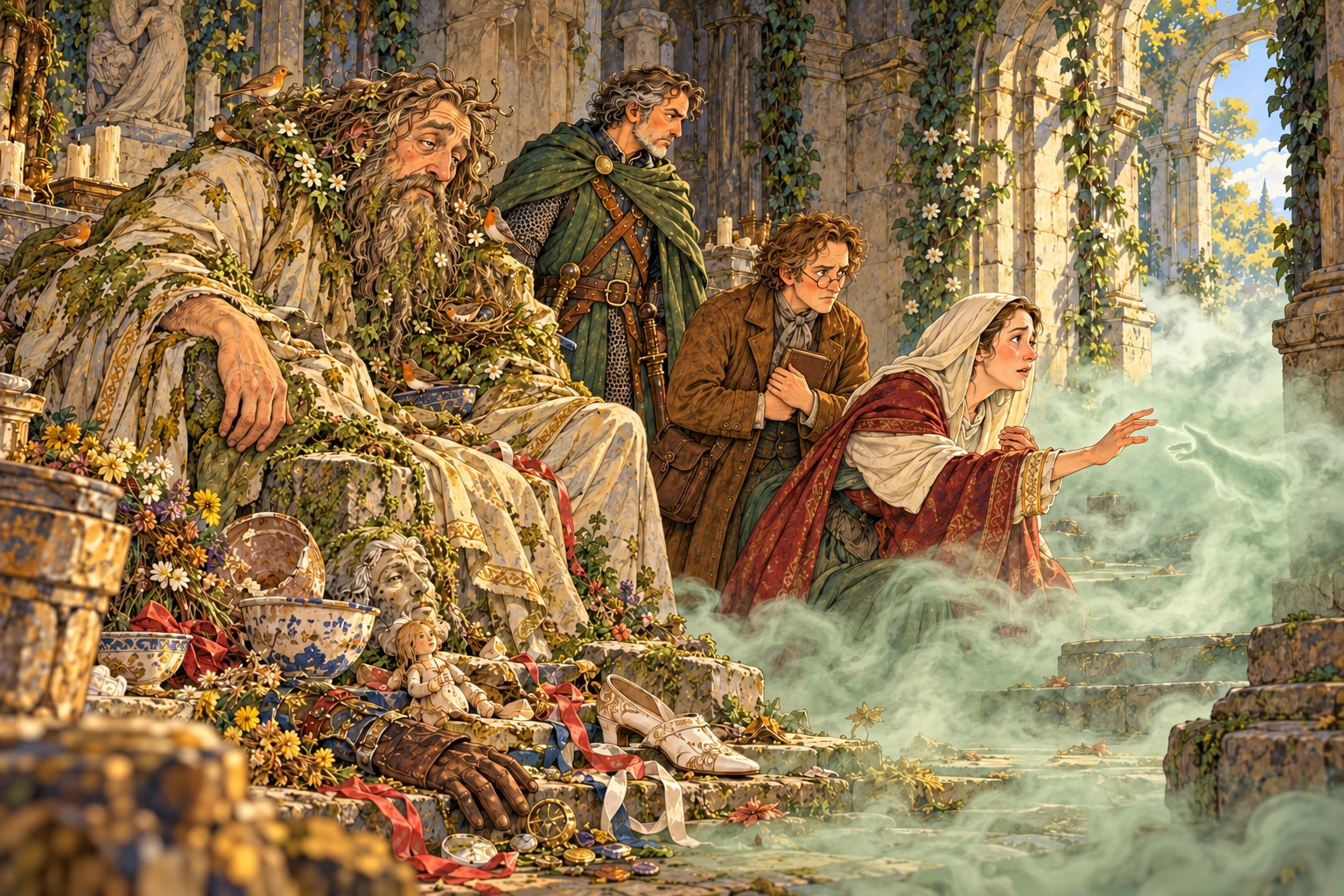
Sir Cardevane of Westmere had heard, from a source he considered theologically alarming, that the green fog was being dreamed by a god.
The source was a bell-ringer from Lorn Hollow, who had arrived with no bell, no shoes, and the peaceful expression of a man who had recently mislaid most of Tuesday.
"It comes from the old temple," said the bell-ringer.
"What comes from the old temple?" asked Bartholomew.
"The fog."
"Temples often have incense," said Bartholomew.
The bell-ringer shook his head at incense. When Bartholomew suggested a priest, he shook it harder.
Sir Cardevane leaned forward.
"What was it?"
The bell-ringer smiled.
"A dream with weather in it."
Bartholomew stopped writing. Sir Cardevane looked pleased.
"At last," he said, "a source with rank."
"That is not always an advantage," said Bartholomew.
The bell-ringer nodded gently, as if Bartholomew had said something from very far away.
"He sleeps below the old temple," he said. "All day. All night. The green fog comes from his mouth when he dreams."
"And what does he dream?" asked Sir Cardevane.
The bell-ringer looked at the window.
"Better things."
Sir Cardevane had the matter entered under divine sources, possible exhalation, and dreams of suspicious productivity.
They rode to Lorn Hollow the next morning. The road was unusually pleasant, which made Sir Cardevane distrust it. It passed through orchards, over low hills, and beside fields where barley moved in soft waves. Bees worked the hedges. Birds called from ordinary trees. Once, a rabbit crossed the road and did not turn into anything else.
"This is the least ominous approach we have had," said Bartholomew.
"Precisely," said Sir Cardevane.
By afternoon, the road changed in sound before it changed in sight. The hedges still grew. The fields still lay under the sun. But the sounds thinned. Fewer carts passed. At one farm, a gate hung open and three cows stood in the lane, chewing thoughtfully as if no one had recently remembered owning them. At the next bend they found a man asleep beside a plough. His horse stood patiently in the furrow. The man's eyes were open.
Sir Cardevane dismounted. "Good man," he said.
The man smiled. "Not this field," he murmured. "The one beyond the mill. Wheat higher than my shoulder. No stones. No taxes. My father there with both hands."
Sir Cardevane looked at the man's hands. They were raw from work. The plough had stopped halfway through a line. A crow stood on the handle. He took the man by the shoulder and shook him. The man blinked. His smile broke. He looked at the field, the plough, the horse, the stones in the soil. Then he put both hands over his face.
They rode on.
Lorn Hollow lay in a dip between three hills, gathered around a square and a dry fountain. It was not deserted. That made it worse. Green fog lay close to the ground, thin as gauze. It wound around ankles, thresholds, cartwheels, tools. It did not choke. It merely made the air seem kinder than it had any right to be. A baker stood in front of an oven with blackened loaves behind him and flour on his arms, smiling. A woman stood beside a well with a snapped rope at her feet, also smiling.
Sir Cardevane crossed to her. "Madam."
"He is coming home," she said.
"Who?"
"My son."
Bartholomew looked at the snapped rope. The bucket lay at the bottom of the well, just visible in the dark.
"When did he leave?" asked Bartholomew.
"Spring."
"This spring?"
"No," she said. "A kinder one."
The green fog curled around the stones of the well. The broken rope lifted once, its two ends almost meeting, then dropped. Sir Cardevane looked towards the old temple beyond the village. Green vapour drifted from its doorway and slid down the steps.
"There," he said.
"Yes," said Bartholomew. "At last we have located something that may resent being called a source."
They walked to the temple. The temple was older than the village. Its stones were white beneath moss and grey above it. Someone had once swept the steps. Someone had stopped halfway. Inside, the air was green. The floor sloped down to a chamber below the old altar. The walls were carved with sleeping faces. Some looked peaceful; others looked worn and tired.
At the bottom lay the god. He was not as large as Sir Cardevane had expected. Then the god breathed. Dust lifted from the floor. Leaves stirred in the cracks of the wall. A small root withdrew into stone. The god lay on a bed of old offerings: broken bowls, dried flowers, ribbons, teeth, letters, dolls, coins, a soldier's glove, a wedding shoe. Moss grew in his beard. Birds nested in the folds of his robe. His skin was the colour of moonlit clay. His eyes were closed.
Green fog crossed the chamber. It rolled over the floor, up the slope, and out through the temple door toward the village below.
Sir Cardevane struck the floor with the butt of his spear. Green fog thickened across the chamber. The god’s next breath took longer to come.
"Sir," said Bartholomew quietly. "If you wake him, they will wake too."
"That is the purpose."
"Yes," said Bartholomew. "That is what worries me."
A pigeon fell from the god's eyebrow, considered its options, and went back to sleep. Bartholomew wrote that down.
Sir Cardevane struck the floor again. The god opened one eye. It was not a large eye, but it contained a great many mornings.
"Who woke me?" said the god.
Sir Cardevane did not bow.
"I am Sir Cardevane of Westmere."
The god opened the other eye.
"That is not an answer."
"It often is."
"Not here."
Bartholomew made a small approving sound.
"Do the dreams bring the green fog, or does it come through them?" asked Sir Cardevane.
The god yawned. A small cloud drifted from his mouth and became, briefly, a white horse running through an orchard. One of the children who had followed them reached for it. Bartholomew caught the child's sleeve. The god breathed again, and for a moment a boy's hand appeared in the fog beside the woman from the well, reaching towards her sleeve. She made a sound and stepped towards it. Sir Cardevane looked away.
"I dream what they bring me," said the god.
"You dream what they cannot carry while awake," said Sir Cardevane.
"That is not a denial."
"No."
"Then you admit responsibility."
The god sat up slowly. Several birds left his robe. One returned immediately.
"They brought me sorrow," said the god. "I stopped counting how much."
Sir Cardevane frowned. "Your dream has stopped the village."
"My dream has comforted it."
"The bread burns."
"The baker is happy."
"The woman at the well thinks her son is coming home," said Bartholomew.
The god's face changed. He looked old then. His shoulders had dropped, and he did not raise them again. "She came to me with one sentence," he said. "Only one. 'Let me see him before I forget his face.' Was that wicked?"
No one answered.
"She saw him," said the god. "Every day."
"She also stopped drawing water," said Bartholomew.
The god's eyes flashed.
"She still has no water," said Bartholomew.
"Thirst is not impressed by poetry," said Bartholomew.
Sir Cardevane looked at the god more carefully. "Where does the fog begin?" asked Sir Cardevane.
The god smiled sadly.
"I do not know."
Bartholomew looked around the chamber, at the offerings, the sleeping faces, the fog thinning along the floor.
"You are a place where dreams gather."
"I am a god."
"Yes," said Bartholomew. "That is what I said."
Green fog continued across the chamber floor and out through the temple door.
The baker looked towards the square.
"My bread," he said.
"Yes," said Bartholomew.
"It burned."
"Yes."
The baker's mouth tightened.
"It always burns at the edges. Even when I watch it."
"That is what bread does," said Bartholomew.
The woman from the well took one step towards the god. "My son."
The god looked at her.
"No," she said. The word was small. Then again: "No."
The god closed his eyes, but he was awake now. He could not dream it back. The woman gripped the edge of the altar until her knuckles whitened.
"You gave him back."
"For a while," said the god.
"You gave him back every morning."
"Yes."
"And now?"
His face changed. "Now you remember he is gone."
The woman struck him. It was a small blow. Her hand hit his chest and made almost no sound. The god bowed his head as if it had been a sword.
"I am sorry," he said.
The chamber was very quiet.
Then a cry of irritation came from outside.
"My goats. Who let my goats into the wash?"
The bell-ringer looked towards the door. Life came back to Lorn Hollow badly. It arrived with smoke, thirst, lost tools, overfed goats, neglected fires, hunger, grief, and one chicken found asleep in a cupboard. The woman from the well had stopped smiling, but her hand still held the shape of the hand that had not been there.
Sir Cardevane watched the villagers stumble out. "This is worse than I expected," he said.
"Yes," said Bartholomew.
"Did I do wrong?"
Bartholomew was silent long enough that Sir Cardevane turned to him.
"That was not rhetorical."
"I know."
"Well?"
Bartholomew looked at the woman from the well. She had not left. She knelt beside the old offerings, one hand over her mouth, one hand on a wooden toy that might once have belonged to a child or a prayer. "No," said Bartholomew. "But right is sometimes very badly behaved."
The god laughed once. Tired.
"You wake me and ask if waking hurts."
"It appears to," said Sir Cardevane.
"It always does."
"Then why dream them at all?"
The god looked at the offerings around his bed.
"They asked."
"All of them?"
"Enough."
"Did they know the cost?"
The god ran one hand through his mossed beard. A beetle fell out, indignant.
"Does anyone?"
Sir Cardevane walked to the temple door. Outside, the light had changed. It was late afternoon. Lorn Hollow looked much the same.
The baker scraped black crust from a loaf and muttered. The bell-ringer stood in the square, looking at his empty hands.
The woman from the well came out last. She picked up the broken rope and tied the two ends together badly. The knot failed.
She stood there. The bell-ringer walked over and held one end for her. The knot held the second time.
The god watched from the doorway and said nothing. The green fog shifted along the rope and slipped through the knot. The god sighed.
"I am tired."
Bartholomew lowered his pen.
"I was worshipped once," said the god. "First fruits. Clear water. Bees in little cages, for dreams with sound in them." "Then they came only when they hurt." The god turned towards the woman. She was still at the well, still working the rope, still not looking up. "She will come back," said the god. "Tonight. She will ask for him again."
"Yes," said Sir Cardevane.
"And if I do not give him to her?"
Sir Cardevane looked at the bucket.
"She will still need water."
The god looked towards the woman. She had pulled the bucket up. Water spilled over her skirt. She was crying, but she was also drinking. The god looked at the village for a long time. Then he bowed his head.
"Very well."
Green fog lay in the cracks, beneath the altar and among the old offerings. A thin edge crossed the temple steps and continued down the hill.
The bell-ringer came to the temple door.
"What shall I ring?" he asked.
"You have no bell," said Sir Cardevane.
"I know."
The god reached into his robe and removed a small bronze bell. It was cracked. The bell-ringer went still.
"This is not mine," he whispered.
"No," said the god. "But it may be enough to begin badly."
The bell-ringer took it. He struck it with his finger. The sound was thin, cracked, and not beautiful. The village heard it.
People looked up from burned bread, broken rope, loose goats, crying children, and the ordinary wreckage of an afternoon. The bell-ringer struck it again. This time, no one smiled at nothing.
That evening, Sir Cardevane and Bartholomew stayed at the inn. It had no hot supper because the cook had spent most of the day dreaming of a kitchen where onions peeled themselves. It had bread. Burnt at the edges. Bartholomew said he had expected worse and was not disappointed. Outside, the cracked bell rang once for nightfall. Across the square, the woman from the well was carrying a bucket home. Slowly. Carefully. Both hands on it. She had relearned the weight.
That night Sir Cardevane dreamed. In the dream, he found the source of the green fog. It stood in a clear pool beneath a tree that had no name. The fog rose from the water in a single, straight, well-labelled line. Bartholomew stood beside him, openly impressed. A crowd had gathered to thank him. Someone had brought banners. The banners were correctly spelled. Sir Cardevane approached the pool.
The answer shone under the water like a coin. He reached for it.
A bell rang. Cracked. Thin. Badly timed.
Sir Cardevane woke in the dark. For a moment he was furious. Then he heard Bartholomew breathing in the other bed. He heard a cart outside. He heard someone in the inn yard swearing softly at a mule. The world had returned without improving itself. Sir Cardevane sat up.
By morning, the dream had faded. The road had not.
Bartholomew found him outside, tightening the saddle. "Did you sleep well?" he asked.
"No."
"Bad dream?"
Sir Cardevane looked towards Lorn Hollow. Smoke rose from the bakery. The cracked bell rang once, uncertainly, then again with more conviction.
"A good one," he said.
"Ah."
"Worse," said Sir Cardevane.
He mounted his horse. The road ahead was muddy and badly rutted, and led somewhere unknown. This seemed, after some thought, preferable.
Case 18
Magician Who Sawed Too Well
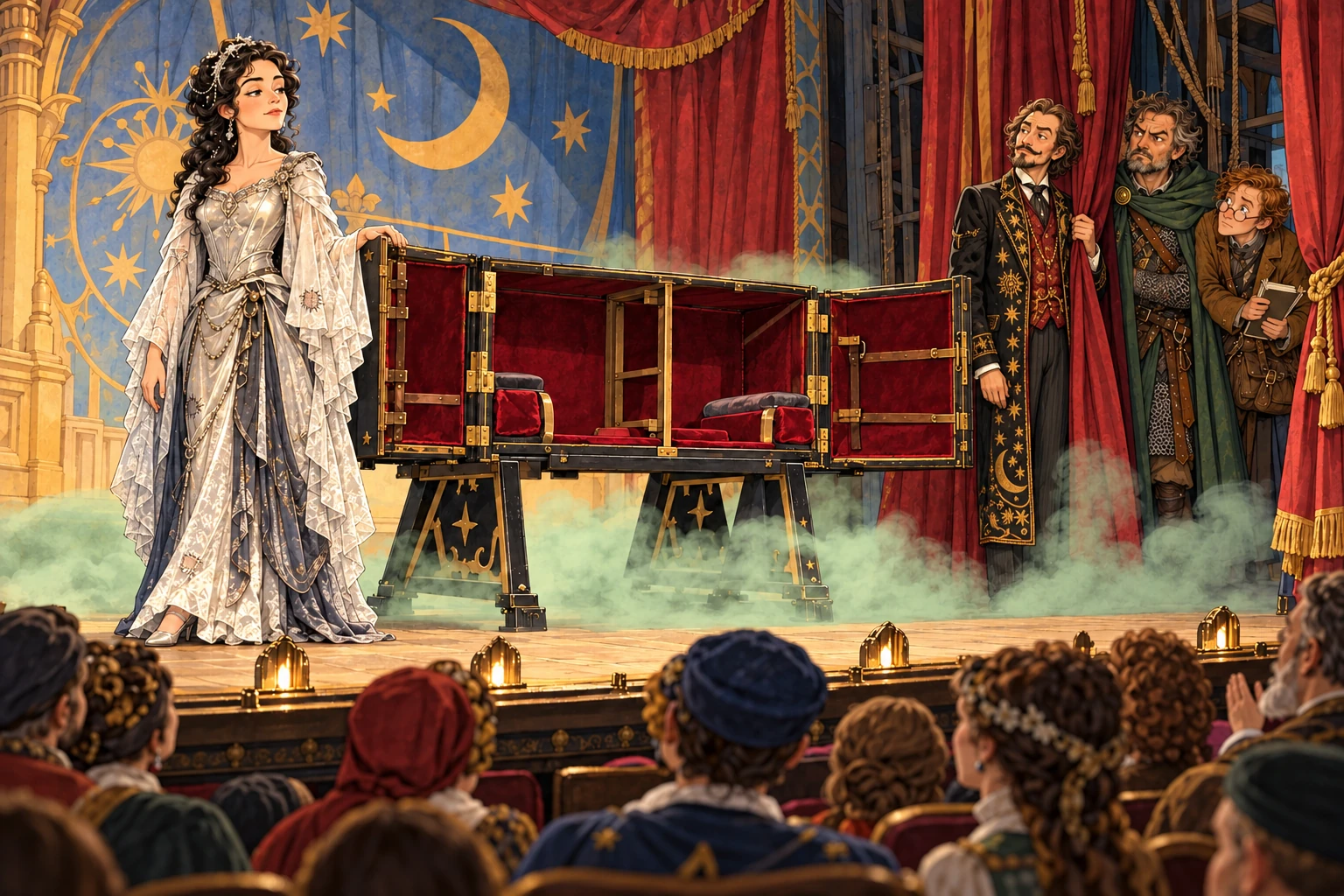
Sir Cardevane of Westmere had heard, from a source he considered theatrical enough to be useful, that the green fog came from a magician's box.
The source was a theatre usher from Bellminster, who had spent three evenings opening doors for late nobles, closing doors on early drunks, and watching Master Cedric Myre saw his assistant in half. This had not troubled him at first. Magicians were expected to do unreasonable things with ladies, boxes, birds, scarves, rings, coins, mirrors, hats, locks, chains, and occasionally fire. But on the third evening, just as the saw reached the middle of the box, green fog had seeped through the seam.
The audience had applauded. The usher had not.
"The lady smiled," said the usher. "But only with the part of her face the audience could see."
Bartholomew stopped writing.
"That is a specific kind of smile."
"It was a specific kind of box," said the usher.
Sir Cardevane leaned forward.
"And the magician?"
"He bowed so deeply his hair nearly became public property."
"Ah," said Sir Cardevane. "A professional."
"His posters call him Master Cedric Myre, Monarch of Marvels, Prince of Phantoms, Emperor of the Impossible, and Conqueror of the Visible World."
Bartholomew dipped his pen. "That is at least three men too many."
"Where is he now?" asked Sir Cardevane.
"Still at the Bellminster Royal Theatre. Last night he made a duchess's pearls disappear."
"Did they return?"
"To a hat."
"That is suspicious."
"To the wrong duchess's hat."
"That is theatre," said Sir Cardevane.
They left for Bellminster that afternoon. The town announced itself before it appeared. Posters covered every wall, gate, pump, stable door, chapel noticeboard, and one patient cow.
MASTER CEDRIC MYRE
FOR THREE NIGHTS ONLY
THE MAN WHO DECEIVES THE EYE OF HEAVEN
Below the words was a picture of a tall man in a velvet cloak, one hand raised towards lightning, the other resting upon a locked chest. Doves burst from his sleeves. A woman in silver stood beside him, smiling. Bartholomew studied the poster.
"He appears to have more cheekbones than is practical."
The Bellminster Royal Theatre stood at the end of Lantern Street. Its front was covered in red lamps, gold paint, and promises. A queue stretched from the ticket booth to the pie seller, who was doing excellent business among people prepared to believe anything.
Sir Cardevane purchased two seats in the second row.
"Why not the first?" asked Bartholomew.
"In the first row one sees hands. In the second row one sees intention."
"In the third row one sees both and pays less."
They entered. The theatre smelled of dust, perfume, candle grease, damp wool, oranges, and expectation. On stage hung a curtain embroidered with stars. Above it, painted clouds opened around a golden eye. Bartholomew looked up.
"That eye is not structurally necessary."
The lamps dimmed. A drum rolled. The curtain rose. Master Cedric Myre appeared in a flash of blue fire.
He was old, though he had made several arrangements against it. His hair shone with the hard black of polished boots. His moustache curled with the confidence of a bridge that had never met weather. His cloak was purple, his waistcoat gold, and his smile broad enough to shelter unpaid debts.
"Ladies and gentlemen," he cried, "you have entered the kingdom of astonishment."
A dove flew from his hat. It looked surprised to have been involved.
"Tonight," said Myre, "you will see coins rise, locked chains open, mirrors conceal, and a man apparently die on this stage."
The audience clapped. Bartholomew opened his notebook. Myre produced six red scarves from an empty sleeve, poured water from a dry jug, turned a handkerchief into an egg, turned the egg into smoke, turned the smoke into a bouquet, and gave the bouquet to a baroness who seemed uncertain whether she was honoured or implicated.
Then the assistant came on. She was younger than the applause expected. She wore silver, as in the poster, though up close the silver looked mended at the hem and tight at the throat. Her name, according to Myre, was Seren.
"Behold," he said, taking her hand, "the bravest woman in Bellminster."
Seren smiled. Sir Cardevane watched the smile. Bartholomew watched Sir Cardevane watching the smile.
"What is it?" he whispered.
"She is counting."
"Counting what?"
"How long to hold it."
Myre led Seren to a tall cabinet painted with moons.
"The Cabinet of Vanishing Certainty," he declared.
The cabinet was shown empty. Myre knocked on its sides. He opened its back. He spun it round. He invited a judge from the audience to inspect it. The judge did so, found nothing, and returned to his seat with the expression of a man disappointed not to have discovered corruption. Seren stepped inside. Myre closed the door.
He raised a silver hoop.
"Observe. No wires. No trap. No accomplice but wonder."
Bartholomew leaned towards Sir Cardevane. "There is always an accomplice."
"Often wonder is underpaid."
Myre struck the cabinet with his wand. The doors flew open. Seren was gone. The audience gasped.
Green fog lay briefly in the empty cabinet, low and pale, almost hidden by the stage smoke. Then it slipped through the floorboards. Sir Cardevane sat forward. Bartholomew wrote one word.
Fog.
The audience thundered. Myre bowed. Seren appeared at the back of the theatre, among the upper boxes, holding a white rose. The crowd turned and cheered.
She bowed too late. Only Sir Cardevane seemed to notice.
The act continued. A chain unlocked itself. A clock ran backward. A glass of red wine became a white mouse, which seemed relieved.
Then two stagehands wheeled out a long black box. The theatre quieted with the particular eagerness of a crowd expecting danger at someone else's expense. Myre placed one hand on the box.
"Ladies and gentlemen, you have seen vanishing. You have seen transmutation. You have seen matter flee the laws that bind lesser rooms. But now you shall witness the old terror itself."
He turned to Seren. She stepped forward.
Her face was calm. Her left hand, Sir Cardevane noticed, was not. It flexed twice before she hid it in the folds of her silver skirt.
"The Division of the Living Lady," cried Myre.
The audience clapped before anything had happened. Bartholomew frowned.
"That is poor evidence."
Seren lay in the box. Myre fastened three brass locks. He displayed them one by one.
"Secure." Click.
"Inescapable." Click.
"Impossible." Click.
Sir Cardevane leaned to Bartholomew. "Impossible things often have hinges."
"That is because carpenters are honest."
Myre picked up the saw. It was large, bright, and ridiculous. He held it above his head until everyone had properly feared it. Then he began.
The saw bit into the slot at the middle of the box. Seren's face appeared through a round opening at one end. Her feet stuck out from the other. She smiled. The audience watched the saw. Sir Cardevane watched her eyes.
At the third stroke, green fog threaded from the seam. At the fourth, it gathered around the saw teeth. At the fifth, it settled along the edge of the box, where the painted gold had worn away from use.
Myre smiled wider. "Watch the box," he said. "Not my hands."
The green fog thickened. Seren blinked once and held still. The audience leaned closer. Bartholomew whispered, "It is not from the cutting."
"Not the cutting," said Sir Cardevane. "Something around it."
The saw reached the bottom. Myre threw his arms wide. The box separated. Seren's head and feet moved apart.
The audience rose. Someone screamed. Someone laughed. Someone threw roses.
Green fog spilled quietly from the joining edge and drifted downstage, lost among applause. Myre bowed to the left. Myre bowed to the right. Myre bowed to the balcony.
Seren remained divided. Her smile did not move.
Sir Cardevane stood. Bartholomew caught his sleeve.
"Not during the act."
"It appears to be during her."
"After," said Bartholomew. "We are in row two. There are rules."
Sir Cardevane sat. Myre clapped his hands. The two halves of the box were pushed together. The locks were opened. Seren stepped out, whole and silver and smiling. The audience roared.
Myre took her hand and lifted it high. To the audience it looked graceful. From row two, Sir Cardevane saw his thumb press once against the bruise at her wrist. For a moment, the green fog gathered behind them in the folds of the stage curtain. Then the lamps flared. It was gone.
After the performance, Sir Cardevane and Bartholomew went backstage. They were stopped by a boy carrying three cages of doves, two of which were occupied and one of which had the defiant emptiness of recent escape.
"No visitors," said the boy.
Sir Cardevane bowed.
"We are not visitors. We are investigating wonder."
"That sounds like visiting."
Bartholomew opened his notebook.
"We are also checking the hinges."
The boy considered this.
"Hinges are through there."
Backstage was not a kingdom of astonishment. It was a kingdom of ropes, pulleys, cracked paint, narrow ladders, false backs, secret drawers, sweating stagehands, nervous doves, tired rabbits, half-eaten apples, and one duchess's necklace hanging from a nail beside a kettle. Bartholomew looked around.
"Much of Heaven appears to be canvas."
"Do not tell the theologians."
They found Seren sitting on a trunk behind the moon cabinet. She had removed her silver headpiece. Without it, she looked younger and more tired, though not weaker. She was rubbing her wrist. Sir Cardevane bowed. "Madam."
She looked up.
"If you are here for an autograph, Master Myre signs in the lobby."
"We are here about the fog."
Her hand stopped moving. Bartholomew shut his notebook halfway.
"There is fog, then."
"There is always fog," she said. "It depends who is allowed to mention it."
Before Sir Cardevane could answer, a door flew open. Master Cedric Myre swept in, followed by a cloud of perfume and triumph.
"Sir Cardevane of Westmere," he said. "A rare honour. A knight in my little temple of impossibility."
"Your temple has many trapdoors," said Bartholomew.
"Faith often requires them."
Myre smiled at Seren.
"My dear, you were luminous."
"I was in the box."
"Exactly."
He turned back to Sir Cardevane. "You enjoyed the performance?"
"I noticed the fog leave the stage," said Sir Cardevane.
Cedric Myre smiled. "Green is a theatrical colour. Theatre must move people."
"It moved under the floor."
Myre's smile tightened.
"A lesser mind might mistake mechanics for miracle."
"A lesser magician might mistake concealment for innocence," said Sir Cardevane.
The lamps backstage flickered. From beneath the sawing box came a thin wash of green. It did not rise far. It kept close to the boards.
Seren looked at it. Myre did not.
"That box," said Sir Cardevane.
"A masterpiece," said Myre. "Designed in Marovia. Improved in Beld. Perfected by myself."
"How does it work?"
Myre laughed softly.
"My dear knight, a magician never reveals his secret."
"Then perhaps the secret reveals the magician."
Bartholomew crouched near the box. "There is a false compartment."
Myre's face changed.
"Do not touch that."
Bartholomew did not touch it. He looked at Seren instead.
"How long are you inside?"
"Long enough."
"That is not a measure."
"It is the measure used here."
Myre stepped between them.
"Seren is an artist. She understands sacrifice."
He was still smiling.
"And she understands which side of the curtain feeds her."
Seren stood. "I understand folding."
"Precision," said Myre.
"Breath holding."
"Discipline."
"Bruises."
"Illusion requires price," said Myre, still smiling.
"Usually paid by the person not speaking," said Sir Cardevane.
The green fog thickened under the box. Myre raised his hands.
"Ah. I see. You have come to rescue the assistant. How vulgar. The old magician and the poor girl in silver. A sentimental reading. The public loves such things."
Seren looked at him.
"The public loves whatever you tell them to look at."
Myre smiled.
"Exactly. That is art."
"No," said Bartholomew. "That is traffic management."
Myre ignored him. He took up his wand from a nearby table and pointed it towards the sawing box.
"You mistake deception for sin. The world is unbearable without deception. Curtains. Manners. Titles. Marriage. Mirrors angled kindly. Would you strip all veils from life?"
"No," said Sir Cardevane. "Only the ones tied too tightly."
Seren looked down at the box. The fog lay around it like spilled dye. Myre tapped the lid.
"This box made me famous."
"It made both of us famous," said Seren.
Myre did not seem to hear.
"I was the boy in the last row once. Too ordinary to be looked at. Then a man vanished a coin from my ear and everyone turned to the absence."
He smiled with real feeling.
"I found the seam. Now they look where I tell them."
The green fog spread a little farther. Sir Cardevane said, "And when they stop?"
Myre's smile faded. "They do not stop."
"When they see the hinge?"
"They clap for the hinge if I instruct them properly."
"When she stops smiling?"
Myre turned to Seren. She did not smile. For the first time all evening, the room became plainly backstage: ropes, tired boards, a black box, a young woman, and an old man in too much velvet.
Green fog lay along the floorboards. Myre saw it then. His eyes narrowed. "Smile," he said.
Seren did not. The fog thickened again. Myre's voice grew soft.
"Seren."
"No," said Seren firmly.
"Do not be childish."
"I am not the child in this room."
Bartholomew's pen stopped. Sir Cardevane said nothing.
Myre lifted his wand. It was not a weapon. It had never needed to be.
"On stage," he said, "a hesitation costs more than pain."
Seren looked at the wand. Then at the box. Then at Sir Cardevane. "You want the source of the fog?"
"Yes," said Sir Cardevane.
"It is not the saw."
"I had begun to suspect."
"It is not the box."
Myre laughed.
"Careful."
"It is the pause before the applause," she said. "The moment when everyone knows I have been made smaller, and agrees to call it wonder."
The green fog rose through the boards, just to the height of her knee, and stayed there.
Myre's face hardened.
"You ungrateful little star."
Seren lifted her chin. "I am not a star. I am the place you hide the hinge."
The backstage lamps went green. Somewhere out front, the audience began calling for an encore. Myre looked towards the sound. His face changed at once. The old charm returned. The smile. The cheekbones. The emperor of visible things.
"They want another," he said.
"No," said Sir Cardevane.
"They paid."
"They applauded the wrong thing."
"That is not my fault. That is my profession."
Myre seized the sawing box and wheeled it towards the stage door. Green fog rolled low across the boards beside the wheels.
Seren stepped in front of him. "Not that act."
Myre's voice became silk.
"My dear, do you intend to disappoint them?"
"Yes."
Myre stopped. From the stage came stamping feet.
Encore. Encore. Encore.
The box rattled from the feet beyond the curtain. Green fog trembled along the seams. Myre's hands shook on the box.
"If I do not dazzle them, they will see me."
"Yes," said Sir Cardevane.
"If they see me, I am finished."
"Possibly."
"You call that help?"
"I call it a shorter trick."
Myre stared at him. Then he laughed. It was a small, untrained laugh, useless for the stage.
"I do not know how to be small on purpose."
"No one does at first," said Sir Cardevane.
Seren reached to the box and unfastened the first brass lock. Click. Green fog remained in that corner.
Myre flinched. "What are you doing?"
"Opening it."
"The trick will be ruined."
"Only if the trick was the box."
She opened the second lock. Click. Bartholomew moved beside her and opened the third. Click.
The lid lifted. Inside was velvet, folded cushions, a sliding panel, a narrow shelf, and two iron braces. The green fog lay in the seams.
The audience continued to stamp. Myre looked at the open box. Then at Seren. Then at the stage.
"They will laugh."
"Perhaps," said Sir Cardevane.
"At me."
"Almost certainly at something," said Sir Cardevane.
"That is intolerable."
"It often is."
Seren took the saw from the table. Myre stepped back. She laid it inside the open box. Then she lowered the lid without locking it.
Green fog remained along the seams. Myre's face emptied.
"What now?"
Seren looked towards the stage.
"Now we show them a different trick."
"There is no different trick."
"There is always a different trick," said Bartholomew. "That is the first suspicious thing about magic."
Seren wheeled the box through the curtain. The audience cheered at once. Myre remained behind. For the first time, he did not know where to stand.
Sir Cardevane waited with him. On stage, Seren raised one hand. The theatre quieted. "Ladies and gentlemen," she said, "Master Myre has shown you many wonders."
Myre closed his eyes.
"He has made coins vanish, scarves multiply, clocks forget themselves, and doves appear from hats they did not choose."
A ripple of laughter moved through the audience. Bartholomew looked impressed.
"She has timing."
"Most assistants do," said Sir Cardevane. "They survive by it."
Seren continued. "But tonight, for the encore, there will be no division."
Silence. Then murmurs. She placed the sawing box centre stage. She opened it.
The audience leaned forward.
"There are hinges," she said.
A gasp moved through the room.
"There are panels. There is velvet in places where velvet has no medical purpose. There is a shelf on which a person may lie if they are willing to breathe less than they ought."
Myre gripped the curtain. The green fog rose faintly around his shoes. Seren looked into the audience.
"And there is also wonder. But it is not where he told you."
She stepped into the open box and stood in full view. "You wanted the trick," she said. "Here it is."
She stepped out of the box before anyone could clap. No one spoke. Then a voice from the stalls.
"Put her back in."
A nobleman in the third row stood.
"We paid for the trick. Do the trick."
Someone laughed at her. A child near the front clapped and was stilled by its mother’s hand. Seren did not move. She did not smile. Green fog lay low along the floor.
Then, from the back row, someone clapped once. It was not a noble clap. It was not an educated clap. Then another joined. Then another. The applause spread, close and intent. Something cleaner.
Backstage, green fog lay low among the ropes and boards. Myre listened. His mouth opened. No command came out. Sir Cardevane looked at him.
"You may go on."
"I have no trick."
"Then bow as yourself."
Myre looked horrified.
"That is not a stageworthy illusion."
"No," said Bartholomew. "But it will be brief."
Myre stepped through the curtain. The applause tightened into attention when the audience saw him. He walked to the centre of the stage. Seren stood beside the open box.
Myre looked at the audience. At the box. At his own hands. Then he gave a smaller bow, leaving his hair almost entirely his own. His actual size. He did not look as though he had chosen it.
A faint green trace remained in the box seam.
Afterward, in the alley behind the theatre, Sir Cardevane and Bartholomew found Seren feeding breadcrumbs to three doves and one indignant white mouse.
"Will you stay with him?" asked Bartholomew.
"No."
Sir Cardevane nodded.
"Will he manage without you?"
"No."
Bartholomew looked at her.
"That was decisive."
"I have spent six years being folded. Decisive is roomier."
The stage door opened. Master Cedric Myre emerged without his cloak. He looked older. He also looked easier to fit through a doorway.
Seren stood. Myre cleared his throat. "I have decided," he said, "to retire the sawing box."
"Good," said Seren.
"I am working on something new," said Myre. "Something with mirrors."
Seren looked at him.
"You have learned nothing."
"I have learned the box is finished," said Myre. "That is enough learning for one evening."
Bartholomew made a note. A faint creak came from inside the theatre. Everyone turned. Myre went back through the open stage door. Seren, Sir Cardevane and Bartholomew followed.
The sawing box stood in its corner, a faint green trace along the seam. Myre opened it. The trace remained in the joint. Bartholomew closed his notebook.
"That seems a practical method."
"For him," said Sir Cardevane. "He will be opening that box for the rest of his life."
They went back out through the stage door. Seren picked up her bag.
"What will you do?" asked Sir Cardevane.
She looked down Lantern Street, where the last posters were already loosening in the evening damp.
"I know every hinge in that theatre," she said. "Every false back. Every drawer. Every mirror angle. Every place where the eye is led away from the hand."
"That is useful knowledge," said Sir Cardevane.
"It is."
"For magic?"
She smiled. This time, with her whole face. "For leaving."
She walked down Lantern Street and did not look back at the theatre.
Case 19
Castle That Would Not Stay Arranged
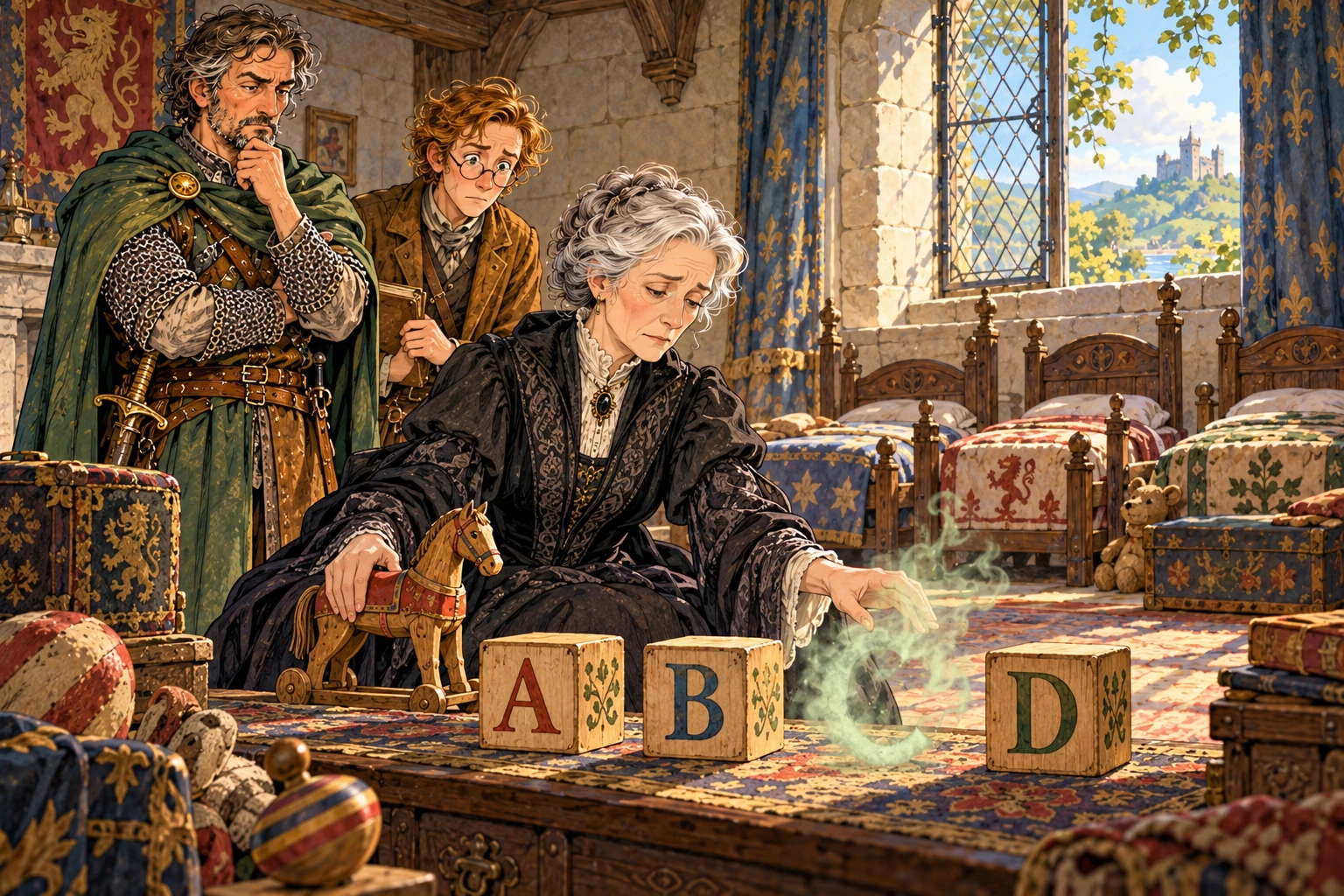
Sir Cardevane of Westmere had heard, from a source he considered shaken but coherent, that the green fog came from a haunted castle.
The source was a furniture mover from North Brindle, who had spent three nights at Castle Morvayne moving chairs from one room to another, only to find them back where they had started by morning. This had annoyed him. It had also frightened him, though he admitted the annoyance had arrived first.
"Chairs are not livestock," said the mover. "They should stay put."
"And the green fog?" asked Sir Cardevane.
"East wing. Every night. Comes under the doors and along the walls."
"Misty creatures?" asked Bartholomew.
The mover lowered his voice.
"Misty order."
Sir Cardevane looked at Bartholomew.
"That," he said, "is worse."
They left the next morning.
Castle Morvayne stood on a hill three miles beyond North Brindle, where the road narrowed, the trees leaned inward, and the wind barely stirred anything. The castle was tall, grey, and severe. Its towers rose in careful order. Its windows were evenly spaced. Its gates were straight. Even the ivy had been trained into straight vertical columns. Bartholomew looked up.
"The ivy appears supervised."
"Good masonry inspires obedience," said Sir Cardevane.
"That is not masonry. That is fear."
The furniture mover, whose name was Osgood, had come with them because Sir Cardevane had said witnesses were useful and Bartholomew had said it was his turn to be useful.
"I only came to collect my cart," said Osgood.
"Where is it?" asked Sir Cardevane.
"It was in the courtyard."
They entered the courtyard. The cart stood on the battlements. Osgood looked up. "That is not a courtyard."
"No," said Bartholomew. "But it is a statement."
The front door opened before they reached it. Osgood stopped. "I will wait here," he said.
"You are a witness," said Sir Cardevane.
"I am witnessing the courtyard," said Osgood. "Which appears to be sufficient."
Sir Cardevane considered this.
"Fair."
They entered alone.
The entrance hall smelled of cold ash and old flowers. Dust lay everywhere, but not evenly. Someone had swept paths through it. A line ran from the door to the stairs. Another crossed towards a long table against the wall. On that table stood six candlesticks. Five were in a row. The sixth lay on its side.
Sir Cardevane approached it. Bartholomew grabbed his sleeve.
"Do not."
"I was only going to set it upright."
"That is exactly why you should not."
Sir Cardevane looked at him. "You are developing instincts."
"I dislike them."
The air near the table thickened. Pale green fog slid out from beneath the staircase and gathered in a thin line on the floor, leading toward the candlesticks. Sir Cardevane stepped back. The sixth candlestick trembled.
A pale hand appeared above it, thin as light but clearly shaped like a human hand. It lifted the candlestick and placed it beside the others. Six in a row. The pressure in the hall eased before anything visible moved.
A ripple crossed the fog. The table shuddered. The last candlestick fell. It rolled once and stopped. The pressure returned.
A woman's voice said, "No."
Bartholomew went very still.
Ahead of them stood a great hall. It was very clean. Too clean. The floor shone. The armour gleamed. The portraits hung in exact lines. The logs in the fireplace were arranged by size, though no fire burned. A long table ran through the centre, set with twenty-four plates, twenty-four cups, twenty-four knives, twenty-four spoons, and no food. Sir Cardevane removed his gloves.
"Someone expects dinner."
"Someone expects dinner not to happen incorrectly," said Bartholomew.
One portrait was different from the others. The woman in it was stern, in black silk, one hand on a book and the other on the back of a chair. Her hair was silver. Her mouth was thin. Her eyes had the expression of someone hearing distant laughter and preparing to forbid it. The brass plate at the bottom had been rubbed so often that only the family name remained.
MORVAYNE
Who Preserved This House.
Sir Cardevane studied her.
"That is an ambitious verb."
They climbed the stairs. On the landing, a narrow carpet ran straight down the corridor. Halfway along it, a wrinkle formed. A door opened. A broom slid out.
It brushed the wrinkle flat and withdrew. The door closed.
"Housekeeping with no visible employee," said Bartholomew.
"That is worse than ghosts," said Sir Cardevane.
The first room was a drawing room. Every chair faced the same point in the carpet. Every cushion sat at the same angle. On the mantel stood seven porcelain shepherdesses, each facing north. Sir Cardevane turned one shepherdess slightly east. Nothing happened.
Then, very slowly, every shepherdess turned east. Bartholomew wrote this down. "Contagious correction."
The room grew colder. Green fog spread from beneath the sofa and along the mantel. One by one, the shepherdesses turned north again. From the wall came a sigh.
"We are being noticed," said Sir Cardevane.
"That was inevitable," said Bartholomew. "You interfered with sheep."
They continued to the east wing. Here the castle changed. The hall was colder. The walls were covered with portraits, all turned slightly towards the corridor. The candles were unlit, yet their wicks smoked. The floor bore no dust, except for a single footprint that appeared ahead of them, then vanished before they reached it. Green fog moved low along the skirting boards and pooled at each doorway.
They passed a room where the breakfast table was set.
"Every morning?" asked Bartholomew.
"No," said a voice from within.
She stood by the table, dressed in grey that had once been formal.
"This is morning."
Sir Cardevane looked at the boarded window. Outside, the light was grey and late. Lady Isolde crossed the room without acknowledging him further. They followed, but by the time they reached the nursery she was out of sight.
The door stood open. Inside were three small beds, perfectly made. Wooden horses stood in a line. A shelf of toys faced the window. A doll sat upright in a chair, its painted eyes fixed on the door. Bartholomew stopped.
"There were children."
On a table lay three wooden blocks.
A.
B.
D.
Sir Cardevane frowned.
"There is a missing C."
The room went very still.
Green fog crawled across the floor, up the table leg, and over the blocks. Above the gap, a green letter appeared.
C.
For one breath the blocks read:
A.
B.
C.
D.
Then the C vanished. The blocks remained:
A.
B.
D.
From the corridor came a sound like someone crying into folded linen.
They reached the end of the east wing. There stood a door painted black. Unlike the rest of the castle, it was not clean. Dust clung to it. The brass handle was dull. Across the door, in faded paint, someone had written:
NOT YET
Sir Cardevane knocked. The door did not open. He tried the handle. Locked.
The green fog gathered around his boots. Behind them, the corridor corrected itself. The carpet rolled backward. The portraits straightened.
The candle smoke drew itself into the wicks. The nursery door closed. At the far end, an armchair slid silently into the corridor and blocked the way. Bartholomew looked at the chair blocking the corridor. "That seems clear enough."
Sir Cardevane looked instead at the black door.
"Not to me."
He took a blank page from Bartholomew’s notebook.
"What are you doing?" asked Bartholomew.
"Making an appointment."
Sir Cardevane wrote:
Sir Cardevane of Westmere requests an interview with whoever is not ready.
He slipped the page beneath the door and waited. The paper slid back. A line had appeared beneath his words.
Tomorrow.
Sir Cardevane wrote:
Today.
The paper slid under the door. Something scratched on the other side. It returned.
Tomorrow, properly.
Sir Cardevane wrote:
Today, improperly.
The door opened.
Behind it was a bedroom. It had once been grand. Now it was nearly empty. A bed stood against the wall. A cracked mirror hung above a table. A wardrobe stood open. On the table lay a hairbrush, a silver key, a folded black ribbon, and a small pile of letters tied with thread. Every object was covered in dust. At the centre of the room stood Lady Isolde, the woman from the portrait.
She was fog with a face within it. Pale. Stern. Tired. Her silver hair was pinned with great care. Her black dress moved as if underwater. Her hands were folded before her. She looked exactly like her portrait, though fear now showed in her face.
"You are early," she said.
Sir Cardevane bowed.
"Only compared with tomorrow."
Bartholomew made a note.
Lady Isolde looked at the room.
"This is not ready," Lady Isolde said.
Sir Cardevane looked around the empty room. "We are already here."
"Yes," she said, and sounded offended by the fact.
Green fog filled the corners. The ribbon on the table straightened, slid another inch, then settled back. Lady Isolde watched it and frowned.
"It knows your rule," said Sir Cardevane.
"And it does not tire."
Lady Isolde's mouth tightened.
"It assists me with the house," Lady Isolde said.
Sir Cardevane looked at the unused bed, the unopened letters and the ribbon that had just moved itself back by an inch.
"There is almost no one left to impress."
"That has never reduced the work."
Bartholomew looked around.
"You have barricaded yourself with housekeeping," Bartholomew said.
Lady Isolde ignored him. She moved to the table and lifted the hairbrush. Dust fell from it. She tried to smooth the dust back into place. It did not cooperate. Her hand shook. "I had everything arranged," she said.
"Did it help?"
"No," she said.
The answer escaped before she could correct it. The room went still. Lady Isolde looked as if she had dropped a plate. From somewhere in the castle came a soft crash.
Lady Isolde turned towards the sound, but did not move.
Sir Cardevane looked at the hairbrush. At the unopened letters. At the ribbon. At the bed that had not been slept in for perhaps a hundred years.
He picked up the wooden horse they had carried from the nursery and left by the door. Lady Isolde stared at it. "That does not belong here."
"No," said Sir Cardevane.
"Take it back."
"You can."
He held out the horse. Lady Isolde took it. Green fog lay against her sleeve.
Lady Isolde tried to move and stopped. "I cannot leave the room. There is too much undone. The linen, the letters, the silver..."
She looked at the dust on the hairbrush and reached for it again. Bartholomew moved the brush out of reach. "Leave the dust," he said.
Lady Isolde looked at him with genuine dislike. Then at the horse. A list gathered in green strands around her. Cupboard. Table. Curtain. Plate. Key. Ribbon. Shelf. Bed. Spoon. Window. Door.
Lady Isolde closed her eyes.
"It keeps count," said Sir Cardevane.
Lady Isolde looked at the list. Her hand tightened around the horse. "Because I cannot," she said.
The green letters blurred along the edge of the list.
For a moment, the room seemed to tilt towards the old order. The bed straightened. The dust returned to lines. The mirror cleared. The ribbon lay perfectly black on the table. Then, from the nursery, came a sound. A block falling.
A.
B.
D.
Lady Isolde opened her eyes. "The C," she whispered.
She walked to the door. Green fog gathered across the doorway. A broom and a chair took shape in it. The cracked mirror showed Lady Isolde younger, sterner, complete. She heard her own remembered voice say, "Not yet."
Sir Cardevane stepped beside her.
"Is that you?"
"No."
"Then it is in the way."
She looked at the fog. Then at the horse in her hand. "Move," she said.
The green haze remained across the doorway. Lady Isolde stood straight as herself. "Move."
She stepped through it. The green strands streamed around her shoulders and along the corridor walls.
They walked through the corridor. Behind them, doors opened in every manner. Some banged. Some stuck. One fell from its hinges entirely, which made Bartholomew wince. They entered the nursery. The three beds stood there.
The toys stood in their lines. On the table lay the blocks.
A.
B.
D.
Lady Isolde placed the wooden horse beside them. Then she looked around the room. "I remember the blankets," she said.
No one spoke.
"The draught from that window. The way the nurse folded the little shirts. Which spoon he preferred. Which flower made him cough."
The green fog gathered at the ceiling.
"I forgot his laugh."
Sir Cardevane said nothing. Bartholomew did not write. Lady Isolde touched the blocks. "His name was Carden."
Green fog lay across the table. For one breath, its loose strands formed the missing letter:
C.
For one breath the blocks read:
A.
B.
C.
D.
Then Lady Isolde put her hand through the fog letter. It vanished. The table held only A, B, and D.
Lady Isolde smiled. It was small. It was terrible.
"He is not missing because the block is missing," she said.
"No," said Sir Cardevane.
"He is gone."
"Yes."
The beds sagged. The toys leaned. The curtains loosened. Downstairs, something crashed.
Green fog remained at the room’s edges, separate from the blocks.
Lady Isolde looked at it. "I thought it helped."
"It did," said Sir Cardevane.
Lady Isolde looked at the fog.
"Yes," she said.
The castle moved. Dust fell. Windows opened. A carpet curled. A portrait slipped sideways. Somewhere, a door creaked open; it had never been properly locked. Lady Isolde stood in the nursery while objects shifted out of their former order.
"It will fall apart," she said.
"Eventually," said Bartholomew.
She looked at him. "Are you always like this?"
"Only where there are rooms," said Bartholomew.
A list of unfinished rooms appeared in green strands around her hem. The linen. The silver. The locks. The accounts. The flowers. The dust. The boy. The boy. The boy.
Lady Isolde looked at it. Then she laughed. Only once. It was not a pleasant laugh. But it was not orderly. "No," she said.
Lady Isolde swept her hand through the green letters. They scattered. Fog remained along the walls. Lady Isolde turned to Sir Cardevane. "You are a very untidy knight."
"Yes."
"Your clerk is worse."
"Frequently."
She nodded. Then she bowed. It was stiff. It was also grateful.
"Leave the horse," she said.
They did.
They descended through the castle. The rooms had changed. The great hall table held twenty-three plates and one empty space. The portraits were crooked. One shepherdess faced east. The carpet wrinkle had returned and was being left alone. In the vase, one white flower was taller than the rest. In the entrance hall, the sixth candlestick still lay on its side.
Sir Cardevane looked at it. Bartholomew said, "Do not."
"I was not going to."
"You were."
"I was considering the ethical status of candlesticks."
"Leave it," said Bartholomew.
Sir Cardevane left it.
Outside, Osgood sat on the steps with his cap in his hands. He looked up. "Is it coming down?" he asked.
Bartholomew looked at the battlements. The cart had moved to the edge. One wheel tilted towards the stairs.
"Eventually," said Bartholomew.
Osgood considered this. "That is the most this castle has ever compromised."
They left Castle Morvayne at dawn. The hill behind them was pale in the morning light. Green fog still lay along the east wing, in loose strands around the windows. Bartholomew looked back.
"Will she be gone now?"
"No," said Sir Cardevane.
"Then what changed?"
Sir Cardevane watched as one shutter on the east wing opened, closed, opened again, and remained half-open.
"That," he said.
Behind them, in Castle Morvayne, Lady Isolde sat in the nursery. The horse lay beside the blocks.
A.
B.
D.
She looked at the empty space. The green fog rose from the floor and shaped a C. Lady Isolde studied it.
"Not today," she said.
She turned away. The C remained above the blocks until she left the room.
Case 20
Merchant Who Frightened the Year Away
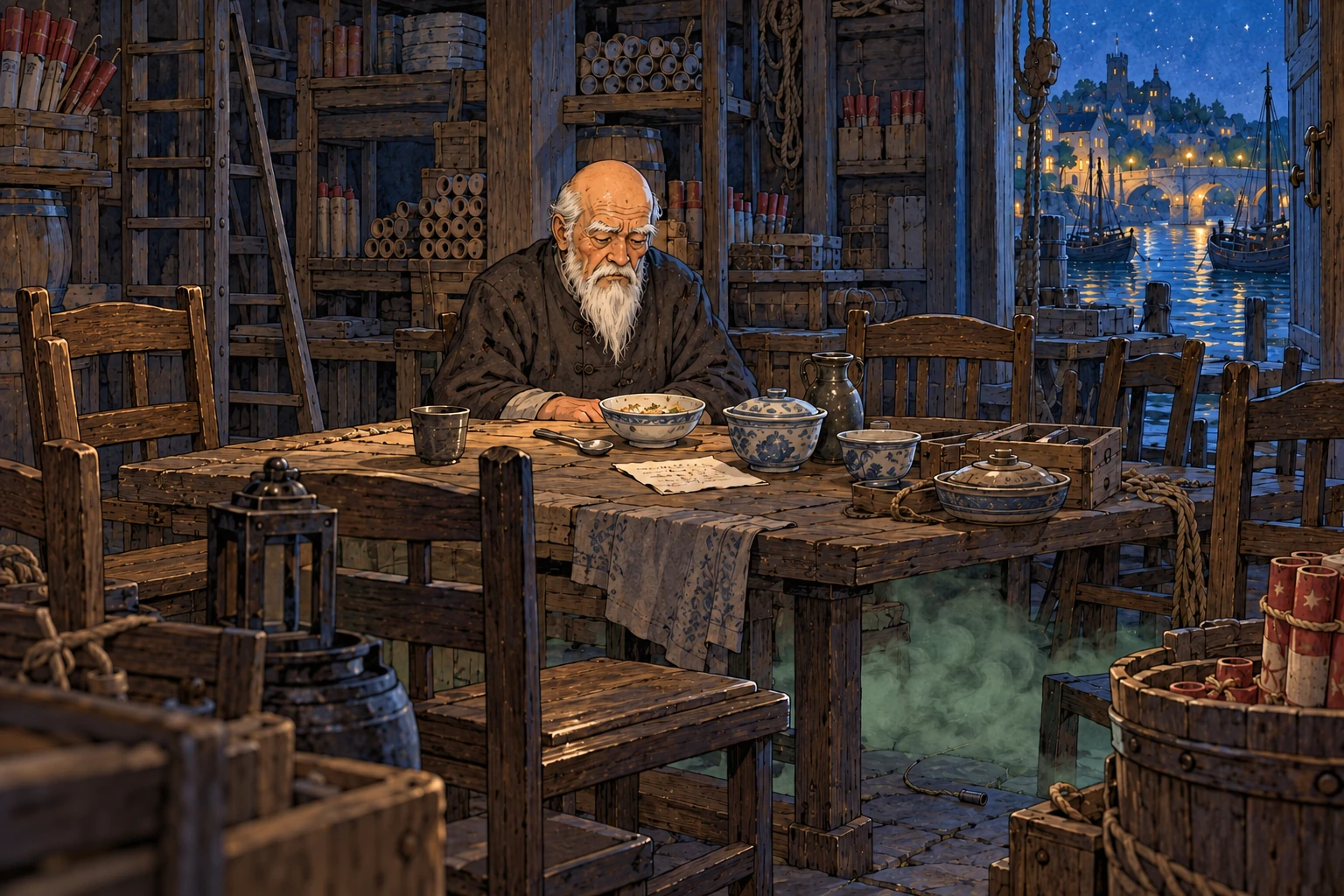
Sir Cardevane of Westmere had heard, from a source he considered recently concussed but still coherent, that the green fog came from fireworks.
This was new. The source was a bell ringer from Lower Thistle, who had spent four nights awake because something beyond the eastern fields kept exploding.
Sir Cardevane leaned forward.
"That is often where trouble begins."
"It started with red sparks," said the bell ringer. "Then yellow. Then green. Then the fog came over the fields and made my bells ring the wrong hour."
"What hour?"
"Last year's."
Bartholomew stopped writing.
"That is not an hour."
"It was at three in the morning."
"Many things become less grammatical at three in the morning," said Sir Cardevane.
"And who is setting off these fireworks?" asked Bartholomew.
"The merchant by the old river storehouse."
"Name?"
"Liang."
"First or last?"
The bell ringer blinked.
"I have never dared ask. He is usually holding fire."
Sir Cardevane nodded.
"A practical obstacle to courtesy."
They rode east the next morning. The road beyond Lower Thistle crossed flat country where reeds stood in the ditches and the wind smelled faintly of sulphur. Black birds watched from fence posts. Sheep grazed in a field with the wary expression of animals who had been interrupted before. At noon, a red flower opened in the sky. It vanished.
A yellow one followed. Then a green burst cracked above the road and released a cloud of pale smoke. The sheep wheeled their whole bodies round at once. Bartholomew stared. "That is inconvenient."
"For sheep, yes," said Sir Cardevane.
"For shepherds."
A shepherd appeared at the far side of the field, waving his hat towards the river. "Master Liang!" he shouted. "It is noon!"
Another explosion answered him. The shepherd lowered his hat. "It is always noon with that man."
They followed the smoke. The old river storehouse stood beside a bend in the water, long, low, and blackened at the roof. It had once held wool. Then grain. Then salt. Now it held crates, paper, powders, string, trays, tools, broken clocks, and a cat with one singed whisker. Above the door hung a painted board.
LIANG
FIREWORKS FOR FEASTS, FUNERALS, WEDDINGS, WARNINGS, APOLOGIES, RETURNINGS, DEPARTURES, AND OTHER UNCERTAIN OCCASIONS
Below it, in smaller letters, someone had added:
NEW YEAR OBSERVED DAILY
Bartholomew read the sign twice. "That seems administratively demanding."
Sir Cardevane dismounted.
"Perhaps he is thorough."
A firework shot from a clay tube beside the door, struck a hanging bucket, reversed direction, and burst into green smoke over Bartholomew's horse. The horse sat down. Bartholomew looked at it. "You are not a dog."
The door opened. An old man stood inside wearing a dark coat marked with small burns. His beard was white. His eyebrows were severe. In one hand he held a taper. In the other he held a firework that was already hissing. "Welcome," he said. "Stand poorly."
Sir Cardevane stepped left. Bartholomew stepped right. The firework passed between them, shot across the road, and exploded behind a hedge. A flock of sparrows rose from it in a shape that briefly resembled an accusation.
Master Liang bowed. "My apologies. That one never goes straight."
"Neither do several roads," said Sir Cardevane.
"Roads bend more easily than people."
"It depends on who made them."
They entered.
The storehouse was larger inside than it had looked from the road, though much of that may have been smoke. Long tables filled the main room. Some held fireworks. Some held bowls. Some held cups gone cold. A row of chairs stood against the wall. No one sat in them. The floor had been swept in paths between the tables, but ash crowded the corners. Strings hung from the rafters. Paper tubes lay in careful rows. Each had a label written in a small exact hand.
FOR BEGINNINGS
FOR RETURNING SAFELY
FOR FORGIVENESS
FOR NOT THINKING
Sir Cardevane looked at the last label. "That is an ambitious device."
Master Liang moved between the tables, checking fuses.
"It is popular."
"With whom?"
"With me."
Outside, another firework burst. The windows flashed red, then yellow, then green. Bartholomew coughed. "Do you celebrate New Year every day?"
"Not every day," said Master Liang.
"How often?"
"When it is necessary."
"And how often is that?"
Master Liang lit a small fuse. "Every day."
The firework spun in a bowl and released a puff of yellow smoke. For a moment, the smoke took the shape of a door opening. Master Liang clapped his hands. The shape broke apart. "Good," he said. "Too clear, but brief."
Bartholomew opened his notebook.
"What was it meant to do?"
"Make noise."
"It made a door."
"Then it was faulty," said Master Liang.
Sir Cardevane studied the room. The cold cups. The empty chairs. The labels. The swept paths through the ash. "What happens if it is quiet?" he asked.
Master Liang did not answer.
A green fog moved from beneath the workbench and lay low around Master Liang's boots. The taper was still in his hand. He touched it to a loose fuse beneath the table. The fuse sparked. Master Liang turned sharply. "No."
The firework burst outward across the room. Red smoke filled the room. Inside it came the sound of laughter. Only for a moment. A woman. A young man. A child striking a spoon against a cup.
Then Master Liang seized a brass lid and slammed it over the smoking tube.
The sound stopped. The red smoke thinned. The chairs were empty. Master Liang stood very still, one hand on the lid.
Bartholomew did not write. Sir Cardevane said, "That one brought something back."
"All fireworks bring something back," said Master Liang.
"Do they?"
"If they are well made."
"And if they are badly made?"
Master Liang looked at the green fog gathering under the table.
"Too much comes back."
Master Liang leaned across the workbench with the taper still in his hand. Its ember brushed the loose fuses. One caught, then a second, then a third.
Bang. Red.
Bang. Yellow.
Bang. Green.
The storehouse filled with colour. A cup rattled on a shelf. A chair scraped back from the wall. The cat opened one eye and immediately closed it again.
Master Liang moved quickly, faster than seemed reasonable for a man of his age. He smothered one firework, kicked another into a bucket, snapped a third fuse with his fingers, and stood breathing hard. The green fog coiled around his boots.
"It assists you," said Sir Cardevane.
Master Liang looked at him.
"It prevents silence."
Sir Cardevane looked at the covered bowls and the empty chairs.
"No. It postpones it."
Master Liang's hand tightened on the taper.
"No," said Sir Cardevane.
Master Liang's face closed.
"You are a knight. You make sentences because other people make your boots."
"That is partly true," said Sir Cardevane.
Bartholomew looked at him.
"Only partly?"
"My left boot is difficult."
Master Liang turned away.
Outside, another explosion shook the roof. Dust fell from the rafters.
"Old years are dangerous," he said. "They follow people through cracks. They hide in quiet rooms. They wait until no one is speaking."
"What do they say?"
Master Liang picked up a paper tube and rolled it tighter.
"That depends on the year."
"And yours?"
He did not answer. The green fog rose behind him. It spread along the wall, thin as breath on glass. Red sparks moved inside it. Yellow sparks. Green. The colours turned and folded, not into pictures, but almost. The colours almost made a table, then a hand, then the beginning of a face.
Master Liang saw it and lit a firework before it could finish. The bang broke the almost shape. He smiled without pleasure.
"There," he said. "Gone."
Sir Cardevane looked at the empty chairs.
"And who else?"
Master Liang's hand tightened around the taper. No one answered.
From outside came a knock. Master Liang froze. The knock came again. A woman's voice called, "Master Liang? I have brought broth and a spoon. Also Jory says if your red smoke frightens his ducks once more, he will send the ducks themselves."
Bartholomew looked interested.
"Do ducks carry messages?"
"Only complaints," said Sir Cardevane.
Master Liang did not move. The green fog slid towards the door and thickened at the threshold, pressing into the gap at the bottom. The woman outside waited. Then footsteps retreated.
A bowl was set down on the step. Master Liang remained still until the footsteps faded. Then he said, "They keep coming back."
"Yes," said Sir Cardevane.
"Poor timing."
"Perhaps."
Master Liang went to the door, opened it a crack, and pulled the bowl inside. He did not look out. He placed the broth on a table among the cold cups. There were already three covered bowls there.
Bartholomew saw them.
"You have visitors."
"No."
"You have food."
Master Liang looked at the covered bowls. "Food is easier."
"Sometimes," said Sir Cardevane.
Master Liang lit another fuse. Sir Cardevane stepped on it. The fuse hissed beneath his boot and died. Master Liang stared at him.
"That was expensive."
"It was evasive."
"You cannot stand on every fuse."
"No," said Sir Cardevane. "But I can begin with this one."
For a moment no one moved. Then the storehouse fell quiet.
Master Liang covered his ears. There was nothing to cover. The green fog gathered behind him in a low cloud. The cat sneezed.
The box on the edge of the workbench tipped and fell. Inside were small paper slips. Names. Dozens of them.
Some written in black ink. Some in faded red. Some crossed out. Some written again beneath the crossing out.
Master Liang stared at them. Bartholomew bent to pick one up, then stopped. Sir Cardevane did not move. Master Liang dropped to his knees. His fingers searched through the slips until they found one near the bottom.
The paper was worn soft from handling. He held the paper in one hand, the taper in the other. "My son," he said.
The green fog trembled. Outside, the river moved against its banks. Master Liang did not look at them.
"I told him not to go."
No one answered.
"I told him a father knows the road."
His mouth tightened.
"I did not know the road."
The taper shook in Liang’s hand. Its ember touched a fuse on the workbench. Master Liang saw the fuse catch. He set the taper on the clear end of the bench and watched the ember travel along it.
"He went," said Sir Cardevane.
Master Liang nodded.
"The horse came back."
The storehouse made the small sound of wood cooling. A rope settling. Master Liang looked at the paper in his hand.
"My wife said I had not sent him to die. My daughter said he had laughed when he left. My neighbours came. They sat in those chairs. They brought food. They spoke his name."
He looked at the chairs.
"I made one firework to frighten the year away."
"And?"
"It worked."
The green fog curled around the chair legs. Master Liang's voice became thinner.
"So I made another."
A yellow spark leapt from the still-burning fuse. The open fireworks lay close together; the others caught in turn before Liang could smother them. One by one, the fireworks hissed.
FOR BEGINNINGS.
FOR RETURNING SAFELY.
FOR FORGIVENESS.
FOR NOT THINKING.
Master Liang looked at them. His hand moved towards the taper. Then stopped. The hissing grew louder.
Bartholomew stepped back. Sir Cardevane did not. Master Liang stood. He picked up the brass lid.
The green fog rose high, full of sparks. The smoke filled the room without taking a face or shape. Master Liang brought the lid down over the nearest firework. Then the next.
Then the next, slowly and deliberately.
Bang. One escaped, bursting red against the roof. Bang. Another burst yellow beneath the table.
Green smoke rolled across the floor and curled around his hands. Master Liang coughed. He kept moving. The last fuse hissed on the workbench.
FOR NOT THINKING.
Master Liang pressed the burning tip beneath the rim of the brass lid. The hiss stopped. Then he tore off the label. The silence returned. This time it stayed.
Master Liang stood among the smoke with the torn label in his hand. His face looked older. It also looked less busy.
Outside, the woman's voice called from the road. "Master Liang? The spoon. I put it in the bowl."
Master Liang laughed once, tired and unguarded.
"That is how people get through the door," he said.
"With spoons?" asked Bartholomew.
"With reasons."
He walked to the door. The green fog gathered at the threshold. It did not move aside. Master Liang looked at it.
Then he opened the door anyway. The fog thinned as the cold air came in.
The woman stood at the end of the path, already turning to leave. She heard the door and looked back. Then at Sir Cardevane. Then at Bartholomew. Then at the smoke. "I shall not ask," she said.
"A wise opening," said Sir Cardevane.
Master Liang stepped aside. She came in and looked at the bowl she had left.
"You haven't touched it."
"I was occupied."
She picked up the spoon, which was already there, and set it more firmly beside the bowl.
"That is the third time this week."
Master Liang did not answer.
"The soup is cold now."
"Then I will have cold soup."
She looked at the empty chairs. At the covered bowls. At the slips of paper on the floor. She did not ask about any of them.
"I'll bring it hot tomorrow," she said.
For a while, no one spoke. The silence was awkward. Then the cat sneezed again. A tiny green spark flew from its whisker and died harmlessly in the broth.
Bartholomew looked at the bowl.
"I would not recommend that."
Master Liang laughed again. This time the sound remained in the room after it ended.
By evening, the storehouse had not changed very much. The tables were still crowded. The roof was still scorched. The fireworks were still dangerous. The chairs were mostly empty. But the door was open. One bowl had been eaten from. One chair had been pulled away from the wall.
On the workbench, Master Liang laid the torn label beside the last firework. He crossed out:
FOR NOT THINKING
And wrote beneath it:
FOR WHEN NOISE IS REQUIRED
He tied the label back onto the firework.
Sir Cardevane watched.
"That is a narrower use."
"Yes," said Master Liang.
"Still dangerous."
"Yes."
Sir Cardevane nodded. Outside, the first stars appeared above the river. The green fog lay low in the yard. Red and yellow sparks moved through it now and then, but they did not catch.
Sir Cardevane mounted his horse.
"Will you stop making fireworks?" asked Bartholomew.
"No," said Master Liang.
"Will you celebrate it tomorrow?"
Master Liang looked towards the open door.
"Not tomorrow."
Bartholomew wrote this down. His notebook did not explode.
They rode away along the old salt road. Behind them, Master Liang stood in the doorway until the horses passed the bend.
Then he went back inside. The bowl sat on the table. The spoon lay beside it. The worn paper with his son's name rested near the cup.
Green fog lay beneath the workbench. An unlit fuse hung over its edge. Master Liang watched it. The room stayed silent. Master Liang reached past the taper for the chair. He pulled it from the wall and sat down.
Fog remained low around the workbench. The room stayed dark and still. Outside, the river moved in the dark. For a long while, Master Liang did not speak.
Afterword
Total cases documented: 20
Cases in which the fog was identified as source: 0
Cases in which the fog was identified as present: 20
Cases in which Sir Cardevane drew his sword: 4 (effective: 0)
Comparative usefulness of the clerk and the sword: insufficiently defined
Conclusion: after twenty cases, every proposed source has failed.
The above has been crossed out. Sir Cardevane asked where case twenty-one was.
Outstanding questions: see attached.
(Nothing is attached.)